
On the morning of January 3, 2026, the parking lot of a Venezuelan restaurant wedged beside a Doral gas station filled before sunrise. People drove in still wearing pajamas, draped in flags of yellow, blue, and red. Word had spread that the United States had captured Nicolas Maduro, and so they came to El Arepazo, the way Venezuelans here have come for nearly two decades to mark every grief and every hope. They sang the national anthem. They cried. For years they had chanted “si, se puede,” yes we can. That morning they chanted “si, se pudo.” Yes, we did it.
There is no other place in the United States where that scene could unfold quite like this. The Venezuelans in Doral have turned a young Florida suburb into the unofficial capital of their exile, a city so thoroughly remade that residents long ago gave it a second name: Doralzuela.
Doral: The Place
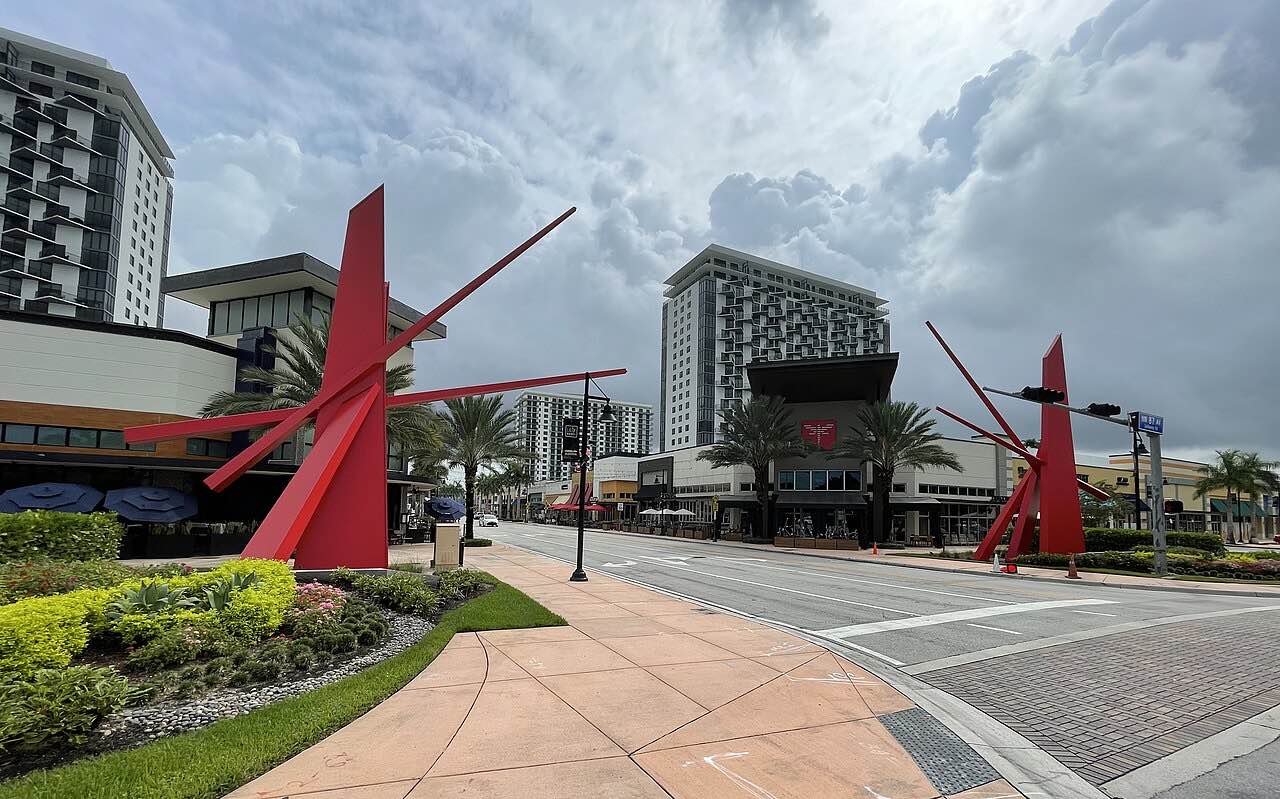
Doral sits about five miles west of Miami International Airport, a flat grid of office parks, gated subdivisions, and glass mid-rises that did not exist a generation ago. It is one of the youngest cities in Florida, a planned suburb where the streets are wide and the architecture is new. The skyline of its downtown core, with its red steel sculptures and palm-lined boulevards, could pass for an artist’s rendering of a city that has only just decided what it wants to be. That blankness, it turns out, made it the perfect canvas.
How Doral Became Doralzuela
Before the Venezuelans
For most of its history, the land that became Doral was swamp on the edge of the Everglades. In the late 1950s, the New York real estate developers Alfred and Doris Kaskel bought roughly 2,400 acres of it for about $49,000, intending to build a golf resort on the cheap wetland west of the city. The Doral Country Club opened in 1962, its name stitched together from Doris and Alfred. For decades that golf course, later famous and eventually bought by Donald Trump, was the only thing most people knew about the area.
Everything around it stayed industrial and quiet. Warehouses served the nearby airport. There was no town center, no real Main Street, barely a population to speak of. When the city finally incorporated on June 24, 2003, after a seven-year campaign by residents, it had fewer than four thousand people. Doral was, in effect, a brand-new municipality waiting to be filled.
The Venezuelans Arrive
The filling had already begun, and it tracked a catastrophe unfolding two thousand miles to the south. When Hugo Chavez won the Venezuelan presidency in 1998 and took office in 1999, the first to leave were not the desperate but the comfortable. Business owners, lawyers, and engineers from Caracas and Valencia began buying property in South Florida as a hedge, a quiet exit option. Many landed in Doral, drawn by new construction, good schools, low crime, and proximity to the airport that connected them home.
The first true wave came with the oil. During the national strike of 2002 and 2003, the Chavez government fired more than 18,000 workers from the state oil company, PDVSA, among them geologists, refinery managers, and petroleum engineers. These were people with credentials, savings, and English, and a striking number of them resettled in Doral. They brought a professional, white-collar character that distinguished this migration from much that came before it in Miami.
It was in that period, in 2004, that two brothers opened a small arepa counter inside a Chevron station on what was then practically a dirt road. They called it El Arepazo. Almost by accident, it became the town square that Doral did not yet have, a place where exiles could argue politics over a reina pepiada and feel, for an hour, like they were home.
Doralzuela at Its Peak
After Chavez died in 2013 and Nicolas Maduro took power, Venezuela’s slow decline became a freefall. Hyperinflation, shortages, and political violence drove millions out of the country from 2014 onward, and Doral absorbed wave after wave of them. The city’s population rose from 45,704 in 2010 to 75,874 by the 2020 census, and Venezuelans became the single largest ancestry group, close to 39 percent of all residents.
By then the transformation was total. Spanish was the default language of the strip malls. Bakeries sold cachitos and pan de jamon; restaurants served pabellon and cachapas; barbershops, law offices, and import shops carried Venezuelan names. The community built institutions to match, anchored by the Venezuelan-American Chamber of Commerce, founded back in 1991 and now headquartered in Doral, which became a clearinghouse for an entire entrepreneurial class.
The politics arrived with the people. Doral sent Venezuelan-American leaders into local office, most notably Luigi Boria, elected mayor in November 2012 and counted among the first Venezuelan-American mayors in the country. El Arepazo became a genuine landmark of exile politics, its walls covered with opposition slogans and, in time, a large portrait of opposition leader Maria Corina Machado watching over the tables. Every disputed election back home produced a gathering in that parking lot.
The Change
The newest arrivals were no longer only the professional class. As the crisis deepened, working people came too, many on foot through Colombia, and many without the savings or papers that had cushioned the earlier waves. The character of Doralzuela broadened from a community of property owners into something closer to a full society, with its own undocumented and its own poor.
That fault line cracked open in 2025. Earlier that year the federal government moved to end Temporary Protected Status for roughly 350,000 Venezuelans, and the Supreme Court allowed the termination to proceed. People who had held work permits and driver’s licenses found themselves, almost overnight, without legal status. The fear was sharpest in Doral, the city with more Venezuelans than any other in the nation, where some of the same naturalized voters who had backed the administration now watched neighbors face deportation to a country they had fled.
The Landmarks of Doralzuela
El Arepazo (10191 NW 58th St). The single most important address in Venezuelan Doral, opened in 2004 inside a gas station when the street was barely paved. For nearly twenty years it has doubled as a restaurant and a political plaza, the place where exiles hold vigils, watch elections, and, in January 2026, danced at dawn over the capture of Maduro. Its walls read like a museum of longing, hung with old product labels and the slogan that the Venezuela of yesterday is impossible to forget.
CityPlace Doral (8300 NW 36th St). An $800 million mixed-use development by the Related Group, its retail and dining core opening around late 2016, with shops, a cinema, and restaurants threaded among apartment towers. For a community that arrived with money and taste, it offered the kind of polished urban life many had left behind in Caracas, and it quickly drew Venezuelan-owned restaurants and boutiques into its arcades.
Downtown Doral (around NW 53rd Street and 87th Avenue). A Codina Partners project that took shape by 2015, this is the planned city center captured in so many photographs, all wide sidewalks, public art, and high-rises. It gave the suburb the dense, walkable heart it had always lacked, and on weekends its plazas fill with Venezuelan families pushing strollers past Venezuelan cafes.
Sabor Venezolano (10722 NW 74th St). One of the dozens of Venezuelan kitchens that make Doral the densest concentration of the country’s food anywhere in the United States, serving the full canon from patacon to chicha. Places like this are where the second generation, raised in Florida, comes to taste a homeland many of them have never seen.
Venezuelan-American Chamber of Commerce (Doral). Founded in 1991, well before the great exodus, the chamber became the institutional backbone of the business community that built Doralzuela. It runs scholarship programs, networking events, and a foundation, and its leadership now overlaps with Doral’s own city council.
Trump National Doral (4400 NW 87th Ave). The descendant of the Kaskels’ original 1962 golf resort, and a reminder that Doral existed before the Venezuelans arrived. Its presence at the center of the city is a strange historical knot, the founding landmark of the suburb now sitting amid the community that defines it, and a stage for national politics that bears directly on that community’s future.
Where the Doral Venezuelans Came From
The exiles of Doral came overwhelmingly from urban Venezuela, and above all from Caracas. The capital sent its professionals first, the lawyers and executives and media figures whose networks and savings let them leave early and land softly. Maracaibo, the oil city on the western lake, sent the engineers and refinery hands cut loose by the PDVSA firings, men and women whose entire careers had been built around crude. Valencia and Maracay, the industrial belt to the west of Caracas, added manufacturers and managers as the factories there emptied out.
They chose Doral over older Hispanic enclaves for practical reasons that quickly became emotional ones. The houses were new and the airport was close. Then, once a critical mass had gathered, people came because their cousins and former colleagues were already there, because the school had other Venezuelan children, because you could buy the right cornmeal at the corner store. Chain migration did the rest, turning a hedge into a homeland.
Doral Today
Today Doral is unmistakably still Venezuelan, but it is a community holding its breath. The restaurants are full and Spanish still rules the strip malls, yet 2025 left a deep anxiety running underneath the prosperity, as families who built two decades of life here confront the loss of their legal footing and the real prospect of being sent back.
The capture of Maduro in early 2026 detonated joy and, immediately after it, an impossible question. For twenty years the suitcase stayed packed because exile was supposed to be temporary. Now, with the regime they fled suddenly gone, some Doral Venezuelans talk of going home to rebuild, while others, especially the young, realize that Doral is the only home they have ever known.
That tension, between the country they left and the suburb they made, is the real story of Doralzuela in 2026. Whatever happens next in Caracas, a generation born in Florida will decide whether this place was a long wait or a new beginning. The flags will keep flying over the gas station either way.
Frequently Asked Questions
Why did Venezuelans settle in Doral?
Venezuelans first chose Doral in the late 1990s and early 2000s for its new housing, low crime, good schools, and closeness to Miami International Airport. The early arrivals were professionals and business owners who bought property as a safe foothold. As more came, chain migration took over, and the Venezuelans in Doral built a self-sustaining community of restaurants, schools, and businesses.
Is Doral still Venezuelan today?
Yes. Venezuelans remain the largest ancestry group in Doral, close to 39 percent of residents at the 2020 census, and the city is still nicknamed Doralzuela. That said, the end of Temporary Protected Status in 2025 and the upheaval in Venezuela in 2026 have left the future of the Venezuelans in Doral genuinely uncertain.
What are the famous Venezuelan landmarks and restaurants in Doral?
The most famous is El Arepazo at 10191 NW 58th St, an arepa spot opened in 2004 that doubles as the center of exile politics. Other well-known places include Sabor Venezolano, the dining and shopping district of CityPlace Doral, and the walkable core of Downtown Doral. The Venezuelan-American Chamber of Commerce anchors the business community.
Where in Venezuela did the Doral community come from?
Most came from urban Venezuela, especially Caracas, which sent professionals and executives first. Maracaibo contributed oil engineers and refinery workers fired during the 2002 to 2003 PDVSA strike, while Valencia and Maracay added manufacturers and managers as their industries collapsed.
When did Venezuelans first arrive in Doral?
The first significant arrivals came after Hugo Chavez won the presidency in 1998, accelerating with the PDVSA firings of 2002 and 2003, and again in a much larger wave after 2014 as the country collapsed under Nicolas Maduro. Each wave deepened the community that turned a young suburb into Doralzuela.
Doral is one chapter in the larger story of how migration reshapes American places, from the Cubans of Little Havana and the Cuban community of Union City, New Jersey to the Haitians of Little Haiti. Every family that arrives carries a homeland in its pockets.