
The smell came off the water first: brine, coal smoke, and the steam of oysters cracking open by the bushel. By the 1890s the wooden stalls of the packing houses along the Fells Point waterfront were full before dawn, and most of the hands prying the shells apart spoke Polish. Women stood in cold, damp sheds for twelve hours a day. Their children worked beside them, shucking when the babies napped, carrying the cans, learning English from the foreman’s shouts. A dollar or two bought a day of it.
This was the entry point. The Polish in Fells Point had stepped off ships at the foot of the harbor a few years earlier, and the packing house was where many of them started. What they made of the cramped brick blocks above Broadway would outlast the canneries, the docks, and nearly everything else.
Fells Point: The Place
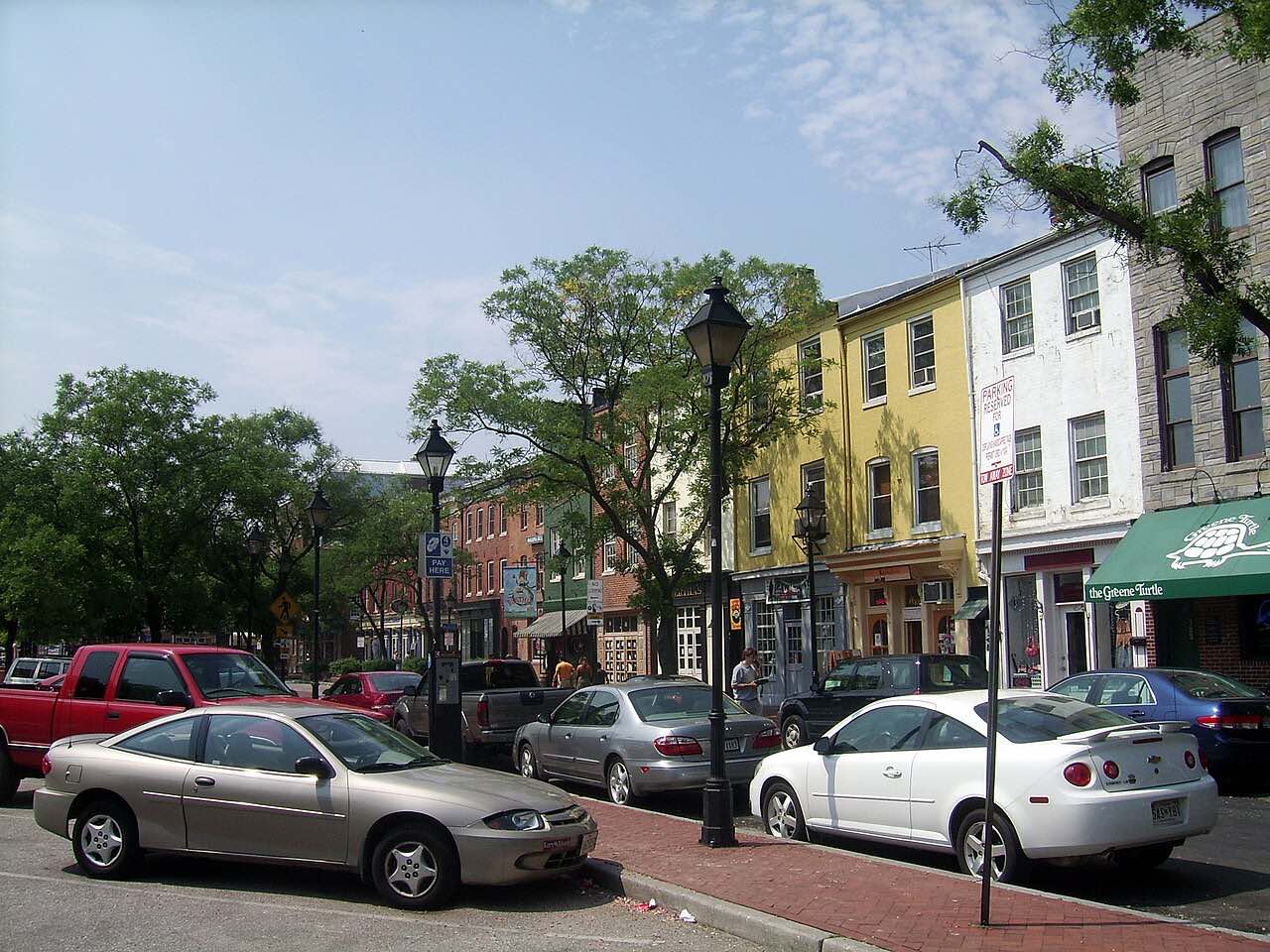
Fells Point juts into the Patapsco River on Baltimore’s southeast side, a flat wedge of waterfront laid out around 1763 and named for the shipbuilding Fell family. Broadway runs north from the water as its wide central spine, lined with brick and Formstone rowhouses on a tight grid of cobbled streets. The harbor, the B&O rail spur, and the canneries that once ringed the shore put work within walking distance of every front door. Today the same streets carry the Charm City Circulator and a dense bar scene, but the housing stock is still the two-story rowhouse the immigrants knew.
How Fells Point Became Little Poland
Before the Poles
Fells Point was a working port long before the Poles arrived. Through the late 1700s and early 1800s it built clipper ships and privateers, and it drew waves of Irish, German, and Czech workers to its docks and yards. By the mid-1800s canning had joined shipbuilding and trade as the engine of daily life. Beginning in the 1830s, dozens of canneries lined the waterfront, and by the end of the century Baltimore was the canning capital of the United States, with the trade ranking as the city’s second-largest industry.
That hunger for cheap, steady labor is what pulled the next group across the Atlantic. The factories needed hands. The ships from Bremen were about to deliver them.
The Poles Arrive
The first Polish settlers reached Fells Point in 1868, the same year the B&O Railroad opened its immigration piers across the harbor at Locust Point. Under a deal between the railroad and the North German Lloyd line, steamships sailed from Bremen to Baltimore at least once a month, and from the 1880s they carried Poles, Lithuanians, Slovaks, Bohemians, and Eastern European Jews into the city. Between 1868 and 1914 roughly 1.2 million European immigrants landed at Locust Point, making Baltimore one of the great ports of entry in the country, often ranked just behind Ellis Island.
Most Poles walked off the pier and across the harbor to Fells Point, where countrymen, a parish, and a packing house job were already waiting. The men took work as stevedores and oyster shuckers on the docks. The women and children filled the canneries and rode wagons out to the truck farms of Anne Arundel County each summer to pick tomatoes and fruit. Mass migration had begun around 1870, and it did not slow: by 1893 about 1,500 Poles were arriving every year, and some 23,000 Polish Americans already lived in the city.
The community organized itself around the altar almost immediately. Polish services began at a rented hall on South Bond Street in the 1870s, and in 1880 the first Polish parish, St. Stanislaus Kostka, opened on South Ann Street under Father Peter Koncz. Seven years later, on December 8, 1887, a second parish, Holy Rosary, was founded to handle the overflow, taking over a former Methodist church at Eastern Avenue and Bethel Street before building its own home. A Polish-language newspaper, Polonia, began printing in 1891.
Fells Point at Its Peak
By the 1920s the blocks above Broadway had earned the name Little Poland. Holy Rosary alone counted around 2,500 families, some 12,000 people, making it one of the largest parishes in the Archdiocese of Baltimore. When the congregation dedicated its towering greystone church on South Chester Street in 1928, roughly 3,000 worshippers packed inside and hundreds more stood on the sidewalk. The building seated 2,000 under a ceiling unbroken by columns, with altars carved from 49 tons of Italian and Spanish marble. People called it the Polish cathedral, and they meant it.
The Poles bought their houses, a point of pride in a city of renters. Building-and-loan associations like the Kosciuszko savings society lent within the community, and Polish homeownership rates in the East Baltimore rowhouses became locally famous. Marble stoops were scrubbed white. Painted window screens, the East Baltimore folk art begun in 1913 by the Czech grocer William Oktavec, spread across the front windows of Polish and Bohemian blocks alike, showing red-roofed cottages and swans that let you see out without being seen.
Social life had its own address. The Polish Home Association took shape in 1906, and on August 11, 1918, its hall, Dom Polski, opened at 510-512 South Broadway to 600 members, built at a cost of $81,000 with speeches, a Polish band, and dancing. The labor movement found a home here too. The parish hall around the corner at 1727 Aliceanna Street served as strike headquarters for longshoremen in 1912, and the American Federation of Labor president Samuel Gompers came to speak there in support of the union.
The Change
The canneries that built Little Poland did not last. Mechanization and the slow death of the Chesapeake oyster thinned the packing-house jobs through the mid-twentieth century, and the waterfront industries that employed generations of Poles closed one by one. Then came the bulldozer threat. In the 1960s, highway planners proposed running an elevated east-west expressway along the harbor’s north shore, a route that would have condemned around 100 buildings in Fells Point and walled the neighborhood off from the water.
The fight to stop it changed the neighborhood’s fate and launched a Polish daughter of Highlandtown into politics. A 33-year-old social worker named Barbara Mikulski helped lead the revolt, declaring that the British could not take Fells Point, the termites could not take Fells Point, and the State Roads Commission would not either. Preservationists won Fells Point a place on the National Register of Historic Places in 1969, the first listing in Maryland, and the highway was killed for good by the late 1970s.
Saving the bricks, though, did not save the community that lived in them. As the neighborhood became desirable, the families left. Bars and restaurants filled the storefronts, the median home price climbed from $77,600 in 1990 to roughly $350,000 by 2014, and St. Stanislaus Kostka, after 120 years, finally closed in 2000. The painted screens came down. The Polish that once filled the packing houses faded from the streets.
The Landmarks of Little Poland
Holy Rosary Church, 408 South Chester Street. Founded on December 8, 1887, the Polish cathedral got its present greystone basilica in 1927-28, designed by Baldwin and Radziszewski and dedicated before a crowd of thousands. It remains the spiritual heart of Polish Fells Point, and the heart story runs deeper than the architecture: the recovery of its longtime priest, Father Ronald Pytel, from a grave heart condition was accepted as a miracle in the 2000 canonization of St. Maria Faustina.
St. Stanislaus Kostka Church, South Ann Street. The mother parish of Polish Baltimore, blessed in 1880, served the community for the entire twentieth century before closing in 2000. Its parish hall at 1727 Aliceanna Street doubled as the 1912 longshoremen’s strike headquarters, where Samuel Gompers rallied the dockworkers. Mother Seton Academy bought the church and convent in 2006.
The Polish Home Club, 510-512 South Broadway. Dom Polski opened in 1918 as the social capital of Little Poland, hosting weddings, conventions of the Polish Falcons, and Saturday-night dances. It survived a Depression-era financial collapse through a community fundraising drive and still operates today, with a restored wood floor where polka bands play and glasses of krupnik are poured.
Broadway Market, 1640-1641 Aliceanna Street. One of Baltimore’s oldest public markets, dating to 1786, with a Polish food hall started by immigrant vendors in 1888. Barbara Mikulski’s great-grandmother, who landed at the foot of Broadway, practiced her English at these stalls because she trusted she would not be cheated. The market was renovated in 2018-19 and still anchors the square.
Sophia’s Place, inside Broadway Market. A Polish deli serving pierogi, kielbasa, golabki, and paczki since 1985, and one of the last places in the old neighborhood where you can still buy the food the canneries’ workers ate at home. The counter changed hands when its namesake retired, but the recipes carried on.
Mikulski’s Bakery, Eastern Avenue at South Madeira Street. A ghost landmark now, the corner shop run by the senator’s grandmother was known for poppy-seed cake and raisin bread with a crumb crust. When Mikulski was elected to Congress in 1976, her Eastern Avenue office stood only steps from where her family had baked.
Where the Fells Point Poles Came From
The Poles who filled Fells Point came from a country erased from the map, partitioned among Prussia, Russia, and Austria. The earliest arrivals, the ones who came in the 1870s, were largely from the Prussian, later German, partition in the northwest, often the Poznan region, fleeing cultural suppression and the upheaval around the Franco-Prussian War. The larger wave at the turn of the century came mostly from Austrian Galicia in the south and from Russian Poland.
The pull was economic to the bone. In Galicia, the source of roughly two-thirds of all Polish emigrants, peasant families faced shrinking farm plots, exhausted soil, and the constant edge of famine. Chain migration did the rest: one cannery wage sent home paid the passage for a brother, a cousin, a whole village in time, all of them stepping off the same Bremen ships and walking to the same blocks above Broadway where someone they knew already lived. The same pattern built Polish enclaves up the coast, from the Polish community in Greenpoint, Brooklyn to Polish New Britain, Connecticut, each one anchored by a parish and a factory.
Fells Point Today
Fells Point is a bar district now, busiest after dark, its rowhouses restored and its waterfront warehouses turned into apartments that cost more than the canneries ever paid in a lifetime. The Polish names on the older storefronts have mostly gone, and the large Polish Festival that ran for 37 years left the city in 2011 over rising fees. On most blocks you would not guess this was once Little Poland.
But the anchors held. Holy Rosary still offers Mass in Polish every week and throws its Polish festival on the church grounds each fall, with pierogi, kielbasa, and stuffed cabbage made by the parish. The Polish Home Club still spins polka records on Broadway. Sophia’s Place still sells paczki from inside Broadway Market, a few steps from where the immigrants’ great-grandmothers learned English.
The packing houses are gone and the families have scattered across the metro area, much as Polish industrial centers thinned everywhere, including the great Polish stronghold of Hamtramck, Michigan. Yet the parish doors open every Sunday and the deli case fills every morning. A neighborhood is more than brick and stone, and in Fells Point the Polish thread is thin now but unbroken, waiting for anyone who wants to follow it back to the foot of Broadway.
Frequently Asked Questions
Why did Polish immigrants settle in Fells Point?
The Polish in Fells Point settled there because work and a community were already on the doorstep. Poles arrived through the port of Baltimore at nearby Locust Point starting in 1868, and the waterfront canneries, docks, and oyster-packing houses needed cheap labor. Chain migration drew each new arrival to the same blocks above Broadway where relatives and a Polish parish were waiting.
Is Fells Point still a Polish neighborhood today?
Not really. After the canneries closed and the area gentrified from the 1970s onward, most Polish families moved out and Fells Point became a bar and restaurant district. A Polish presence survives, though: Holy Rosary holds a weekly Polish Mass, the Polish Home Club still hosts dances, and Sophia’s Place sells Polish food at Broadway Market.
What are the most famous Polish landmarks in Fells Point?
The best known is Holy Rosary Church at 408 South Chester Street, the greystone “Polish cathedral” founded in 1887. Others include the former St. Stanislaus Kostka, the mother parish from 1880, and the Polish Home Club, Dom Polski, which opened on South Broadway in 1918 and still operates as a social hall.
Where did the Fells Point Poles come from?
They came from a partitioned Poland divided among Prussia, Russia, and Austria. The earliest 1870s arrivals were largely from the Prussian, later German, partition around Poznan, while the larger turn-of-the-century wave came mostly from Austrian Galicia and Russian Poland, driven by land shortages and rural poverty.
When did Polish immigrants first arrive in Fells Point?
The first Polish settlers reached Fells Point in 1868, and mass migration began around 1870. The community grew quickly: by 1893 roughly 1,500 Poles were arriving in Baltimore each year, and the Polish in Fells Point had already founded their first parish, St. Stanislaus Kostka, in 1880.
If your family’s story passed through the packing houses and rowhouses of Fells Point, the trail starts at the foot of Broadway and leads back across the ocean to a Galician village or a Poznan farm. The Polish thread here is faint but real, and it is yours to follow.