
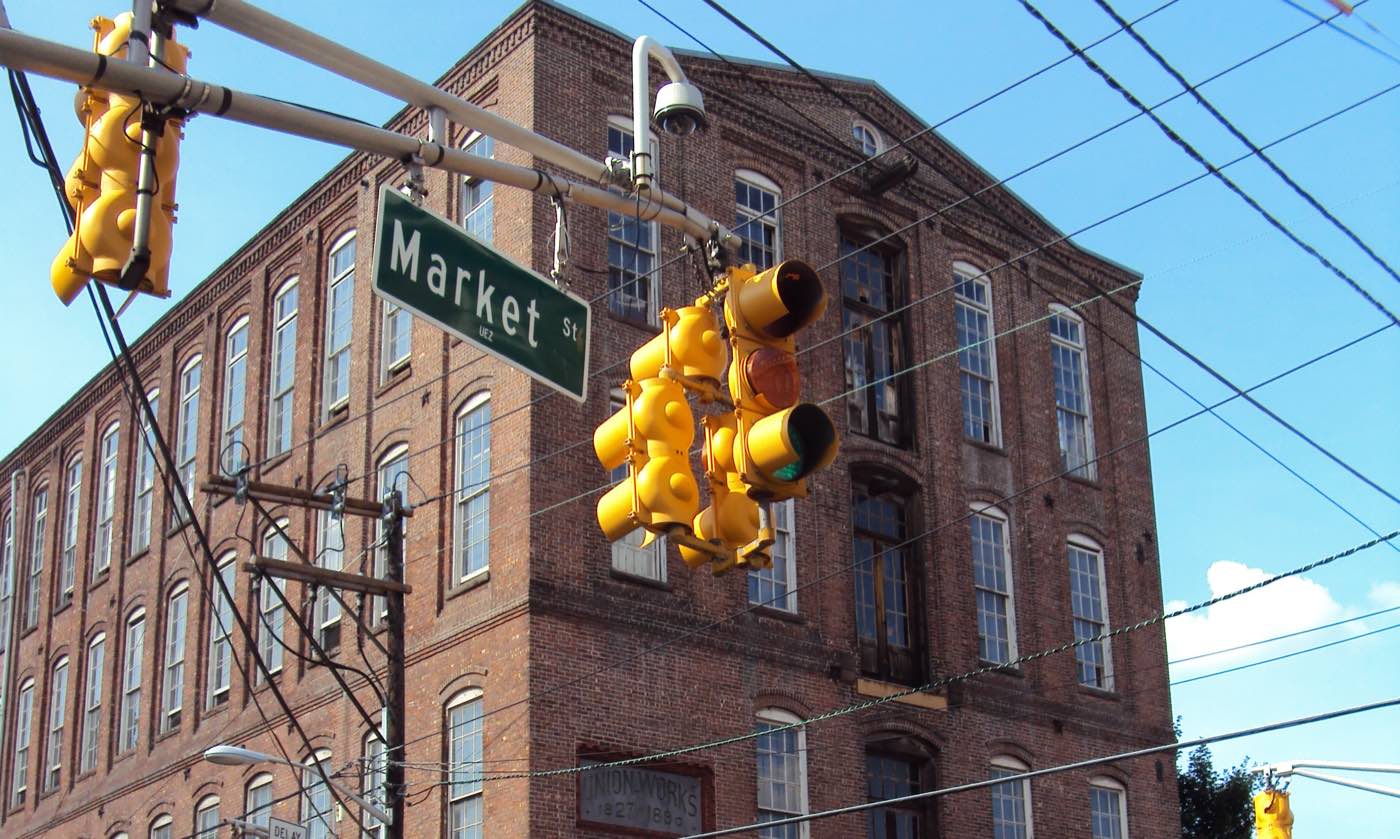
Every October, a stretch of Market Street in Paterson turns purple. Men and women in habits the color of crushed grapes carry a heavy painted image of Christ on their shoulders, a few inches at a time, while incense drifts past brick mills that once spun silk. The procession of the Lord of Miracles is the same one that fills the streets of Lima, transplanted whole to a New Jersey factory town. For one weekend, the city the Peruvians here left behind walks right past the bodega and the cevicheria.
This is the heart of the Peruvians in Paterson story, the largest Peruvian community in the United States, built in a place that knew exactly what it felt like to make something with your hands.
Paterson: The Place
Paterson sits in Passaic County, fifteen miles northwest of Manhattan, built around the seventy-seven-foot Great Falls of the Passaic River. Alexander Hamilton chose the falls in 1792 as the power source for America’s first planned industrial city, and by the late 1800s the water drove enough looms to earn the nickname Silk City. The downtown that grew up around it, all four-story brick and tight grid streets, runs along Market and Main. Those same buildings, and the cheap apartments above the shops, are the housing stock the Peruvians would later fill.
How Paterson Became Little Lima
Before the Peruvians
Paterson was a city built on cloth. By the 1880s it held more than a third of all the silk factories in the United States, and by the turn of the century it processed the bulk of the nation’s raw silk imports, a history the National Park Service traces back to Alexander Hamilton’s 1792 plan. The work pulled in wave after wave of newcomers, the Irish first, then Italians, then Eastern European Jews and Syrians, who at one point ran dozens of the mills themselves.
The downtown district just below the falls, long called Dublin for its first arrivals, passed from Irish to Italian hands over the decades. Then came the great unraveling. The 1913 silk strike, with more than twenty thousand workers out for five months, signaled a labor town under strain, and through the mid-twentieth century the mills slipped south and overseas. By the time the Peruvians arrived in force, Silk City was a city looking for its next chapter.
The Peruvians Arrive
A handful of Peruvians had reached Paterson astonishingly early. Researchers at Rutgers have traced names to around 1920, men like Victor Tarazona, Frank Maravi, and Carlos Dulanto, most of them former merchant seamen who stepped off the trading routes and reinvented themselves as textile workers in the mills. They were a curiosity, not yet a community. A city resolution later put the count at just four Peruvian residents in 1926.
The real story begins in the 1950s. As factory work still beckoned, the first true cluster formed, roughly a hundred Peruvian families by the end of the decade. Then came the people who would build everything. Guillermo Callegari Balarezo landed in August 1962 with a single bag and found, by his own recollection, about eleven Peruvians in the whole city.
It did not stay that way for long. Callegari remembered four more men arriving the next week, then twenty or thirty every week after. The newcomers took the jobs Paterson still had, in the last of the mills, in machine shops, on loading docks, and they wrote home about an old factory town where rent was low and a Peruvian face was no longer a surprise.
By the 1980s the pull had turned into a push. Peru was buckling under economic collapse and the violence of the Shining Path and Tupac Amaru insurgencies, and Paterson, with its growing nucleus of relatives and paisanos, was the obvious place to run to. As the mill jobs finally vanished, the Peruvians did what the Italians and Irish had done before them, and what the Portuguese in Newark’s Ironbound did in their own industrial corner of New Jersey. They opened businesses of their own.
Little Lima at Its Peak
Market Street became the spine of it. Restaurants, bakeries, travel agencies that sold tickets to Lima and wired money in the other direction, insurance offices, hair salons, butcher shops trimmed for Peruvian cuts. The Peruvians in Paterson were no longer mill hands. They were shopkeepers, and the shops were unmistakably theirs.
The numbers tell the scale. By 2009 Peruvians owned roughly half of the city’s twenty-eight hundred Hispanic-owned businesses, including some forty-five restaurants. The Census counted around ten thousand Peruvians in the downtown core, though community leaders, pointing to undercounting, put the true figure closer to thirty thousand across the city.
It made Paterson the unofficial capital of the Peruvian community in the United States, and the largest Peruvian enclave outside South America, much as the Cubans of Union City made their own New Jersey town a capital in exile. New Jersey has the highest per-capita Peruvian American population of any state, and this is its beating center. The proof arrived in 2016, when the city formally christened the blocks around Mill, Market, Main, and Cianci Streets as Peru Square, a designation residents had pushed for over a decade.
The Change
The Peruvians never had Market Street to themselves, and they do not now. Dominicans and Mexicans arrived in the same downtown blocks, opening their own restaurants and groceries alongside the cevicherias, so that a single corner might offer ceviche, mangu, and tacos within a few doors of each other. The same dynamic played out an hour east, where the Dominicans of Washington Heights built their own capital in Manhattan. Paterson today is a majority-Hispanic city, and Little Lima is one neighborhood inside a larger Latino mosaic.
The second generation has spread out, too. Children of the men who arrived with one bag have moved to Clifton, Passaic, and the suburbs beyond, trading the apartment over the shop for a house with a yard. Peruvian Americans are notably well educated, with a share of college graduates well above the national Hispanic average, and many of the grandchildren know Lima mainly through summer visits and their grandparents’ cooking.
What has not faded is the gravitational pull of the place. The consulate is still here, the parade still fills the streets every July, and the purple still comes out every October. Little Lima has thinned at the edges, but its center holds.
The Landmarks of Little Lima
Peru Square, Mill and Market Streets. The street sign went up on a Saturday afternoon in November 2016, pulled from its cover by Mayor Jose Torres before a crowd of about a hundred with traditional music and dancing. The designation, covering the blocks bounded by Mill, Market, Main, and Cianci, was the work of the Peru Square Association, who had lobbied for years. It made official what everyone already called the place.
La Tia Delia, 28 Market Street. A fixture of Little Lima that traces back to the community’s founding migrations of the 1960s, this is the kind of room where the Peruvian breakfast is taken seriously, chicharron and relleno and strong coffee. Locals call it a hidden gem toward the quieter end of Market Street. It has outlasted most of its neighbors and is still serving.
Panchito’s. Remembered as one of the very first Peruvian restaurants to open on Market Street, Panchito’s helped prove that a Peruvian kitchen could anchor a block. Where the early arrivals had cooked for one another at home, places like this turned that cooking outward, into a business and a landmark.
The Cathedral of St. John the Baptist, 381 Grand Street. The seat of the Diocese of Paterson, at the corner of Main and Grand, is where the city’s Peruvian Catholics gather each October for the Mass of El Senor de los Milagros, the Lord of Miracles. The bishop himself presides over the bilingual liturgy, and the purple-robed brotherhood carries the image out into downtown. The devotion is a direct copy of Lima’s, the largest religious procession in the Americas, made small enough to fit Paterson’s streets.
The Consulate General of Peru, 100 Hamilton Plaza. Peru opened a consulate in Paterson on the strength of the community here, and from a downtown high-rise it serves the more than seventy-five thousand Peruvians the government counts in New Jersey. Passports, documents, and a piece of home are processed a few blocks from Peru Square. Few American cities of Paterson’s size carry a foreign consulate, and fewer still earned one this way.
The Peruvian Parade route, Passaic to Paterson. Every July the celebration of Peruvian independence marches from Gregory and Main Avenue in Passaic, down Main Street through Clifton, and ends at a festival in Paterson’s Main Memorial Park. Floats, folkloric dancers in full costume, and live music draw tens of thousands. It is, by common reckoning, the largest parade in the state of New Jersey.
Where the Paterson Peruvians Came From
Most of Paterson’s Peruvians came from the cities, and above all from Lima itself, the sprawling coastal capital that by the late twentieth century was absorbing migrants from every corner of the country. The earliest arrivals had a seafaring path, merchant sailors who knew the Atlantic trade and decided to stay. The later, larger waves were working families from urban Peru chasing the same factory wages that had drawn Europeans to Silk City generations earlier.
Their reasons were a mirror of Paterson’s own history. They came for the mills while the mills lasted, and when those closed they came to join relatives already settled, fleeing an economic crisis and the political violence that gripped Peru through the 1980s. Chain migration did the rest. One man with a single bag became eleven, then a hundred families, then a square named for a country three and a half thousand miles away.
Paterson Today
Walk Market Street now and you still hear Peruvian Spanish, smell rotisserie chicken and fresh bread, and pass travel agencies advertising fares to Lima. The restaurants have multiplied beyond the founding handful, and the October procession and July parade remain among the largest Peruvian gatherings anywhere in the country. The Peruvians in Paterson are no longer a curiosity. They are an institution.
But the neighborhood is sharing space and changing hands, the way Paterson neighborhoods always have. Dominican and Mexican businesses sit beside the Peruvian ones, and the second and third generations are scattering to the suburbs, holding onto Lima through food, faith, and the wire transfers that still cross the equator every month. The grandparents who arrived with one bag are growing old in a city they made their own.
What remains is a rare thing in American immigration history, a community that did not just survive its founding generation but became the recognized capital of its diaspora. The mills are quiet, but Silk City found its next chapter in the people who came to weave a different kind of life. As long as the purple comes out each October, Lima has a second home on Market Street.
Frequently Asked Questions
Why did Peruvians settle in Paterson?
The first Peruvians in Paterson came for factory work in the silk and textile mills that gave the city its Silk City nickname. When that industry declined in the 1980s, later arrivals turned to opening their own businesses, and family connections drew thousands more from Peru to join relatives already there.
Is Paterson still a Peruvian community today?
Yes. Paterson remains the largest Peruvian community in the United States and the unofficial capital of the Peruvian diaspora, centered on the Peru Square area along Market Street. Dominican and Mexican families now share the same downtown blocks, and many second-generation Peruvians have moved to nearby suburbs, but the core institutions remain.
What are the famous Peruvian landmarks and festivals in Paterson?
The best-known sites are Peru Square at Mill and Market Streets, longtime restaurants like La Tia Delia at 28 Market Street, and the Cathedral of St. John the Baptist. The signature events are the July Peruvian Parade, the largest parade in New Jersey, and the October procession of El Senor de los Milagros.
Where in Peru did the Paterson Peruvians come from?
Most came from urban Peru, especially the capital city of Lima, which itself drew migrants from across the country in the late twentieth century. The earliest settlers were former merchant seamen, while the larger later waves were working families fleeing economic crisis and political violence at home.
When did Peruvians first arrive in Paterson?
A few Peruvians, mostly former sailors, reached Paterson as early as the 1920s. The community proper formed in the 1950s, grew rapidly after pioneers like Guillermo Callegari Balarezo arrived in 1962, and expanded most dramatically through the 1980s. The Peruvians in Paterson have been building this neighborhood for roughly a century.
Every family that walks behind the purple image in October carries a story that began somewhere in Peru and found a second beginning on Market Street. Those stories of departure, work, and belonging are the ones worth holding onto.