
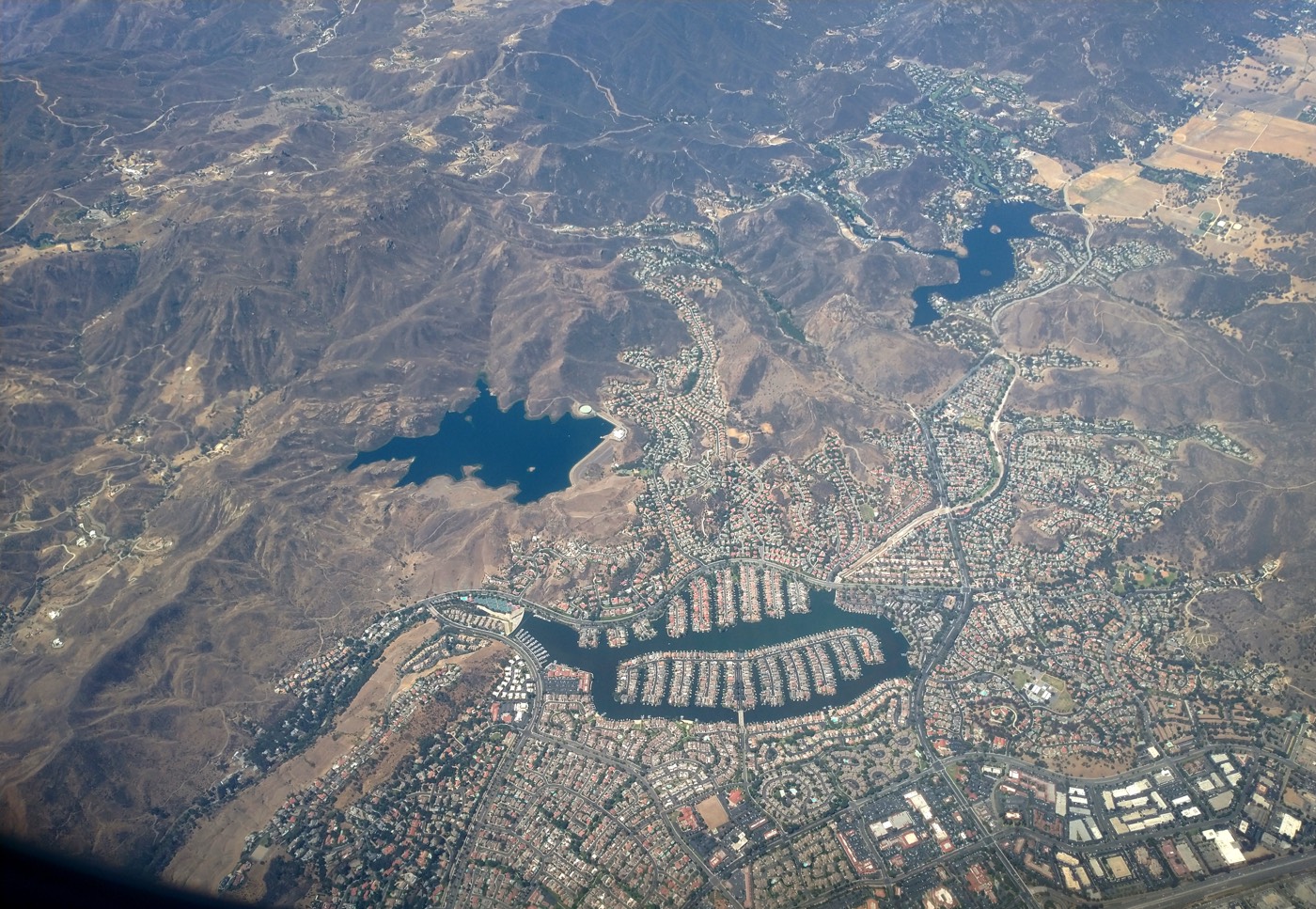
Drive west out of the San Fernando Valley, past Calabasas, and the freeway opens into a basin of low hills and a man-made lake. This is Westlake Village, and the Persians in Westlake Village have made it one of the quietest, most comfortable corners of the Iranian diaspora in Southern California. There is no shopfront sign in Farsi to announce them. There is, instead, a monthly gathering at an Italian restaurant by the water, a New Year table laid each spring, and several hundred households where Persian is spoken at the dinner table.
The Place
Westlake Village sits roughly 40 miles west of downtown Los Angeles, in the Conejo Valley, straddling the line between Los Angeles and Ventura counties. It was conceived in the 1960s by the American-Hawaiian Steamship Company as a master-planned community, built around a private man-made lake at its centre.
The city incorporated in 1981 as the 82nd municipality of Los Angeles County. Its population at the 2020 census was just over 8,000, with a median household income well above the national figure, which makes it one of the more affluent communities in greater Los Angeles. The lake at its centre is private, ringed by homes and a handful of restaurants, and much of the social life of the town orbits it.
The community straddles a county line, and roughly two-thirds of what people loosely call Westlake Village actually lies within the Ventura County city of Thousand Oaks. For a Persian family, that ambiguity is useful: the schools, the grocers and the restaurants of the corridor all blur together across the line, and the community treats Westlake, Agoura Hills and Thousand Oaks as a single stretch.
It is a place of curving streets, sailboats, and golf, secluded by design. That seclusion is precisely what drew a certain kind of Iranian family out here.
How It Became Persian
The Persians did not arrive in Westlake Village first. They arrived in Los Angeles first, and then, over a generation, they moved outward.
The 1979 wave and Tehrangeles
The 1979 Iranian Revolution sent hundreds of thousands of Iranians abroad, and a very large share of them settled in Los Angeles. The metropolitan area now hosts the largest Iranian-American community outside Iran, with estimates ranging into the hundreds of thousands. The cultural heart of that community formed in Westwood, on the stretch of Westwood Boulevard known as Tehrangeles, where Persian bookshops, restaurants and grocers crowded together within a few blocks.
Those first arrivals were often urban, secular and professional: doctors, engineers, merchants and academics who had built careers in Tehran and rebuilt them in California. The wealth and education of that first wave is part of why the community’s later moves carried it into expensive suburbs rather than working-class districts.
From Westwood the community fanned out. Families settled in Encino, in Tarzana, and further west into Woodland Hills, each move pushing the western edge of Iranian Los Angeles a little further out.
Crossing the county line
The next jump was the largest. Crossing out of the San Fernando Valley meant crossing into Calabasas, and from there into the Conejo Valley itself. Today, Calabasas has the densest concentration of Farsi speakers in the corridor, with roughly 650 households, and Farsi is reported to be the second most common language spoken there after English.
Westlake Village and the surrounding Conejo Valley sit just past Calabasas, the next link in the same chain. Around 600 households in the Conejo Valley speak Farsi. These were largely families chasing the same things that drew everyone else to Westlake Village: top-ranked schools, low crime, and large houses on quiet streets, with the bonus that relatives back in the Valley were never more than a half-hour drive away.
A community organises
The defining institution of Persian Westlake Village is not a building. It is a group. In 1995 a longtime local resident, Pari Daneshnia, a retired accountant, founded an Iranian organisation that has met monthly ever since.
It was deliberately built as a nonpolitical, nonreligious group, a place to speak Farsi, hear from speakers in medicine, law and the arts, and keep Persian poetry and history alive in a town with no Farsi signage on its streets. The group has met for years at Boccaccio’s, the Italian restaurant on the lake, and it hosts an annual Persian New Year celebration along with fundraising events.
Daneshnia later established a foundation, in 2010, that supports Persian studies at California State University, Northridge, and assists schools in Tehran. It is a small detail, but a telling one: the community here looks both outward to its old home and inward to the institutions of its new one.
The Landmarks
Boccaccio’s Restaurant, 32123 Lindero Canyon Road, Westlake Village. This lakeside Italian restaurant is the monthly meeting place of the local Iranian organisation. Locals sometimes arrive by sailboat across Westlake Lake, and on meeting nights the dining room fills with Farsi conversation, presentations, and poetry, an Iranian salon hosted in an Italian room.
Maral Cuisine, 5843 Kanan Road, Agoura Hills. A short drive east, Maral is one of the corridor’s destinations for gourmet Persian dining, offering both traditional and modern takes on the cuisine in an elegant, relaxed setting. For Westlake families, it is the place to bring out-of-town guests for kabob and saffron rice without driving back into the Valley.
Sadaf Restaurant, 868 E. Thousand Oaks Boulevard, Thousand Oaks. An outpost of one of the better-known names in Los Angeles Persian dining, Sadaf serves traditional kabobs, saffron rice and stews such as ghormeh sabzi. It draws guests from Thousand Oaks, Westlake Village and Agoura Hills alike, anchoring the corridor’s everyday Persian table.
Diar Market, 2671 Thousand Oaks Boulevard, Thousand Oaks. The corridor’s Persian grocer, Diar stocks the staples a Westlake kitchen needs: grass-fed meats, fresh produce, prepared foods, frozen meals, baked goods and yogurt sodas. It is where the week’s sabzi and the New Year’s herbs get bought.
Hyatt Regency Westlake, 880 S. Westlake Boulevard, Westlake Village. The town’s largest hotel ballroom has hosted Conejo Valley Nowruz celebrations, including a New Year evening of food, dancing and entertainment that drew some 250 guests. For a community without its own cultural hall, the hotel ballroom does the work of one each spring.
The Promenade at Westlake, 100 Promenade Way, Westlake Village. Opened in 1996, this open-air shopping centre is the social living room of the town, and on any given weekend its cafes and walkways are a cross-section of Westlake, Persian families among them. It is the unglamorous, everyday landmark where a community without an enclave still runs into itself.
The Daneshnia Foundation. Founded in 2010 by the same resident who started the local Iranian organisation, the foundation funds Persian studies at California State University, Northridge, and supports schools in Tehran. It is the community’s bridge institution, tying the Conejo Valley to both a California campus and the old country.
Where They Came From
The Persians of Westlake Village are, overwhelmingly, the children and grandchildren of the post-1979 exodus from Tehran and Iran’s other large cities. They are not, for the most part, recent immigrants. They are the second move and the third move of a family that first landed in Westwood or Beverly Hills.
That history shapes the community’s character. These are professional families, accountants, doctors, lawyers and business owners, who chose the Conejo Valley for its schools and its quiet rather than for any existing Persian institution. They built the institution, in the form of a monthly meeting, after they arrived.
It is worth noting what Westlake is not. It is not Glendale, where the Iranian presence overlaps with a large Armenian one, nor is it the dense Westwood core. It is a dispersed, suburban, intentionally low-key version of Iranian California, the diaspora at its most assimilated and most comfortable.
Westlake Village Today
Today the Persians of Westlake Village are woven into the fabric of an affluent suburb rather than concentrated in a visible district. You will not find a Farsi sign on the main boulevard. You will find Persian surnames on the rosters of the local schools, Persian families at the Promenade on a Saturday, and a steady demand for the kabob and grocery shops just over the line in Agoura Hills and Thousand Oaks.
The monthly organisation founded in 1995 still meets, now a fixture of three decades. Each spring the Nowruz table is laid, sometimes at the Hyatt, sometimes at smaller gatherings, with the haft-seen and the herbs from Diar. The community’s institutions are modest and human-scaled, but they are durable.
If there is a defining trait, it is this quietness. The Persians here did not build a Tehrangeles. They built a comfortable, dispersed, deeply rooted suburban life, and then, so they would not lose the language and the poetry, they started meeting once a month by the lake.
Frequently Asked Questions
How many Persians live in Westlake Village?
There is no precise count for the city alone. Around 600 households in the wider Conejo Valley, which includes Westlake Village and Thousand Oaks, speak Farsi, with a further 650 or so in neighbouring Calabasas. The Persians in Westlake Village are part of this dispersed Conejo Valley community rather than a single concentrated district.
Why did Persians settle in Westlake Village?
Most are second-generation moves from the post-1979 Iranian community that first settled in Westwood, Beverly Hills and the San Fernando Valley. They came west for the top-ranked schools, low crime and large homes, while staying within a short drive of relatives in the Valley.
Is there a Persian organisation in Westlake Village?
Yes. A nonpolitical, nonreligious Iranian organisation founded in 1995 by local resident Pari Daneshnia has met monthly for decades, often at Boccaccio’s restaurant. It hosts speakers, celebrates Persian poetry and history, and holds an annual Persian New Year celebration.
Where do Persians in Westlake Village shop and eat?
The corridor’s Persian businesses cluster just east in Agoura Hills and Thousand Oaks. Restaurants include Maral Cuisine in Agoura Hills and Sadaf in Thousand Oaks, while Diar Market in Thousand Oaks is the area’s main Persian grocer.
How is Westlake Village different from Calabasas or Encino for Persians?
Calabasas has the densest concentration of Farsi speakers in the corridor, where Farsi is the second most common language, while Encino sits closer to the older San Fernando Valley core. Westlake Village is further west, more dispersed and more suburban, the diaspora at its quietest and most assimilated.
How do Persians in Westlake Village celebrate Nowruz?
Nowruz, the Persian New Year, is marked each spring with haft-seen tables, family gatherings and larger events. The local Iranian organisation holds an annual celebration, and Conejo Valley Nowruz events have drawn hundreds of guests to venues such as the Hyatt Regency Westlake.
If your family’s story passed through Westlake Village, or any of the places Persians have made home in America, Atlas of Home can trace that journey. From the streets of Tehran to a monthly gathering on a Conejo Valley lake, to wherever you are now.