
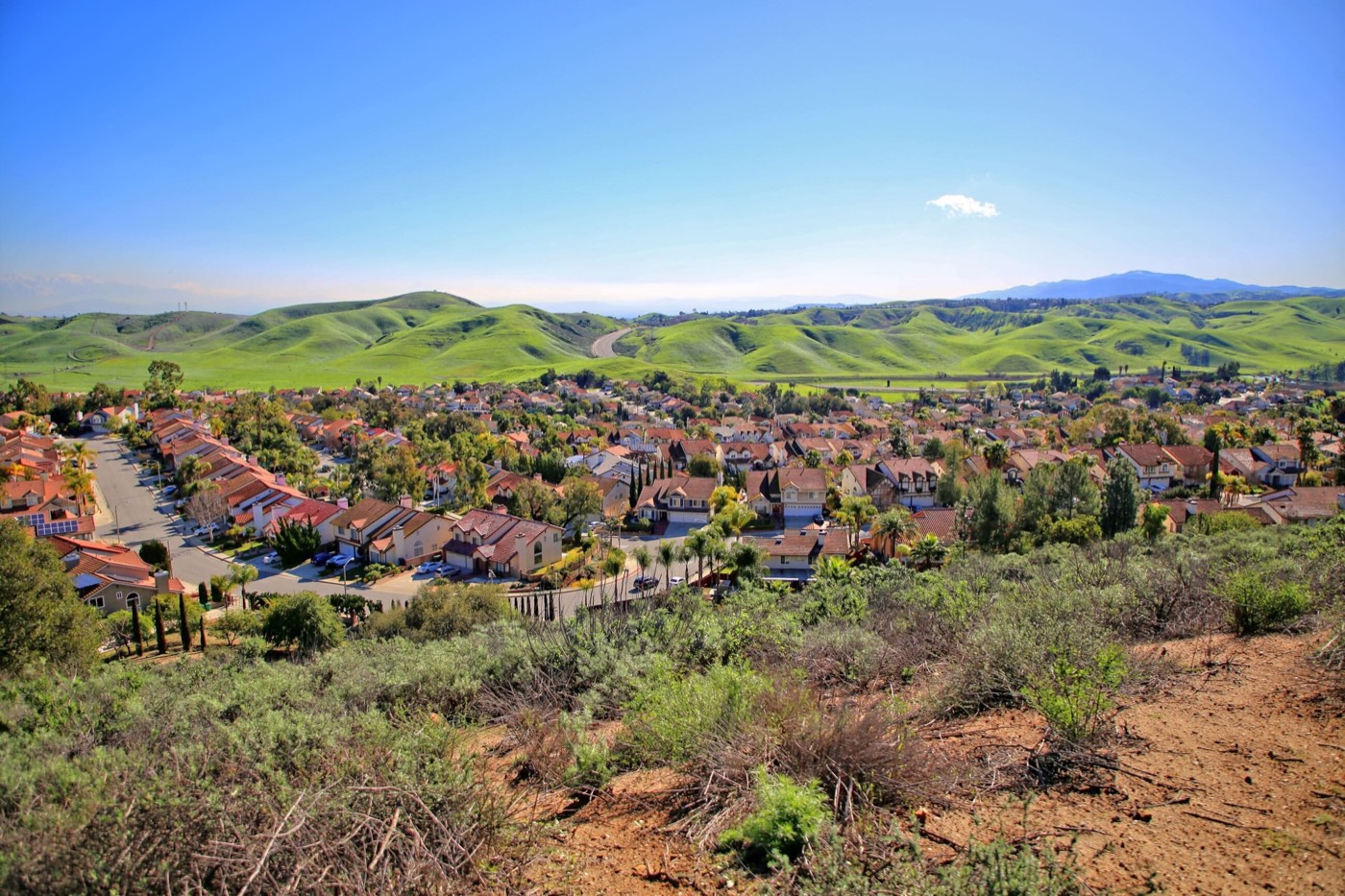
Drive south on Diamond Bar Boulevard past the golf course and the hills fold open, street after street of stucco houses climbing toward the ridgeline. Somewhere along that boulevard you pass an H Mart, a Korean barbecue restaurant with valet parking, a Presbyterian church with a Korean name on the sign. The Koreans in Diamond Bar did not build a Koreatown here. They came for the schools, the quiet, and the view, and they made a community out of Sundays and grocery runs and a high school that sends its graduates to every campus in the University of California.
The Place
Diamond Bar sits in the far southeastern corner of Los Angeles County, where the San Gabriel Valley runs into the Inland Empire and brushes the edge of Orange County. It is hills and freeways: the 57 and the 60 cross at its northern edge, and the rest is winding residential streets draped over the ridges of what was once a cattle ranch.
The city takes its name from a branding iron. In 1918 the rancher Frederick E. Lewis registered a mark, a diamond over a bar, for the spread he ran across these canyons. The name outlived the cattle.
Today around 55,000 people live here, and a clear majority of them are Asian American. It is one of the most comfortably affluent and most Asian cities in California, and yet it has no single ethnic main street. The community lives in the schools, the churches, and the shopping plazas tucked between the hills.
How It Became Korean
A ranch sold for a master plan
The modern city was an idea before it was a place. In the 1950s the Transamerica Corporation bought the old Diamond Bar Ranch, thousands of acres of Brea Canyon, with the intention of building one of the nation’s first master-planned communities. The first homes went up around 1959, and the Pomona Freeway pushed through the area a decade later.
For its first decades Diamond Bar was a white middle-class suburb, the kind of place families moved to for a new tract house and a yard. It was not incorporated as a city until 18 April 1989, late by California standards. By then the population that would define its future had already begun to arrive.
The Korean arrival
Korean immigration to Southern California surged after the 1965 Immigration and Nationality Act lifted the old national-origin quotas. The first wave settled in central Los Angeles, in the blocks around Olympic and Western that would become the Koreans in Koreatown, Los Angeles. That neighbourhood was the entry point: the churches, the banks, the first jobs.
The second move was outward. As Korean families established themselves through small business and the professions in the 1980s and 1990s, they began looking for the same things every striving suburban family wanted, bigger houses, lower crime, and above all good schools. Diamond Bar offered all three, with new construction and freeway access to the Korean commercial spine of Los Angeles.
Schools as the magnet
What pulled Korean families to this corner of the county, more than anything else, was the Walnut Valley Unified School District. The district serving southern Diamond Bar is consistently ranked among the strongest in California, and Diamond Bar High School in particular became a name passed between Korean families across the region.
The numbers tell the story plainly. At Diamond Bar High, Asian American students now make up roughly seven in ten of the enrolment, and the school routinely lands in the top few percent of California high schools, with proficiency rates in English, maths, and science far above the state average. For immigrant parents who had staked everything on their children’s education, that record was the entire argument.
The Inland gateway
Diamond Bar also sits at a crossroads of Korean Southern California. To the west lie the older San Gabriel Valley Asian suburbs. To the south, down the 57 freeway, runs the Orange County Korean corridor through Fullerton and Buena Park, home to the Koreans in Fullerton, California. To the southwest sits the planned-community Korean enclave of the Koreans in Cerritos, California.
Diamond Bar became the hilltop in the middle of that map, close to everything Korean Southern California offered, but a step removed, greener and quieter than any of it.
A community alongside a larger one
The Korean story here runs in parallel with a larger Chinese American one. By the 2000s, Chinese ancestry had become the single most common Asian background in the city, and that community has its own deep roots, told in the Chinese in Diamond Bar, California. Korean families have been the substantial second presence, around a tenth of the city in census estimates from the period, sharing the same plazas, schools, and ridgelines.
The two communities are neighbours rather than rivals. A Korean church and a Chinese banquet hall can share a parking lot here, and the children sit in the same AP classes at Diamond Bar High.
The Landmarks
H Mart, 2825 S Diamond Bar Boulevard. The anchor of Korean Diamond Bar is its grocery store. The H Mart plaza is where families stock up on banchan and short rib, where the food court sells delimanjoo and kimbap, and where you are as likely to hear Korean spoken on a Saturday morning as English. For many residents it is the closest thing the city has to a town square.
Diamond Bar Center, 1600 Grand Avenue. The city’s civic event hall sits up in Summitridge Park with a view across the valley. Its Grand View Ballroom, which seats more than 800, has hosted countless Korean weddings, hwangap sixtieth-birthday banquets, and church anniversaries, the kind of large family gatherings that anchor a community without a downtown.
Diamond Bar Golf Course, 22751 Golden Springs Drive. The public county course is one of the city’s oldest landmarks, an 18-hole championship layout threaded along the freeway. Golf carries real weight in Korean American social life, and the course and its clubhouse have long been a fixture for the city’s Korean professionals.
Korean Presbyterian Church of Diamond Bar. The Presbyterian church is the institution Korean immigrants carry with them everywhere, the place where new arrivals find language, childcare, and a network. Diamond Bar’s congregations follow that pattern, offering Korean-language worship and the social scaffolding that a dispersed suburban community relies on.
Diamond Bar Korean Evangelical Church. Among the evangelical congregations serving the area, it reflects the central role of the Protestant church in Korean American life. Sunday is the day the community gathers, and the church calendar, more than any neighbourhood, gives the year its shape.
Diamond Bar High School, 21400 Pathfinder Road. The reason many families came at all. A perennial top-ranked public school, it is the institution Korean parents discuss before they ever look at a house, and its graduates fan out across the University of California and beyond.
Diamond Bar Boulevard. Not a single address but the spine of the city, lined with the strip plazas where Korean barbecue restaurants, bakeries, tutoring centres, and professional offices cluster. There is no Korean district here; the businesses are stitched into ordinary suburban shopping centres, which is exactly how this community prefers it.
Where They Came From
Most Korean families in Diamond Bar trace back to the great migration out of South Korea that followed the 1965 reform of American immigration law, the same wave that built Los Angeles Koreatown. Many came from Seoul and the surrounding Gyeonggi province, and others from the southern port city of Busan, professionals and small-business owners who arrived through the 1970s and 1980s.
Their path into Diamond Bar was rarely direct. The typical route ran from central Los Angeles, or from the first-generation Korean enclaves of the South Bay and Orange County, out to the hills once a family had the means to trade density for space. Diamond Bar was a destination of arrival, the suburb you reached after the harder years.
The pull was generational. Parents who had worked long hours in shops and offices wanted their children in the best schools they could find, and they were willing to commute long distances on the 57 and 60 to put them there. The houses on these ridges are, in a real sense, monuments to that bet on education.
Diamond Bar Today
Diamond Bar today is a settled, comfortable, majority-Asian city, and the Korean community within it is firmly second-generation and beyond. The children who came for Diamond Bar High have grown up, gone to university, and in many cases come back to raise their own families on the same streets.
The community remains quiet by design. There is no Korean festival shutting down a main street, no neon district. The life of the community runs through the church directory, the H Mart aisles, the parent networks around the schools, and the weekend banquets at the Diamond Bar Center.
What Diamond Bar offers the Korean families who chose it is a particular kind of American success, undramatic and durable. It is a place where a community built its life around schools and faith and family, and where the view from the ridge, on a clear day, still reaches all the way to the mountains. For the full civic picture, the city’s recorded history and demographics and the record of Diamond Bar High School both bear out what residents already know.
Frequently Asked Questions
How many Koreans live in Diamond Bar?
Diamond Bar has roughly 55,000 residents, a clear majority of them Asian American. Census estimates from the 2000s and 2010s put the Korean share at around a tenth of the city’s population, making the Koreans in Diamond Bar one of its largest communities alongside a bigger Chinese American population.
Why did Korean families move to Diamond Bar?
The main draw was schools. The Walnut Valley Unified School District, and Diamond Bar High School in particular, ranks among the strongest in California, which made the city a magnet for education-focused Korean immigrant families. Affordable new housing in the 1980s and 1990s and easy freeway access to Korean Los Angeles sealed the choice.
Is there a Koreatown in Diamond Bar?
No. Unlike Los Angeles, Diamond Bar has no Korean commercial district. The Korean community here is suburban and dispersed, organised around churches, the H Mart on Diamond Bar Boulevard, and the schools rather than a single neighbourhood.
Where do Koreans in Diamond Bar shop for Korean food?
The H Mart at 2825 South Diamond Bar Boulevard is the community’s main grocery anchor, with a food court and a wide Korean selection. Korean barbecue restaurants, bakeries, and cafes are scattered through the strip plazas along Diamond Bar Boulevard and nearby Grand Avenue.
How is Diamond Bar connected to other Korean communities?
Diamond Bar sits between several Korean centres. Koreatown in Los Angeles lies to the west, the Orange County Korean corridor through Fullerton and Buena Park runs south down the 57 freeway, and the planned Korean enclave of Cerritos is to the southwest. Diamond Bar is the quieter hilltop in the middle.
What is daily life like for Korean families in Diamond Bar?
Life centres on family, faith, and education. Korean churches provide the weekly social rhythm, the schools shape the calendar, and large family events fill venues like the Diamond Bar Center. It is a settled, second-generation community that prizes quiet success over visible enclaves.
If your family’s story passed through Diamond Bar, or any of the places Koreans have made home in America, Atlas of Home can trace that journey. From the streets of Seoul and the port of Busan, to the churches and hilltop houses of Diamond Bar, to wherever you are now.