
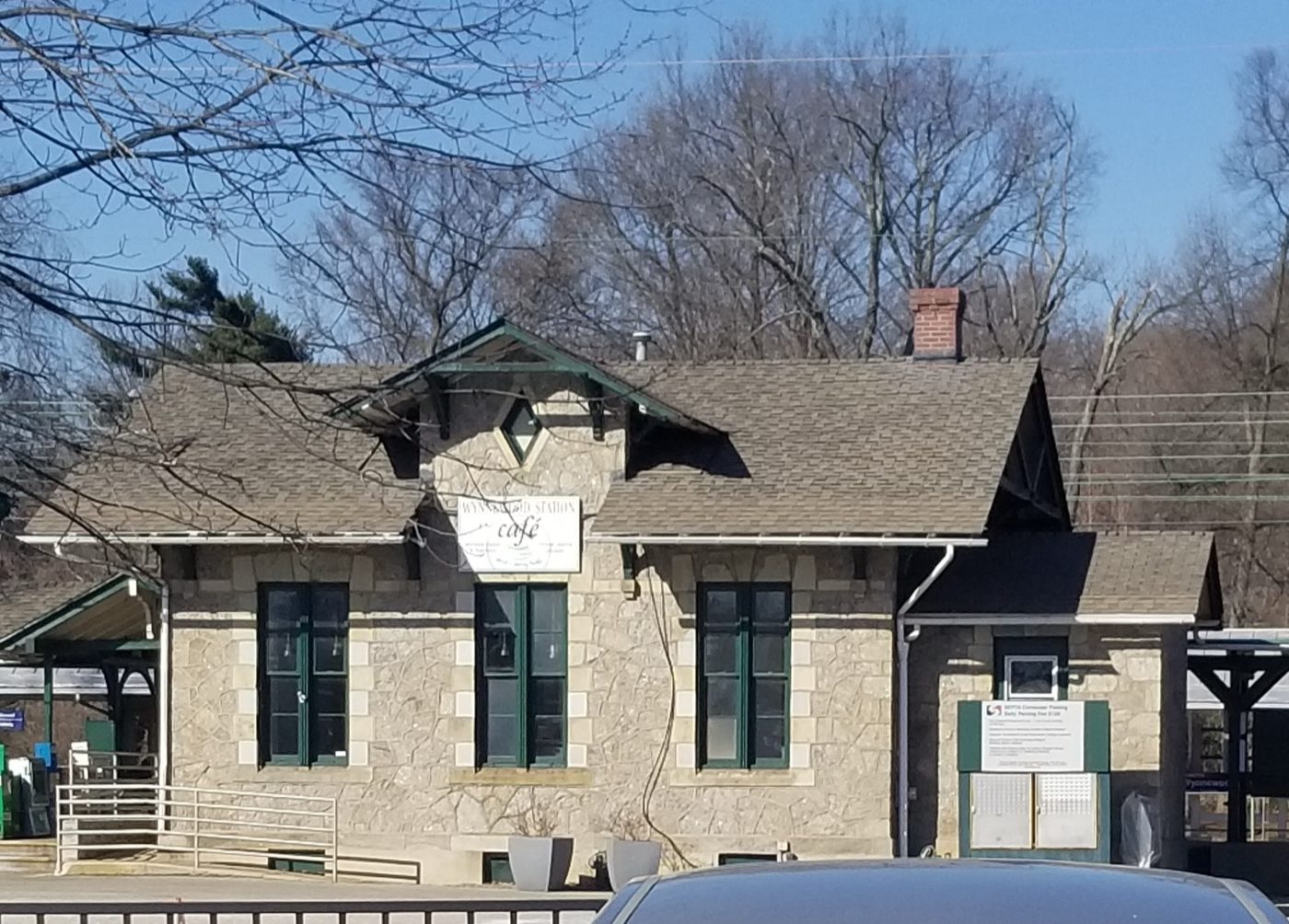
On a Saturday morning in Wynnewood, the SEPTA platform is quiet, the Giant on East Wynnewood Road is stocked with Empire chicken and Cholov Yisroel dairy, and a steady current of families walks the leafy blocks toward Remington Road. The Jews in Wynnewood did not arrive here by accident. They crossed City Avenue one household at a time, carrying with them the institutions of West Philadelphia and rebuilding them, larger and greener, on the Main Line.
The Place
Wynnewood is an unincorporated community west of Philadelphia, straddling Lower Merion Township in Montgomery County and a sliver of Haverford Township in Delaware County. It was named in 1691 for Dr. Thomas Wynne, William Penn’s physician and the first Speaker of the Pennsylvania General Assembly.
It sits in the heart of the Philadelphia Main Line, the chain of affluent suburbs named for the old Pennsylvania Railroad line that still runs through them. At the 2010 census the community counted 13,572 residents, with a median household income of roughly $86,861 and fewer than one percent of families below the poverty line.
The streets are old and shaded, the houses are stone and brick, and the train into Center City takes about twenty minutes. That short ride links Wynnewood to a Philadelphia still rich with immigrant neighbourhoods, from the Jewish blocks of Wynnefield to the rowhouses of Italian South Philadelphia. For a Jewish family leaving the city in the second half of the twentieth century, that combination was close to ideal.
How It Became Jewish
The Main Line was not built for Jews. Lower Merion was settled in 1682 by Welsh Quakers granted the Welsh Tract by William Penn, and for two centuries it stayed overwhelmingly Quaker and Protestant. For a long stretch of the twentieth century, many Main Line communities carried discriminatory housing covenants, and Jewish families understood which doors were closed.
The first arrivals
The earliest documented Jewish presence in Lower Merion is modest and old. The Lower Merion Historical Society traces it to 1884 and the arrival of the Harrison family from Louisiana. A Jewish cemetery, Har Hazaitim, was consecrated in Gladwyne in 1893, the township’s only Jewish burial ground, by then long inactive.
For decades the community was too small for a synagogue. Families worshipped at home. According to the Lower Merion Historical Society, that changed in March 1936, when ten local businessmen founded the Main Line Hebrew Association, pooling six hundred dollars in cash on behalf of about thirty families. It was the area’s first organised congregation, the seed of everything that followed.
Crossing City Avenue
The real transformation came after the Second World War, and it came from one direction in particular. Just over the city line, in the West Philadelphia neighbourhoods of Wynnefield and Overbrook Park, lived a large and prosperous Jewish population. As covenants weakened and the suburbs opened, a growing number of those families jumped across City Avenue into Merion, Bala Cynwyd, and Wynnewood.
It was a short move in miles and an enormous one in meaning. The same families who had filled the pews of Wynnefield congregations now wanted institutions on the Main Line side of the line. The synagogues, in time, followed them out.
The synagogue boom of the 1950s
In a single decade, Lower Merion went from one congregation to a cluster of them. Main Line Reform Temple-Beth Elohim was founded in 1952 as the area’s first Reform congregation, organised by young couples. In April 1953 Natalie Hodes became its president, at the time the only woman leading a synagogue in the country.
Lower Merion Synagogue, the township’s first Orthodox congregation, began in 1954 with just a handful of families and would grow into the largest Orthodox synagogue in Pennsylvania. Temple Adath Israel, founded in 1946, built its celebrated Pietro Belluschi sanctuary in 1958 and 1959, its twelve concrete supports symbolising the twelve tribes of Israel.
Temple Beth Hillel-Beth El, the Conservative congregation that anchors Jewish Wynnewood today, dates its founding to 1958. It settled on an eight-acre property at 1001 Remington Road, where an early-1900s mansion still stands at the centre of a campus that grew a sanctuary wing in 1968, a school wing in 1990, and a connecting structure in 2002.
The institutions arrive
Worship was only part of it. In 1971 the Kaiserman Jewish Community Center opened at 45 Haverford Road in Wynnewood, a full-service centre with a preschool, summer camps, fitness facilities, and adult education, the secular hearth of the community.
The most influential migration of a synagogue came later. Har Zion Temple, founded in 1923 in Wynnefield and once among the most influential Conservative congregations in the country under Rabbi Simon Greenberg, followed its members out of the city. In December 1972 it purchased seventy-five acres in Penn Valley, broke ground in 1974, and dedicated its new campus in 1976. The move was the clearest possible statement that the centre of Jewish gravity had shifted from West Philadelphia to the Main Line.
By 1970, the Main Line suburbs had become one of the recognised concentrations of Jewish life in the greater Philadelphia region, alongside the Northeast, the Old York Road suburbs, and Mount Airy. Wynnewood sat near the middle of it.
The Landmarks
Temple Beth Hillel-Beth El, 1001 Remington Road. The Conservative heart of Jewish Wynnewood, founded in 1958 on an eight-acre estate. The congregation has long been a pioneer of egalitarian, fully participatory worship, and its open-seating policy on the High Holidays became part of its identity.
Main Line Reform Temple-Beth Elohim, 410 Montgomery Avenue. The area’s first Reform congregation, founded in 1952. Its home at 410 Montgomery Avenue had earlier housed Adath Israel; Main Line Reform purchased the former mansion when Adath Israel moved on, a literal handing-down of Jewish space from one congregation to the next.
Kaiserman Jewish Community Center, 45 Haverford Road. Open since 1971, the JCC is where Wynnewood’s Jewish life happens outside the sanctuary: the preschool, the camps, the fitness floor, the holiday programmes. A kosher eatery, Nana’s Kitchen, has operated inside the building.
Giant, 50 East Wynnewood Road, Wynnewood Shopping Center. The everyday infrastructure of a kosher home. The store keeps a large kosher section with Empire and Aaron’s meats and poultry, a kosher fish counter, Cholov Yisroel dairy, and a kosher bakery, the kind of amenity that lets observant families live here without a long drive for groceries.
Perelman Jewish Day School, Stern Center, Wynnewood. The Schechter-affiliated day school, once known as the Solomon Schechter Day School of Greater Philadelphia, educates children from PreK through fifth grade on its Wynnewood campus, serving families from Center City and the western suburbs.
Har Zion Temple, 1500 Hagys Ford Road North, Penn Valley. A short drive from Wynnewood, this is the congregation that moved its entire seventy-five-acre campus out of Wynnefield in 1976, the single most visible monument to the West Philadelphia-to-Main Line migration.
Lankenau Medical Center, Lancaster Avenue near Overbrook. Not a Jewish institution, but a Wynnewood landmark woven into Jewish family life here. The teaching hospital is one of the region’s largest employers and a workplace for many of the doctors and professionals who settled the surrounding blocks.
Where They Came From
The Jews of Wynnewood are, overwhelmingly, the children and grandchildren of West Philadelphia. The deepest roots run to Wynnefield and Overbrook Park, just across City Avenue, where an earlier generation of Ashkenazi families, descended from the great Eastern European immigration of 1881 to 1924, built a dense urban Jewish world.
When the postwar suburbs opened, those families moved the short distance west, into Merion, Bala Cynwyd, and Wynnewood. They were not strangers building from nothing. They were a community relocating, with its rabbis, its schools, and in Har Zion’s case its very buildings, into greener and more spacious surroundings.
That continuity is why Wynnewood’s Jewish life felt established almost from the start. The institutions were not invented on the Main Line. They were carried there.
Wynnewood Today
Wynnewood today is a settled, professional, comfortably Jewish suburb rather than a frontier. The synagogues that opened in the 1950s are mature institutions now, several of them with second and third generations of the same families in their pews. The community sits within a broader Main Line Jewish belt that runs through the Jewish community in nearby Bala Cynwyd and across the wider township covered in the story of Jewish Lower Merion.
It is distinct from its neighbours even so. Bala Cynwyd, just over the city line, holds much of the area’s kosher dining; the heavily Orthodox blocks cluster closer to that border. Wynnewood’s character is more Conservative and Reform, more centred on the big congregational campuses at Remington Road and Montgomery Avenue and on the Kaiserman JCC. Across the river, the suburban Jewish story repeats itself in places like the Jewish community of Cherry Hill, New Jersey, another postwar landing ground for city families.
The Lower Merion School District, consistently among the strongest in the state, remains a powerful draw, as do the private schools, Friends’ Central and Baldwin among them, and the cluster of Jewish day schools nearby. For a family weighing where to raise children within reach of Philadelphia, Wynnewood still answers the same question it answered seventy years ago, with shaded streets, a fast train, and a synagogue within walking distance.
Frequently Asked Questions
Where is the Jewish community in Wynnewood, Pennsylvania?
The Jews in Wynnewood are concentrated in Lower Merion Township, Montgomery County, on the Philadelphia Main Line just west of the city. Major institutions cluster around Remington Road, Montgomery Avenue, and Haverford Road, with the heavily Orthodox blocks sitting closer to the Bala Cynwyd border.
Why did Jewish families move to Wynnewood and the Main Line?
Most came from the West Philadelphia neighbourhoods of Wynnefield and Overbrook Park after the Second World War. As discriminatory housing covenants weakened, prosperous Jewish families crossed City Avenue into Merion, Bala Cynwyd, and Wynnewood for more space, strong schools, and a fast commuter train.
What are the main synagogues in Wynnewood?
Temple Beth Hillel-Beth El at 1001 Remington Road (Conservative, founded 1958) and Main Line Reform Temple-Beth Elohim at 410 Montgomery Avenue (Reform, founded 1952) are the anchors. Har Zion Temple, a major Conservative congregation, sits nearby in Penn Valley.
Is there kosher food in Wynnewood?
Yes. The Giant supermarket at 50 East Wynnewood Road keeps a large kosher section with Empire and Aaron’s meats, a kosher fish counter, Cholov Yisroel dairy, and a kosher bakery. More kosher dining sits just over the line in Bala Cynwyd.
When did the Jewish community in Wynnewood take shape?
It crystallised in the 1950s. After the Main Line Hebrew Association was founded in 1936, a wave of congregations opened between 1952 and 1958, and the Kaiserman JCC followed in 1971, giving the Jews in Wynnewood a full set of institutions within two decades.
What is the Kaiserman JCC?
The Kaiserman Jewish Community Center at 45 Haverford Road, open since 1971, is the secular hub of Jewish Wynnewood. It runs a preschool, summer camps, a fitness centre, adult education, and holiday programming, and it has housed a kosher eatery on site.
If your family’s story passed through Wynnewood, or any of the places Jews have made home in America, Atlas of Home can trace that journey. From the rowhouses of Wynnefield to a synagogue on Remington Road, to wherever you are now.