
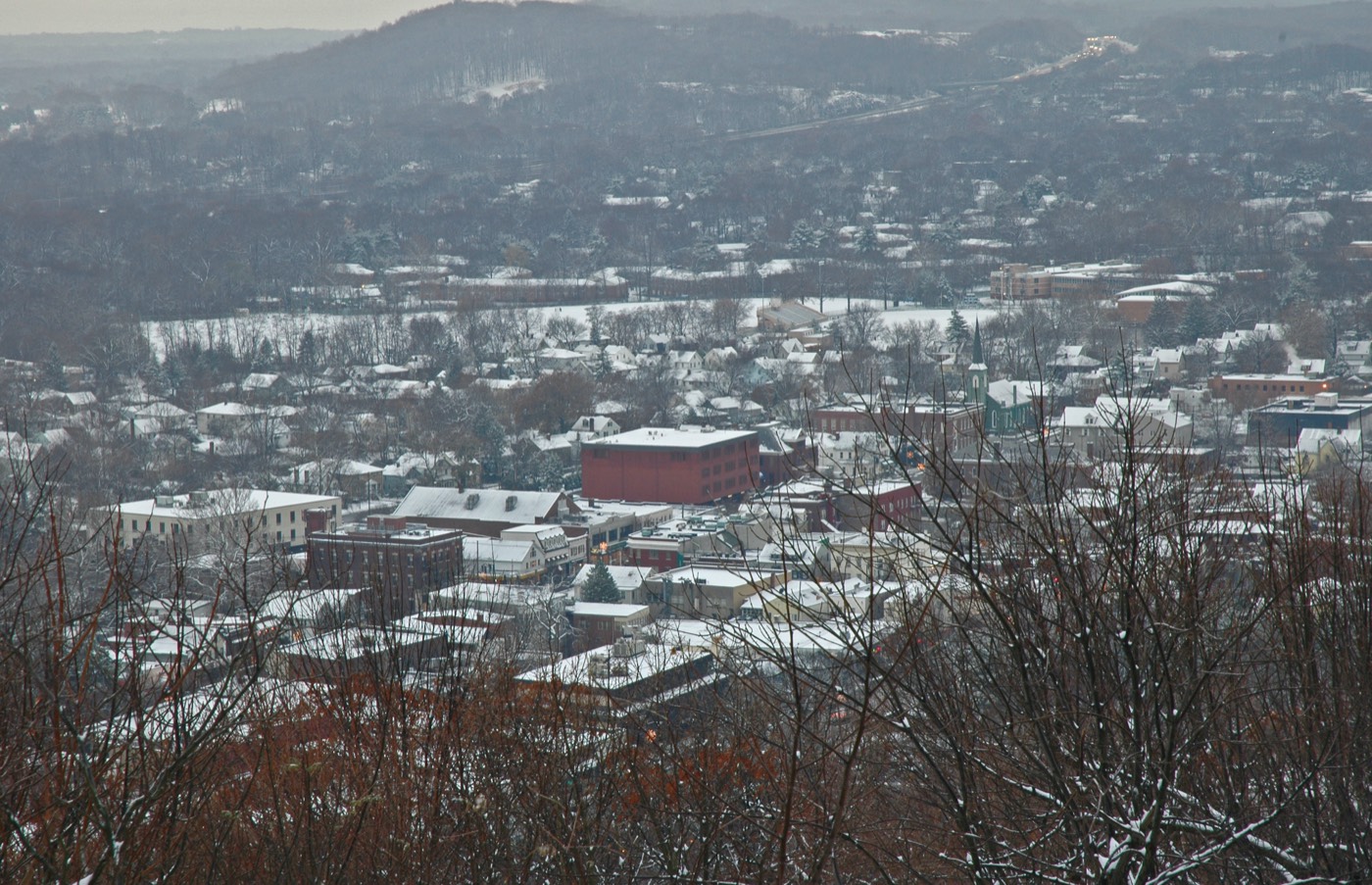
On a Saturday morning along Millburn Avenue, the township wears its quiet prosperity lightly. A clock tower marks the corner of Main and Essex, commuters drift toward the Lackawanna platform, and a few blocks east the Percival Goodman sanctuary of Congregation B’nai Israel holds a Shabbat service that has run, in one building or another, since the Coolidge administration. The story of the Jews in Millburn, New Jersey is the story of a paper-mill town that became one of the wealthiest suburbs in America, and of the families who left Newark to make their lives in it.
The Place
Millburn is a township in southwestern Essex County, roughly fifteen miles west of Midtown Manhattan and firmly inside the New York commuter belt. It was incorporated on 20 March 1857, carved from Springfield Township, and its name comes from the burn, a Scottish word for stream, that once turned the local mills.
Samuel Campbell built the first paper mill here in 1790, and for a century the brooks running off South Mountain powered a working industrial village. The mills are gone now. What remains is a township of about 21,710 people, anchored by a compact downtown and by the unincorporated section of Short Hills, a census place of some 14,422 residents that holds most of the township’s population and most of its reputation for money.
The 2013 to 2017 American Community Survey put Millburn’s median household income at 202,862 dollars, the highest of any New Jersey municipality over 10,000 people. The property tax bills, among the steepest in the state, buy a school system that has ranked at or near the top of national lists for open-admission high schools.
How It Became Jewish
Millburn did not begin as a Jewish town. It began as a mill village and then a Victorian railroad suburb, and the first Jewish presence here was small, a handful of families and merchants spread along the Avenue in the early twentieth century. The community that grew into one of the largest in Essex County arrived later, and it arrived largely from one place: Newark.
The first congregation, 1924
The pivot came in 1924. On 29 April that year, a group of families incorporated Congregation B’nai Israel, the first Jewish congregation in the area. They bought ground on Lackawanna Place and finished a modest building just before the High Holy Days of 1925, when 75 heads of households gathered with their families for services.
It was a small start, but a consequential one. After B’nai Israel took root in Millburn, congregations followed in Union, Livingston, Springfield and Summit. The Millburn synagogue had become the seed of a suburban Jewish geography that now stretches across the western Essex hills.
A refugee rabbi and a synagogue that made the news
Rabbi Melvin Keiffer became the congregation’s first rabbi in 1942. When he was called to wartime service, the pulpit passed to Rabbi Max Gruenewald, a German refugee then teaching at the Jewish Theological Seminary. Gruenewald had led the Haupt Synagogue in Mannheim until it was destroyed during the Kristallnacht pogrom of November 1938. Two stones from that ruined sanctuary were set into the Millburn building in 1950, a quiet bridge between a burned synagogue in Germany and a growing one in Essex County. He served until 1969.
In 1954 the congregation moved from Lackawanna Place to its present home at 160 Millburn Avenue, into a building designed by the architect Percival Goodman. It was a landmark of modern American synagogue design. Time Magazine featured it, and Goodman had commissioned a generation of New York abstractionists to furnish it: Adolph Gottlieb designed the ark curtain, Herbert Ferber sculpted the Burning Bush that hangs on the facade, and Robert Motherwell painted the lobby mural. A working Conservative synagogue had become, almost by accident, a museum of postwar American art.
The Newark exodus, 1950s and 1960s
The real surge came after the Second World War. Newark had been home to a large and proud Jewish community, but suburbanisation pulled families westward through the 1950s and 1960s, and the city’s unrest in 1967 accelerated a departure that was already well underway. Jewish families left Newark in large numbers for the Essex County suburbs, and Millburn, with Livingston and South Orange and the Jewish community of West Orange, absorbed many of them.
It is the migration Philip Roth fixed in print. His 1959 novella Goodbye, Columbus follows a newly affluent Jewish family in the Short Hills section of Millburn, and one of its scenes plays out on the Millburn High School track. The book caught the precise moment when the children of Newark’s tenements were buying lawns and station wagons in the hills to the west.
It is the same suburban Jewish migration that reshaped towns across the state, from the Conservative and Orthodox enclaves of Teaneck to the older established community of Englewood in Bergen County.
The institutions followed the people. In 1968 Temple B’nai Jeshurun, the oldest Reform congregation in New Jersey, relocated from Newark to a 21-acre campus in Short Hills, bringing roughly 1,100 member families with it. By the end of the 1960s the township had two major synagogues and a Jewish population large enough to shape its civic calendar.
The Landmarks
Congregation B’nai Israel, 160 Millburn Avenue. The township’s founding congregation and its architectural treasure. The Percival Goodman building, with ark curtain by Gottlieb, sculpture by Ferber and mural by Motherwell, remains an active Conservative synagogue, and a renovation completed in 2011 expanded its school and social spaces. The building is recognised on the register of modern synagogue architecture.
Temple B’nai Jeshurun, 1025 South Orange Avenue, Short Hills. The oldest Reform congregation in New Jersey, it left Newark for this Short Hills campus in 1968 and today serves well over a thousand member families drawn from Millburn, Livingston, Maplewood, Summit and the surrounding towns.
Millburn Deli, 328 Millburn Avenue. Open since 1946, this is the neighbourhood deli that has fed the Avenue for nearly eighty years. It is famous locally for its sandwiches, the house “sloppy joe” especially, and for the kind of multi-generational loyalty that turns a counter into an institution.
Paper Mill Playhouse, 22 Brookside Drive. Built on the site of an old paper mill and operating as a theatre since 1938, the Playhouse is the official State Theatre of New Jersey. For generations of Millburn families it has been the place to take grandparents and grandchildren on the same evening.
The Mall at Short Hills, 1200 Morris Turnpike. An upscale shopping centre of roughly 1.4 million square feet, it has been the township’s commercial flagship and a regional landmark of suburban affluence, the kind of place that gives Short Hills its shorthand reputation.
Millburn High School, 462 Millburn Avenue. Repeatedly ranked at or near the top of national lists for open-admission public high schools, it is, for many Jewish families weighing the move out from the city, the single most persuasive argument for Millburn. Its track is the one Roth wrote into Goodbye, Columbus.
South Mountain Reservation. The 2,000-acre county forest spanning Millburn, Maplewood and West Orange that gives the township its hills, its hiking trails and the elevated views that take in the whole downtown in a single sweep.
Where They Came From
Millburn’s Jewish families came overwhelmingly from Newark, and behind Newark from the great Eastern European migration of the late nineteenth and early twentieth centuries. The grandparents and great-grandparents of today’s Short Hills residents were, in many cases, the immigrants of Newark’s Weequahic and Clinton Hill neighbourhoods, Jews from Poland, Russia, Lithuania and the lands of the old Pale of Settlement.
That generation built businesses and a dense urban Jewish life in Newark. Their children, prospering in the postwar boom and pulled by space, schools and the Lackawanna commuter line, moved west into Essex County. Rabbi Gruenewald’s arrival added a thread of German Jewish refugee experience, the Central European Jewry that fled the Reich, and that strand too became part of the township’s congregational memory.
The result is a community whose roots run through one of America’s classic Jewish cities, replanted a dozen miles west in the hills above the Rahway River.
Millburn Today
Millburn today is a wealthy, high-achieving township whose Jewish community is woven into its civic life rather than concentrated in a single enclave. B’nai Israel and Temple B’nai Jeshurun anchor Conservative and Reform congregational life, and the township remains one of the largest Jewish communities in Essex County alongside Livingston and South Orange.
The wider demographics have shifted markedly. Between 2010 and 2020 the township’s Asian population roughly doubled to about a third of residents, a sign of how the same forces that once drew Jewish families from Newark, top schools and an easy Midtown commute, now draw a new generation of professional families from elsewhere. Millburn is no longer the single-story suburb of Goodbye, Columbus. It is a more layered place.
What endures is the texture: the Shabbat services at 160 Millburn Avenue, the sandwich line at the Millburn Deli, a curtain by Gottlieb behind the ark and two stones from Mannheim set quietly in the wall. The mills that named the town are long silent, but the community that grew up after them is still here, keeping time by the clock tower at Main and Essex.
Frequently Asked Questions
Are there many Jews in Millburn, New Jersey?
Yes. Millburn has one of the largest Jewish communities in Essex County, along with neighbouring Livingston and South Orange. The community took shape after the Second World War as Jewish families moved out from Newark, and it is supported by major Conservative and Reform congregations.
What is the oldest synagogue in Millburn?
Congregation B’nai Israel, incorporated on 29 April 1924, is the township’s founding Jewish congregation. Its first building on Lackawanna Place opened in 1925, and it moved to its current home at 160 Millburn Avenue in 1954.
Why is Congregation B’nai Israel architecturally famous?
Its 1950s building was designed by architect Percival Goodman and featured in Time Magazine as an example of modern religious architecture. It includes an ark curtain by Adolph Gottlieb, a Burning Bush sculpture by Herbert Ferber and a lobby mural by Robert Motherwell.
How did the Jews in Millburn come to settle here?
Most came from Newark. Suburbanisation through the 1950s and 1960s, and the city’s unrest in 1967, pushed Jewish families west into Essex County, with Millburn, Livingston, West Orange and South Orange among the main destinations. Temple B’nai Jeshurun moved its congregation from Newark to Short Hills in 1968.
Is Millburn the same as Short Hills?
Short Hills is an affluent unincorporated community and census-designated place within Millburn Township, home to most of its residents. The two names are often used together, but Short Hills is a section of the larger township of Millburn.
What is the connection between Millburn and Philip Roth?
Philip Roth’s 1959 novella Goodbye, Columbus is set in the Short Hills section of Millburn and follows a newly affluent Jewish family. A key scene takes place at the Millburn High School track, making the township a literary landmark of postwar suburban Jewish life.
If your family’s story passed through Millburn, or any of the places Jews have made home in America, Atlas of Home can trace that journey. From the tenements of Newark to a Shabbat service on Millburn Avenue, to wherever you are now.