
On a weekday morning along Clifton Avenue, the pavements fill with men in black hats walking toward study halls, women steering double strollers between kosher supermarkets, and yellow buses idling outside dozens of private schools. The Jews in Lakewood, New Jersey have turned a faded Gilded Age resort into one of the fastest growing towns in America, and the engine of it all is a single yeshiva founded by a refugee from Nazi-occupied Europe.
The Place
Lakewood sits in Ocean County, about an hour and a half south of New York City and a short drive from the Jersey Shore. It was incorporated as a township on 23 March 1892 and took its name a decade earlier, in 1880, for the lakes and pine forests that drew the wealthy down from the city.
For a generation around the turn of the twentieth century, this was a winter resort for the rich and famous. President Grover Cleveland wintered here in the early 1890s, and financier George Jay Gould built an estate on the shore of Lake Carasaljo in 1896. John D. Rockefeller bought property in 1902.
The grand hotels are long gone. What remains is a town of roughly 135,000 people, recorded in the 2020 census, growing faster than anywhere else in New Jersey, with a culture built almost entirely around Torah study and family.
How It Became Jewish
A refugee and fourteen students
The story of the Jews in Lakewood begins with one man. Rabbi Aharon Kotler was born Aharon Pines in 1892 in what is now Belarus, orphaned at ten, and raised by an uncle in Minsk. He studied at the famous Slabodka yeshiva in Lithuania and went on to lead the yeshiva of Slutsk, which after the First World War relocated to the town of Kletsk.
When the Second World War broke out, Kotler and his students fled to Vilna, then the main refuge for the yeshivas of the occupied territories. The Vaad Hatzalah rescue organisation brought him to America on 10 April 1941. He arrived determined to rebuild, on American soil, the world of European Torah scholarship that the Holocaust was destroying.
In 1943, Kotler founded Beth Medrash Govoha in Lakewood, then a quiet town of around 10,000 people. It opened with fourteen students. The choice of Lakewood was deliberate: cheap, quiet, far enough from the distractions of the city, with the pine air that had once drawn the resort crowd.
The kollel model takes hold
What made Lakewood different from older American yeshivas was Kotler’s insistence that men keep studying full time after marriage. The kollel, a community of married scholars supported so they can learn rather than work, was rare in pre-war America. Kotler built it into the heart of his institution.
That model proved enormously influential. Graduates fanned out across the country to found and staff yeshivas and day schools, and Lakewood became a kind of seedbed for American Haredi life. But many stayed, and as they married and had children, the town began to fill with families who measured success in pages of Talmud rather than dollars.
Kotler died on 29 November 1962. His son Shneur Kotler succeeded him and presided over decades of growth. Today the rosh yeshiva leadership includes Rabbi Malkiel Kotler, the founder’s grandson, alongside Rabbis Yerucham Olshin, Dovid Schustal and Yisrael Neuman.
From a yeshiva town to a boomtown
For its first few decades the community grew steadily but quietly. The acceleration came later. As housing costs in Brooklyn and other Orthodox enclaves climbed, Lakewood offered something rare: space, lower prices, and an established religious infrastructure of schools, shuls and kosher shops already in place.
The numbers tell the story. Beth Medrash Govoha, which opened with fourteen students, enrolled close to 9,700 by 2024 across its undergraduate and kollel divisions, making it the second largest yeshiva in the world after the Mir in Jerusalem. The town grew with it.
Lakewood’s population jumped 45.6 per cent between 2010 and 2020, from 92,843 to 135,158, the highest growth rate of any municipality in New Jersey. The median age sits around 18, a figure that reflects one of the highest birth rates in the country. Lakewood now records more than 5,000 births a year, well above far larger New Jersey cities.
That growth has not been frictionless. The public school district buses roughly 10,000 non-public students to scores of private yeshivas, a cost that has strained its budget for years and ended up in the courts. The vast majority of Lakewood’s school-aged children attend private religious schools. The community votes largely as a bloc, guided by a rabbinic council, and that political weight has reshaped local government and spilled into disputes with neighbouring towns.
The Landmarks
Beth Medrash Govoha, Seventh Street and Private Way, Lakewood. The yeshiva spreads across roughly 35 acres and multiple campuses near the centre of town. Its study halls, full from early morning into the night, are the reason everything else here exists. To understand Lakewood you have to understand that this institution, not a factory or a port or a college sports team, is the town’s beating heart.
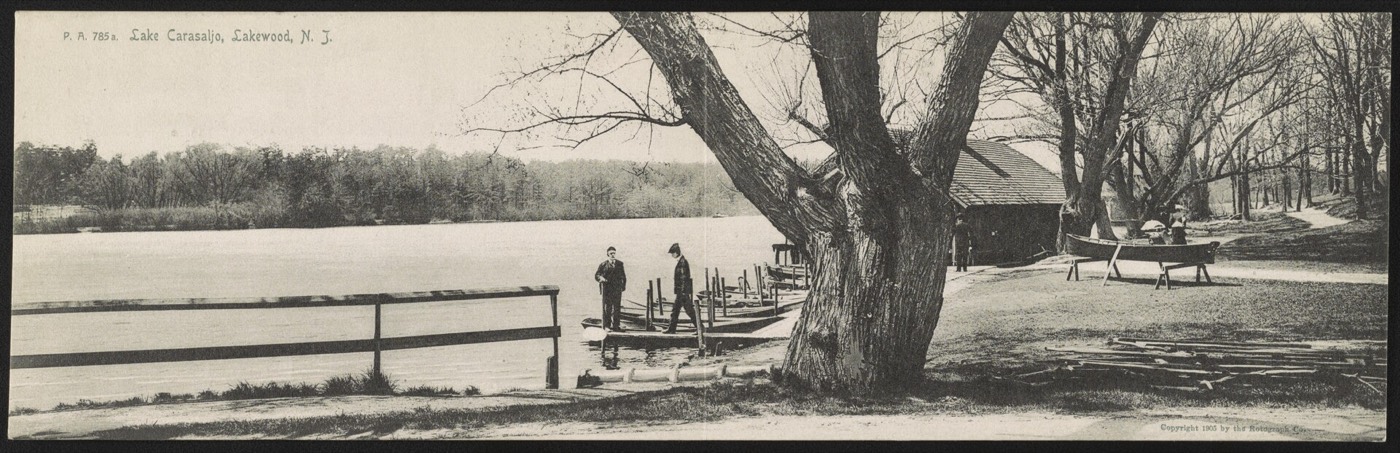
Lake Carasaljo, central Lakewood. The man-made lake traces back to the mid-1700s, when a dam was built to power a sawmill on the South Branch of the Metedeconk River. It was named for the three daughters, Carrie, Sally and Josephine, of the man who created it. A 4.5-mile trail rings the water, and on Sunday afternoons it fills with families walking the shore.
Georgian Court University, 900 Lakewood Avenue. The campus was once George Jay Gould’s Gilded Age estate, bought by the Sisters of Mercy in 1924. A National Historic Landmark with formal gardens and the Sister Mary Grace Burns Arboretum, it is a green reminder of the resort town that stood here before the yeshiva arrived.
Gourmet Glatt, 1700 Madison Avenue. A flagship kosher supermarket whose aisles, packed before every Sabbath, are a fair measure of the community’s scale. Where Lakewood’s Jewish food world once amounted to a few shops on Clifton Avenue, it now supports full-size kosher supermarkets that rival any conventional chain.
Shloimy’s Kosher World, 1750 Clifton Avenue. Clifton Avenue was the original spine of Jewish Lakewood, and this large kosher market keeps the street at the centre of daily shopping. The contrast with the modest storefronts of the early decades is a quiet record of how far the community has come.
Pizano Restaurant, 1715 Clifton Avenue. A kosher dairy restaurant on the historic avenue, part of a dining scene that now runs from pizza counters to fine-dining tables. Eating out kosher in Lakewood is no longer a compromise but an industry, advertised across the hundreds of pages of the weekly Lakewood Shopper.
The Strand Theater, 400 Clifton Avenue. Designed by the celebrated theatre architect Thomas Lamb and opened in 1922, the 1,066-seat Strand survives from the resort era and is listed on the state and national registers of historic places. It anchors the older civic downtown that predates the township’s transformation.
Where They Came From
The founding generation came, by way of Kotler, from the great Lithuanian yeshiva world: Slabodka, Slutsk, Kletsk, names from a Jewish Eastern Europe that the Holocaust erased. The men who rebuilt that world in Lakewood carried its rigorous, intellectually intense style of Talmud study with them.
The later waves had a more local origin. As Lakewood became known and as it kept building, it drew Orthodox families from the crowded, expensive enclaves of New York City, above all from Brooklyn neighbourhoods like Borough Park and Flatbush. They came south for room to raise large families at a lower cost without leaving an Orthodox world behind.
That pattern of overflow from New York’s Orthodox districts links Lakewood to a wider map of communities. The same forces shaped enclaves such as the Jews in Riverdale, New York and the Jews in Hewlett, New York, and the Five Towns community of the Jews in Lawrence, New York, each a place where families seeking space and affordability built dense religious life outside the city core.
Lakewood Today
Lakewood today is a town under constant construction. Planning boards approve new synagogues, schools and housing developments year after year, and the skyline of half-finished townhouse roofs is as characteristic as the study halls. Projections that the population could pass 200,000 by 2030 may or may not hold, but the trajectory is unmistakable.
It is also a town of real tensions. The cost of busing tens of thousands of private-school children, the strain on the public schools that serve a poorer, largely non-Jewish minority, and the friction as Orthodox families move into neighbouring townships have all made Lakewood a frequent subject of New Jersey news and court cases. None of this is hidden, and locals on every side discuss it openly.
And yet, for the families who live here, Lakewood is simply home, and an unusual kind of home at that: a place where a child can walk to one of dozens of schools, where the supermarket stocks for the Sabbath as a matter of course, and where the institution that defines the town is not a stadium or a corporation but a study hall founded by a man who arrived with nothing in 1941. The grand hotels never came back. Something else grew in their place. The transformation echoes the way immigrant communities have remade towns across the country, from the Jews in University Heights, Ohio to the Sikhs in Carteret, New Jersey and the Irish in Rockaway, New Jersey.
Frequently Asked Questions
Why is Lakewood, New Jersey so Jewish?
The Jews in Lakewood, New Jersey trace their community to 1943, when Rabbi Aharon Kotler founded the Beth Medrash Govoha yeshiva there with fourteen students. The yeshiva grew into one of the largest in the world, and the Orthodox families it drew, reinforced by overflow from New York and very high birth rates, eventually became the majority of the township.
What is Beth Medrash Govoha?
Beth Medrash Govoha, often shortened to BMG or simply Lakewood, is the yeshiva that anchors the town. Founded in 1943 by Rabbi Aharon Kotler, it had enrolled close to 9,700 students across its divisions by 2024, making it the second largest yeshiva in the world after the Mir Yeshiva in Jerusalem.
How fast is Lakewood growing?
Lakewood grew 45.6 per cent between 2010 and 2020, reaching 135,158 residents, the fastest growth rate of any municipality in New Jersey. The town records more than 5,000 births a year and has a median age of around 18, reflecting the large families of the Orthodox community.
Where did Lakewood’s Jewish families come from?
The founding scholars came from the Lithuanian yeshiva world of Slabodka, Slutsk and Kletsk by way of Rabbi Kotler. Later waves came largely from Orthodox neighbourhoods of New York City, especially Brooklyn districts like Borough Park and Flatbush, seeking lower housing costs and more space.
What landmarks should I know in Lakewood?
Beyond Beth Medrash Govoha, Lakewood has Lake Carasaljo with its 4.5-mile loop trail, Georgian Court University on the former Gould estate, the historic 1922 Strand Theater, and a dense commercial strip of kosher supermarkets and restaurants centred on Clifton and Madison Avenues.
Was Lakewood always an Orthodox town?
No. Lakewood began as a Gilded Age winter resort in the 1890s, hosting figures like Grover Cleveland, George Jay Gould and John D. Rockefeller. The Orthodox transformation started in 1943 with the yeshiva and accelerated sharply after 2000 as families moved in from New York.
If your family’s story passed through Lakewood, or any of the places Jews have made home in America, Atlas of Home can trace that journey. From the lost yeshiva towns of Lithuania to the study halls and kosher streets of Ocean County, to wherever you are now.