
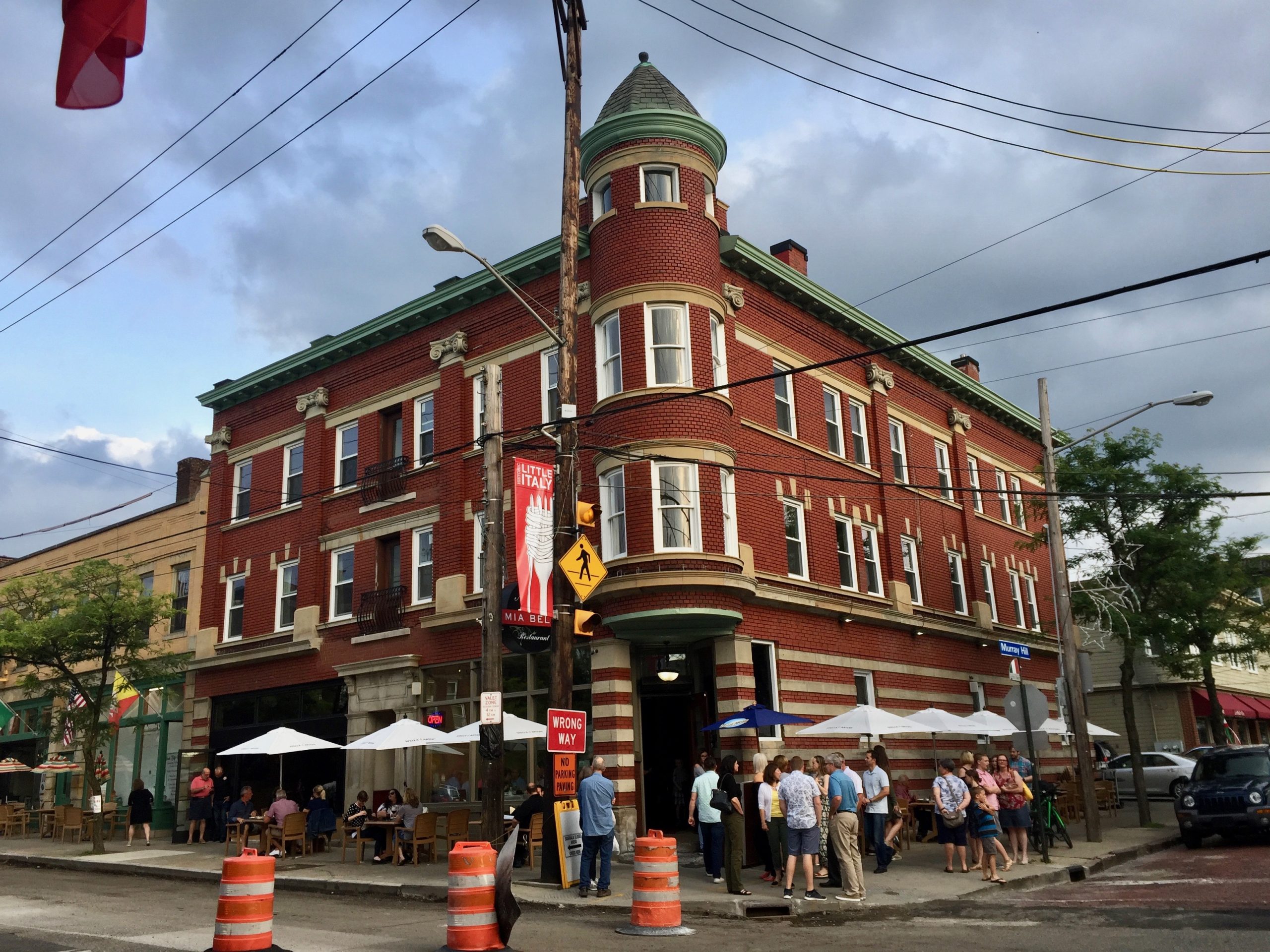
They called it the Hill, and you climbed it on foot. Up from University Circle, past the iron gates of Lake View Cemetery, the road tilted and the city changed. By the time you reached Mayfield and Murray Hill, the air smelled of yeast and sugar from the bakeries, the language on the sidewalk wasn’t English, and someone was shouting from a third-floor window in a dialect that hadn’t crossed the ocean for fifty years. From the 1890s on, this corner of Cleveland was Italy.
Every August, it still is. The Feast of the Assumption pours out of Holy Rosary Church and down Mayfield Road, a statue of the Virgin carried on the shoulders of men who learned the route from their fathers, who learned it from theirs. Around the procession: sausage smoke, zeppole frying in oil, a hundred thousand people pressed shoulder to shoulder for four days in the middle of summer. The neighbourhood is small. The feast is the largest Italian street festival in Ohio.
The Place
Cleveland’s Little Italy sits on a steep slope on the city’s east side, wedged between Lake View Cemetery to the north and the University Circle cultural district to the south. The whole neighbourhood runs only a few blocks. Mayfield Road climbs east up the hill from Euclid Avenue, and Murray Hill Road cuts south off it like a ladder rung. The Cleveland State Line of the RTA Red Line stops at Little Italy-University Circle, a short walk away.
The housing is dense and old: narrow frame and brick homes built up against each other on tight lots, a few wider Victorians on the side streets, and storefronts running the length of Mayfield. It is one of the most intact historic ethnic neighbourhoods left in the American Midwest. You can walk it in twenty minutes and still feel like you have been somewhere.
How It Became Italian
The Stonecutters at Lake View
The story begins next door, in the cemetery. Lake View was laid out in 1869 as Cleveland’s grand garden cemetery, and the city’s industrial wealth wanted the headstones of Europe: marble, granite, carved cherubs, classical columns. To get them, the cemetery and the monument firms went looking for Italian stonecutters.
One who came was Joseph Carabelli, a sculptor from Porto Ceresio in Como province in northern Italy. He landed in New York in 1870, worked there a decade, then arrived in Cleveland and set up the Lake View Granite and Monumental Works near the cemetery gates. He hired countrymen. They hired theirs. Within a few years, a small colony of Italian stonemasons had settled at the foot of the cemetery, on Mayfield Road.
The work was steady. When the 180-foot James A. Garfield Memorial was completed in 1890 for the assassinated president, Italian hands had carved much of its stone. So had they on the mansions of Millionaires Row along Euclid Avenue. Cleveland’s marble Cleveland was being made by men who lived three blocks away.
The Villages Empty Out
What turned a colony into a neighbourhood was chain migration from a small cluster of villages in southern Italy. Researchers studying the parish records have found that about half of the Italians who came to Cleveland traced back to just ten villages, and a striking share of Little Italy’s families came from three of them: Ripamolisano, Matrice, and San Giovanni in Galdo, all in the Molise region near Campobasso. Other families came from Sicily, from Campania near Naples, and from Abruzzo.
The pattern was the one repeated across the diaspora. A cousin wrote home that there was work. A brother sent the boat fare. A young man arrived with a paper address pinned inside his coat, found the relative on Mayfield Road, and was sleeping on a kitchen floor by nightfall. By 1900 the neighbourhood had its own butchers, its own grocers, its own funeral home, its own dialects layered street by street.
Holy Rosary, 1892
A community of Catholics needs a parish. In August 1892, with the colony already several hundred strong, the cornerstone was laid for Holy Rosary Catholic Church on Mayfield Road. It was Cleveland’s first Italian national parish and only the second in the diocese to be founded specifically for Italians. The first building went up in three months. It was modest, wood-framed, plain.
The Italians of Little Italy outgrew it almost immediately. By 1901 the parish was building a far larger church on the same block, at the corner of Mayfield and Coltman, with a baroque facade, statues along the roofline, and a copper-domed cupola visible from the cemetery gates. It was dedicated on 9 November 1909. It is still the spiritual centre of the neighbourhood.
The First Feast
The Feast of the Assumption began in 1898, six years after the parish was founded. Italian Catholic feasts traditionally include a procession with a statue of the Virgin carried through the streets, and Holy Rosary’s parishioners brought the tradition with them. The first feast was small. A few candles, a hand-carried statue, neighbours leaning out of windows.
It has run every year since, with breaks only during the two world wars and the 2020 pandemic. The crowd is now estimated at around a hundred thousand over four days. The procession still leaves from Holy Rosary on August 15, the Solemnity of the Assumption, and the route still runs down Mayfield Road.
Alta House
The other anchor came from an unlikely benefactor. In 1895 a small day nursery opened on Mayfield Road for the children of Italian mothers who worked. Joseph Carabelli, the stonecutter, approached John D. Rockefeller, who was a Cleveland resident at the time. Rockefeller funded a proper settlement house and put up a new building.
It opened on 20 February 1900 and was named Alta House, after Rockefeller’s daughter Alta. The address is 12510 Mayfield Road. By 1913 it had grown to include a library, a gymnasium, and one of the first public swimming pools in Cleveland. For decades it was where the children of immigrants learned to read English, to swim, to box, to belong to a city that had not quite let them in yet.
The Landmarks
Holy Rosary Church, 12021 Mayfield Road. Founded 1892, present church dedicated 1909. The parish is still active, still Italian, still the centre of the August feast. Listed on the National Register of Historic Places in 1976. Most Little Italy weddings, baptisms, and funerals still pass through these doors.
Alta House, 12510 Mayfield Road. Open since 1900. Rockefeller’s gift to the neighbourhood, named for his daughter. It functioned as a settlement house for most of the twentieth century and remains a community centre and Italian-American cultural site today. The bocce courts at the back are not decoration. People play.
Presti’s Bakery, 12101 Mayfield Road. Open since 1903 and the oldest bakery still operating in Cleveland. Started by Rose and Charles Presti with Sicilian family recipes that have not changed much. The cassata, the cannoli, the seeded Italian bread, the line out the door on a Saturday morning, the cafe in the back where two generations of regulars argue about the Indians and the Browns. If Little Italy has a kitchen, this is it.
Corbo’s Bakery, 12200 Mayfield Road. Founded by the Corbo family in 1958 and on Mayfield since the early 1960s. Famous for its cassata cake: sponge, custard, whipped cream, fresh strawberries. It is the cake that shows up at every Cleveland Italian wedding, christening, and graduation. Four generations of Corbos have made it.
Mama Santa’s, 12305 Mayfield Road. Opened on 25 July 1961 by Guido and Nancy Scaffidi, who had emigrated from Gioiosa Marea in Sicily after Guido came home from the war. Named for Nancy’s mother Santa, who cooked in the kitchen. The pizza is Sicilian thin-crust, the pasta is hand-cut, and the dining room has not been remodelled in any way that matters.
Lake View Cemetery, gates at 12316 Euclid Avenue. Where the story started. The grounds hold the Garfield Memorial, the Wade Memorial Chapel, and thousands of headstones carved by the Italians of Little Italy. Many of those same masons are buried inside. Carabelli, the founding stonecutter, is here. So is John D. Rockefeller.
The Feast of the Assumption, every August 15. Four days, four nights, a procession from Holy Rosary down Mayfield Road, food booths on every corner, a Mass under string lights. The largest Italian street festival in Ohio and one of the longest continuously running in the United States. It has happened in this neighbourhood since 1898.
Where They Came From
The Italians of Cleveland’s Little Italy came overwhelmingly from southern and central Italy, the Mezzogiorno, in the great wave of emigration between 1880 and 1924. The largest single cluster was from the province of Campobasso in Molise: the villages of Ripamolisano, Matrice, and San Giovanni in Galdo emptied out in chain after chain across forty years. Sicilian families came from Patti, Palermo, and Gioiosa Marea. Campanian families came from villages around Benevento, south of Naples. A smaller but significant group came from Abruzzo and Calabria.
What they had in common was poverty, and what they brought was skill. The men were stonemasons, carpenters, marble carvers, plasterers, tile setters. The work that built Cleveland’s grand era, from the cemetery to the steel mills to the downtown towers, was done in part by hands trained in mountain villages that had been carving stone for a thousand years.
Little Italy Today
The neighbourhood is still here, more intact than almost any comparable Little Italy in the United States. The bakeries are still open, the church is still full on Sunday, the feast still happens in August. You can walk Mayfield Road on a weekday afternoon and hear Italian spoken, mostly by older residents but not only.
The descendants have largely moved out, the way descendants do. Mayfield Heights, Lyndhurst, Highland Heights, the eastern suburbs along Interstate 271, that’s where most Cleveland Italian families live now. They come back for the feast, for a baptism at Holy Rosary, for a Sunday lunch at Mama Santa’s. Little Italy is a place they belong to more than a place they live in.
The pressure from University Circle is real. Case Western Reserve University, the Cleveland Clinic, and the Cleveland Museum of Art are all a short walk south, and student and professional housing has pushed into some of the neighbourhood’s edges. Rents on Mayfield have climbed. A few of the old shops have closed. But the core blocks are protected by a tight historic-district fabric and by a community that has not been willing to let the place become something else.
If you stand on the corner of Mayfield and Murray Hill in mid-August, with the procession passing and the smell of sausage in the air, you can hear two centuries of Italian Cleveland at once. The masons who carved the cemetery. The grandmothers who fed the settlement house. The Scaffidis arriving from Sicily after the war. The grandchildren coming back for the feast. It is a small neighbourhood. It is still going.
Frequently Asked Questions
Why did Italians settle in Little Italy, Cleveland?
Italian stonecutters were recruited in the 1870s and 1880s to carve monuments at the new Lake View Cemetery, including the James A. Garfield Memorial. They settled at the foot of the cemetery along Mayfield Road, and chain migration from a handful of villages in Molise, Sicily, and Campania built the colony into a full neighbourhood by 1900.
Is Little Italy in Cleveland still Italian today?
Yes, more than most. The bakeries, restaurants, and Holy Rosary parish are still Italian-run, and the Feast of the Assumption still draws around a hundred thousand people every August. Most descendants now live in the eastern suburbs like Mayfield Heights and Lyndhurst, but they return constantly, and the neighbourhood retains a strong Italian-American identity.
What are the most famous Italian landmarks in Little Italy, Cleveland?
Holy Rosary Catholic Church at 12021 Mayfield Road, Alta House at 12510 Mayfield Road, Presti’s Bakery at 12101 Mayfield Road, Corbo’s Bakery at 12200 Mayfield Road, Mama Santa’s at 12305 Mayfield Road, and Lake View Cemetery just to the north. The Feast of the Assumption, held every August 15, is the neighbourhood’s defining annual event.
Where in Italy did the Cleveland Little Italy community come from?
The largest cluster came from three villages in the province of Campobasso in Molise: Ripamolisano, Matrice, and San Giovanni in Galdo. Sicilian families came from Patti, Palermo, and Gioiosa Marea. Other significant origins include the Benevento area in Campania, plus Abruzzo and Calabria. About half of all Italians who came to Cleveland traced back to roughly ten southern Italian villages.
When did Italians first arrive in Cleveland’s Little Italy?
The first Italian stonecutters arrived in the early 1870s to work at Lake View Cemetery, which had been laid out in 1869. The colony grew through the 1880s, was substantial enough to found Holy Rosary parish in 1892, and reached its peak in the first two decades of the twentieth century.
When is the Feast of the Assumption in Cleveland’s Little Italy?
The feast is centred on August 15, the Solemnity of the Assumption, and now runs as a four-day street festival around that date. It has been celebrated in Little Italy every year since 1898, with breaks only during the two world wars and 2020. It is the largest Italian street festival in Ohio.
Trace Your Story
If your family’s story passed through Cleveland’s Little Italy, or any of the villages of Molise, Sicily, Campania, or Calabria that sent their sons up Mayfield Hill, Atlas of Home can trace that journey. From the mountain town to the masonry yard to the bakery on Mayfield Road, to wherever you are now.