
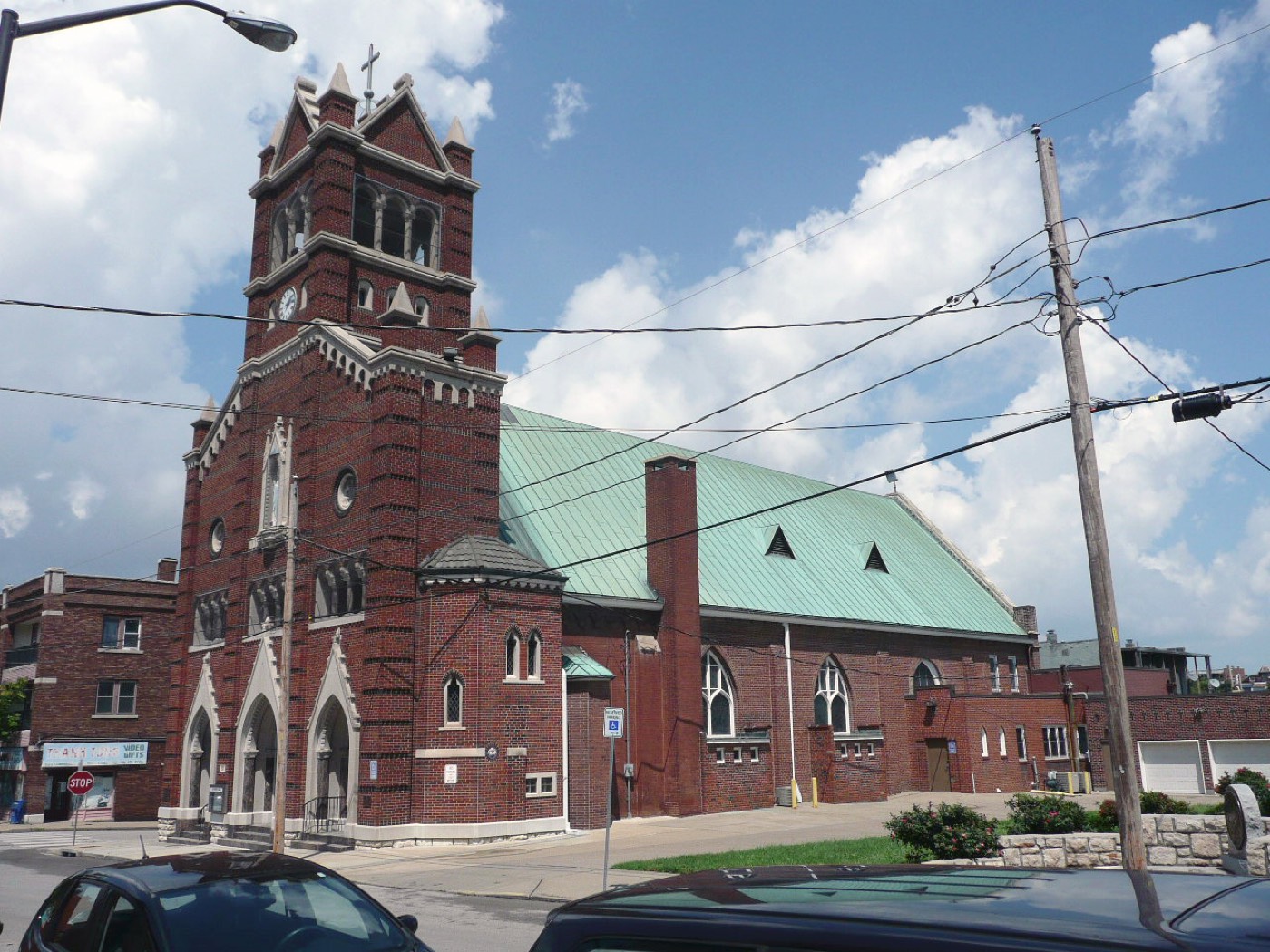
Stand outside Holy Rosary on East Missouri Avenue on a March weekend, and the air carries the smell of fried dough and anise. Inside, a long table groans under hundreds of Italian cookies, sold by the boxful. This is Columbus Park, the small wedge of bottomland north of downtown that the Italians in Kansas City built into a Little Italy, and the church at its centre has anchored Sicilian Kansas City for more than a hundred and thirty years.
The Place
Columbus Park sits in the North End of Kansas City, Missouri, a low pocket of ground tucked between the bluffs of downtown and the Missouri River. The historic Italian district stretched, at its peak, from roughly 8th Street north to the river and from Main Street east to Woodland Avenue.
It is a small place now, hemmed in on every side. Bridges, trafficways and interstate ramps wall it off from the neighbourhoods around it, so that what was once a sprawling immigrant quarter feels today like an island a few blocks across.
At its heart stands Holy Rosary Catholic Church, a Gothic Revival landmark whose arcaded bell and clock tower still rises over the old streets. Around it cluster the bakeries, delis and red-sauce restaurants that carry the neighbourhood’s Sicilian memory.
How It Became Italian
The first arrivals
The earliest records of Italians in Kansas City reach back to around 1859 and 1860, when only a handful of families lived in the river town. Real immigration began in the 1880s, and it gathered speed in the 1890s as Sicilians started arriving in numbers.
They came for work. The railroads that fanned out from Kansas City needed labour, and the packing houses and produce markets along the river needed hands. The North End, cheap and close to the freight yards and the City Market, was where the newcomers landed.
By the early twentieth century the pattern was set. About 80 to 85 per cent of Kansas City’s Italians traced their roots to Sicily, a share that held as the community grew.
A church of their own
In 1890 the Scalabrini Fathers, an order founded in Italy to minister to emigrants scattered across the Americas, sent Father Ferdinando Santipolo to Kansas City. His charge was to build a parish for the city’s Italians.
The parish of Holy Rosary was founded in 1891. Its first congregants worshipped in a storeroom at 5th and Forest Streets, and a small wood-frame church soon followed.
Fire took that first building in the early hours of Easter Sunday, 12 April 1903. The altar dedicated to St Anthony of Padua survived the flames, and the present brick church rose on the same ground, dedicated on 20 December 1903. It has been served by the Scalabrinian missionaries ever since, an unbroken Italian thread now well past its hundred and thirtieth year.
The North End at its height
By the time of the First World War, close to 3,000 Italians had settled in Kansas City, and they were the city’s largest single ethnic group. The North End had become an Italian world unto itself.
The community did not stay poor for long. Italians invested in the neighbourhood they had made, building apartments and houses and opening businesses of every kind. Among them were shopkeepers and grocers, but also real estate men, bankers, lawyers and doctors, the makings of a self-sufficient quarter.
In 1926 the city renamed Washington Square Park, a short walk west of Holy Rosary’s doors, as Columbus Square Park, an early public nod to the Italians who lived around it. Decades later that name would give the whole neighbourhood its modern identity.
This was the Kansas City of the same great Italian migration that filled the foundries of the Italians in Waterbury, Connecticut and the garment shops of the Italians in Rochester, New York. The same Sicilian and southern villages emptied toward American cities, and Kansas City’s share gathered in the bottomland by the river.
The roads come through
What the immigrants built, the mid-century city largely unbuilt. Beginning in the 1950s and reaching a peak in the 1960s, a wave of highway and bridge construction tore through the old North End.
The ASB and Paseo bridges, the 6th Street Trafficway, and the interstate ramps of I-29 and I-35 all took their toll, along with the public housing of Guinotte Manor. A 1967 article in the Kansas City Star reckoned that roughly a third of the Holy Rosary neighbourhood’s residents had been displaced by highway work.
The roads did more than remove houses. They isolated what remained, cutting the neighbourhood off from the districts around it and shrinking the old Little Italy to a small island of streets.
From North End to Columbus Park
In April 1967 residents voted to rename the North End. They chose Columbus Park, after the square that had carried Columbus’s name since 1926.
The renaming coincided with a slow outward drift. As Italian-American families educated their children and sent them off to universities, the young moved away from the old streets, many settling in the Northeast or across the river in North Kansas City.
The neighbourhood never emptied of Italians entirely, but it stopped being only theirs. In the later twentieth century, Vietnamese Catholic families settled in Columbus Park, drawn in part to the faith that Holy Rosary still served, and the area became Italian and Vietnamese at once.
The Landmarks
Holy Rosary Catholic Church, 911 E. Missouri Ave. The heart of Italian Kansas City, dedicated in 1903 and served by the Scalabrinian missionaries since 1891. Its Gothic Revival front carries three pointed-arch entrances and an arcaded bell and clock tower. The surrounding Holy Rosary Historic District, roughly bounded by 5th, Campbell, Harrison and East Missouri Avenue, was added to the National Register of Historic Places on 7 February 2007.
Columbus Square Park. A short walk west of the church, this was Washington Square Park until 1926, when the city renamed it for Christopher Columbus in recognition of the Italian families around it. The park later lent its name to the whole neighbourhood when residents voted in 1967.
Garozzo’s, 526 Harrison St. Michael Garozzo opened his homey Italian tavern in the heart of Columbus Park in 1989, and it has anchored the block ever since. Its Chicken Spiedini, skewered and grilled in the Sicilian manner, was a Garozzo’s creation that became a Kansas City standard found on menus across the metro.
Cascone’s. A family restaurant whose tradition reaches back to 1930, Cascone’s has long been a fixture of Italian Kansas City, with a Columbus Park location near a streetcar stop on 5th Street serving breakfast and lunch.
Carollo’s Grocery & Deli, near the City Market. Tucked at the edge of the historic City Market, Carollo’s keeps the old grocer’s trade alive with house-made Italian sausage, olive salad, chicken spiedini, cannoli and overstuffed sub sandwiches. It is the kind of counter that has fed the North End for generations.
The St Joseph Table at Holy Rosary. In 1960, organisers say, Holy Rosary became the first parish in the area to move the St Joseph Table out of family homes and into the church. The Sicilian devotion to St Joseph has since grown into a weekend-long fundraiser, its tables heaped with Italian cookies sold by the box, and it is described as Kansas City’s oldest such tradition.
The Feast of Our Lady of the Audience. This devotion was carried to Kansas City by immigrants from Sambuca di Sicilia, in the Sicilian province of Agrigento, and it is still honoured here. It is a direct line from one Sicilian town to one Missouri parish, kept alive across more than a century.
Where They Came From
Kansas City’s Italians were overwhelmingly Sicilian, four out of five at least. They came not from Sicily in the abstract but from a cluster of specific towns, and they came in chains, each arrival drawing the next.
The home towns recur in the community’s own records: Campofelice di Fitalia, Camporeale, Corleone, Ragusa, Cefalu, Castelvetrano and Sambuca di Sicilia among them. Newcomers settled near friends and relatives from the same villages, who could find them work and lodging and a familiar dialect.
That is why a Sicilian saint’s feast travels intact from Sambuca di Sicilia to East Missouri Avenue. The migration moved village by village, and the devotions, recipes and surnames travelled with it. The same chain logic settled the Italians in Endicott, New York around a shoe factory and the Italians in Worcester, Massachusetts in its triple-deckers; in Kansas City it gathered the Sicilians in the bottomland by the rail yards.
Kansas City Today
Columbus Park is still recognisably Italian, and still recognisably Catholic, but it is no longer a single-village world. Holy Rosary holds the centre, its tower still visible over the streets, its feasts and fundraisers still drawing the descendants of the old families back across the metro.
Those descendants are now spread across the whole Kansas City area, on both the Missouri and Kansas sides of the line. The community that once packed a few blocks of the North End is dispersed, yet it stays connected through the church, through organisations like UNICO and the local Italian heritage groups, and through a calendar of events that keeps the Sicilian thread taut.
The food has outlasted the enclave. Garozzo’s spiedini, Cascone’s red sauce and Carollo’s cannoli reach far beyond Columbus Park, a Sicilian inheritance that Kansas City as a whole now claims. The Italians here, like the Jews in Creve Coeur and the Indians in Chesterfield across the state in suburban St Louis, are a Missouri community whose centre of gravity has moved outward while its institutions hold.
Walk the old streets today and the past is legible: the brick of Holy Rosary, the family names on the deli signs, the St Joseph cookies in March. Little Italy shrank, but it did not vanish. It simply spread.
Frequently Asked Questions
Where did the Italians in Kansas City settle?
The Italians in Kansas City settled in the North End, a low neighbourhood between downtown and the Missouri River. At its height the district ran from 8th Street to the river and from Main Street to Woodland Avenue. Today its surviving core is known as Columbus Park.
Why did Italians come to Kansas City?
They came for work. From the 1880s onward, the railroads, packing houses and produce markets along the Missouri River drew Italian labour, with Sicilians arriving in large numbers in the 1890s. The cheap North End, close to the freight yards and City Market, was where they first settled.
What is Holy Rosary Catholic Church?
Holy Rosary is the Italian parish at the centre of Columbus Park, founded in 1891 by the Scalabrini Fathers to serve immigrants. The present Gothic Revival church at 911 E. Missouri Ave was dedicated in 1903 after fire destroyed the first building, and it remains the heart of Italian Kansas City.
Where in Italy did Kansas City’s Italians come from?
About four in five were Sicilian, from towns such as Camporeale, Corleone, Ragusa, Cefalu, Castelvetrano and Sambuca di Sicilia. They migrated in chains, settling near relatives from the same villages, which is why Sicilian feasts and devotions survive in the neighbourhood today.
What happened to Kansas City’s Little Italy?
Highway and bridge construction in the 1950s and 1960s, including the interstate ramps, the 6th Street Trafficway and the ASB and Paseo bridges, displaced about a third of the Holy Rosary neighbourhood and isolated what remained. The North End was renamed Columbus Park in 1967, and many Italian families moved outward.
Is Columbus Park still Italian today?
Yes, in part. Columbus Park remains Kansas City’s historic Little Italy, anchored by Holy Rosary and its old delis and restaurants, though Vietnamese Catholic families have also settled there. The wider Italian community is now spread across the metro on both the Missouri and Kansas sides.
If your family’s story passed through Kansas City, or any of the places Italians have made home in America, Atlas of Home can trace that journey. From a Sicilian village like Sambuca di Sicilia to the bottomland of the North End, to wherever you are now.