
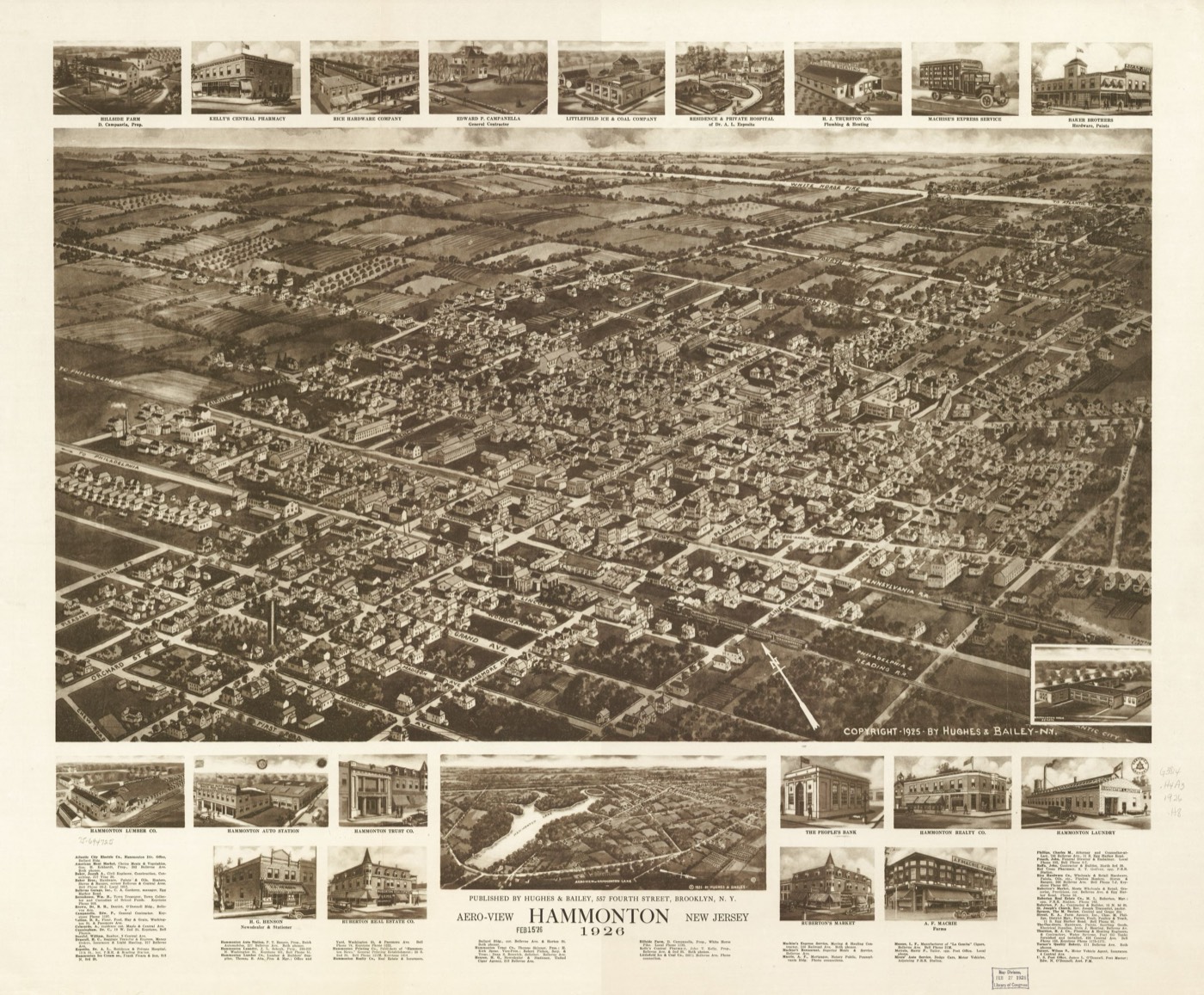
In the flat sandy reaches of the New Jersey Pinelands, a small town sells itself as the Blueberry Capital of the World. But spend an afternoon on Bellevue Avenue, read the surnames on the storefronts, and another story rises to the surface. The Italians in Hammonton did not just settle here. They became the place. By the start of this century nearly half the town claimed Italian ancestry, the highest share of any municipality in New Jersey, and one of the highest anywhere in America.
The Place
Hammonton sits in Atlantic County, roughly midway between Philadelphia and Atlantic City, where the Camden and Atlantic Railroad once cut a straight line through the pines. The town was first settled in 1812, when William Coffin built a home and a sawmill in the wilderness, and it took its name from his son, John Hammond Coffin. It incorporated as a town on 5 March 1866.
The soil here is sandy and acidic, poor for most crops but, as it turned out, perfect for blueberries and grapes. That accident of geology shaped everything that followed. Today Hammonton and the surrounding county grow more than 80 per cent of New Jersey’s blueberry crop, tens of millions of pounds a year, and the harvest still depends on hands that have worked these fields for four and five generations.
For a town of fewer than 15,000 people, Hammonton carries an outsized identity. Much of it was carried here from one small village in Sicily.
How It Became Italian
The story Hammonton tells about itself begins with a single farmer. The man most accounts credit is Salvatore Calabrese, an Italian immigrant and Union Navy veteran who reached Hammonton around 1863. (His name is rendered in some records as Calabrasce, a reminder of how immigrant names were caught and bent by American clerks.) He had married a local woman and made a life in the pines, and he began writing home.
The village that emptied
Home, for Calabrese, was Gesso, a tiny hill village above Messina in north-eastern Sicily. The same Gesso, as it happens, that generations later would claim Jill Biden among its descendants. Calabrese wrote to friends and countrymen there, urging them to come and farm land of their own. They came.
By 1866 a young man named Matteo Campanella, fleeing conscription, had hidden for months in Messina before escaping to America and making his way to Hammonton. Around 1870 he sent for his brother. The two prospered, bought more land, and then did what every chain migration does: they sent for relatives, who sent for others, who sent for others still.
From labourers to landowners
What made Hammonton different from the crowded Italian quarters of Newark or the Lower East Side was land. The men who arrived did not stay labourers for long. They picked berries and cleared brush, saved what they could, and bought their own acres of cheap Pineland soil. Ownership, not tenement wages, was the engine of the community.
That pattern accelerated through the late nineteenth century and into the twentieth. By 1920 Italian surnames accounted for well over 60 per cent of the population. Bellevue Avenue, the commercial spine that opened when the railway reached town in 1858, filled with Italian groceries, bakeries, shoemakers and tailors. It was a path that mirrored Italian communities taking root across the state at the same moment, from the Italians who settled Bloomfield to the Italian families of Clifton further north.
The fruit that made the fortune
The blueberry itself was a twentieth-century arrival. The cultivated highbush blueberry was developed in this corner of New Jersey in the early 1900s, and Hammonton’s Italian families were perfectly placed to grow it. The land was theirs, the labour was theirs, and the timing was theirs.
In 1935 five sons of Italian immigrants, Duke, Bill, Ernie, Al and Anthony Galletta, started the Atlantic Blueberry Company with five acres in the Pinelands. By 1979, after acquiring a neighbouring property, the farm reached 1,320 acres and was reckoned the largest highbush blueberry farm in the world. The Galletta family still runs it, into a fourth generation, on more than 750 acres.
Wine followed the same logic. The Tomasello family had vines in the ground by 1888, and when Prohibition ended in 1933 they opened Tomasello Winery to the public. It is now New Jersey’s oldest continuously family-owned winery, run by the third generation of Tomasellos on Route 30.
Faith carried in procession
If land was the foundation, faith was the binding. On 16 July 1875, a group of Italian immigrants gathered at the home of Antonio Capelli, at 232 Pine Road, to pray to Our Lady of Mount Carmel. They gave thanks for safe passage, for a good harvest, and for the years ahead. They carried an image of the Madonna in procession through the fields.
That gathering became a feast, and the feast never stopped. By 1886 it had moved to Hammonton Lake Park; in 1905 the Our Lady of Mount Carmel Society was chartered to run it. It is the longest-running Italian religious festival in the United States. In July 2025 the town marked its 150th year, still processing the Madonna through the streets, still frying zeppole, still drawing tens of thousands.
The Landmarks
St. Joseph (St. Mary of Mt. Carmel) Church, 226 French Street. The first Catholic church built in Hammonton, and the spiritual centre of the Italian community for a century and a half. It became the focal point of the Mount Carmel devotion, and the parish remains the keeper of the feast that defines the town.
Tomasello Winery, 225 North White Horse Pike. Vines were first planted on this ground in 1888, and the winery opened in 1933 as soon as Prohibition lifted. Run by the third generation of Tomasellos, it is the oldest continuously family-owned winery in the state, producing tens of thousands of cases a year from a town better known for berries.
Atlantic Blueberry Company. Founded in 1935 by the five Galletta brothers, sons of Italian immigrants, on a five-acre start. By 1979 it was the largest highbush blueberry farm on earth. More than any single business, it turned an immigrant agricultural community into an industry that feeds the country.
The Eagle Theatre, 208 Vine Street. A moving-picture house first opened on Vine Street in 1914, in the heart of an Italian downtown. After decades dark, it was revived in 2009 as a professional theatre, complete with a wine lounge, an unmistakably Hammonton touch.
Bagliani’s Market, 417 12th Street. An Italian specialty market and butcher that has served the town for roughly half a century. It is the kind of place where the meat case, the imported tins and the homemade sausage carry on the everyday Italy that the feast celebrates once a year.
Illiano’s. For more than thirty years a downtown go-to for classic Italian cooking, the chicken marsala and linguini with clams that locals order without looking at the menu. Alongside Bruni’s Pizzeria and Casciano Coffee Bar and Sweetery, it anchors the eating end of Bellevue Avenue.
Hammonton Lake Park. The green expanse where the Mount Carmel feast settled in 1886 and where the procession still gathers. For generations of Hammonton Italians, the park is where the private devotion of one immigrant’s parlour became the public heart of a town.
Where They Came From
Hammonton is, to an unusual degree, the child of one village. The dominant origin was Gesso, the hill hamlet above Messina in north-eastern Sicily, the home of Salvatore Calabrese and the Campanella brothers. Chain migration did the rest: as Calabrese and the Campanellas drew their kin across the ocean, more than half the population of Gesso eventually relocated, many of them to Hammonton itself.
Sicilians dominated, but they were not the whole story. The town’s wider Italian population drew from across the south and the centre of the peninsula, and in 2008 Hammonton formalised a sister-city bond with San Gregorio da Sassola, a comune in the hills east of Rome, honouring a second strand of its heritage. What united them all was a hunger for land they could call their own, and a faith they were determined to carry with them, the same impulse that drew Italians north to the suburbs of New Rochelle and Hawthorne in New York.
Hammonton Today
By the 2000 census, 45.9 per cent of Hammonton’s residents claimed Italian ancestry, the highest proportion of any New Jersey municipality and second in the nation only to Johnston, Rhode Island. That figure has eased only slightly since. For a town of around 14,700 people, it remains an extraordinary concentration of one heritage.
The town has changed in the ordinary ways American towns do. A growing Hispanic population now works many of the farms the Italians once worked themselves, and the downtown has gained an arts district, a theatre and a clutch of wineries that draw weekenders off the road to the shore. The Italian families have moved, by and large, from the fields to the front offices, from picking berries to owning the operations.
But the through-line holds. Every July the Madonna goes back into the streets, and the surnames on the floats are the same ones on the storefronts and the winery labels and the farm gates. In Hammonton, the Italian story is not a museum piece. It is who answers the phone.
Frequently Asked Questions
Why are there so many Italians in Hammonton, New Jersey?
The Italians in Hammonton trace back to a single Sicilian farmer, Salvatore Calabrese, who settled around 1863 and wrote home to his village of Gesso urging others to come. Chain migration did the rest: families sent for relatives, who sent for more, until much of Gesso had relocated and Italians made up the majority of the town.
What percentage of Hammonton is Italian American?
At the 2000 census, 45.9 per cent of Hammonton residents claimed Italian ancestry, the highest share of any municipality in New Jersey and second nationally only to Johnston, Rhode Island. The figure has remained close to half ever since, making the Italians in Hammonton an unusually dominant community.
What is the Our Lady of Mount Carmel feast in Hammonton?
It is the longest-running Italian religious festival in the United States, first held on 16 July 1875 at the home of immigrant Antonio Capelli. The town marked its 150th year in 2025. Each July the image of the Madonna is carried in procession, drawing tens of thousands of visitors.
Where in Italy did Hammonton’s Italians come from?
The overwhelming majority came from Gesso, a small village above Messina in north-eastern Sicily, the same village now known as Jill Biden’s ancestral home. The town also honours a second heritage through its sister-city bond with San Gregorio da Sassola, near Rome, formalised in 2008.
Why is Hammonton called the Blueberry Capital of the World?
The sandy, acidic Pineland soil is ideal for highbush blueberries, and Hammonton’s Italian families, who owned the land, built the industry. The Galletta family’s Atlantic Blueberry Company, founded in 1935, became the largest highbush blueberry farm in the world by 1979, and the region still grows over 80 per cent of New Jersey’s crop.
What is there to see of Italian Hammonton today?
Visitors can attend the July Mount Carmel feast, taste at Tomasello Winery on Route 30, shop at Bagliani’s Market on 12th Street, dine at downtown spots like Illiano’s, and take in a show at the restored Eagle Theatre on Vine Street. St. Joseph Church on French Street remains the community’s spiritual centre.
If your family’s story passed through Hammonton, or any of the places Italians have made home in America, Atlas of Home can trace that journey. From a hill village above Messina to the blueberry fields of the Pinelands, to wherever you are now.