
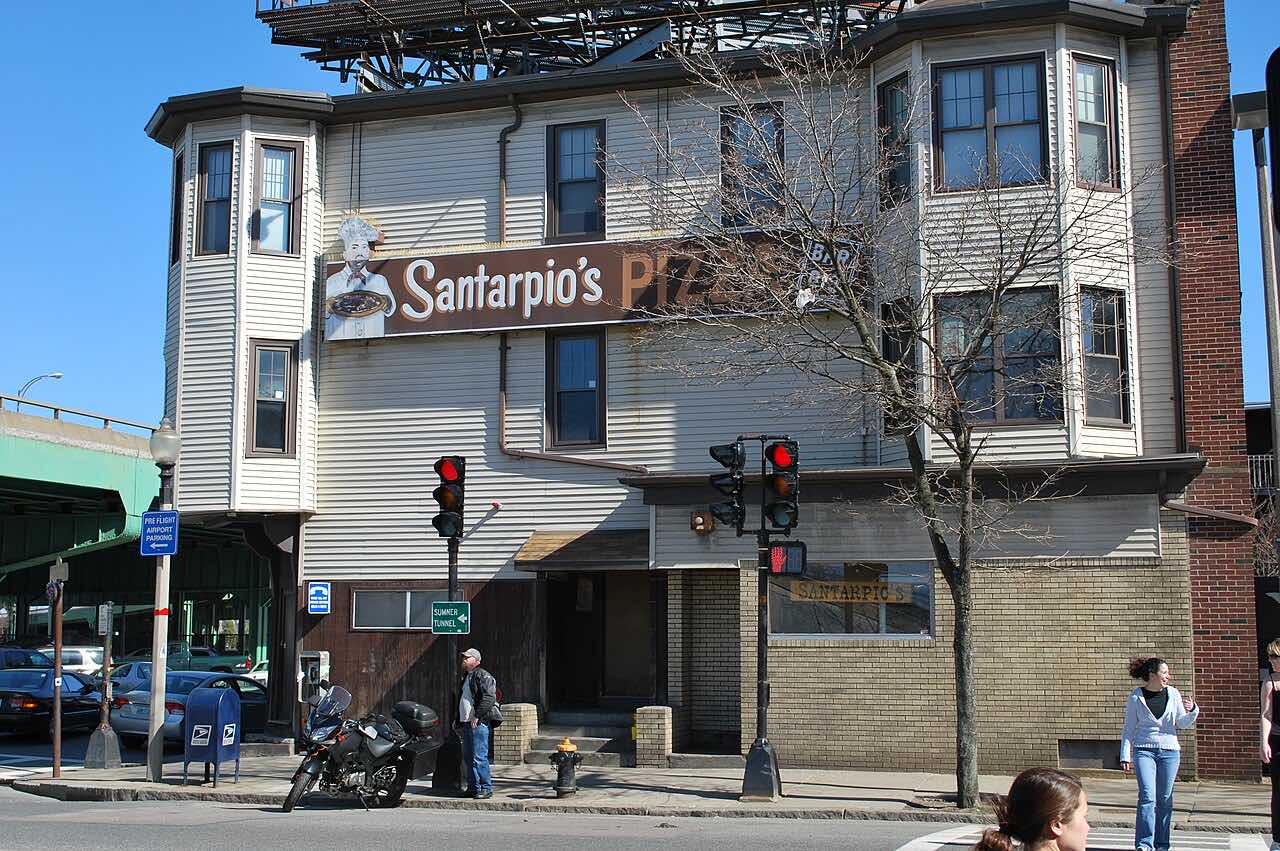
The line forms outside 111 Chelsea Street before the door is unlocked, the way it has for longer than anyone waiting can remember. Inside, a man feeds dough that another man’s grandfather might have eaten, and the charcoal grill throws off the smell of lamb on skewers, blackening at the edges, salty and sweet. This is Santarpio’s, and it is the closest thing East Boston has to a parish hall for the Italians who made this place their own. Across the harbor the downtown towers glitter. Up the hill, a bronze Madonna nearly four stories tall watches the jets climb out of Logan. Between the pizza and the shrine sits the story of how a former shipyard became one of the most Italian neighborhoods in America.
East Boston: The Place
East Boston, or “Eastie,” is a peninsula across the inner harbor from downtown, reachable by the Blue Line subway and two highway tunnels under the water. It was assembled in the nineteenth century by filling the channels between five harbor islands, Noddle’s, Hog’s, Governor’s, Bird, and Apple. The housing stock is dense and walkable: wood-frame triple-deckers and brick rows climbing from the waterfront at Maverick Square up to the heights at Orient Heights and Eagle Hill. Logan International Airport occupies the eastern flats, the runways built where the marsh once was.
How East Boston Became Italian
Before the Italians
Before the Italians, East Boston built ships. In 1845 Donald McKay, an immigrant from Nova Scotia, opened a shipyard on Border Street and over the next four decades launched some of the fastest sailing vessels ever made. His Flying Cloud raced from New York to San Francisco in eighty-nine days in 1851, and his Sovereign of the Seas logged twenty-two knots in 1854, a speed record under sail. The yards drew skilled labor from Canada’s Maritime Provinces, Scotland, and Scandinavia, and for a stretch of the 1800s East Boston held more Canadian-born residents than any other Boston neighborhood.
The Irish came first and came hardest, driven by the famine of the 1840s. By 1855 the census counted more than 3,500 Irish-born residents, men who drained the swamps, drove the wharf pilings, and worked the waterfront. They built the neighborhood’s Catholic life around St. Nicholas Church, founded in 1844 and later renamed Most Holy Redeemer, still the oldest Catholic parish in East Boston. After the Irish came Russian and Eastern European Jews, arriving from the 1890s; by the First World War they numbered around five thousand and formed one of New England’s larger Jewish communities. Each wave was a layer the Italians would build on top of.
The Italians Arrive
In 1875 East Boston held about a dozen Italians. Everything changed after 1895. Some came straight from southern Italy; many more crossed the harbor from the crowded North End, looking for room. The Italian-born population more than doubled in a single decade, from 4,565 in 1910 to 10,151 in 1920, by then more than a quarter of all the Italians in Boston. The growth was chain migration in its purest form: one man from a town wrote home, sent for a brother, who sent for a cousin, who boarded with the first family until he found his own rooms on the same street.
That clustering shaped the map. The largest settlement grew around Maverick Square and Jeffries Point, along Cottage, Summer, Havre, and Decatur Streets, where southern Italians packed into triple-deckers, often a dozen people to a household with boarders besides. A second, smaller, and more prosperous Italian colony took root up in Orient Heights, weighted toward northern Italians who tended to own shops and skilled trades. The newcomers were shoemakers and tailors, butchers and barbers, blacksmiths and storekeepers, and by 1900 a majority worked skilled manual jobs rather than raw day labor.
East Boston at Its Peak
By the 1920s the Italians were the dominant presence in a neighborhood that hit its all-time peak of roughly 64,000 people in 1925. Religious life multiplied to match. St. Lazarus had opened in Orient Heights in 1892 as the first Italian parish, run by the Scalabrinian fathers, who built a new church on Ashley Street in 1922. Our Lady of Mount Carmel opened on Gove Street in Jeffries Point in 1905 under Franciscan care, and older parishes like Most Holy Redeemer and Sacred Heart added Italian-language Masses.
Outside the churches, the community organized itself densely. The first Massachusetts lodge of the Order Sons of Italy formed in 1910. There were mutual-aid clubs, political discussion circles like the Mazzini Club, and, on the radical edge, an anarchist cell whose two most infamous members, Nicola Sacco and Bartolomeo Vanzetti, would be executed in 1927 after one of the century’s most contested murder trials. Daily life ran on the saint societies and the festivals they staged, processions that carried a hometown Madonna or patron through streets strung with lights, the old village calendar transplanted whole to a peninsula in Boston Harbor.
The Change
What broke the neighborhood open was not decline but the airport. Logan had been expanding for decades, but in the late 1960s the state moved to take Wood Island Park, a forty-acre green designed by Frederick Law Olmsted with ball fields, tennis courts, and bathhouses where generations had learned to swim. In 1967 the bulldozers came, and homes along tree-lined Neptune Road went with them. The neighborhood fought back. On September 28, 1968, a group of Italian and Irish mothers, led by Anna DeFronzo with organizers like Fran Riley, pushed their children’s strollers into the path of the dump trucks rumbling toward the runways and refused to move. The “baby carriage blockade” forced the trucks to a halt and won real concessions, though the park was already gone.
The Maverick Mothers turned a grievance into a tradition of resistance that outlived them, but the postwar tide ran the other way regardless. Italian families followed the American script to the suburbs, to Revere and Winthrop, Everett and Saugus, leaving the triple-deckers behind. By the 1980s the old colony was thinning, and a new migration was already filling the rooms.
The Landmarks of East Boston
Santarpio’s Pizza, 111 Chelsea Street. Frank Santarpio opened it as a bakery in 1903 and the family began selling pizza in 1933, after Prohibition ended and a bar went in alongside the ovens. Four generations later it still runs from the same address, and the charcoal-grilled lamb spiedini have become as much a draw as the thin-crust pies, an institution that resisted expansion for a century to keep the old-world feel intact.
The Madonna Queen of the Universe Shrine, 142 Orient Avenue. The Don Orione Fathers, an Italian order founded in 1893 by Saint Luigi Orione, came to Boston in 1949 to care for elderly Italians and in 1954 dedicated a thirty-five-foot bronze and copper Madonna above their Orient Heights home. The statue is a replica of one on Rome’s Monte Mario by the sculptor Arrigo Minerbi, an Italian Jew whom the same order had hidden from the Nazis. Archbishop Richard Cushing blessed it, and it still stands over the harbor with the Logan runways spread out below.
Most Holy Redeemer Church, Maverick Street. Founded in 1844 as St. Nicholas, it is the oldest Catholic church in East Boston and began as the spiritual home of the Irish before the Italians arrived to fill its pews and add their own Masses. Its survival across nearly two centuries makes it the connective tissue between every immigrant layer the neighborhood has held.
Our Lady of Mount Carmel, Gove Street. Opened in 1905 to serve the Italians of Jeffries Point, the Franciscan parish anchored the densest Italian streets for almost a century before it closed in 2004 and was eventually sold to a developer in 2016. It is a ghost landmark now, but for the people who were baptized and married there it remains the center of the map.
Maverick Square. The commercial heart of immigrant East Boston, the square sat atop the harbor tunnel and the Blue Line and funneled the daily traffic of a working neighborhood: the bakeries and salumerias, the social clubs, the saint-society banners strung overhead in feast season. It is the place the Italians stepped off the ferry or up from the subway and into a new life.
Suffolk Downs. Built on filled marshland in just sixty-two days and opened on May 29, 1935, the Art Deco racetrack became a fixture of Eastie life where Seabiscuit and Whirlaway once ran. Live racing ended in 2019, and its 161 acres are now becoming a vast residential and commercial district, the largest single piece of the neighborhood’s future being written on the site of its past.
Where the East Boston Italians Came From
The great majority came from southern Italy. World War I draft cards point most heavily to the provinces of Calabria and Sicily, the same regions of hard hills and harder economics that emptied so many towns into America between the 1890s and the 1920s. Smaller numbers arrived from the north, from Liguria and Abruzzi, and it was these northern Italians who concentrated up in Orient Heights, more often shopkeepers and skilled tradesmen than laborers.
What pulled them specifically to East Boston, rather than the better-known North End, was room and work. The peninsula had jobs on the waterfront and in the trades, it had the cheap triple-decker housing the North End lacked, and it already had a beachhead of paesani. Once that first cluster formed, the village networks did the rest, channeling whole hometowns into the same few streets.
East Boston Today
East Boston is no longer an Italian neighborhood, and it does not pretend to be. Since the 1990s a new generation of immigrants, Salvadorans and Colombians and Brazilians, has reshaped the streets, and by the 2020 census Latino residents made up just over half of the peninsula’s 43,000 people. The bakeries that sold cannoli now sit beside pupuserias and Brazilian markets, and the same triple-deckers that once held a dozen Calabresi hold a new set of families chasing the same thing.
The Italian presence persists, though, in the things that refuse to leave. The line still forms outside Santarpio’s. The Madonna still looks out over the harbor from Orient Heights. Every summer the Italia Unita festival, running in Central Square since 1995, fills the air with the music and food of the old country for a weekend. These are not relics so much as anchors, held by descendants who long ago moved to the suburbs but come back for the feast.
The newest pressure is money. Luxury condominium towers are rising along the same waterfront where clippers once launched and immigrants once landed, driving rents up and working families out, the way the airport once did with bulldozers. East Boston has always been a place people arrive, build a life, and eventually hand to whoever comes next. The Italians built their chapter on top of the Irish and the Jews, and they would recognize, in the Salvadoran and Brazilian families filling the triple-deckers now, the exact shape of their own beginning.
Frequently Asked Questions
Why did Italians settle in East Boston?
Italians settled in East Boston after 1895 because the peninsula offered jobs on the waterfront and in the trades, cheap triple-decker housing the crowded North End could not provide, and an early cluster of fellow townspeople to join. Once that beachhead formed, chain migration drew whole hometowns from Calabria and Sicily into the same few streets around Maverick Square. The Italians in East Boston quickly grew from a handful to the dominant group.
Is East Boston still an Italian neighborhood today?
No. East Boston is now majority Latino, with Salvadoran, Colombian, and Brazilian residents making up just over half the population as of the 2020 census. The Italian legacy survives in landmarks like Santarpio’s Pizza and the Madonna Queen Shrine and in the annual Italia Unita festival, but the working-class Italian families largely moved to the suburbs decades ago.
What are the most famous Italian landmarks in East Boston?
The best-known are Santarpio’s Pizza at 111 Chelsea Street, open since 1903 and famous for its charcoal lamb skewers, and the Madonna Queen of the Universe Shrine in Orient Heights, a thirty-five-foot bronze statue dedicated in 1954. Most Holy Redeemer, founded in 1844, is the oldest Catholic church in East Boston, and the former Our Lady of Mount Carmel on Gove Street anchored the Italian streets of Jeffries Point until 2004.
Where did the East Boston Italians come from?
The great majority of Italians in East Boston came from southern Italy, especially the provinces of Calabria and Sicily, with smaller numbers from the northern regions of Liguria and Abruzzi. The northern Italians tended to settle in the more prosperous Orient Heights section, while southern Italians packed the streets around Maverick Square and Jeffries Point.
When did Italians first arrive in East Boston?
A dozen or so Italians lived in East Boston in 1875, but large-scale arrival began after 1895. The Italian-born population grew from 4,565 in 1910 to 10,151 in 1920 and peaked in the 1920s, when Italians became the dominant ethnic group in a neighborhood that reached its all-time high of about 64,000 people in 1925.
If your family’s story passed through the triple-deckers of Maverick Square, the pews of Mount Carmel, or the harbor crossing that brought a brother over to join a brother already here, that history is worth holding onto. The same chain migration shaped the Italians of Boston’s North End just across the water, the Italians of South Philadelphia, and ran alongside the Irish of Dorchester who arrived a generation earlier.