
On a wet morning in mid March, the whole of Rockland County seems to funnel down Central Avenue. Close to 100,000 people line a few short blocks of a hamlet that holds barely 16,000 of them. They have come for the parade, but they have really come for something older. The Irish in Pearl River are not a curiosity here. They are the town.
Census after census tells the same story. More than half of Pearl River’s residents claim Irish ancestry, the highest share of any community in New York State. That figure is not a rounding error or a marketing slogan. It is the reason a child here can grow up speaking the grammar of Gaelic football, Irish step and a parish calendar without ever once thinking it strange.
The Place
Pearl River sits in the town of Orangetown, in southern Rockland County, a little over twenty miles north of Manhattan and a stone’s throw from the New Jersey line. It is a hamlet, not an incorporated village, which means it has no mayor of its own, only a name, a school district and a fierce sense of itself.
Curiously, there is no pearl and no river. The most significant watercourse is a stream called Muddy Brook, and the original settlers knew the area as Muddy Creek. The grander name arrived in the 1870s, attached to a railroad timetable and a businessman’s ambitions.
What gives the place its shape is the grid downtown, centred on a wide thoroughfare called Central Avenue that meets Main Street at the heart of things. Around it sit the pubs, the bakeries, the parish and the train station, all within an easy walk. It is, by design, a town built to be walked through and gathered in.
How It Became Irish
A German’s grid, an Irish future
The town that the Irish would inherit was laid out by a German. In 1870 a German immigrant industrialist named Julius E. Braunsdorf bought the land at Muddy Creek and donated a parcel to the New Jersey and New York Railroad, ensuring the trains would stop here.
Braunsdorf was a restless inventor. In 1872 he founded the Aetna Sewing Machine Company and became the hamlet’s first postmaster. The following year he built two brick train stations, passenger and freight, which still stand. He also designed the street layout, naming the avenues after Benjamin Franklin and Franklin’s sons.
For decades Pearl River was a factory town. The Dexter Folder Company arrived in 1894, and in 1907 Ernst J. Lederle established the antitoxin laboratories that would become Lederle Laboratories, for generations the area’s largest employer. This was a place of steady industrial wages, a railhead, and Catholic churches. For Irish families looking to leave the city, it was almost purpose built.
Out of the city, up the river
The decisive shift came after the Second World War. Rockland County stayed semi rural until the 1950s, when new bridges and parkways stitched it to New York City. The Tappan Zee Bridge and the highways that fed it turned a day’s journey into a commute.
What followed was one of the great suburban migrations of the postwar era. Rockland’s population leapt from 89,276 in 1950 to well over 300,000 by 2020, and a great share of those new arrivals came up from the five boroughs, the Bronx in particular. Among them were Irish American families who had grown up in places like Inwood in upper Manhattan, the Irish enclave of Woodlawn in the Bronx and Irish Yonkers, neighbourhoods we have written about in their own right, and who now wanted lawns and parish schools.
They did not scatter. They clustered, the way the Irish had always clustered in places like Pennsport in Philadelphia or the Irish Channel in New Orleans, around a church, a pub and a sport. In Pearl River all three were available, and the families who arrived made sure their children inherited them whole.
The parade that put down roots
If one institution fixed Pearl River’s Irish identity in place, it was the parade. The Rockland County St Patrick’s Day Parade, organised by the local Ancient Order of Hibernians, began in March 1963. For nearly a decade it wandered, held in different parts of the county.
It came to Pearl River in 1972 and 1973, and in 1974 it settled here for good. Half a century on it draws crowds approaching 100,000, one of the largest such parades in New York State, an extraordinary number for a hamlet of its size. The day functions as a homecoming, a reunion and a statement of who lives here.
Raising the next generation Irish
What kept Pearl River Irish across the decades was not nostalgia but training. The town runs on Gaelic football. The Rockland GAA club, founded in 1972, held its first practice sessions on the old vacant school grounds off Lincoln Avenue in Pearl River. It has since grown into one of the largest Gaelic Athletic Association clubs anywhere outside Ireland, with hundreds of playing members, almost all of them American born.
Alongside the football came the dancing and the music. Pearl River supports schools of Irish dance, including a branch of the Inishfree School of Irish Dance, and the community fields hundreds of young musicians and over a thousand young dancers across the area. A child raised here is likely to know a reel, a hard shoe and a kickout before they reach high school.
Binding it all together is the parish of St Margaret of Antioch. The church was first built in 1900 and rebuilt in 1931 after a 1929 fire, and Saint Margaret School has educated the hamlet’s children since 1953. Church, club and school formed a single machine for passing identity down, and it has not stopped running.
The Landmarks
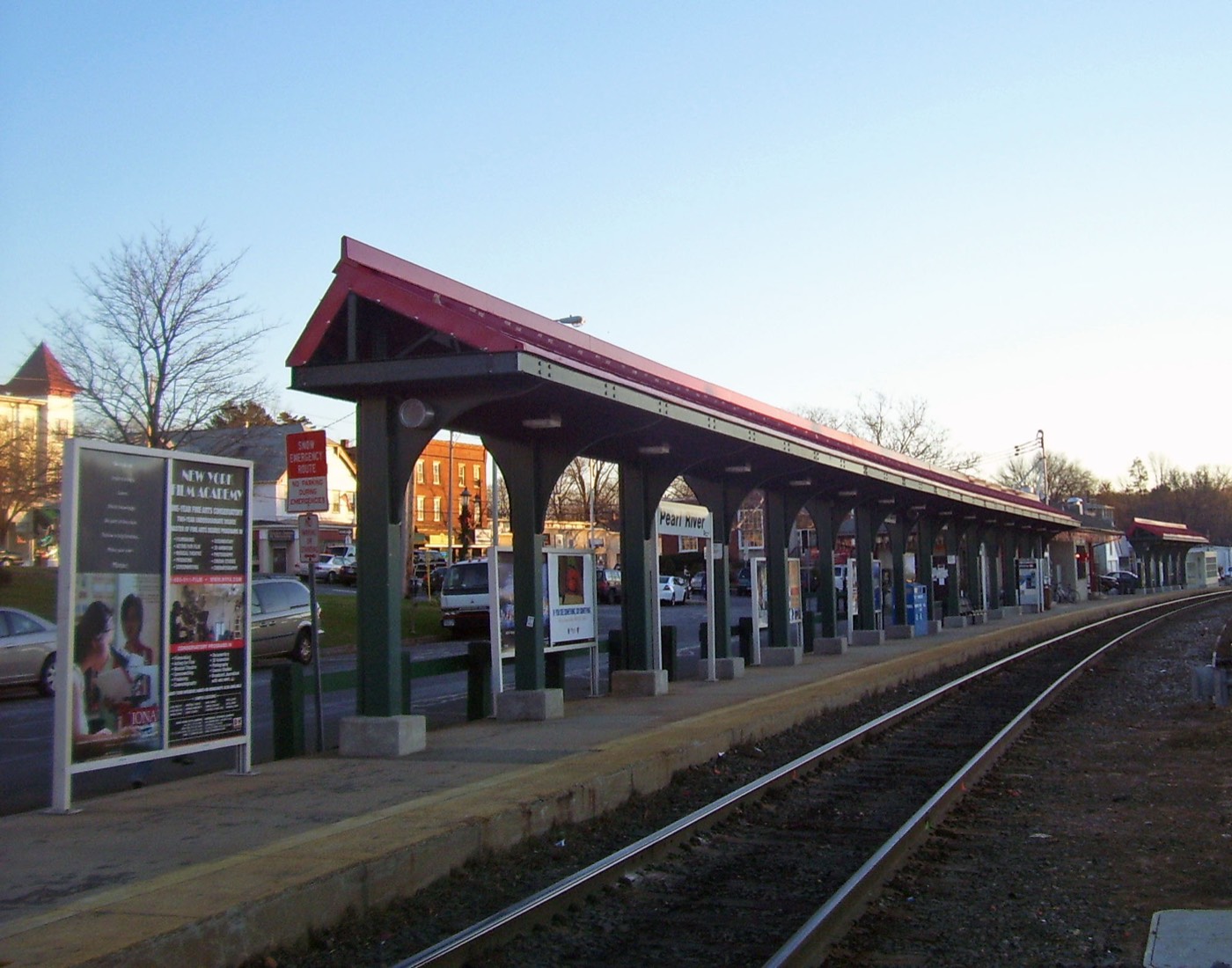
Pearl River station, 35 South Main Street. One of the two brick stations Julius Braunsdorf built in 1873, it still serves New Jersey Transit’s Pascack Valley Line carrying commuters toward Hoboken. It is the oldest working piece of the town, the literal reason Pearl River exists, and generations of Irish commuters have passed under its eaves on the way to city jobs.
St Margaret of Antioch Church, Central Avenue. The spiritual centre of Irish Pearl River, first raised in 1900 and rebuilt in 1931 after fire. Its attached school, open since 1953, has been the first classroom for thousands of the hamlet’s children and remains a defining feature of family life here.
Murty’s Publick House, 29 West Central Avenue. A traditional Irish pub a short walk from the station, on the strip where the town does its gathering. On parade day and ordinary Fridays alike, it is one of the rooms where the community actually meets.
Uncle Tommy’s Tavern, 33 West Central Avenue. Its neighbour a few doors down, another Irish pub on the same central block. The clustering of pubs along one stretch of Central Avenue is itself the point: this is a downtown built for walking from one to the next.
Gildea’s Restaurant, 61 East Central Avenue. An Irish pub and restaurant on the eastern side of the avenue, long a fixture of the local dining scene. It rounds out a Central Avenue that functions, in effect, as the town’s Irish high street.
Blue Hill Plaza, off Veterans Memorial Drive. Completed in 1972, this office complex was Rockland County’s first commercial skyscraper. It is not an Irish landmark, but it marks the moment Pearl River became a serious commuter suburb, the engine that pulled city families up the river and into these streets.
Lincoln Avenue grounds. The vacant old school grounds off Lincoln Avenue where Rockland GAA held its first practices in 1972. From that modest start grew one of the largest Gaelic football clubs outside Ireland, and the field is part of why the sport is woven so deeply into local childhoods.
Where They Came From
The immediate origin of Pearl River’s Irish is not Ireland but New York City. These are, in the main, families who came up from the Bronx, Manhattan and the inner suburbs in the postwar decades, carrying a culture already a generation or two settled in America.
Behind that lies the older Irish migration to New York itself, the long flow out of rural Ireland into the tenements and parishes of the city across the nineteenth and twentieth centuries, a story that also reached cities as far apart as Savannah, Georgia and the Mission District of San Francisco. Pearl River represents the next chapter of that story: the move from urban Irish enclaves to a suburban one, where the same institutions could be rebuilt with more room.
The result is a community that is overwhelmingly American born yet markedly Irish in its rhythms. The football, the dancing and the parade are not imported wholesale from Ireland. They are second and third generation creations, made in Rockland by people whose grandparents may have left counties they themselves have only visited.
Pearl River Today
Pearl River is, by any measure, an affluent and comfortable place. It is a settled commuter suburb with a low poverty rate, good schools and a walkable downtown, the kind of town families move to and stay in for decades. The trains still run to the city each morning and back each night.
The Irish character has proven remarkably durable. Where many ethnic enclaves thin out within a generation or two of leaving the old neighbourhood, Pearl River has held its identity by institutionalising it, in the GAA club, the dance schools, the parish and above all the parade. These are not relics. They are full, active and youth driven.
The town is also changing at the edges, as all suburbs do, with growing Hispanic and Asian populations recorded in recent census counts. But the central fact remains intact. In a country where Irish America is often a matter of a surname and a single day in March, Pearl River is one of the few places where it is still a way of life, lived out loud on Central Avenue.
Frequently Asked Questions
Why are there so many Irish in Pearl River, New York?
The Irish in Pearl River are mostly the descendants of New York City families, many from the Bronx, who moved north into Rockland County in the postwar decades when new bridges and highways made it commutable. They clustered around a Catholic parish, a Gaelic football club and the pubs of Central Avenue, and built institutions that kept the community Irish across generations.
Is Pearl River really the most Irish town in New York State?
Yes. According to US Census Bureau data, more than half of Pearl River’s residents claim Irish ancestry, the highest proportion of any community in New York State. That is why the hamlet, with a population of around 16,000, is regularly named the most Irish place in New York.
When is the Rockland County St Patrick’s Day Parade in Pearl River?
The Rockland County St Patrick’s Day Parade is held in Pearl River each March, organised by the local Ancient Order of Hibernians. It began in 1963, settled permanently in Pearl River in 1974, and now draws crowds approaching 100,000, making it one of the largest St Patrick’s Day parades in New York State.
What is Rockland GAA and where does it play?
Rockland GAA is a Gaelic Athletic Association club founded in 1972 that held its first practices on grounds off Lincoln Avenue in Pearl River. With hundreds of mostly American born members, it is among the largest GAA clubs outside Ireland and is central to how the Irish in Pearl River pass the culture to their children.
Where is the Irish part of Pearl River?
The heart of Irish Pearl River is downtown, along Central Avenue and around St Margaret of Antioch Church. That stretch holds the parish, the Irish pubs such as Murty’s Publick House and Gildea’s, and the route of the annual parade, all within walking distance of the train station.
How do I trace my family’s connection to Pearl River?
Start with the institutions that organised Irish life here: St Margaret of Antioch parish records, the Pearl River school district, the Ancient Order of Hibernians and Rockland GAA. From there, follow the trail back through the New York City neighbourhoods, often in the Bronx, from which so many Pearl River families came before reaching back to Ireland itself.
If your family’s story passed through Pearl River, or any of the places Irish people have made home in America, Atlas of Home can trace that journey. From a county in Ireland to a tenement in the Bronx, to a house off Central Avenue, to wherever you are now.