
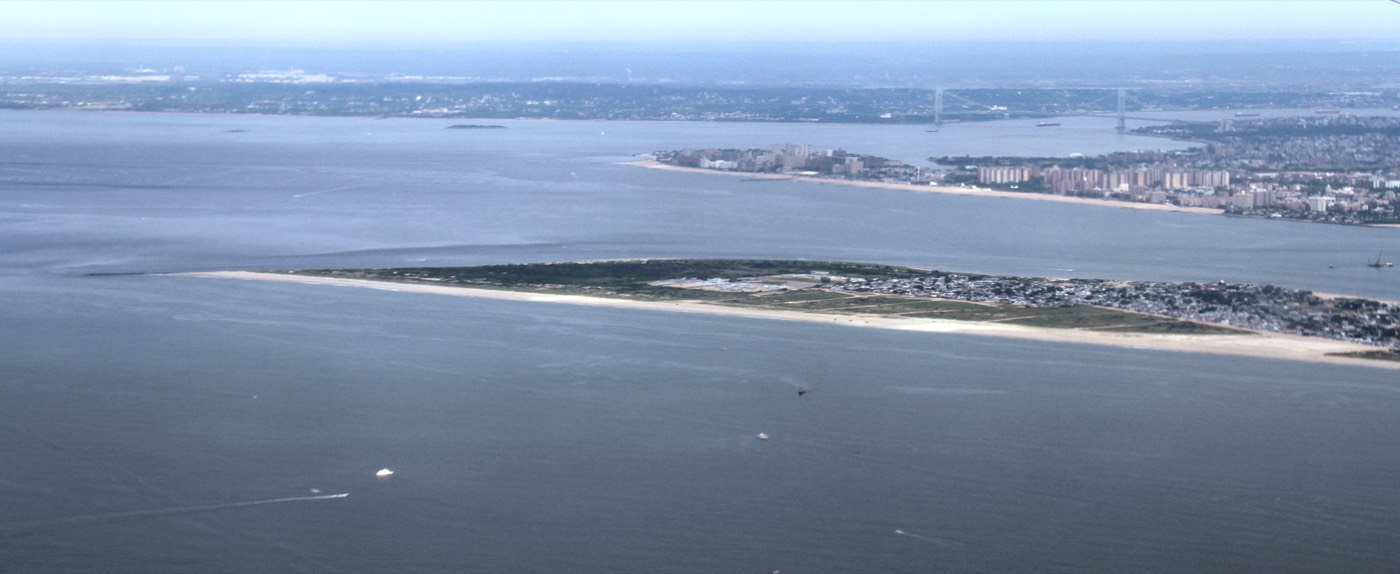
At the very western tip of the Rockaway peninsula, where Queens runs out of land and the city becomes nothing but ocean, the Irish in Breezy Point have built something that exists almost nowhere else in modern New York: a few hundred acres of small wooden bungalows, passed down through brothers, sisters and cousins, where more than half the people still claim Irish blood. They call it the Irish Riviera, and the name has stuck for the better part of a century.
The Place
Breezy Point sits on a barrier spit at the far southwestern end of the Rockaway peninsula, the last neighbourhood in Queens before the Atlantic and Lower New York Bay. It is roughly 500 acres of low clapboard cottages packed tightly together, threaded by narrow lanes, most of them gated and closed to outsiders.
The whole community is owned by the Breezy Point Cooperative. Residents own their houses and hold shares in the co-op, which owns the land beneath them, the beaches, and the roads. Only one street, Rockaway Point Boulevard, is open to the public. Every other lane ends at an electronic gate.
It is one of the rare corners of the city still served by volunteer fire companies, and one of the most homogeneous places in America. In the 2000 Census its ZIP code, 11697, recorded the second-highest concentration of Irish-Americans in the country.
How It Became Irish
A summer colony by the sea
In the early twentieth century, the western Rockaways were a resort, a place where city families came to escape the tenement summers. As ferry and rail links improved, working families from Brooklyn, Queens and the Bronx began leasing plots and putting up small wooden bungalows for the warm months.
Many of those families were Irish-American, and many of the men were firefighters, police officers, electricians and civil servants. They came for the same reasons everyone did: the sea air, the cheap waterfront, and a postcard view of the city skyline they spent their working lives protecting.
The Catholic Club and the Irish Riviera
The community grew around its institutions, and the institution at its heart was the Catholic Club, which has anchored Breezy Point since 1922. Through the interwar years the area drew in predominantly Irish and Italian-American households, and by the 1930s the bungalow colony had earned its nickname: the Irish Riviera.
What made it different from other Irish-American strongholds in the city, from the Irish of Pennsport in Philadelphia to the river-ward Irish of the Irish Channel in New Orleans, was its closeness. The houses were small and crammed together, and the families inside them were related. Brothers bought next to brothers; cousins summered down the lane. The result was a kind of village logic, where everyone knew everyone, that has survived into the present.
From summer rentals to a cooperative
For decades the land underneath the bungalows belonged to a single estate, and residents merely leased it. That changed in 1960, when the property was sold to the Atlantic Improvement State Corporation for 17 million dollars.
Faced with the prospect of losing their summer homes to development, the residents organised. They pooled their money, bought roughly half the land back, and formed the Breezy Point Cooperative. The arrangement gave the community collective control over its own future, and it is the reason Breezy Point looks the way it does today rather than as a wall of apartment towers.
Plans for high-rise buildings did appear in the late 1960s, but a city ordinance halted them. The bungalows stayed. So did the families.
From summer to year-round
Over time, what had been a seasonal colony turned permanent. Winterised bungalows replaced summer shacks, and people who had spent their childhood Augusts on the point came back to live there for good. The same Irish-American families that had rented in the 1930s now owned shares and raised their own children behind the gates.
The co-operative entrenched the community’s character through its membership rules. Before buying a house, a prospective owner traditionally had to be recommended by existing members and approved by the board. That gatekeeping, much debated over the years, is a large part of why Breezy Point stayed so consistently Irish-American across generations when the rest of the city changed around it.
The day the demigods fell
No event marked Breezy Point more deeply than the eleventh of September, 2001. In a community where so many men were firefighters and police officers, the World Trade Center attacks struck with terrible directness. More than two dozen residents of this one small neighbourhood were killed.
At the western end of the point, a memorial now stands at Rockaway Point Boulevard and Beach 218th Street. It holds glass etchings, one for each neighbour lost, and a cross-shaped beam of steel salvaged from the World Trade Center. Each September the names are read aloud, a rose laid for each, and a bell rung after each name.
Fire and water
Just over a decade later came Hurricane Sandy. On the night of 29 October 2012, as the storm surge swallowed the streets, rising seawater reached electrical wiring and a fire broke out near Ocean Avenue. With the roads flooded and trucks unable to reach the blaze, it spread house to house.
By morning, around 130 homes had burned to the ground and dozens more were damaged. It was a community largely built and protected by firefighters, watching its own houses burn beyond reach. The point rebuilt, slowly and stubbornly, the way it has done everything else.
The Landmarks
The Catholic Club, Breezy Point. The oldest institution on the point, dating to 1922, the club has been the social and civic centre of the community for more than a century. It hosts everything from youth athletics to community meetings, and it was reopened with fresh energy in 2014 after years as the gathering place for generations of Breezy Point families.
St. Thomas More Church, 204-25 Rockaway Point Boulevard. Part of the Blessed Trinity Parish, this is the Catholic heart of an overwhelmingly Catholic community. On the morning after the Sandy fire, and every 11 September since, the parish has been the place where Breezy Point gathers to grieve and to remember.
The Breezy Point 9/11 Memorial, Rockaway Point Boulevard and Beach 218th Street. At the far tip of the point, glass etchings honour each resident lost in 2001 alongside a cross of World Trade Center steel. It is the most solemn place in the neighbourhood and, in many ways, the place that explains it.
Kennedy’s, 406 Bayside. A waterfront restaurant and bar tracing its roots back to 1910, Kennedy’s serves seafood and steak with the bay at its back, fish and chips on Sundays and live music on Saturday nights. It is the kind of room where three generations of the same family might be at neighbouring tables.
The Sugar Bowl, 15 Bedford Avenue. A snack shop by day and a beach bar by night, the Sugar Bowl has darts, foosball and a volleyball court out back. For decades it has been where Breezy Point’s summer evenings unwind, equal parts ice cream stand and local institution.
Rockaway Point Boulevard’s shops. The one public road carries the neighbourhood’s small commercial life: the grocer Deidre Maeve’s, Hanna’s Pharmacy and the Breezy Point True Value hardware store. In a place with no chain stores behind the gates, these are the everyday anchors of village life.
The Breezy Point Surf Shop, 61 Breezy Point Avenue. A reminder that for all its history, this is still a beach community at the edge of the Atlantic, where summer means salt water and the long stretch of co-op sand belongs to the residents.
Where They Came From
The Irish of Breezy Point did not, for the most part, sail directly from Ireland to the point. They came from elsewhere in New York: the Irish-American districts of Brooklyn, the Bronx and the rest of Queens, the children and grandchildren of immigrants who had arrived in earlier waves. The same migration seeded the Irish enclaves chronicled in the Mission District of San Francisco and the old port city of Savannah, Georgia, each shaped by the same letters home and the same fares posted back across the Atlantic.
Those earlier waves had their deepest roots in the west of Ireland, the counties hardest hit by the Great Famine and by the long emigration that followed it, places like Mayo, Galway, Kerry and Cork. Chain migration did the rest: a relative already settled in New York would send a letter, and often the fare, and another family member would follow.
By the time Breezy Point formed its character in the 1920s and 1930s, its residents were second and third-generation New York Irish, drawn together less by a shared county than by a shared faith, a shared line of work in the fire and police departments, and a shared longing for a patch of seaside they could afford and call their own.
Breezy Point Today
Breezy Point remains, against every odds the city could throw at it, recognisably itself. The co-operative still owns the land. The gates still close at the end of the lanes. The volunteer fire companies still answer their own alarms, and the Catholic Club still stands where it has stood since 1922.
It is also a place that has been tested. The fires of Sandy and the losses of 2001 are written into its present, not just its past, and the rebuilt blocks sit beside the older bungalows as a reminder of both. The membership rules that kept it so consistently Irish-American have drawn criticism over the years, and the wider New York around it has grown more diverse than the point itself, much as other tight-knit New York enclaves, from the Jewish families of Riverdale to those of Hewlett on the Nassau line, have held to their own character against the same tide.
Yet for the families who summered here as children and stayed as adults, Breezy Point is less a neighbourhood than an inheritance. It is one of the most Irish places left in America, a village of cousins at the end of the subway map, still holding its ground where Queens meets the sea.
Frequently Asked Questions
Why are there so many Irish in Breezy Point, New York?
The Irish in Breezy Point are mostly descendants of New York Irish-American families, many of them firefighters and police officers, who built and bought small seaside bungalows there from the early twentieth century onward. The Catholic Club, founded in 1922, and the resident-owned cooperative helped keep the community tightly Irish across generations.
Why is Breezy Point called the Irish Riviera?
By the 1930s, the bungalow colony at the tip of the Rockaways had become so heavily Irish-American that it earned the nickname the Irish Riviera, and the name has persisted ever since. In the 2000 Census its ZIP code recorded the second-highest concentration of Irish-Americans of any community in the United States.
What is the Breezy Point Cooperative?
The Breezy Point Cooperative is the community organisation that owns the roughly 500 acres of land, beaches and roads. Residents own their homes and hold shares in the co-op, which was formed in 1960 after residents bought back about half the land for some 11 to 12 million dollars to prevent it being developed.
How did 9/11 affect the Irish in Breezy Point?
Because so many residents were firefighters and police officers, the September 11 attacks hit Breezy Point with rare severity, and more than two dozen people from this one small neighbourhood were killed. A memorial at Rockaway Point Boulevard and Beach 218th Street honours them with glass etchings and a beam of World Trade Center steel.
What happened to Breezy Point during Hurricane Sandy?
During Hurricane Sandy on 29 October 2012, floodwaters reached electrical wiring and started a fire that spread house to house while emergency vehicles could not get through the flooded streets. Around 130 homes burned to the ground, and dozens more were damaged, in a community largely built by firefighters.
Can anyone buy a house in Breezy Point?
Not easily. Most of Breezy Point is a gated community, and buyers have traditionally needed to be recommended by existing cooperative members and approved by its board before purchasing a home. This gatekeeping is a major reason the neighbourhood has stayed so consistently Irish-American over the decades.
If your family’s story passed through Breezy Point, or any of the places Irish families have made home in America, Atlas of Home can trace that journey. From a famine-emptied parish in the west of Ireland, to a tenement in Brooklyn or the Bronx, to a bungalow at the edge of the Rockaways, to wherever you are now.