
On a Saturday morning in Peachtree City, a family of four glides along a shaded path on a single golf cart, the children steadying tiffin boxes on their laps as they head to a friend’s house two villages over. The driver is a software architect who grew up in Hyderabad; his wife works in supply chain for an automotive company off Highway 74. The Indians in Peachtree City did not arrive in a wave, the way they did in the Indian enclaves of north Atlanta. They trickled in, one engineering offer and one school district at a time, until the cul-de-sacs of Braelinn and Kedron began to fill with the smell of curry leaves in the evening.
The Place
Peachtree City sits about 30 miles south of downtown Atlanta, in the heart of Fayette County. It was chartered in 1959, the brainchild of developers at Bessemer Securities who imagined a planned community modelled on British garden towns and the American “new towns” of Reston, Virginia, and Columbia, Maryland.
The town is built as five distinct villages: Aberdeen, Braelinn, Glenloch, Kedron, and the West Side, each with its own schools, shops, and recreation. Threading them together are roughly 80 miles of golf-cart paths, the feature for which Peachtree City is famous nationwide.
With a median household income comfortably above six figures and a population near 42,000, it is one of the most affluent suburbs in metropolitan Atlanta. For the Indian families who settled here, that affluence came packaged with two things they prized above almost everything else: quiet and good schools.
How It Became Indian
The Indian story in Peachtree City is, at its heart, a story about jobs and about classrooms. It does not begin with a temple or a grocery row. It begins with the industrial park.
The engineers came first
When Bessemer Securities laid out Peachtree City, they set aside a large industrial park beside the local airport, and over the following decades it filled with the kind of employers that hire engineers by the dozen. Panasonic Automotive Systems built its North American headquarters in the area. Cooper Lighting, NCR, and a cluster of aviation and manufacturing firms put down roots across Fayette County.
These were companies that recruited mechanical, electrical, and software engineers, and through the 1990s and 2000s a steady share of those hires were Indian professionals, many arriving on H-1B visas and later sponsoring green cards. An engineer placed at a plant off Highway 74 needed somewhere to live within a sane commute. Peachtree City, with its lakes and its safety and its paths, made the shortlist.
The schools sealed it
If the jobs brought Indian families to Fayette County, the schools kept them there. Fayette County Public Schools, and McIntosh High School in particular, gave Peachtree City a reputation that travelled fast through Indian professional networks.
McIntosh High School, on Walt Banks Road, has for years ranked among the strongest public high schools in Georgia, placing in the top tier of the state and earning a National Blue Ribbon designation in 2007. Its Advanced Placement participation runs high, and its results in subjects from literature to calculus sit well above the county and state averages.
For first-generation Indian parents, many of them engineers and physicians who had clawed their way up through competitive Indian university entrance exams, a free public school that fed children toward Georgia Tech and Emory was not a perk. It was the entire point. Word spread, household by household, that Peachtree City was a place where you did not have to pay private tuition to give your child a serious shot.
The studios and the IT corridor
The 2010s added a new flavour to the local economy. In 2013 the Pinewood Group announced a major film studio in Fayette County, built in partnership with a trust connected to the Cathy family of Chick-fil-A. Renamed Trilith Studios in 2020, it grew into the largest production facility outside Hollywood, home for years to Marvel productions including Black Panther and several Avengers films.
The studio drew a wave of post-production, visual-effects, and IT contract work, fields where Indian technologists were already heavily represented. Combined with the broader Atlanta IT boom, Trilith helped Peachtree City attract a slightly younger, more mobile generation of Indian professionals who might once have defaulted to Alpharetta or the Indian neighbourhoods of Johns Creek in the north.
A different geography from north Atlanta
This is the crucial thing to understand about Indian Peachtree City: it grew up on the opposite side of the metro from the established South Asian heartland. The largest and densest Indian suburbs of Atlanta, places like Alpharetta, Suwanee, and Cumming, sit north of the city, anchored by the IT corridor along Highway 400.
Peachtree City families, by contrast, oriented themselves around the southern industrial belt and the airport. They were never going to drive 90 minutes each way for groceries, so they built a quieter, more self-contained version of Indian suburban life, supplemented by weekend pilgrimages north for temples and the big Patel Brothers runs.
The Landmarks
Star of India, 256 Commerce Drive. The anchor of Indian dining in Peachtree City, this full-service restaurant has served the town for well over a decade from its spot off Commerce Drive. For many families it doubles as a community node: a place to bring visiting parents from India, to cater a Diwali office lunch, or to introduce American neighbours to dosa and butter chicken.
BAPS Shri Swaminarayan Mandir, 460 Rockbridge Road NW, Lilburn. The spiritual centre of gravity for Gujarati and many other Hindu families across all of metro Atlanta, including Peachtree City, sits roughly an hour to the north. Inaugurated in 2007 and hand-carved from Italian marble, Turkish limestone, and Indian pink sandstone, it is among the largest traditional Hindu temples in the United States. Peachtree City families make the drive for festivals and milestone ceremonies.
McIntosh High School, 201 Walt Banks Road. More than a school, it is a reason people moved. Generations of Indian Peachtree City children have passed through its AP classrooms, its robotics teams, and its science fairs, and its reputation continues to draw families house-hunting from across the metro.
The Peachtree City Industrial Park, off Dividend Drive near the airport. The economic engine that started it all. Home to Panasonic Automotive’s operations, Cooper Lighting, and a host of manufacturers, it is where many of the town’s first Indian residents reported to work, and where some still do.
Trilith Studios, 461 Sandy Creek Road, Fayetteville. The 700-acre film campus just outside Peachtree City reshaped the local economy in the 2010s. Its appetite for visual-effects, post-production, and IT talent helped pull a newer generation of Indian technologists toward Fayette County.
The Avenue Peachtree City, 232 City Circle. The town’s open-air shopping centre functions as a default Saturday gathering point. Indian families browse alongside everyone else, then peel off to the golf-cart paths that connect it to the rest of town, a small daily ritual of belonging in a place built around the cart.
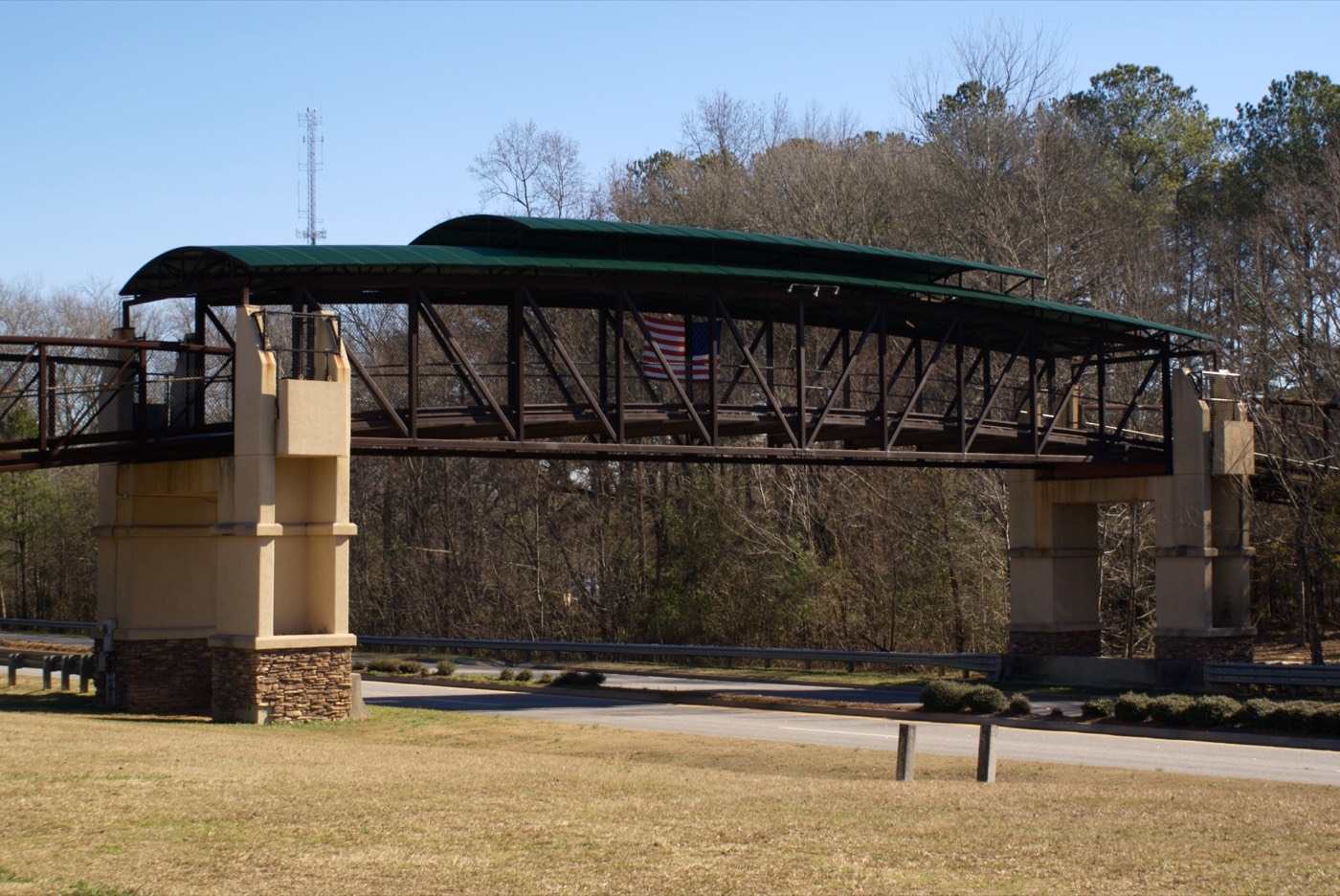
Lake Peachtree and the cart-path bridges. The lakes and the bridges that vault the golf-cart paths over the highways are the visual signature of the town. Indian children here learn to drive a cart before they learn to drive a car, and many of their earliest American memories are of crossing those bridges with friends.
Where They Came From
The Indians of Peachtree City reflect the engineering-and-IT skew of their migration. A large share trace their roots to Telugu-speaking Andhra Pradesh and Telangana, the regions around Hyderabad that have sent so many software engineers to American technology employers since the 1990s.
Gujarati families form the other major thread, many connected to the wider Gujarati business and professional networks that built so much of Hindu Atlanta, including the great mandir up in Lilburn. Smaller numbers come from Tamil Nadu, Kerala, Karnataka, and the Punjab, reflecting the full geography of skilled Indian migration.
What unites them is less a single home state than a single path: technical education in India, a professional visa, an American employer, and a deliberate search for a town where the schools were excellent and the streets were calm. Peachtree City answered that search from the south side of the metro.
Peachtree City Today
Indian Peachtree City remains a community defined by its dispersal rather than its density. There is no single Indian shopping plaza, no dense apartment cluster, no street where every third mailbox carries a familiar surname. The families are spread across the five villages, woven into the ordinary fabric of an affluent American suburb.
That dispersal has costs. Parents drive north for the largest temples and the deepest grocery aisles, and children sometimes grow up with fewer Indian classmates than they might have in Johns Creek or Marietta. The cultural infrastructure is thinner, assembled from a handful of restaurants, informal home gatherings, and the long drive to Lilburn for the big festivals.
But the trade was deliberate, and most families would make it again. They came for safe streets, top schools, and the strange civic poetry of a town you can cross by golf cart. In return they accepted a quieter, more diffuse kind of Indian American life, the kind that shows up not as a visible enclave but as a steady presence at the high-school science fair, the Saturday cricket pickup, and the Diwali potluck that fills a cul-de-sac with light.
Frequently Asked Questions
How many Indians live in Peachtree City, Georgia?
Peachtree City’s population is roughly 42,000, of which about 8.5 percent is Asian, a category that includes the Indian community along with other Asian groups. Indians in Peachtree City number in the low thousands and are spread across the town’s five villages rather than concentrated in one enclave.
Why did Indian families move to Peachtree City?
Two forces drew them: jobs and schools. The Peachtree City industrial park and nearby employers like Panasonic Automotive hired large numbers of engineers, while Fayette County’s highly ranked schools, especially McIntosh High School, made the town a magnet for Indian professional families focused on their children’s education.
Is there a Hindu temple in Peachtree City?
There is no major traditional mandir within Peachtree City itself. Indian and Hindu families typically drive north to the BAPS Shri Swaminarayan Mandir in Lilburn, one of the largest Hindu temples in the United States, for festivals and major ceremonies.
Where do Indians in Peachtree City buy groceries and eat out?
Star of India on Commerce Drive is the town’s longtime Indian restaurant. For specialty groceries, many families combine local shopping with periodic trips to the larger Indian markets in the wider Atlanta area, including the well-known Patel Brothers stores in the metro.
How is Peachtree City different from north Atlanta’s Indian suburbs?
The Indians in Peachtree City live on the south side of the metro, oriented around the airport and the industrial belt, rather than the IT corridor of the north. Compared with dense enclaves like Johns Creek or Alpharetta, Peachtree City’s Indian community is smaller, more dispersed, and quieter, built around schools and engineering jobs rather than a visible commercial strip.
What schools do Indian families in Peachtree City choose?
Fayette County Public Schools, and McIntosh High School in particular, are the major draw. McIntosh ranks among the top public high schools in Georgia and earned a National Blue Ribbon designation, and its strong Advanced Placement record is a frequent reason Indian families cite for moving to the area.
If your family’s story passed through Peachtree City, or any of the places Indians have made home in America, Atlas of Home can trace that journey. From an engineering campus in Hyderabad to a golf-cart path in Braelinn, to wherever you are now.