
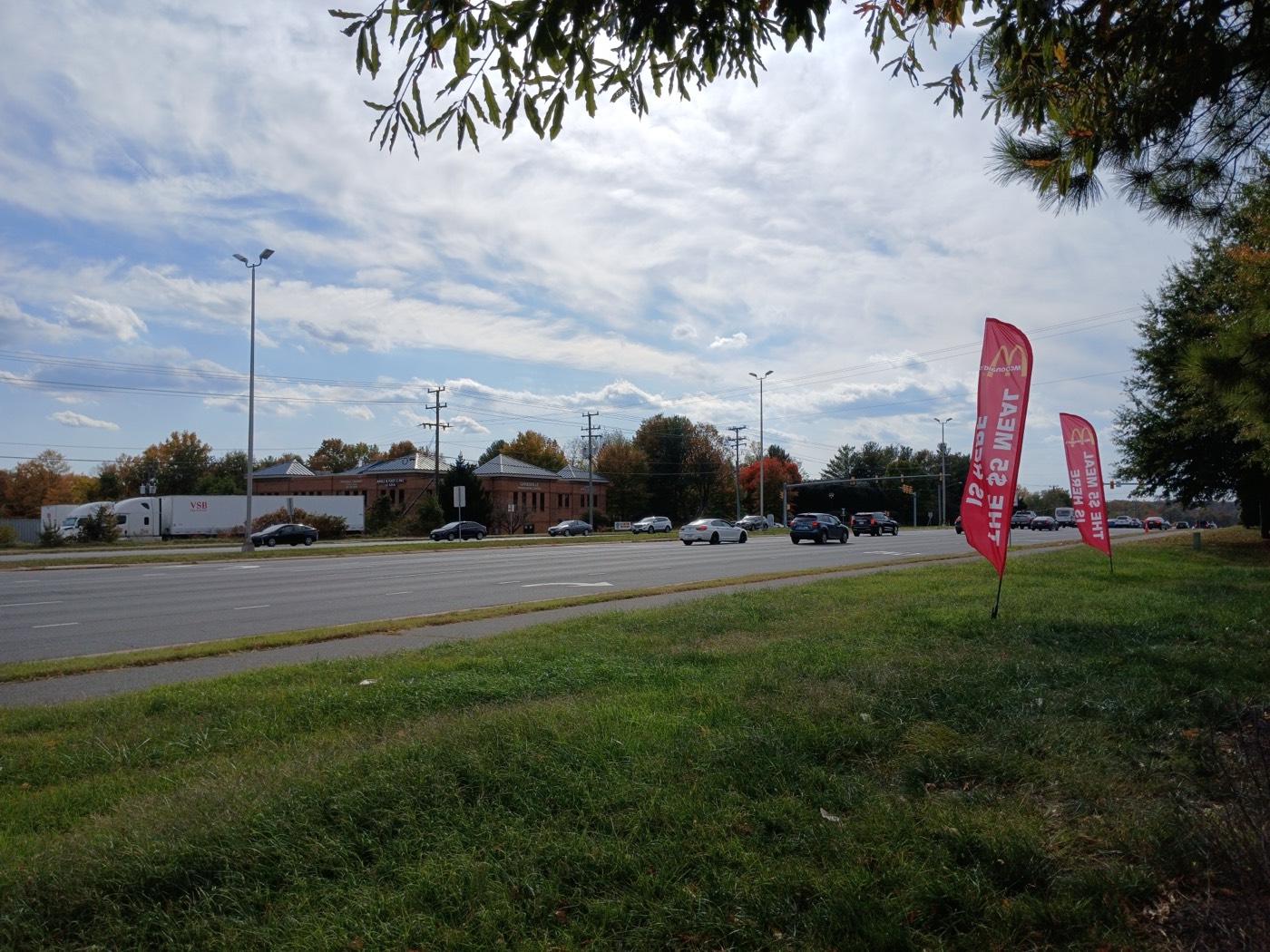
Drive west on Interstate 66 past the last of the Beltway’s congestion and the land opens up: the Bull Run Mountains rise on the horizon, cattle pasture gives way to roofline after roofline, and somewhere around Exit 43 the radio station you were half-listening to gives way to a Telugu podcast playing from the next lane. This is Gainesville, an exurb of Washington that barely existed as a place thirty years ago. Today the Indians in Gainesville, Virginia have made it one of the fastest-growing South Asian footholds in the western suburbs, a community of engineers and federal contractors raising children in golf-course subdivisions where the foothills meet the sprawl.
The Place
Gainesville sits in western Prince William County, about 35 miles from downtown Washington, near where Route 29 crosses Interstate 66 at the foot of the Blue Ridge. It began as a railroad depot: in 1850 a landowner named Thomas Brawner Gaines sold a right-of-way to the railroad on condition that trains stop at a station bearing his name, and the depot opened by 1856, shipping grain, timber and cattle (Wikipedia).
For more than a century it stayed rural, a cattle-shipping town surrounded by Piedmont farmland. Then the farms became subdivisions. The census-designated place counted roughly 16,000 people in 2020 and has grown more than 19 per cent since, pushing toward 20,000, with a median household income above $170,000.
The growth is recent enough that residents remember when there was nothing here. What replaced the pasture was a particular kind of suburb: gated golf communities, big-box retail, top-ranked schools, and the demographic mix that follows knowledge work in the federal corridor.
How It Became Indian
The federal corridor pulls west
The Indian presence in Gainesville is downstream of a much larger story. Asian Indians are the single largest Asian-American group in Virginia, numbering around 170,000, ahead of Filipino and Chinese residents (Asian Americans in Virginia). They are concentrated almost entirely in Northern Virginia, clustered in Fairfax, Loudoun and Prince William counties, drawn by the region’s information-technology, engineering and federal-contracting economy.
India is the second most common birthplace for foreign-born Virginians, with roughly 98,000 residents born there. The state’s Asian population surged nearly 40 per cent between 2010 and 2020, propelled by the skilled-worker and family-reunification migration that followed the 1965 immigration reforms. In Prince William County, more than a quarter of all residents are now foreign-born.
From inner suburb to exurb
The first wave of Indian families in the Washington area settled closer in, in places like Herndon, Fairfax and later Ashburn, where the early data-centre and telecom boom of the 1990s created thousands of technical jobs. As those inner suburbs filled and prices climbed, the search for newer, larger houses pushed families steadily westward along the I-66 and Route 29 corridors.
Gainesville was the next frontier. The same things that made it attractive to any commuting professional made it attractive to Indian engineers in particular: brand-new construction, far more square footage per dollar than in Fairfax, and schools that ranked among the best in the state. A house in Dominion Valley or Piedmont offered what a townhouse inside the Beltway could not.
The trade was the commute. Linton Hall Road and I-66 carry a long, grinding journey toward the District and the contractor offices of Tysons and Reston, softened for some by commuter buses and slug lines toward the Metro. Many families decided the schools and the space were worth the early alarm clock.
The chain takes hold
Migration of this kind compounds. One family settles in a subdivision, vouches for the schools and the neighbours, and a cousin or a colleague from the same firm buys two streets over. Word travels through the dense professional and kin networks that connect Indian families across the region, and a critical mass forms.
By the 2020s the effect was visible in the numbers. Gainesville recorded an Asian share of roughly 14 to 15 per cent, well above the county average, with Indians the largest part of that. It was visible, too, in the grocery aisles, the restaurant signage and the children’s names on the honour rolls of Battlefield, Patriot and the newer Gainesville High School.
What had been a cattle depot was now, within a single generation, a place where you could buy fresh curry leaves on a Saturday morning and run into three families you knew from temple.
The Landmarks
Virginia Gateway, 13301 Gateway Center Drive. The commercial heart of Gainesville, a sprawling open-air centre of more than 120 shops and restaurants anchored by Wegmans, Target and Lowe’s. For Indian families it is the practical centre of gravity: the weekend errand run, the place to meet friends, the suburban high street that did not exist when the first arrivals bought their lots.
Rajdhani Mandir, 4525 Pleasant Valley Road, Chantilly. The most accessible major temple for Gainesville’s Hindu families, about half an hour east. Founded in 1985 and consecrated on its eight-acre wooded site in 2000, it houses deities including Venkateswara, Shiva, Ganesh and Shirdi Saibaba, and runs full programmes for Diwali, Navaratri and Janmashtami.
Durga Temple of Virginia, 8400 Durga Place, Fairfax Station. Established in 1989 as the first temple dedicated to Durga in the United States, it remains a spiritual anchor for North Indian families across the region. For many Gainesville households the drive east to Durga or Rajdhani is a fixed point of the religious calendar.
Dominion Valley Country Club, Haymarket. A gated master-planned community on the Gainesville and Haymarket line, built around two Arnold Palmer golf courses. Subdivisions like this one, and neighbouring Piedmont with its Tom Fazio course, are where a large share of the area’s Indian professional families have bought homes.
Battlefield High School, Graduation Drive, Haymarket. Among the highest-ranked public high schools in Virginia, with a near-universal graduation rate and a heavy slate of Advanced Placement courses. The strength of schools like Battlefield and nearby Patriot is, by most families’ own account, the single biggest reason they chose Gainesville over closer-in suburbs.
The Indian grocers of the corridor. Stores stretching along the Gainesville, Haymarket and Bristow corridor stock the staples of a South Asian kitchen: fresh produce and curry leaves, dal and rice by the sack, frozen parathas, sweets and puja supplies. Their arrival is the surest sign that a suburb has reached the density to sustain a community, not just a scattering of households.
Heritage Hunt, Gainesville. A large gated active-adult community of more than 1,800 homes around an Arthur Hills golf course. As the first generation of Indian arrivals ages, communities like this one increasingly house grandparents and retirees who came to be near their working children and grandchildren.
Where They Came From
The Indians of Gainesville are not a single regional community so much as a cross-section of skilled migration. The largest threads trace to the technology heartlands of the south, Andhra Pradesh, Telangana, Tamil Nadu and Karnataka, the states that have sent so many software engineers into the American federal and IT economy that Telugu is now one of the fastest-growing languages in the country.
Alongside them are families from Gujarat, Maharashtra, Punjab and the Hindi-speaking north, many of whom arrived through the same H-1B and employment-based green-card pathways that built the wider Northern Virginia diaspora. The common denominator is professional: this is a community assembled by visas tied to engineering, IT and federal contracting rather than by a single village or province.
That professional origin shapes everything about how the community lives, from the premium placed on schools to the heavy concentration in golf-course subdivisions to the long tolerance for a punishing commute in exchange for square footage and test scores.
Gainesville Today
On a weekend the rhythm of the community is easy to read. Mornings bring the grocery run along the corridor and youth cricket and cluster of cars outside a friend’s house for a birthday. Evenings in autumn bring the drive east to Rajdhani or Durga for Navaratri and, a few weeks later, Diwali, when subdivision cul-de-sacs glow with diyas and the bigger houses host open-door dinners.
It is, by the honest measure, a suburb still in the making rather than an established enclave. Gainesville has the families, the groceries and the temples within reach, but not yet the dense civic infrastructure of older diaspora centres. For the largest temples, the longest-established restaurants and the cultural associations, residents still drive east to Chantilly, Fairfax and Herndon, or north to Ashburn.
What it does have is trajectory. Few places in the region are growing faster, and few are drawing Indian families at the rate Gainesville is. The cattle depot of the railroad age has become, within a generation, a Piedmont suburb where the foothills frame subdivisions full of engineers, and where the next house to change hands is as likely as not to belong to a family that arrived on an H-1B and decided this was the place to put down roots.
Frequently Asked Questions
How large is the Indian community in Gainesville, Virginia?
Gainesville’s Asian population is roughly 14 to 15 per cent of its nearly 20,000 residents, well above the Prince William County average, and Indians are the largest part of that group. The Indians in Gainesville, Virginia are part of a statewide Asian-Indian population of around 170,000, the largest Asian group in Virginia.
Why did Indian families move to Gainesville?
Most came for newer, larger homes at lower prices than inner suburbs like Fairfax, paired with top-ranked schools such as Battlefield and Patriot. The pull is the same federal-corridor economy, information technology, engineering and government contracting, that drew Indian professionals to Northern Virginia generally.
Where do Indian families in Gainesville worship?
The nearest major Hindu temples are Rajdhani Mandir in Chantilly, about 30 minutes east, and the Durga Temple of Virginia in Fairfax Station. Both run full festival programmes for Diwali, Navaratri and other observances, and both serve families across the western suburbs.
Where can I find Indian groceries and food near Gainesville?
Indian grocers and restaurants are spread along the Gainesville, Haymarket and Bristow corridor, with Virginia Gateway in Gainesville serving as the main retail hub. For the widest selection, many families also shop and dine in the larger Indian commercial clusters in Chantilly, Fairfax and Herndon.
How does Gainesville compare to other Northern Virginia Indian suburbs?
Gainesville is newer and more exurban than established centres. Indian families often weigh it against nearby South Riding, Aldie and Chantilly in Loudoun and Fairfax, and against the older hub of Herndon. The Indians in Gainesville, Virginia trade proximity to those clusters for space and schools further west.
What are the best schools in Gainesville for Indian families?
Battlefield High School and Patriot High School both rank among the top public high schools in Virginia, with very high graduation rates and broad Advanced Placement offerings, and the newer Gainesville High School serves the area as well. School quality is the reason most families cite first for choosing the area.
If your family’s story passed through Gainesville, or any of the places Indians have made home in America, Atlas of Home can trace that journey. From a software-engineering job in Hyderabad or a green card sponsored in the federal corridor, to a golf-course subdivision in the Virginia Piedmont, to wherever you are now.