
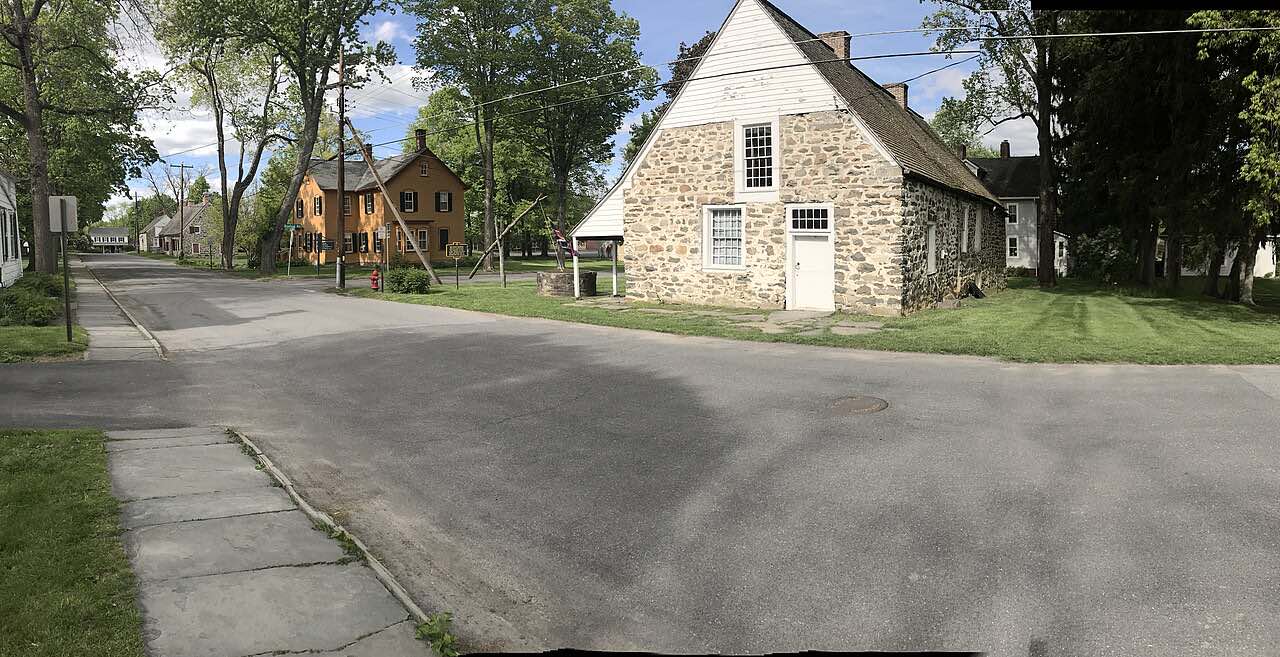
Walk west off Route 32 in the village of New Paltz, past the pizza places and the head shops that serve the college crowd, and the asphalt narrows into something older. Seven stone houses sit under a canopy of sycamores along a single curving lane, their fieldstone walls a yard thick, their gable ends turned to the road in the Flemish manner. The oldest of them went up around 1705. The families who raised them spoke French in the kitchen, kept their records in Dutch, and named the whole place after a sliver of the German Rhineland where they had once found shelter. This is Huguenot Street, and the Huguenots in New Paltz left a row of buildings here that has almost no equal in North America.
New Paltz: The Place
New Paltz sits in Ulster County on the west bank of the Wallkill River, roughly 80 miles north of New York City and within sight of the Shawangunk Ridge. The village covers under two square miles, hemmed by farmland to the south and the cliffs of the Mohonk Preserve to the west. Its housing runs from nineteenth-century brick on Main Street to student rentals near the campus. The historic district is a flat ten-acre pocket where the Wallkill loops close to the old village center.
How New Paltz Became a Huguenot Refuge
Before the Huguenots
Long before any European saw the Wallkill, the land belonged to the Esopus, a Munsee-speaking branch of the Lenape. Archaeology on Huguenot Street has turned up evidence of Native wigwams on the exact ground the settlers later built on, and in 2017 the museum raised a replica Esopus wigwam near the Wallkill from cedar saplings and bark to mark that older presence.
The Esopus had already fought two brutal wars with the Dutch of nearby Wiltwyck, today’s Kingston, in the 1650s and 1660s. By the time the French-speaking newcomers arrived, the survivors were under pressure to sell. On September 15, 1677, twelve men acting for about sixty refugees signed a contract with Esopus sachems for a tract of nearly 40,000 acres. The price was paid in goods: blankets and cloth, kettles and tools, horses, wine, gunpowder, and lead.
The Huguenots Arrive
The buyers were Huguenots, French Protestants who had fled Catholic France during the persecutions that built toward the 1685 revocation of the Edict of Nantes. Most of these particular families were Walloons from the borderland of French Flanders, and they did not sail straight to America. They went first to the Rhineland Palatinate, the patchwork of Protestant German states along the Rhine, and settled for a time around Mannheim.
The German word for that region is Pfalz, pronounced something like “Paltz” in the local dialect. When the families finally crossed the Atlantic and bought their Wallkill land, they named the new settlement die Pfalz in memory of the place that had taken them in. The royal patent confirming the purchase came from Sir Edmund Andros, the colonial governor, on September 29, 1677. By the next year, in 1678, the families had moved down from the Dutch town of Hurley and begun building on the riverbank.
Twelve patentees held the grant, and they are remembered as the Duzine, from the French for “the twelve.” The names were Louis Bevier, Christian and Pierre Deyo, Antoine Crispell, Louis, Abraham, and Isaac DuBois, Hugo Freer, the brothers Abraham and Jean Hasbrouck, and Andries and Simon LeFevre. They farmed much of the land in common at first and divided the rest among themselves and their heirs over the following decades.
New Paltz at Its Peak
The first homes were simple wood structures. In the early 1700s the families replaced them with the stone houses that still stand, walls of local fieldstone laid up thick against the winters. The Duzine governed New Paltz almost as a small republic. In 1728 the patentees and their descendants formalized the arrangement as an elected body of twelve, one seat for each founding line, open to descendants through both male and female lines.
That body ran the town’s affairs for the better part of a century. The New York State Legislature confirmed its authority in 1785, and the Twelve Men kept holding elections into the 1820s, long after most of America had abandoned anything like it. French faded first, giving way to the Dutch of the wider Hudson Valley, and Dutch in turn gave way to English. Yet the families held the land, and the street, for generation after generation.
The Change
The world the Duzine built rested on enslaved labor, and New Paltz never hid that for those willing to read the record. In 1703, nine of the roughly 130 people living in the settlement were enslaved. By the 1755 county census, dozens of New Paltz households owned enslaved people, and the will of patentee Jean Hasbrouck named three he held: Garret, James, and Molly.
The institution unwound slowly under New York’s gradual emancipation laws in the first decades of the 1800s. As the enslaved gained freedom and the patentee fortunes dispersed, the old common landholding came apart. The railroad reached New Paltz, the state opened a teacher-training school in 1828 that grew into the university, and the stone houses passed out of daily family use and into a different kind of life as relics of a vanished order.
The Landmarks of Huguenot Street
The Jean Hasbrouck House, 69 Huguenot Street, dates to 1721 and is the most striking of the row, a tall stone block with a steep pyramid roof and the only surviving jambless Dutch fireplace in the district. It was built for the family of patentee Jean Hasbrouck, and the difficult masonry was carried out in large part by enslaved men named Garret and James. The preservation society bought it at the close of the 1890s, making it the first house museum on the street.
The Abraham Hasbrouck House, 94 Huguenot Street, rose in stages between 1721 and the 1730s. The widow Wyntje Hasbrouck became one of the wealthiest landowners in New Paltz here and raised seven sons who served in the Revolution. Like every house on the lane, it ran on enslaved hands; the family held several people across the eighteenth century.
The Bevier-Elting House, 84 Huguenot Street, began as a single stone room built for patentee Louis Bevier and grew in three phases into a deep Flemish-roofed dwelling. By 1790 it had passed to the Elting merchants, who ran a store from it and held four enslaved people. A woman named Molly and two men were enslaved by the Bevier side a generation earlier.
The Deyo House, 74 Huguenot Street, started as a modest two-room stone structure for the family of patentee Pierre Deyo. In 1894 the descendant Abraham Deyo Brodhead, soon to be village mayor, swelled it into the rambling Queen Anne mansion you see now, swallowing the colonial core inside. It was near this house, during that very renovation, that workmen unearthed a human skull later identified as an enslaved African man.
The DuBois Fort, 81 Huguenot Street, was built around 1705 for the widow of patentee Isaac DuBois and long carried a local legend that its small openings were gun ports. In the twentieth century it served as a tearoom and then a restaurant called The Old Fort before the museum took it over in 1968. It is now the visitor center where every tour begins.
The French Church, 60 Huguenot Street, is a 1972 reconstruction of the stone meetinghouse the congregation built in 1717. The first church here was a log building of 1683; the reconstruction, funded by the Crispell family, carries the name Crispell Memorial. Beside it lies the original burying ground, where the patentees and their descendants were laid for nearly two centuries.
Where the New Paltz Huguenots Came From
The founding families were Walloon Huguenots, French speakers from the contested ground between France and the Spanish Netherlands, in and around French Flanders and Artois. Persecution drove them out of that borderland in the middle decades of the 1600s, and they regrouped in the Rhineland Palatinate around Mannheim before the wars of Louis XIV reached even there.
That double exile, from Flanders to the Palatinate to the Hudson Valley, is why the New Paltz story braids three languages together. The settlers carried French names and a French faith, picked up German place-attachment in the Pfalz, and slotted into a Dutch-speaking colonial world once they reached New York. The community in the French Quarter of New Orleans grew from a very different French stream, and the French of Belden Place in San Francisco arrived two centuries later, but New Paltz holds the oldest standing trace of French settlement in the country.
Huguenot Street Today
Historic Huguenot Street is now a National Historic Landmark district and a working museum, founded back in 1894 by descendants who called themselves the Huguenot Patriotic, Historical, and Monumental Society. Seven stone houses, the reconstructed French Church, the old burying ground, and the Esopus wigwam stand within ten acres, and the family associations still gather here, Hasbroucks and Deyos and DuBois descendants returning to a street their ancestors laid out.
What has changed most is the story the museum chooses to tell. The skull found in 1894 sat boxed in the collection for over a century before scholars from the nearby university identified the man as African. In 2013 he was reburied in the old ground beneath a stone carved with a Sankofa, the Akan symbol for retrieving what was lost; it was the first interment there since 1864. Guides now say plainly that enslaved people lived and labored in every house on the lane, and the life of Sojourner Truth, born into bondage elsewhere in Ulster County, is part of the interpretation.
Around the district, New Paltz is a college town, home to a State University of New York campus founded in 1828 with several thousand students and a Main Street of cafes and outfitters for the hikers bound for the Shawangunks. The contrast is the point. A street that has been continuously lived on since 1678, often called the oldest such street in America, still runs quiet under its sycamores while a modern town hums a block away, and the harder truths of its founding are finally spoken aloud.
Frequently Asked Questions
Why did the Huguenots settle in New Paltz?
The Huguenots in New Paltz were French Protestant refugees who had fled persecution in France and sheltered in the German Palatinate before crossing to America. In 1677 they bought nearly 40,000 acres along the Wallkill River from the Esopus people and settled there the next year. They wanted farmland and the freedom to practice their faith, far from Catholic France.
Is Huguenot Street still a Huguenot place today?
Daily life on Huguenot Street is now a museum operation rather than a living French community, but the connection is far from dead. Descendant family associations for the Hasbrouck, Deyo, DuBois, and other founding lines still gather there, and the original burying ground and stone houses remain in place. The surrounding village is a State University college town.
What are the most famous landmarks on Huguenot Street?
The best-known is the Jean Hasbrouck House of 1721, with the only surviving jambless Dutch fireplace in the district. Other landmarks include the DuBois Fort of about 1705, now the visitor center, the Deyo House, the Bevier-Elting House, and the reconstructed 1717 French Church beside the old burying ground. Seven original stone houses survive in all.
Where did the New Paltz Huguenots come from?
The founding families were Walloon Huguenots from the French-speaking borderland of Flanders and Artois, between France and the Spanish Netherlands. After fleeing persecution they spent years in the Rhineland Palatinate around Mannheim, the region called die Pfalz, which is how New Paltz got its name. From there they sailed to New York.
When did the Huguenots first arrive in New Paltz?
The Huguenots in New Paltz signed their land agreement with the Esopus sachems on September 15, 1677, and received a royal patent that same month. They moved onto the land and began building in 1678. Twelve patentee families, known as the Duzine, founded the settlement and governed it for more than a century.
If your family’s story passed through a stone house on the Wallkill, a Walloon name, or one of the long migrations from Flanders to the Rhine to the Hudson, the threads are worth following. You can trace a similar pattern of faith and resettlement among the Dutch who founded Holland, Michigan.