
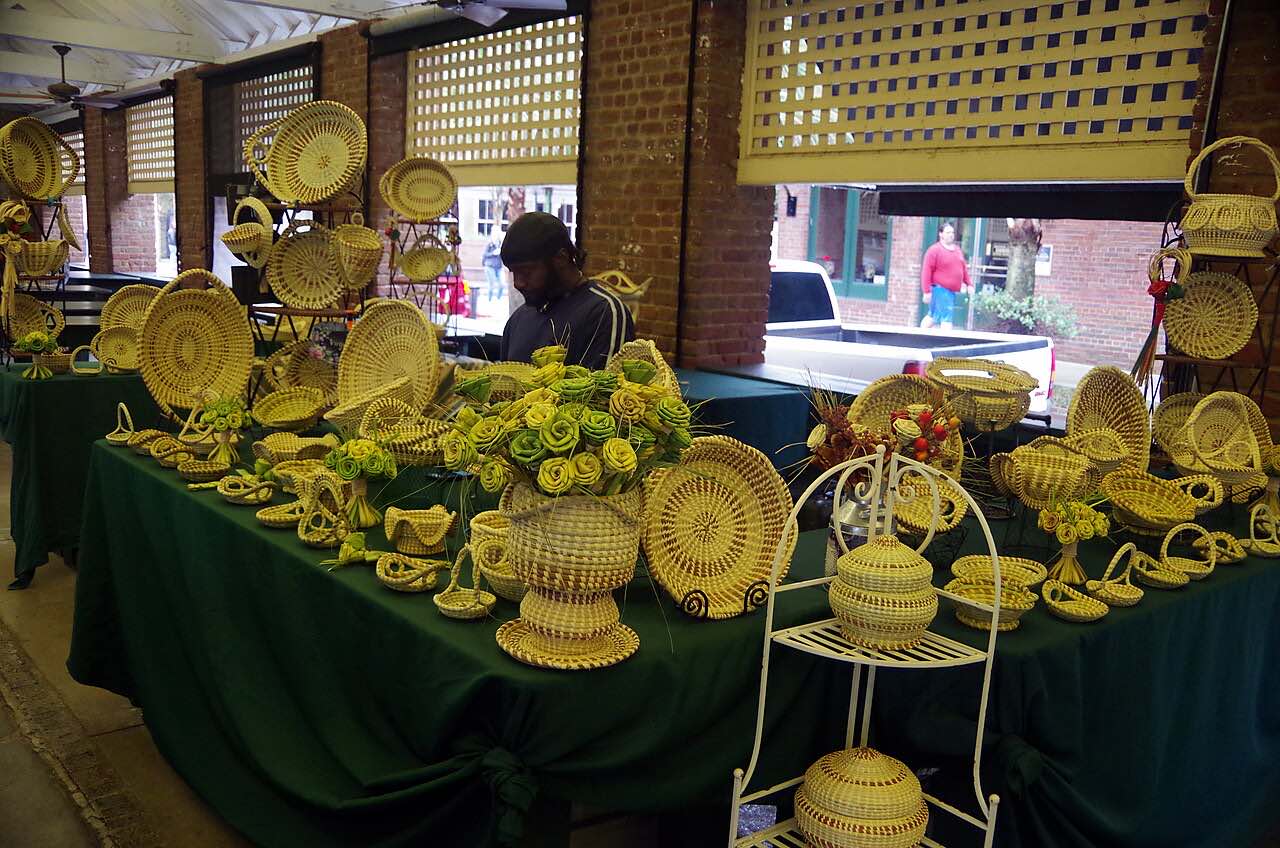
Before sunrise on Highway 17 in Mount Pleasant, a woman sets out folding tables and begins to sew. Not stitch cloth, but coil bundles of sweetgrass and bulrush into bowls and flat fanners, looping each round tight with a strip of palmetto. The shape in her lap is the one her great-great-grandmother used to winnow rice on a tidal plantation. Drive the back roads of St. Helena, Wadmalaw, and Johns Island and you will hear what else survived: a creole speech, old words on West African grammar, spoken here since before the Civil War.
These are the Gullah Geechee in the Lowcountry, the descendants of West and Central Africans enslaved on the rice, indigo, and Sea Island cotton plantations that made Charleston the richest city in colonial America. Cut off by water for generations, they kept more of Africa alive than almost any community in the United States.
The Lowcountry: The Place
The Lowcountry is the flat, tidal coastal plain of South Carolina, a maze of barrier and interior Sea Islands threaded with salt marsh, blackwater creeks, and rivers running brown to the Atlantic. Charleston anchors its center, with Beaufort to the south and the islands of St. Helena, Hilton Head, Daufuskie, Edisto, Wadmalaw, and Johns scattered along the shore. Many of these islands had no road bridge until well into the twentieth century, reached only by boat across the sounds. The land is low, hot, and fertile, and for two centuries it grew the crops that built a slaveholding empire.
How the Lowcountry Became Gullah Geechee Country
Before the Gullah
For thousands of years the Sea Islands belonged to Native peoples, among them the Yamasee, Kiawah, and Edisto, who fished the estuaries and gave several islands their names. Spanish and then English colonists pushed them out. Charleston, founded in 1670, grew quickly on a single discovery: the tidal flatlands of the Lowcountry were ideal for rice. By the early 1700s, rice and later indigo had turned the colony into the wealthiest in British North America, and that wealth rested entirely on enslaved labor.
The planters wanted specific people. Rice was an African crop, and the techniques of flooding, banking, and winnowing had been perfected over centuries on the Rice Coast of West Africa, the stretch from Senegambia down through Sierra Leone. Slave traders in Charleston advertised it openly. One notorious broadside hawked captives “just arrived from the Windward and Rice Coast,” prized for their knowledge of rice culture. During the crucial decades of tidal rice development, historians estimate more than 40 percent of enslaved people in South Carolina came from these rice-growing regions.
The Gullah Arrive
Most of those captives entered through Sullivan’s Island, the small barrier island at the mouth of Charleston harbor that served as a quarantine station for arriving slave ships. By some estimates, close to half of all enslaved Africans brought to North America passed through this single point, which is why the writer Toni Morrison called for a marker there. In 2008 the Toni Morrison Society placed a steel bench near Fort Moultrie, a quiet answer to her line about there being no bench by the road.
On the isolated plantations, people from many African nations were thrown together, speaking dozens of languages. What emerged was Gullah, a creole whose vocabulary is mostly English but whose grammar, rhythm, and many words come from Mende, Kikongo, Vai, and other African tongues. The word “Geechee,” used more often in Georgia, may trace to the Ogeechee River or to the Kissi people of Sierra Leone. The two names describe one people: Gullah in South Carolina, Geechee further down the coast.
The turning point came during the Civil War. In November 1861, Union forces captured Port Royal Sound, and the white planters fled, abandoning roughly ten thousand enslaved people on the Sea Islands around Beaufort. What followed was the Port Royal Experiment, an early test of what freedom might look like. Northern missionaries and teachers arrived in 1862, and freedpeople began buying the plantation land they had worked, often in small parcels at low prices.
The Lowcountry at Its Peak
For the next half century, Sea Island Gullah communities lived with a degree of independence rare for Black Americans in the Jim Crow South. They owned their land, farmed and fished it, and governed much of their own daily life because so few outsiders could reach them. The isolation that had once been a tool of bondage became, after freedom, a shield.
Spiritual life centered on the praise house, a small one-room building where neighbors gathered on weeknights between Sunday church services. There they prayed, testified, and ended the night with the ring shout, a counterclockwise shuffle and song that carried straight from West and Central African worship. On Daufuskie Island the oyster industry boomed from the 1880s, and at its height the island held two to three thousand people, most working the shellfish beds. Across the islands, families grew okra, field peas, and benne, fished the creeks for shrimp and crab, and sewed sweetgrass baskets the way their ancestors had on the Rice Coast.
The Change
The bridges changed everything. A causeway reached St. Helena, and in 1956 the James F. Byrnes Bridge finally connected Hilton Head to the mainland. Almost overnight, developers saw beachfront. Hilton Head became a resort, and the Gullah families who had owned most of its land began to lose it. Since the bridge, they have lost close to two-thirds of their acreage on the island.
Much of that loss came through heirs’ property, land passed down without a will across many generations until dozens of relatives share an undivided claim. A single heir can force the sale of the entire parcel, and developers and tax pressure did the rest. On Daufuskie, pollution from a Savannah River paper mill killed the oyster beds by 1959 and emptied the island. The community that had held on through slavery and Jim Crow now faced a slower kind of dispossession, paved with golf courses and gated gates.
The Landmarks of the Lowcountry
Penn Center, 16 Dr. Martin Luther King Jr. Drive, St. Helena Island. Founded in 1862 as Penn School by the Pennsylvania missionaries Laura Towne and Ellen Murray, it was among the first schools in the South created to educate formerly enslaved people. A century later it became a rare integrated meeting ground in the segregated South, and Dr. Martin Luther King Jr. and his Southern Christian Leadership Conference retreated here several times in the 1960s, staying in Gantt Cottage. The campus was named a National Historic Landmark District in 1974.
Sullivan’s Island, Charleston harbor. This is where the Middle Passage ended for a vast share of the Africans brought to North America, held in pest houses before sale in Charleston. The steel “bench by the road” near Fort Moultrie, placed in 2008, marks the ground that Toni Morrison said had no memorial. It is one of the most consequential and least known sites in American history.
The sweetgrass basket stands of Highway 17, Mount Pleasant. By 1930 basket sewers had begun selling their work along the highway, then the main road between Florida and the Northeast, an early direct-to-market trade run almost entirely by Gullah women. The stands still dot the road today. Mary Jackson, who grew up sewing baskets in Mount Pleasant, was named a MacArthur Fellow in 2008 for carrying the four-hundred-year-old form into fine art.
The Brick Church and the Praise Houses, St. Helena Island. Built by enslaved labor in 1855 and later used by Penn School, the Brick Church still stands among the live oaks. Scattered around it are a handful of surviving praise houses, the small frame buildings where the ring shout was kept alive when larger gatherings were forbidden. A few are still in use.
Mary Fields School, Daufuskie Island. In 1969 a young white teacher named Pat Conroy taught Gullah children in this two-room schoolhouse, then wrote about the experience in his book “The Water Is Wide,” fictionalizing the island as Yamacraw. The book put the isolation and neglect of the Sea Island communities in front of a national audience.
Charleston City Market, 188 Meeting Street. Under the long open sheds downtown, Gullah artisans sell sweetgrass baskets to visitors from around the world, one of the few places where the craft meets a daily public. The market sits a short walk from where, two centuries ago, the people who first sewed those baskets were bought and sold.
Where the Lowcountry Gullah Came From
The Gullah trace their roots to the Rice Coast of West Africa, a region running from modern Senegal and Gambia through Guinea, Sierra Leone, and into Liberia. Planters sought captives from these places by name because the people there, especially the women, held generations of expertise in growing rice in tidal and inland fields, the exact skill the Lowcountry demanded. Ethnic groups including the Mende, Vai, Temne, and Kissi were carried across in large numbers.
The connection is not a guess. When the Mende language survived in a Gullah funeral song sung on the Georgia coast, scholars traced it directly to Sierra Leone, and in 1989 Sierra Leone’s president visited Gullah country in recognition of the tie. Central African peoples from the Kongo region shaped the language and the ring shout as well, so the Lowcountry’s culture is a braid of West and Central African strands woven on American soil.
The Lowcountry Today
The Gullah Geechee in the Lowcountry are in the middle of a renaissance, even as the fight for land goes on. In 2006 Congress created the Gullah Geechee Cultural Heritage Corridor, a federally designated stretch running from Wilmington, North Carolina to Jacksonville, Florida, with a commission charged with preserving the language, crafts, and history. Legal clinics now help families clear title to heirs’ property and hold onto land that has been theirs for more than a century.
Chefs like Benjamin “BJ” Dennis of Charleston have brought Gullah foodways to a national stage, cooking okra soup, red rice, and Frogmore stew the way the Sea Islands always have, vegetable-forward and built on seafood. Two festivals draw thousands each year: the Hilton Head Island Gullah Celebration through February and Beaufort’s Original Gullah Festival over Memorial Day weekend, running since 1986. Elders are recording the old praise-house songs before they are lost, and younger people are learning the language on purpose.
The pressure has not let off. Resort money still presses against the last Gullah-owned parcels, and every funeral takes another keeper of the old words. But the people who turned bondage into a culture and isolation into endurance are not finished. They are sewing the next basket, singing the next shout, and teaching the next child to say it in Gullah.
Frequently Asked Questions
Why did the Gullah Geechee settle in the Lowcountry?
The Gullah Geechee in the Lowcountry did not choose to come. Their ancestors were West and Central Africans enslaved and brought to the rice, indigo, and Sea Island cotton plantations around Charleston and Beaufort, many chosen specifically for their rice-growing expertise. After emancipation, freedpeople bought plantation land on the isolated Sea Islands and stayed.
Is the Lowcountry still Gullah Geechee today?
Yes, though under pressure. Gullah Geechee communities remain strongest on interior islands like St. Helena, Wadmalaw, and Johns, where resort development came slower. On Hilton Head and others, families have lost much of their land, but the culture endures through language, foodways, festivals, and the Gullah Geechee Cultural Heritage Corridor.
What are the most famous Gullah Geechee landmarks?
Penn Center on St. Helena Island, founded in 1862 as one of the first schools for freed slaves, is the best known, along with the sweetgrass basket stands on Highway 17 in Mount Pleasant. Sullivan’s Island, where most enslaved Africans entered North America, and the surviving praise houses and the Brick Church on St. Helena are also central sites.
Where did the Lowcountry Gullah come from?
They came from the Rice Coast of West Africa, the region stretching from Senegal and Gambia through Sierra Leone to Liberia. Planters deliberately sought captives from these areas, including the Mende, Vai, and Temne peoples, for their generations of knowledge in growing rice in tidal fields.
When did the Gullah Geechee first arrive in the Lowcountry?
Enslaved Africans were brought to the Lowcountry from the founding of Charleston in 1670, with the heaviest arrivals during the rice boom of the 1700s. The Gullah Geechee in the Lowcountry became free landowners after Union forces captured Port Royal in 1861 and the Port Royal Experiment began in 1862.
If your family’s story passed through the Sea Islands, the rice fields, or the praise houses of the South Carolina coast, that history is worth tracing. The same instinct shaped other communities we have followed, from the Creoles of Treme in New Orleans to the Garifuna in the South Bronx and the Haitians of Little Haiti in Miami.