
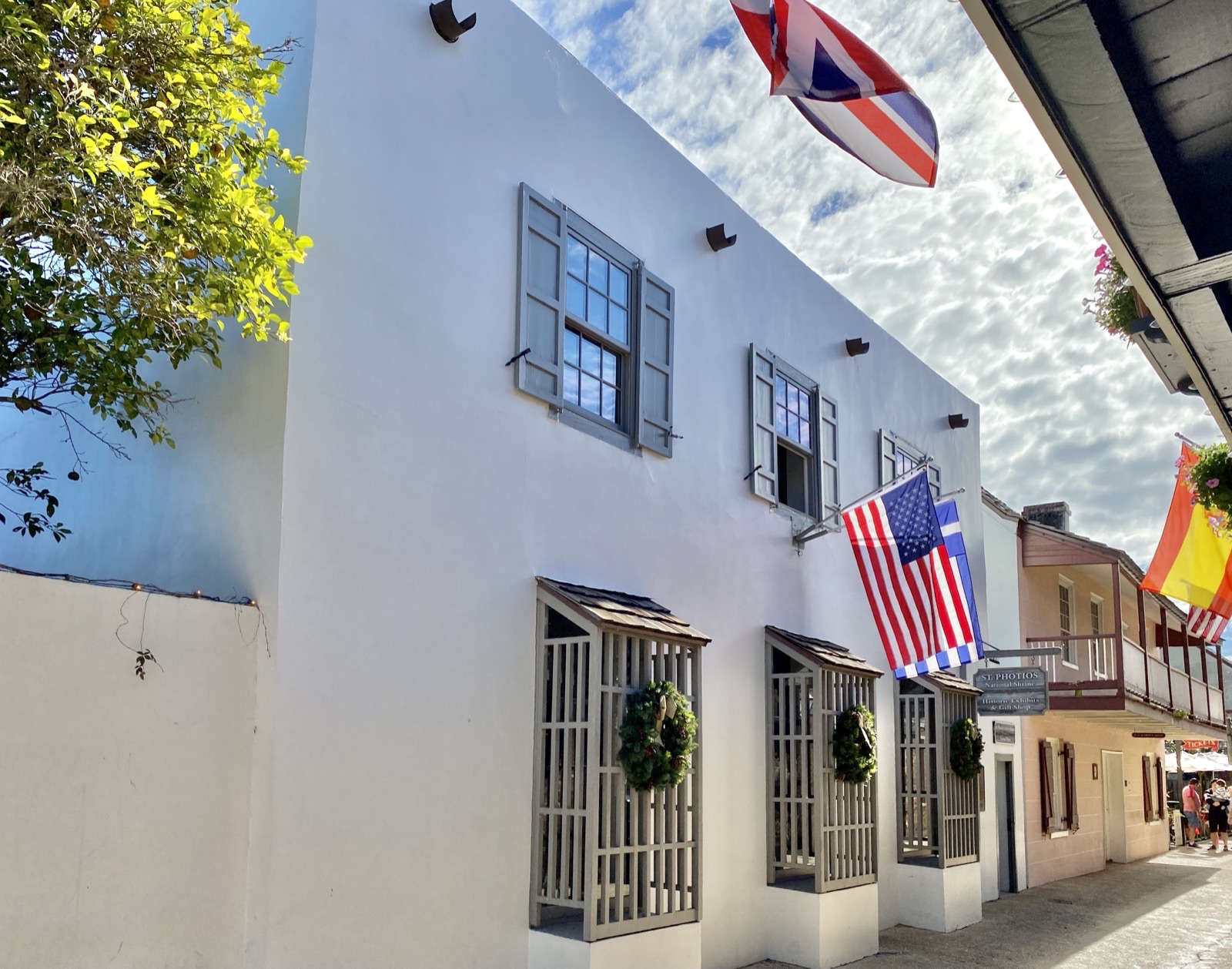
They walked in barefoot, sunburnt, and starving, fewer than three hundred where there had once been more than a thousand. In the summer of 1777 the survivors of a broken plantation seventy miles to the south came up the King’s Road and into St. Augustine, Florida. Among them were the Greeks of New Smyrna, families from Mani, Crete, and Smyrna who had crossed an ocean for fifty promised acres and found a death camp instead. They are the oldest Greek community in America, and this narrow Spanish town on Florida’s Atlantic coast is where that story begins.
St. Augustine: The Place
St. Augustine sits on the northeast coast of Florida, founded by the Spanish in 1565 and the oldest continuously occupied European settlement in the continental United States. Its colonial core is a tight grid of coquina-stone houses, balconied lanes, and the Castillo de San Marcos guarding the inlet.
The spine of that old town is St. George Street, a pedestrian lane lined with eighteenth-century buildings. Halfway along it, at number 41, stands a low coquina house that most tourists pass without a second look. That house is the reason this town matters to Greek America.
How St. Augustine Became Greek
Before the Greeks
For two centuries before the Greeks arrived, St. Augustine was a Spanish military outpost, a Catholic garrison town of soldiers, friars, and frontier families. Power passed back and forth between Spain and Britain through the eighteenth century, and in 1763 the town came under British control.
It was a small place, perhaps a few thousand souls, clinging to the edge of a vast and difficult peninsula. There was no Greek presence here at all. That would change because of one ambitious Scottish doctor and the colony he built down the coast.
The Greeks Arrive
In 1768 Dr. Andrew Turnbull, a Scottish physician with connections in London, launched one of the largest single recruitment drives in colonial American history. He named his planned settlement New Smyrna after the Aegean birthplace of his Greek wife, Maria Gracia Dura Bin of Smyrna.
Through 1767 his ships worked the Mediterranean, stopping at Mahon on Menorca, at Livorno, and at the Greek ports of Melos, Mani, Koroni, and Methoni, as well as Crete, Santorini, and Smyrna itself. The pitch was simple: indenture yourself for a few years of work, then receive your freedom and fifty acres of Florida land. Roughly 1,400 colonists signed on, the largest contingent Minorcan, with around 500 Greeks and a smaller number of Italians and Corsicans.
The crossing was brutal before they ever saw Florida. More than 200 colonists died at sea. The survivors landed near present-day New Smyrna Beach on June 26, 1768, and began clearing land for indigo, the cash crop meant to make Turnbull rich.
New Smyrna at Its Worst
What followed was not a community at its peak. It was a colony in collapse. Mosquito-borne fever, scurvy, hurricanes that flattened the palmetto huts, and chronic shortages of food and clothing killed the colonists by the hundreds.
The broken promises came fast. The fifty acres never materialised, the indenture terms stretched on, and the overseers used the whip. In August 1768, only weeks after landing, an Italian named Carlo Forni led a desperate revolt. The rebels seized the storehouse and the rum, attacked the overseers, and tried to sail for Havana before being run down. Forni was executed.
Over the colony’s decade, by most accounts close to 700 of the original colonists died. The Greeks among them had no Orthodox priest. They were ministered to by Father Pedro Camps, the Minorcans’ Catholic priest, who kept registers of births and deaths through the worst of it and refused to counsel his people to accept their bondage.
The Walk North
In 1777, three colonists slipped away to St. Augustine and laid their grievances before Governor Patrick Tonyn. Tonyn, no friend of Turnbull, investigated, freed the colonists from their contracts, and offered them sanctuary in town.
That July the survivors abandoned New Smyrna en masse and walked the roughly seventy miles north along the King’s Road. Of the 1,400 who had set out from the Mediterranean, fewer than 600 were still alive, and perhaps half of those were Greek and Minorcan together. They arrived with nothing and settled into the northern quarter of St. Augustine.
Spanish authorities later granted the empty Avero House on St. George Street to Father Camps for use as a chapel. The Greeks worshipped there alongside the Minorcans, and the building became known locally as the Minorcan Chapel. The first enduring Greek presence in what would become the United States had found its footing on this street.
The Landmarks of Greek St. Augustine
St. Photios Greek Orthodox National Shrine (Avero House), 41 St. George Street. This coquina house, built in the 1740s, is the only Greek Orthodox national shrine in America. The Greek Orthodox Archdiocese purchased it in the mid-1960s, restored it to its eighteenth-century appearance, and opened the shrine on February 27, 1982 to honour the New Smyrna colonists. It was consecrated in 1985.
The St. Photios Chapel. Inside the shrine is a small Byzantine chapel covered in frescoes painted by the iconographer George Filippakis, assisted by his father Constantine and his brother John. The chapel is named for Saint Photios the Great, the ninth-century Ecumenical Patriarch of Constantinople, and holds relics of early Church saints. A perpetual flame and memorial honour the colonists who died at New Smyrna.
St. George Street itself. The lane the survivors settled near is now the busiest pedestrian street in the old city. The shrine sits quietly among the shops and cafes, a reminder that this tourist thoroughfare was once the refuge of starving Greek and Minorcan families.
The colonists’ registers. The parish records kept by Father Camps, listing names such as Anastasios Mavromatis, Demetrios Fundulakis, and the Costa and Llambias families, survive as the documentary backbone of the story. They let descendants today trace a line straight back to 1768.
Holy Trinity Greek Orthodox Church, 2940 County Road 214. The living parish of the modern Greek community, west of the historic core. Each October it hosts the St. Augustine Greek Festival, with food, pastry, music, and folk dancing that draw thousands. The 2026 festival is set for October 10 and 11.
Where the St. Augustine Greeks Came From
The Greeks who reached Florida in 1768 came overwhelmingly from three places: the Mani peninsula in the southern Peloponnese, the island of Crete, and the great Aegean port of Smyrna on the coast of Asia Minor. These were hard-pressed regions under Ottoman rule, places where the promise of free land overseas could outweigh the risk of an Atlantic crossing.
The Maniots in particular came from a famously independent mountain society. That these specific villages sent emigrants to a Scottish doctor’s Florida indigo scheme is one of the stranger threads in the wider Greek story, a thread that later ran through twentieth-century communities like the Greek sponge divers of Tarpon Springs, the Greeks of Astoria, Queens, and Greektown in Detroit. St. Augustine simply came first, by more than a century.
St. Augustine Today
The Greek thread in St. Augustine today runs two ways. There is the deep root, the colonial story preserved at the shrine on St. George Street, visited by tens of thousands of pilgrims and tourists a year. And there is the living parish at Holy Trinity, descendants and newer Greek-American families who keep the festival and the liturgy going.
Much of the original colonial bloodline folded into the broader Minorcan community of St. Augustine over the centuries, since Greeks, Minorcans, and Italians intermarried and worshipped together from the start. Datil-pepper cooking and old St. Augustine surnames carry traces of that mixed colonial population. Disentangling the purely Greek line from the Minorcan one is often impossible, which is itself part of the story.
What endures is the claim, and it is a real one. The first Greeks to set foot and stay in what became the United States came through here, and the only Greek Orthodox national shrine in the country marks the spot. For a community that would later build neighbourhoods from Florida’s Gulf coast to the avenues of Queens, this small coquina house is the place the American chapter opened. Like the Cuban cigar families of Key West further south, the Greeks of St. Augustine show how a single Florida town can hold the origin point of an entire American community.
Frequently Asked Questions
Why did Greeks settle in St. Augustine, Florida?
The Greeks in St. Augustine, Florida were survivors of the New Smyrna colony, an indigo plantation founded in 1768 by Dr. Andrew Turnbull about seventy miles to the south. When that colony collapsed under disease, starvation, and broken promises, the survivors were freed from their contracts in 1777 and given sanctuary in St. Augustine. They settled in the town’s northern quarter and worshipped at the Avero House on St. George Street.
Are there still Greeks in St. Augustine today?
Yes. There is a living parish, Holy Trinity Greek Orthodox Church on County Road 214, which hosts the annual St. Augustine Greek Festival each October. Many descendants of the original 1768 colonists also remain, though over the centuries that bloodline blended into the wider Minorcan community of the old city.
What is the most famous Greek landmark in St. Augustine?
The St. Photios Greek Orthodox National Shrine at 41 St. George Street, housed in the historic Avero House. It is the only Greek Orthodox national shrine in America and was dedicated in 1982 to honour the New Smyrna colonists. Inside is a Byzantine chapel with hand-painted frescoes and a memorial to the colonists who died.
Where in Greece did the St. Augustine Greeks come from?
The roughly 500 Greeks recruited for New Smyrna came mainly from the Mani peninsula in the southern Peloponnese, the island of Crete, and the Aegean port of Smyrna in Asia Minor. Turnbull’s ships gathered them from these regions during a recruiting voyage through the Mediterranean in 1767. These were the homelands of the first Greeks in St. Augustine, Florida.
When did Greeks first arrive in St. Augustine?
Greek colonists first reached Florida in June 1768 as part of the New Smyrna colony. They arrived in St. Augustine itself in July 1777, after walking north when the colony failed. This makes St. Augustine the site of the oldest Greek community in the United States.
If your family’s story passed through St. Augustine, or any of the places the Greeks made home, from the villages of Mani and Crete to a coquina chapel on St. George Street, Atlas of Home can help you trace that journey. Explore your story →
Sources and further reading: Avero House on Wikipedia and the Saint Photios Greek Orthodox National Shrine history.