
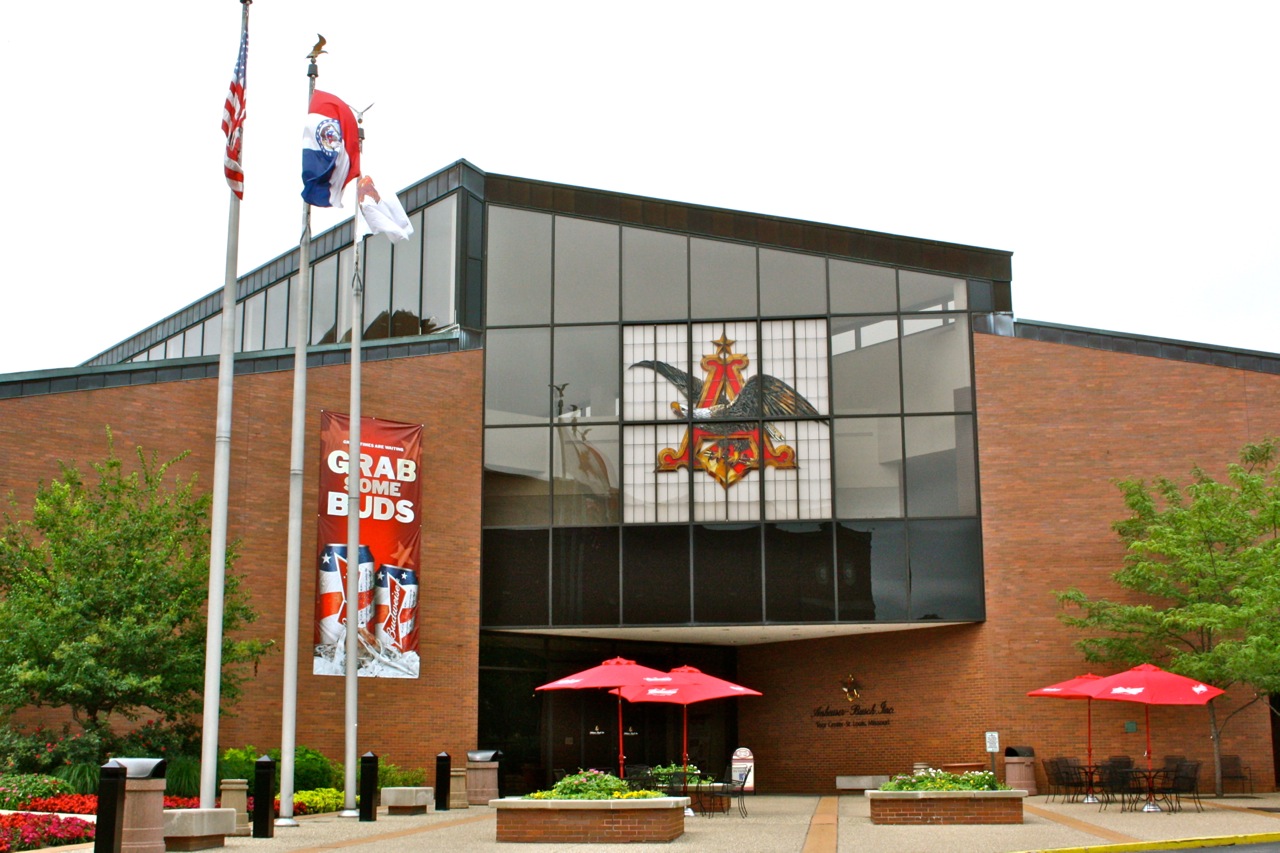
The Anheuser-Busch Clydesdales still clip down the cobblestones some mornings, eight horses harnessed in line, breath fogging the cold air on Pestalozzi Street. A century and a half ago, those streets were full of German voices. From the 1840s through to the 1920s, if you walked south of downtown St. Louis past the lager houses and the row of red-brick flats, you were in a small piece of Bavaria. The city kept the brewery. It kept the market hall. The rest faded into surname and habit.
The Place Itself
Soulard sits directly south of downtown St. Louis, pressed against the Mississippi River. It is the city’s oldest neighbourhood and one of its smallest, a tight grid of nineteenth-century brick row houses, flounder houses, and corner taverns. The Anheuser-Busch complex anchors its eastern edge along Lynch Street. The Soulard Farmers Market, the heart of the place, sits at 730 Carroll Street, four blocks west of the brewery.
Bohemian Hill rises on the south side. Downtown’s office towers loom to the north. Interstate 55 cuts the neighbourhood off from the riverfront. The housing is famously dense and famously preserved, a National Register historic district since 1972.
How It Became German
Before the Germans
The neighbourhood takes its name from Antoine Soulard, a French royalist naval officer who arrived in Spanish St. Louis in 1794 and married into the Creole Chouteau family. Antoine’s widow Julia donated the land for a public market in 1838, on condition the city use it as a market forever. The promise still holds.
In the 1830s the area was still French Creole and Anglo-American, a fringe of frame houses and small farms outside the original village. That changed quickly.
The First Wave: Dreissigers and Forty-Eighters
Germans began trickling into St. Louis in the early 1830s, the so-called Dreissigers fleeing political repression after the Hambach Festival and the Frankfurt Putsch. Then the failed revolutions of 1848 sent a second wave. These were the Forty-Eighters, political refugees who had wanted German unification, constitutional rights, and an end to monarchy. Many were lawyers, journalists, doctors, teachers. They were not peasants.
The numbers are staggering. St. Louis had about 16,000 residents in 1840. By 1850 the city was 77,000. By 1860 it was 160,000. Roughly half were German or of German descent. Most of them landed on the south side, in the cheap brick blocks of what became Soulard.
The Brewing Years
Beer made Soulard. The natural cave system under the south side held the steady cool temperature lager required, and Bavarian-trained brewers knew exactly what to do with it. Johann Adam Lemp, born in Eschwege in 1798, opened the Western Brewery in 1840 after his grocery store became more popular for its beer than its sausages. By the 1850s south St. Louis had over fifty breweries clustered along the bluffs.
In 1852 a small operation called the Bavarian Brewery opened on Carondelet Avenue, between Dorcas and Lynch streets. It struggled. Soap manufacturer Eberhard Anheuser bought it out in 1860. His son-in-law Adolphus Busch, who had emigrated from Mainz-Kastel near Frankfurt in 1857, joined the firm after the Civil War. In 1879 the partnership was renamed Anheuser-Busch. Busch then did something no other American brewer had done at scale. He pasteurised the beer, refrigerated the rail cars, and shipped it nationally. Soulard’s brewery became the largest in the United States.
Soulard at Its Peak
By the 1880s the neighbourhood was a German town within an American city. German was spoken on the streets, in the schools, in the parish pews, and from the pulpits. The Westliche Post, founded in 1857 by the Forty-Eighter Carl Daenzer, was the largest German-language daily west of New York. Carl Schurz, the most famous Forty-Eighter of all, became part owner in 1867 and a United States senator from Missouri the same year. A young Hungarian-Jewish reporter named Joseph Pulitzer filed his first stories at the Westliche Post in 1867 and became a co-owner by 1872.
The Turnverein gymnastic societies, founded by Friedrich Jahn in Berlin in 1811, set up multiple St. Louis chapters. They were freethinker, anti-slavery, anti-clerical. During the secession crisis of 1861, German Turners armed and drilled openly in St. Louis and helped keep Missouri in the Union. That is not a detail Confederate Missouri likes to remember.
The Change
Two things broke the German neighbourhood. The first was the First World War. The 1917 anti-German hysteria swept the country, and St. Louis, the most German big city in America, was hit harder than most. German was banned in schools. The Westliche Post lost subscribers and folded in 1938. Street names were changed. Berlin Avenue became Pershing Avenue. Families anglicised surnames.
The second was Prohibition. The 1920 Volstead Act closed every brewery in Soulard except Anheuser-Busch, which survived on yeast, ice cream, and a malt syrup called Bevo. Lemp went under. Falstaff was sold off in 1922. By the time alcohol was legal again in 1933, the German brewing economy of south St. Louis had been gutted. The neighbourhood emptied out. The buildings stayed.
The Landmarks
Soulard Farmers Market, 730 Carroll Street. The market traces back to a public market established on land Julia Soulard donated in 1838. The current Grand Hall was built in 1929 in an Italian Renaissance “H” plan modelled after Brunelleschi’s Foundling Hospital in Florence. Saturday mornings still draw thousands. Producers set up before sunrise.
Anheuser-Busch Brewery, 1200 Lynch Street. The Bavarian Brewery opened on this block in 1852. Eberhard Anheuser took control in 1860, and Adolphus Busch grew it into the largest brewery in the country. The brick brew house, the clock tower, and the Clydesdale stables are National Historic Landmarks. The free tour still ends with a tasting room.
St. Mary of Victories Church, 744 South Third Street. Founded in 1843, this was the second Catholic church in St. Louis and the first dedicated to the city’s German Catholic population. Services were held in German for nearly a century. After the 1956 Hungarian Uprising, refugees took over the parish, which became unofficially the Magyar Templom. It still stands at the foot of the Poplar Street Bridge ramp, a small brick survivor.
Saints Peter and Paul Church, 1919 South Seventh Street. Founded in 1849 by Father Simon Sigrist to serve Soulard’s German Catholics, the parish grew so quickly the current Gothic church, designed by Franz Georg Himpler, was completed in 1875. Father Franz Goller served as pastor for fifty-two years, from 1858 to 1910. The Stations of the Cross were painted in Beuron, Germany.
The Lemp Mansion, 3322 DeMenil Place. Adam Lemp’s grandson William built the family home above the brewery tunnels on the south edge of Soulard. Four members of the Lemp family died by suicide in the house over forty years, the dynasty ending with William Lemp Jr. in 1922. Today it is a restaurant, a haunted-history tour, and a reminder of what Prohibition did to a German brewing family.
The Lemp Brewery Complex, 3500 Lemp Avenue. Just south of Soulard proper, the red-brick Lemp brewery buildings sit shuttered and adapted. At its peak the brewery was larger than its neighbour Anheuser-Busch. Falstaff was its flagship beer. The Lemps were the first American brewers to ship coast to coast. Closed by Prohibition, never reopened.
Where They Came From
St. Louis Germans came overwhelmingly from the southwest of the German-speaking world. Bavaria sent the brewers. Hesse sent farm families through the port of Bremen. Württemberg sent artisans and Protestant clergy. The Palatinate, the Rhineland-Pfalz that had already filled colonial Pennsylvania, sent another wave westward up the Mississippi.
Many of the most influential names came from the Frankfurt-Mainz axis. Adolphus Busch was born in Mainz-Kastel in 1839, the second-youngest of twenty-two children. Adam Lemp came from Eschwege in northern Hesse. Carl Schurz came from Liblar in the Rhineland. The Forty-Eighters who reshaped the city’s politics came mostly from Baden, Bavaria, and the Rhineland, the states where the 1848 revolutions burned hottest.
Chain migration did the rest. A brewer wrote home, a cousin followed, a village in the Palatinate emptied a few houses at a time into the cheap brick flats south of Carroll Street.
Soulard Today
Soulard today is best known for Mardi Gras. A handful of regulars at the now-closed Hilary’s bar started the celebration in 1980 with a $1,250 budget and 200 attendees. By the 1990s it had become the second-largest Mardi Gras parade in the United States, after New Orleans. Krewes spend months building floats. The Purina Pet Parade holds a Guinness record. The neighbourhood the Germans built is now famous for a French Catholic holiday.
The brewery still dominates the eastern skyline. The market still opens before dawn on Saturday. The two German Catholic churches still hold Mass. But the language is gone. The Turnverein halls are gone. The Westliche Post is gone. Most German-Americans in St. Louis assimilated and dispersed into the suburbs of south county a generation or two ago. What remains is heritage as memory rather than living identity, present in surnames, in the names on the brewery, in a few stained-glass windows.
South St. Louis was never only German. Bohemian Hill, just south of Soulard proper, was Czech. The Hill, further south and west, became and stayed Italian. Bevo Mill, further out still, took in a large Bosnian community after the 1990s. Soulard sits at the head of all of them. Its red brick streets were the gate through which immigrants entered the south side of the city for nearly two centuries.
Frequently Asked Questions
Why did Germans settle in Soulard, St. Louis?
Soulard offered cheap brick housing on St. Louis’s south side, close to the Mississippi waterfront and to the natural cave system that made lager brewing possible. From the 1830s onward, Dreissigers and then Forty-Eighters arrived as political refugees from the failed German revolutions, and chain migration brought Bavarian, Hessian, and Palatine families to the same few blocks.
Is Soulard still German today?
Soulard is no longer a German community in any living sense. The Anheuser-Busch brewery, the Soulard Farmers Market, and two German Catholic churches remain as historic anchors, but most German-Americans long since dispersed into the south county suburbs. The neighbourhood is now best known for its annual Mardi Gras celebration.
What are the most famous German landmarks in Soulard?
The Anheuser-Busch Brewery (1200 Lynch Street), the Soulard Farmers Market (730 Carroll Street), Saints Peter and Paul Church (1919 South Seventh Street), St. Mary of Victories Church (744 South Third Street), and the Lemp Mansion (3322 DeMenil Place) are the surviving anchors of German Soulard.
Where in Germany did the Soulard community come from?
Most St. Louis Germans came from the southwest of the German-speaking world: Bavaria, Hesse, Württemberg, the Palatinate, and the Rhineland. The Forty-Eighter intellectual émigrés came mostly from Baden, Bavaria, and the Rhineland. The brewers who built the south-side beer industry came predominantly from Bavaria and Hesse.
When did Germans first arrive in Soulard?
German immigration into Soulard began in the 1830s with the Dreissigers, accelerated dramatically after the failed 1848 revolutions, and peaked between the 1850s and the 1880s. By 1860 roughly half of St. Louis’s 160,000 residents were of German descent, and most lived on the south side.
What happened to the German community in Soulard?
Two forces broke the neighbourhood. The First World War triggered an anti-German backlash that shut down German-language schools, newspapers, and clubs. Prohibition in 1920 closed every Soulard brewery except Anheuser-Busch, gutting the economic core of the community. The buildings remain. The German St. Louis they once held does not.
If your family’s story passed through Soulard, or any of the south-German towns and Rhineland villages that fed it, Atlas of Home can trace that journey. From the breweries of Bavaria and the courthouses of Baden to the brick flats of Carroll Street, to wherever you are now.