
They sailed from Bremerhaven in April 1845, fifteen Franconian Lutherans on a ship called the Caroline, headed for a patch of swampy oak forest in the Saginaw Valley of Michigan. Their pastor was twenty-six. Their mission was to convert the Chippewa to Christianity, and the town they founded that August they named Frankenmuth, “courage of the Franconians”. The Indian mission would falter. The German Lutheran town would not. Today, 180 years later, three million visitors a year come looking for Bavaria in mid-Michigan.
Frankenmuth, The Place
Frankenmuth sits in Saginaw County, about ninety minutes north of Detroit and twenty minutes south of Bay City. The Cass River curls through the middle of town, crossed by a 239-foot Bavarian-style wooden covered bridge built in 1980. Population at the 2020 census was 4,987, with median age above fifty.
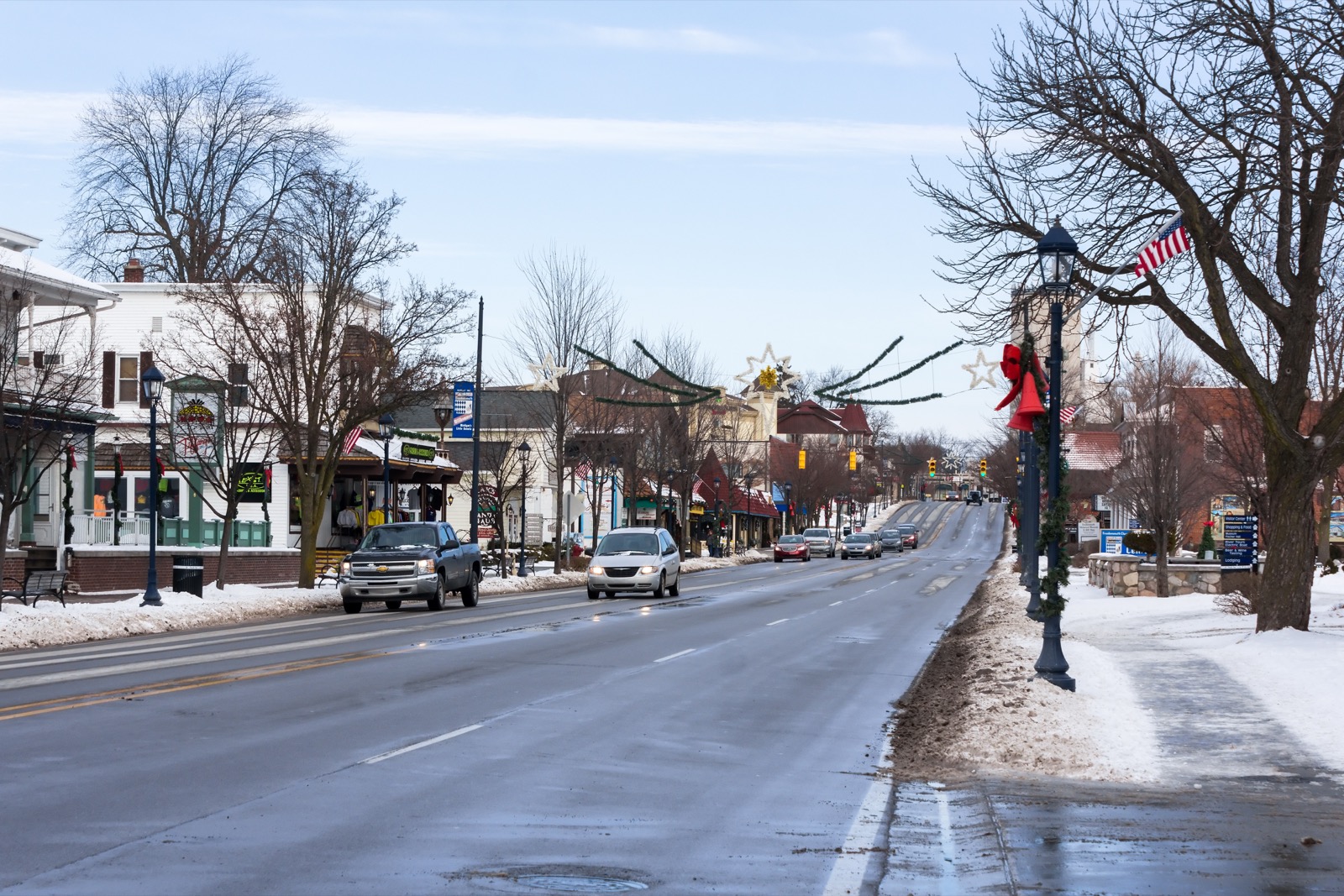
The whole commercial district plays a single architectural note: timber-framed Franconian facades, steep gabled roofs, painted shutters, window boxes spilling with red geraniums in summer. Main Street runs straight through the middle, lined with restaurants and shops and finished off by the spire of St. Lorenz Lutheran Church rising over the rooftops a few blocks west.
How Frankenmuth Became Bavarian
Before the Germans
Before 1845, the land along the Cass River belonged to the Chippewa, who used it for seasonal hunting and fishing camps. The river valley was a tangle of oak, ash and tamarack swamp, sparsely settled by white pioneers and largely untouched by farming.
The federal government had recently purchased a vast tract of land from the Saginaw Chippewa under the 1819 Treaty of Saginaw, opening the territory for sale. By the early 1840s the Saginaw Valley was a frontier in the literal sense: a few scattered German immigrant families, a Lutheran missionary preaching the gospel from horseback, and a Chippewa population already being squeezed westward.
That Lutheran missionary was Friedrich Wyneken, a Hanoverian-born pastor who wrote home to Germany in 1840 begging for help. His report described thousands of German immigrants in Ohio, Indiana and Michigan with no church, no school, no pastor to bury their dead.
The letter landed on the desk of a country pastor in Neuendettelsau, a small village in the Mittelfranken region of Bavaria. His name was Johann Konrad Wilhelm Loehe.
The Lutherans Arrive (1845)
Loehe was an unusual man. He was a confessional Lutheran in an era of theological compromise, a brilliant preacher who never crossed the Atlantic himself but who would shape the next century of American Lutheranism from his Bavarian parsonage. By 1844 he had hatched a plan: send a mission colony, an entire German Lutheran village transplanted whole, to the Saginaw Valley.
The colony would have two purposes. It would serve the spiritual needs of German pioneers already in Michigan. And it would carry the gospel to the Chippewa.
To lead it, Loehe chose August Crämer, a graduate of Erlangen University then teaching German at Oxford. Crämer was twenty-five when Loehe asked him, twenty-six when he stepped onto the deck of the Caroline. He had also just become engaged to a young woman named Dorothea Benthien, who agreed to make the crossing with him.
Fifteen settlers sailed with him, most of them farmers from the village of Roßtal and the surrounding country around Neuendettelsau and Nuremberg. The voyage took seven weeks. From Castle Garden in New York they pushed west through the Erie Canal, the Great Lakes, Detroit, and finally up the Cass River by Indian trail to a tract of 680 acres the church had bought from the federal government for $1,700.
They arrived on August 18, 1845. They named the place Frankenmuth: Franken for Franconia, Mut for courage. By Christmas Day 1846 they had built a log church. They called it St. Lorenz, after a famous Lutheran church in Nuremberg.
The Town at Its Peak (1880 to 1950)
The Indian mission did not succeed. The Chippewa were already drifting away from the cleared lands of the white settlers, moving to better hunting grounds west and north. Crämer and his successors baptised perhaps thirty-five Chippewa converts in those early years. By 1848 the colony helped establish a satellite mission station further north called Bethany, and a decade later the mission to the Chippewa had effectively ended.
What did not end was the German Lutheran town. Word reached Franconia and Saxony. More families came. By the 1860s and 1870s Frankenmuth was a substantial farming community of dairies, wheat fields, sausage-makers and beer-brewers.
In 1862, two cousins named William Knaust and Martin Heubisch founded the Cass River Brewery on the banks of the river, brewing German-style lagers for the German-style town. It is the brewery that still operates today as the Frankenmuth Brewery, claimant to the title of America’s oldest microbrewery.
In 1880 the congregation completed the third and current St. Lorenz Lutheran Church, a 1,200-seat Gothic Revival sandstone giant designed by Cleveland architect C. H. Griese. In 1847 St. Lorenz had become one of the fourteen charter congregations of what would soon be called the Lutheran Church-Missouri Synod, the conservative confessional body founded that year by Saxon and Franconian Lutheran immigrants. The mother church of an entire American denomination stood in a town of a thousand people.
German remained the language of daily life for a century. German-language services were held at St. Lorenz into the 1950s. The parochial school taught in German. Sausage-makers cured wieners and bratwurst and weisswurst by old village recipes. The whole place looked, to outsiders, less like a Michigan town than like a piece of Bavaria that had floated up the Cass River and dropped anchor.
The Bavarian Turn (1959 Onward)
By the 1950s Frankenmuth had a problem. The German immigrant generation was dying. The young people increasingly spoke English. Cars and highways were carrying tourists right past the town on the way to somewhere else.
One family decided to do something about it. William “Tiny” Zehnder Jr., his brother Eddie and sister Dorothy ran the Zehnder family’s restaurant on Main Street, an old hostelry called the Exchange Hotel that their parents had bought in 1928 and turned into a chicken-dinner restaurant. In 1950 the Zehnders bought their main competitor across the street, Fischer’s Hotel, where the family-style chicken dinner tradition had actually started.
Tiny travelled to Bavaria and Austria in the late 1950s and was struck by the timber-framed Bavarian villages there. In May 1959 he opened Fischer’s Hotel as the Frankenmuth Bavarian Inn, with a full Bavarian facade, dirndl-clad servers and a glockenspiel tower. The grand opening was a sensation. Within weeks it became an annual celebration: the Frankenmuth Bavarian Festival, now Michigan’s largest German-heritage event, held every June since.
For the next fifty years, Tiny Zehnder more or less talked the rest of Main Street into following his lead. By the 1980s every commercial building downtown had been remodelled in Franconian timber-frame style. The covered wooden bridge across the Cass River was built in 1979 and 1980 by the Vermont craftsman Milton Graton at the Zehnders’ commission. Frankenmuth had reinvented itself, not by becoming something new, but by amplifying what it already was.
The Landmarks of German Frankenmuth
St. Lorenz Lutheran Church, 140 Churchgrove Road. Mother church of the Lutheran Church-Missouri Synod and the spiritual anchor of the colony from the day the log church was dedicated in 1846. The current 1880 sandstone building seats 1,200 and still rings its bells across the rooftops of Frankenmuth every Sunday. A separate historical chapel on the grounds preserves Pastor Crämer’s pulpit and the original communion vessels brought from Bavaria.
Zehnder’s of Frankenmuth, 730 South Main Street. The chicken-dinner restaurant that built the town. Founded as the Exchange Hotel in 1856, bought by William and Emilie Zehnder for $20,000 and a leap of faith in 1928, opened as Zehnder’s on Mother’s Day 1929. The all-you-can-eat family-style chicken dinner became the signature of Frankenmuth eating. The Zehnder family still runs the place, and so does the original recipe.
Bavarian Inn Restaurant, 713 South Main Street. The Fischer family started the chicken-dinner tradition here in the early 1900s. Tiny Zehnder bought the place in 1950, reopened it as the Frankenmuth Bavarian Inn in 1959, and effectively launched modern Frankenmuth tourism on that opening day. The glockenspiel in the tower plays four times daily.
Bronner’s CHRISTmas Wonderland, 25 Christmas Lane. The world’s largest Christmas store, founded in 1945 by a Frankenmuth-born sign painter named Wallace “Wally” Bronner. He started in his parents’ basement painting signs for local merchants. Eighty years later, Bronner’s covers 320,000 square feet, sells ornaments from fifty countries, and pulls in over two million visitors a year. Wally Bronner died in 2008. His family still runs it.
Frankenmuth Brewery, 701 Main Street. Founded in 1862 as the Cass River Brewery by cousins William Knaust and Martin Heubisch. It survived Prohibition, a 1987 fire, and a 1996 tornado that flattened most of the building. Reopened in 2003 on the same Main Street site, it claims the title of America’s oldest microbrewery.
Holz-Brücke Covered Bridge. The wooden covered bridge across the Cass River, 239 feet long, built by Vermont bridgewright Milton Graton between 1979 and 1980 and dedicated September 9, 1980. The Zehnders commissioned it as both a working bridge to their land across the river and a piece of frank Bavarian theatre. It uses no metal in the main structure: 163,288 board feet of Douglas fir, oak and tamarack, pegged together.
Frankenmuth Historical Museum, 613 South Main Street. A small but careful museum in an 1905 brick storefront, with the original immigration records, German-language school primers, the log-cabin diorama of the 1845 arrival, and the story of the Indian mission told honestly. Worth an hour before lunch.
Where the Frankenmuth Germans Came From
The 1845 founding settlers came almost entirely from a single corner of Bavaria: Franconia, specifically the rural country around Neuendettelsau in Mittelfranken. Eight of the original fifteen were from the small town of Roßtal, just outside Nuremberg. Most of the rest came from villages within thirty miles of Wilhelm Loehe’s parish.
These were not the more famous Saxon Lutheran emigrants who founded the Missouri Synod’s Perry County colony at the same time. Frankenmuth’s people were Franconian: rural Bavarians, mostly small farmers, devout in a conservative Lutheran tradition that the broader Bavarian state church was abandoning. Loehe was effectively recruiting from the disaffected confessional fringe of his own region.
The chain migration that followed in the 1850s, 1860s and 1870s broadened the catchment area. Settlers came in from across Franconia, from Bayreuth in the east to the country around Nuremberg, and eventually from Lower Saxony and Hesse as well. But the Franconian root never left. It is still there in the dialect that elderly parishioners at St. Lorenz can still produce on request, and in the sausage recipes, and in the architecture of the rebuilt Main Street.
Frankenmuth Today
Around 80 percent of Frankenmuth’s roughly 5,000 residents still claim German ancestry on the census. The Zehnder and Bronner families still run their businesses. St. Lorenz Lutheran is still a major Missouri Synod congregation, with the cemetery behind the church holding three generations of the families who built the town.
The economy is now almost entirely heritage tourism. Around three million visitors come every year for the chicken dinners and Bronner’s and the Bavarian Festival in June and the Oktoberfest in September and the famous Christmas season that lights up Main Street from October through January.
The German language is no longer spoken on the street. The Lutheran services at St. Lorenz are in English. The Bavarian-themed Main Street is genuinely a 1960s and 1970s remodel rather than original. None of that makes the place less German. It makes it German in the way an American small town becomes German over six generations, which is its own thing, and worth preserving.
The town is busier and more prosperous than it has ever been. The mission to the Chippewa that brought the Caroline across the Atlantic in 1845 did not succeed. The Franconian colony it left behind is still here, still Lutheran, still showing up every June in lederhosen, still serving family-style chicken dinners to anyone who comes looking.
Frequently Asked Questions
Why did Germans settle in Frankenmuth?
Frankenmuth was founded in August 1845 as a Lutheran mission colony, organised in Bavaria by Pastor Wilhelm Loehe of Neuendettelsau. Loehe sent fifteen Franconian settlers with Pastor August Crämer to convert the Chippewa of the Saginaw Valley and to serve German pioneers already in Michigan. The Indian mission gradually failed, but the German Lutheran farming town that grew up around it has been there ever since.
Is Frankenmuth still German today?
Yes, in heritage if not in daily language. Around 80 percent of Frankenmuth’s roughly 5,000 residents still claim German ancestry, and St. Lorenz Lutheran Church remains an active and major Missouri Synod congregation. The German language is largely gone from everyday speech, but Bavarian festivals, sausage-makers, Lutheran traditions and the Zehnder and Bronner family businesses keep the German identity of Frankenmuth very much alive.
What are the most famous German landmarks in Frankenmuth?
The most famous German landmarks in Frankenmuth are St. Lorenz Lutheran Church (the mother church of the Missouri Synod, 1845), Zehnder’s of Frankenmuth and the Bavarian Inn Restaurant on Main Street, Bronner’s CHRISTmas Wonderland on Christmas Lane, the 1862 Frankenmuth Brewery, and the Holz-Brücke Bavarian wooden covered bridge over the Cass River. The annual Bavarian Festival every June and the Frankenmuth Historical Museum on South Main Street are also major German heritage anchors.
Where in Germany did the Frankenmuth Germans come from?
The original 1845 settlers came almost entirely from Franconia, specifically the rural Mittelfranken country around Neuendettelsau and Nuremberg in northern Bavaria. Eight of the fifteen founders came from the town of Roßtal alone. Later chain migration in the mid-19th century broadened the catchment area across Franconia, including the Bayreuth and Nuremberg regions, with smaller numbers from Lower Saxony and Hesse.
When did Germans first arrive in Frankenmuth?
The first fifteen German settlers arrived in the Saginaw Valley on August 18, 1845, after a seven-week voyage from Bremerhaven aboard the ship Caroline. They had been recruited and dispatched as a Lutheran mission colony by Pastor Wilhelm Loehe of Neuendettelsau in Bavaria, and led by Pastor August Crämer. By the end of 1846 they had built a log church and named the new town Frankenmuth, “courage of the Franconians”.
If your family’s story passed through Frankenmuth, or any of the Franconian villages around Neuendettelsau and Roßtal that sent their sons and daughters across the Atlantic in 1845, Atlas of Home can trace that journey. From a Bavarian parsonage to a log cabin on the Cass River, to wherever you are now.