
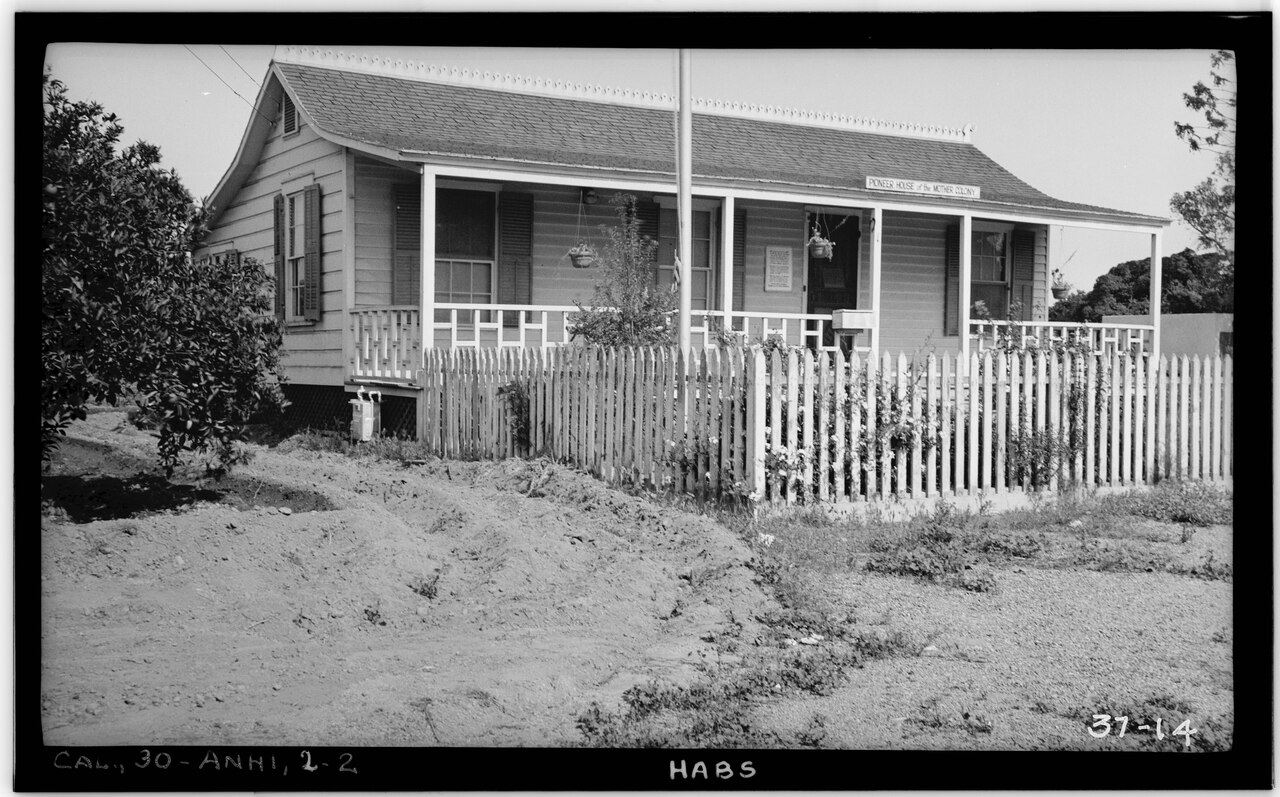
They called it the Mother Colony. Not officially, and not for long. But in the late 1850s, if you rode a wagon twenty-eight miles south of Los Angeles to the dust-flat plain north of the Santa Ana River, you would have heard German spoken on every porch. Fifty families, each with a twenty-acre vineyard plot, building a wine country in the California sunshine. They named the place Anaheim. Home by the Ana.
The Place
Anaheim sits in northern Orange County, on the flat coastal plain between the Santa Ana Mountains and the Pacific. The Santa Ana River curls along its southern edge. Today it is suburban California in its purest form: ranch houses, strip malls, the freeway grid, and the spires of Disneyland rising over the rooftops.
In 1857 it was almost nothing. The 1,165 acres the Germans purchased were part of Rancho San Juan Cajón de Santa Ana, a Mexican-era land grant held by Juan Pacífico Ontiveros. Sheep grazed it. A few willow groves marked the riverbanks. The price was two dollars an acre.
How It Became German
San Francisco, 1857
The story does not start in Anaheim. It starts in San Francisco, where a community of German immigrants, many of them refugees from the failed revolutions of 1848, had been living and working since the Gold Rush. They were musicians, brewers, gunsmiths, bookbinders, carpenters. Some had a little capital. Most had the restless conviction that California still owed them something better than rented rooms in the fog.
In February 1857, a Los Angeles surveyor named George Hansen travelled north to meet with them. Hansen had been born in Fiume, then part of the Austrian Empire, in 1824. He had come to California in 1853 with a hundred dollars and a set of surveying instruments, and he had mapped much of Los Angeles County. He spoke German, English, French and Spanish. He had an idea.
What if the San Francisco Germans pooled their money, bought a tract of cheap land in the warm south, and built a cooperative wine-growing colony? Each shareholder would put in $750. Hansen would survey the land, dig the irrigation ditches, plant the vines, and run the colony as Superintendent. When the vineyards came into bearing, each family would receive a fully planted twenty-acre lot. Title would transfer. Then they could live as winemakers.
Fifty men signed on. They called themselves the Los Angeles Vineyard Society.
Building Anaheim, 1857 to 1859
Hansen rode south and found the Ontiveros parcel. The Society bought it that autumn. Through 1858 and 1859, Hansen and a small crew of Mexican and Native labourers laid out the colony on a strict grid: a central townsite surrounded by fifty numbered twenty-acre vineyard lots, each with its own irrigation lateral fed from a seven-mile main canal that drew water out of the Santa Ana River.
They planted some 400,000 Mission grape cuttings. They built adobe walls and willow hedges around the perimeter to keep cattle out. And in late 1859, the first families left San Francisco and rode down to take possession of their land.
The name Anaheim was a small piece of poetry. Ana, for the river. Heim, the German word for home. Home by the Ana.
The Wine Years
By 1860 the colony was producing 2,000 gallons of wine. By the mid-1860s the figure was in the hundreds of thousands. For roughly a quarter of a century, the Anaheim district was the largest wine-producing region in California, ahead of Napa, ahead of Sonoma, ahead of Los Angeles itself.
Most of the founding fifty had no prior experience in viticulture. They learned. The bookbinder learned. The gunsmith learned. The brewer turned vintner. The colony’s wines travelled by ox-cart to the coast, where they were loaded onto small boats at a wharf the colonists built called Anaheim Landing, about twelve miles west of the town. From there, they sailed to San Francisco and east around the Horn.
A school opened. A German-language newspaper, Der Anaheim Courier, started printing in 1870. A Lutheran congregation gathered. The Anaheim Turnverein, a gymnastic and social club in the German tradition, held picnics and shooting matches. Beer was brewed locally. The town spoke German in its homes, English in its shops, and Spanish in its fields.
The Blight
It began quietly. In 1884, growers noticed leaves curling and drying on vines in a few vineyards. The fruit shrivelled. By the following summer, half the acreage in the Anaheim district was dead. By 1888, the disease had taken roughly 400,000 vines. Forty thousand acres of grapes across southern California were lost.
No one knew what the disease was. It was called, simply, the Anaheim disease. A century later, scientists identified the pathogen as Xylella fastidiosa, a bacterium spread by leafhopper insects that clogs the water-conducting vessels of the vine. We now call it Pierce’s disease, after the plant pathologist who studied it. There was no cure then. There is no cure now.
The colony’s economic foundation collapsed in less than five years. Some families left. The ones who stayed pulled out their dead vines and tried other crops. Walnuts. Sugar beets. The long pale Anaheim chili pepper, which a local farmer would later make famous. And, most successfully, citrus. By the early 1890s, Valencia orange groves stood where the vineyards had been.
The Landmarks
The Mother Colony House, 414 North West Street. Built in 1857 by George Hansen as his home and Society office, this small redwood cottage is the first wooden building in Anaheim and the oldest surviving wood-framed structure in Orange County. It originally stood at the corner of what is now Anaheim Boulevard and Cypress Street. In 1929 the Daughters of the American Revolution saved it from demolition and moved it to its present site, where it has been a museum ever since. Three small rooms. Plain plank walls. The first home of the colony.
Founders’ Park, 400 North West Street. The Mother Colony House sits inside this small heritage park next to the Woelke-Stoffel House, an 1894 Queen Anne built by a later wave of Anaheim Germans. Both buildings are on the National Register of Historic Places, listed together in 2013. A short walk through the park tells the colony story from founding to citrus era.
Anaheim Carnegie Library, 241 South Anaheim Boulevard. Built in 1908 with a grant from Andrew Carnegie, the city’s first dedicated library building served the community for decades before becoming the Anaheim Museum and, more recently, the Muzeo cultural centre. It is one of the few Edwardian-era civic buildings to survive Anaheim’s post-war suburban rebuild.
Kraemer Building, 124 South Claudina Street. A 1924 commercial block commissioned by the Kraemer family, descendants of one of Anaheim’s prominent German-Catholic ranching dynasties. It anchors the downtown intersection where the original colony’s main street crossed the Southern Pacific tracks.
Anaheim Heritage Center, 241 South Anaheim Boulevard. Operated by the city in the old Carnegie Library, the Heritage Center holds the colony’s original ledger books, photographs, vineyard maps, and the Society’s surveyor’s chains. It is the closest thing Anaheim has to a single archive of the German years.
Pearson Park, 401 North Anaheim Boulevard. The land here was donated by Charles Pearson, an early colonist’s grandson, and developed in the 1920s. The park’s amphitheatre, built in 1927, stands on ground that was once part of vineyard lot fifteen.
Anaheim Landing. Now part of the Seal Beach Naval Weapons Station and effectively inaccessible to the public, this small inlet on Anderson Bay was the colony’s port for wine shipments to San Francisco. A historical marker on Pacific Coast Highway near Seal Beach is the only visible trace.
Where They Came From
The founders were not from one place. They were a cross-section of mid-19th-century German emigration: Württembergers, Bavarians, Saxons, Hessians, men from the Rhineland and the Palatinate and the Hanseatic ports. Some had left during or after the 1848 revolutions, when the dream of a unified liberal Germany collapsed under Prussian and Austrian arms. Others had simply followed cousins to California for the gold.
Augustus Langenberger, one of the colony’s most prominent figures, was born in 1824 in Bielefeld, in what was then the small principality of Lippe. He had reached California in 1849 and married into the Yorba family, one of the great Mexican ranching dynasties of southern California. He bridged the German colony and the Californio world in a way few others could.
The pattern that followed was textbook chain migration. Once the colony was established, brothers wrote for brothers. Sisters wrote for sisters. Through the 1860s and 1870s, more Germans arrived from the same villages, the same regions, often the same families. Anaheim was never a single-village transplant the way some American immigrant towns were. It was a federation of Germanies, held together by language and shared purpose.
Anaheim Today
The German colony is gone, and has been for more than a century. Pierce’s disease ended the vineyards. The orange groves that replaced them lasted until the 1950s, when developers pulled them out for tract housing. In 1955, Walt Disney opened Disneyland on a 160-acre former orange grove on the city’s southern edge, and Anaheim became, in the public imagination, a theme-park town.
The 2020 census recorded a population of 346,824. About 54 per cent identify as Hispanic or Latino, the great majority of Mexican descent. Anaheim today is, demographically and culturally, a Mexican-American city with a tourism economy. The German story is one layer in a longer sequence of arrivals and departures, not the dominant present-day identity. Anyone honest about the place has to say that.
What remains of the colony is preserved in fragments. The Mother Colony House still stands. The downtown grid Hansen surveyed in 1858 is still the downtown grid. Anaheim Hofbräu, founded in 1980 by later German arrivals, kept a German restaurant going in the old town until the 2010s. The Anaheim Heritage Center curates the records. And the name itself, the small two-syllable poem that thirty-something men in a San Francisco meeting hall picked in 1857, is on every freeway sign in Orange County. Home by the Ana, still.
Frequently Asked Questions
Why did Germans settle in Anaheim?
A group of fifty German immigrants living in San Francisco wanted to leave the city’s fog and rented rooms for a piece of warm land where they could grow grapes and make wine. In 1857 they formed the Los Angeles Vineyard Society, hired surveyor George Hansen, and bought 1,165 acres on the Santa Ana plain at two dollars an acre. They named the colony Anaheim, “home by the Ana”.
Is Anaheim still a German town?
No. The German colony lasted from 1857 until Pierce’s disease destroyed the vineyards in the late 1880s, and the community gradually dispersed and assimilated through the early 20th century. Today Anaheim is a majority-Latino city of 346,824 best known internationally for Disneyland. The German story survives in landmarks, archives, and the city’s name.
What are the most important German landmarks in Anaheim?
The Mother Colony House at 414 North West Street, built by founder George Hansen in 1857, is the original colony home and the oldest wooden building in Orange County. It sits inside Founders’ Park alongside the 1894 Woelke-Stoffel House. The Anaheim Carnegie Library, now the Heritage Center, holds the colony’s original records and ledgers.
Where in Germany did the Anaheim founders come from?
The fifty founding families came from across the German-speaking world rather than a single region. Documented origins include Württemberg, Bavaria, Saxony, Hesse, the Rhineland, the Palatinate, and the small northern principalities like Lippe. Many had emigrated after the failed revolutions of 1848 and lived in San Francisco for several years before joining the Anaheim colony.
When did Germans first arrive in Anaheim?
The Los Angeles Vineyard Society purchased the land in 1857, surveyors and labourers began laying out the colony that year, and the first families moved down from San Francisco in December 1859. By 1860 the colony was producing wine, and for the next twenty-five years Anaheim was California’s largest wine-producing district.
What happened to the German wine industry in Anaheim?
Beginning in 1884, a mysterious disease later identified as Pierce’s disease, caused by the bacterium Xylella fastidiosa, killed roughly 400,000 vines in the Anaheim district within five years. The colony’s economy collapsed. Surviving families replanted in walnuts, sugar beets, and most successfully Valencia oranges, which carried Anaheim through the early 20th century.
If your family’s story passed through Anaheim, or any of the places where Germans built a home in America, Atlas of Home can trace that journey. From a village in Württemberg or Bavaria, to a wine colony on the Santa Ana plain, to wherever you are reading this now.