
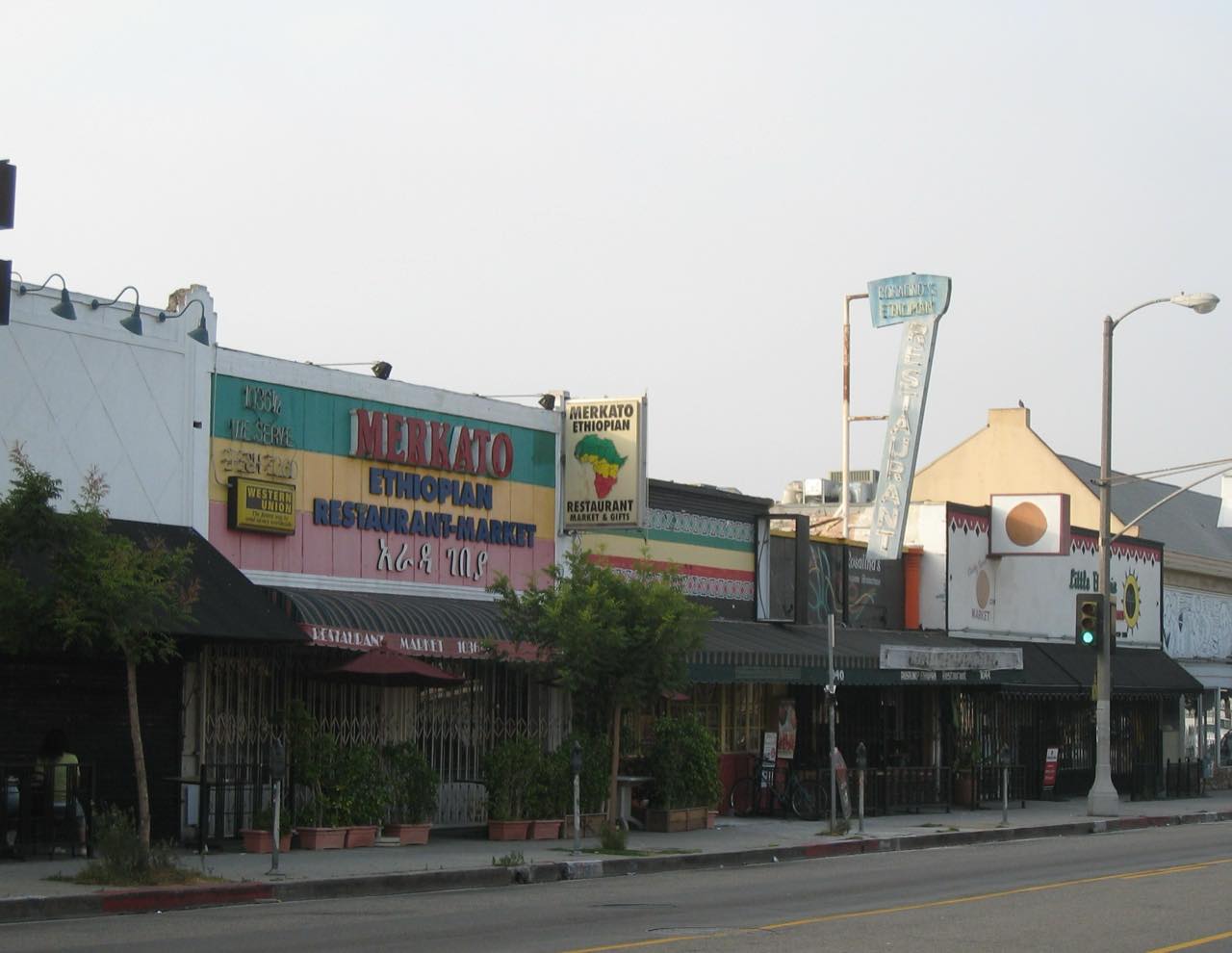
The smell hits before the signs do. Walk south on Fairfax Avenue past Olympic Boulevard and the air turns to roasting coffee, simmering berbere, and a thread of frankincense drifting from a doorway. Hand-painted storefronts carry looping Amharic script beside their English names. A blue city street sign overhead reads Little Ethiopia, stamped with the seal of Los Angeles. On three short blocks, a country eight thousand miles away keeps its afternoon.
This is the only neighborhood in any American city officially named for an African nation. It did not happen by accident, and it did not happen quickly. It took a generation of exiles, one stubborn restaurateur, and a recession that made the rent cheap enough to gamble on.
Little Ethiopia: The Place
Little Ethiopia runs along South Fairfax Avenue, anchored on the stretch between Olympic Boulevard and Whitworth Drive in the Mid-City area of Los Angeles. It sits just south of the historic Jewish Fairfax district, a few minutes from the Miracle Mile and the museums of Museum Row. The housing nearby is a mix of older low-rise apartments and modest single-family homes from the 1920s and 1930s. There is no rail stop on the block, so most visitors arrive by car and circle for parking.
How Fairfax Avenue Became Little Ethiopia
Before the Ethiopians
Long before injera, this corner of Fairfax belonged to Jewish Los Angeles. The avenue to the north had been the spine of the city’s Jewish life since the 1940s, lined with kosher bakeries, delis, and bookshops. The lower blocks were quieter, an extension known informally as SoFax, short for south of Fairfax. Hebrew lettering still survives on a few older facades, ghosts of the businesses that came first.
By the late 1980s, the strip was struggling. The early-1990s recession hollowed out small retail across the city, and storefronts on lower Fairfax sat empty with low rents and no takers. That emptiness, as it turned out, was an opening. For the full story of the avenue’s first chapter, the Jewish community that built Fairfax to the north has its own history worth reading.
The Ethiopians Arrive
Ethiopians did not come to America in large numbers until politics forced them out. Under Emperor Haile Selassie, the few who went abroad were students and diplomats who expected to return home. The 1974 coup that toppled Selassie and installed the Marxist military council known as the Derg changed everything. The terror and forced conscription that followed turned a trickle of travelers into a generation of exiles, many of them young, educated, and unable to go back.
American law opened the door wider over time. The Refugee Act of 1980 created a path for those fleeing the violence, and the Diversity Visa lottery introduced in 1990 brought a second wave through the decade that followed. Between 1992 and 2002, roughly five thousand Ethiopians a year settled in the United States. Washington, D.C. drew the largest share and remains the heart of the American community. Los Angeles became the other pole.
The man who turned a scattering of newcomers into a neighborhood was Fekere Gebre-Mariam. He had arrived in Los Angeles in 1971, before the coup, and by the 1980s he was running a small restaurant. In 1988, watching the success of the Ethiopian cluster forming in Washington, he moved his restaurant Rosalind’s onto South Fairfax Avenue and bet that others would follow.
They did. Chain migration did the rest: a cook who found work poured tips into a market of his own, a cousin opened a travel agency to book flights home, a friend leased the empty unit next door. By 1994 the block held five Ethiopian restaurants, a coffeehouse, a market, a travel agency, and a silk-screen shop, almost all of them clustered within sight of one another.
Little Ethiopia at Its Peak
By the turn of the millennium the strip had outgrown its old nickname. Locals called it Ethiopian Restaurant Row, or Little Addis after the capital, Addis Ababa, and most often Little Ethiopia. The recession that had emptied the block became the reason it filled: cheap rents, vacant shops for sale, and neighbors who left the newcomers alone to build.
The business owners decided the name should be official. A small group led the campaign: Fekere Gebre-Mariam of Rosalind’s, Belay Dawit of Merkato, Meshesha Biru of Nile Travel, and the brothers Birhanu and Getahun Asfaw of Messob. They lobbied City Hall to designate the blocks formally, the way Los Angeles had marked Chinatown, Koreatown, and a dozen other enclaves.
In November 2002, the Los Angeles City Council voted unanimously to recognize the district as Little Ethiopia. It was the smallest of the city’s officially designated ethnic neighborhoods, and the only one in the country named for a nation of Africa. The blue signs went up at Fairfax and Olympic soon after.
The Change
Official status did not freeze the block in place. Some of the founding businesses closed or changed hands as a second generation grew up American, drawn toward professions their parents had not been able to enter. Rising rents along Fairfax, the same pressure that scattered Washington’s Ethiopian strip, pushed against the margins of the restaurants here too.
What held the block together was the food and the ritual around it. The coffee ceremony and the shared platter of injera gave Little Ethiopia an experience visitors could not get from a menu alone, and that kept the doors open when retail elsewhere on Fairfax turned over. The strip thinned but did not empty.
The Landmarks of Little Ethiopia
Rosalind’s Ethiopian Restaurant, 1044 South Fairfax Avenue. The block begins here. Fekere Gebre-Mariam moved his restaurant to this address in 1988 and is remembered as the godfather of Fairfax, the man whose gamble started the row. Rosalind’s is widely called the oldest Ethiopian restaurant in the city, and it survived the pandemic shutdowns that nearly broke the model of shared, hand-eaten meals.
Merkato Ethiopian Restaurant and Market, 1036 South Fairfax Avenue. Named for the sprawling open-air market in Addis Ababa, Merkato pairs a restaurant with a grocery selling spices, teff flour, coffee, and imported staples. Its owner, Belay Dawit, was one of the four leaders who pushed the city to make the name official. The painted Amharic sign out front is one of the most photographed on the street.
Messob Ethiopian Restaurant, 1041 South Fairfax Avenue. Open since 1985, Messob is among the longest-running on the block, named for the woven basket-table that Ethiopian families gather around to eat. Brothers Birhanu and Getahun Asfaw built it into an anchor and joined the campaign for designation. For years it was the room celebrities and visiting Ethiopian musicians were taken to first.
Nile Travel. Less photographed than the restaurants but just as vital, Nile Travel was the agency that booked the flights home. Run by Meshesha Biru, another of the four campaign leaders, it handled the air tickets, the wired remittances, and the paperwork that tied the block to Addis Ababa. The travel agency was always the quiet infrastructure of an immigrant strip.
Nyala Ethiopian Cuisine, 1076 South Fairfax Avenue. A ghost of the row’s busier years, Nyala drew a steady crowd for decades before closing. Named for the spiral-horned antelope of the Ethiopian highlands, it was one of the restaurants that made the block feel like a district rather than a single destination. Its shuttered front is a reminder of how thin the margins on Fairfax can be.
Awash, around the corner on Pico Boulevard. Just off the main strip, Awash takes its name from the river that runs through Ethiopia’s interior. Small and unflashy, it is the kind of neighborhood room where the coffee ceremony unfolds without ceremony for a tourist, the green beans washed and roasted over coals at the table before the first cup is poured.
Where the Little Ethiopia Ethiopians Came From
The exiles who built Fairfax came overwhelmingly from Ethiopia’s cities, and above all from Addis Ababa. The Derg’s repression fell hardest on the educated urban class, the students and professionals who had the most to lose and the means to leave, so the people who landed in Los Angeles were disproportionately city dwellers carrying a capital-city culture of coffee houses and restaurants with them.
They settled in Los Angeles for the same reasons immigrants always have: cheap rent during a downturn, a foothold opened by someone who arrived first, and a critical mass that made a country reproducible on three blocks. Their Eritrean neighbors, from the territory to Ethiopia’s north that won independence in 1993, share much of the cuisine and the coffee ritual but built their own American story; the largest of those communities, the Eritreans of Oakland, anchored the Bay Area instead.
Little Ethiopia Today
The block is quieter than it was at its peak, but it is far from finished. Restaurants still draw weekend crowds who come for the experience as much as the food, the platter of injera set down between strangers, the slow theater of the coffee ceremony with its incense and three poured rounds. A second generation, raised in Los Angeles and often working far from Fairfax, treats the strip as the place to bring outsiders and to come home for the holidays.
Once a year the block belongs entirely to the community. Every September, for the Ethiopian New Year, Enkutatash, the street closes to traffic and fills with thousands of people in white cotton dress, vendors, drummers, and dancers under the September sun. The festival has run for more than two decades, a yearly proof that the neighborhood still has a center even as the city changes around it.
Greater Los Angeles is now home to one of the largest Ethiopian communities in the country, tens of thousands of people spread far beyond these three blocks. Most of them do not live on Fairfax. They do not need to. The strip was never really a place to live; it was a place to belong, and on a September afternoon with the drums going, it still is.
Frequently Asked Questions
Why did Ethiopians settle on Fairfax Avenue in Los Angeles?
The early-1990s recession left the lower blocks of South Fairfax full of cheap, empty storefronts just as exiles from Ethiopia’s 1974 revolution were arriving in Los Angeles. Restaurateur Fekere Gebre-Mariam moved his restaurant there in 1988, and others followed through chain migration. The Ethiopians in Little Ethiopia clustered where the rent was low and a neighbor had already broken the ground.
Is Little Ethiopia still Ethiopian today?
Yes, though it is smaller than at its peak. Restaurants, markets, and a coffee culture still anchor the three blocks, and the Ethiopian New Year festival each September draws thousands. Rising rents and a more dispersed second generation have thinned the strip, but it remains the symbolic heart of Ethiopian Los Angeles.
What are the most famous landmarks in Little Ethiopia?
Rosalind’s at 1044 South Fairfax, opened on the block in 1988, is widely called the city’s oldest Ethiopian restaurant. Merkato at 1036 South Fairfax and Messob at 1041 South Fairfax, the latter open since 1985, are the other longtime anchors. The blue Little Ethiopia city sign at Fairfax and Olympic marks the gateway.
Where did the Ethiopians in Little Ethiopia come from?
Most came from Ethiopia’s cities, above all the capital Addis Ababa, after the 1974 coup brought the Derg military regime to power. The repression fell hardest on the educated urban class, so the Ethiopians in Little Ethiopia were largely city dwellers who carried a capital-city cafe culture with them. Later arrivals came through the Diversity Visa lottery of the 1990s.
When did Ethiopians first arrive in Los Angeles?
A small number of Ethiopian students and professionals lived in Los Angeles before 1974, but the community grew after the coup that year sent exiles abroad. The Fairfax cluster took shape from 1988, and the City of Los Angeles officially designated Little Ethiopia in November 2002. It was the first American neighborhood named for an African nation.
If your family’s story passed through a block like this one, a strip of a faraway country rebuilt in an American city, that history is worth holding onto. The same migration that filled Fairfax filled neighborhoods across the map, including the original Little Ethiopia in Washington, D.C. that inspired it.