
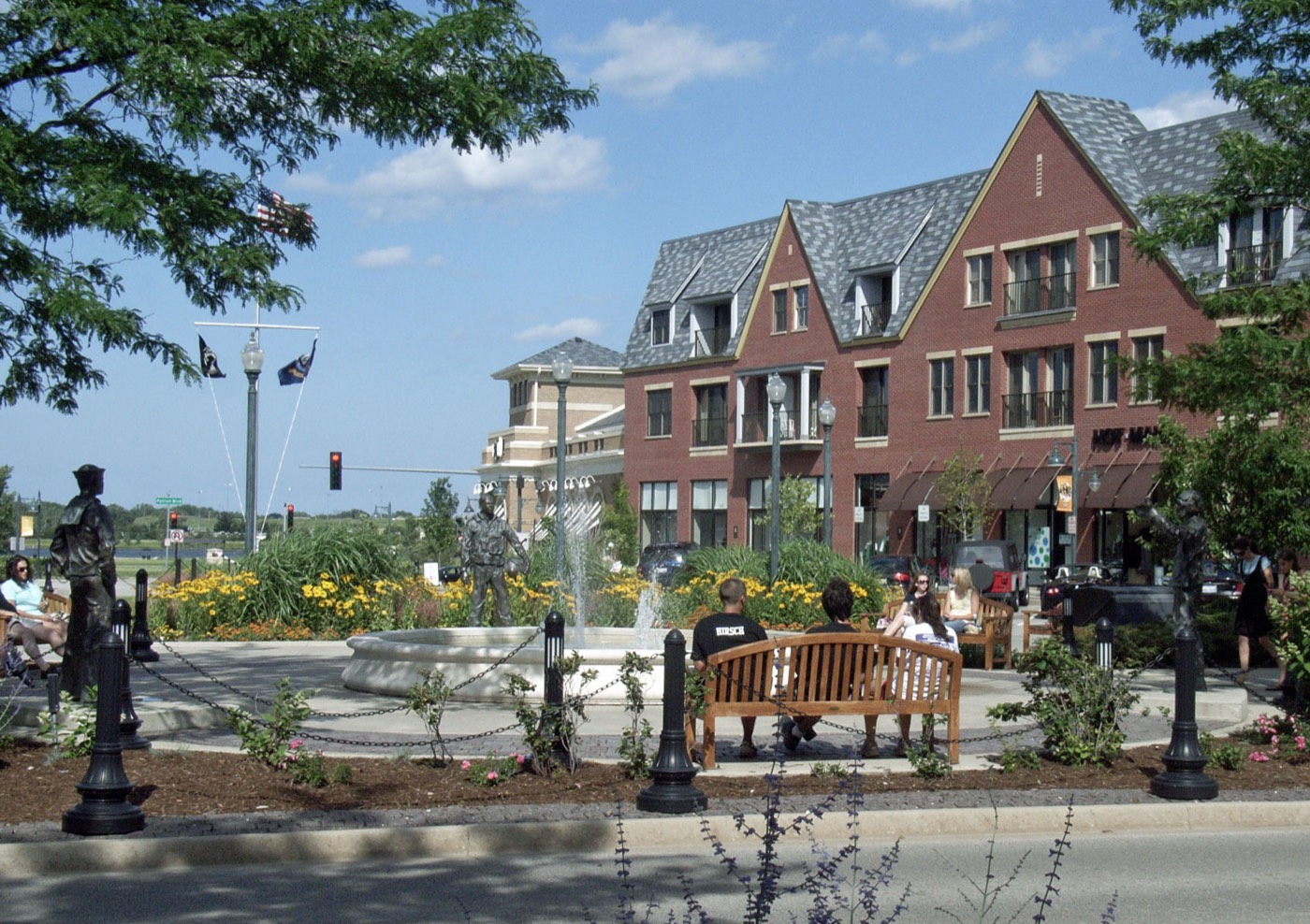
On a Saturday morning at The Glen Town Center, a clutch of families drifts between the bookshop and the cafes along Tower Drive, the children running ahead in matching school hoodies while the parents trade notes in Mandarin about maths tutors and orchestra auditions. This is one of the quieter truths of the Chinese in Glenview, Illinois: a community that arrived not in a single wave but household by household, drawn north along the lakeshore by the same thing that has pulled professional families to this town for generations, the schools.
The Place
Glenview sits about twenty miles north of downtown Chicago, on the north branch of the Chicago River, near the southern edge of the storied North Shore. It is an old farming settlement that grew up slowly, first called South Northfield, then North Branch and Oak Glen, before taking the name Glenview in 1895 and incorporating as a village in 1899 with just 350 residents.
For most of the twentieth century the village was defined by the Glenview Naval Air Station, established in 1940 on more than a thousand acres of former farmland. When the base closed in 1995, the runways came up and a new district rose in their place, and the village kept its reputation as one of the most affluent and highly educated corners of metropolitan Chicago.
Today Glenview is home to roughly 47,000 people, with a median family income near $139,000 and a school system that consistently ranks among the best in Illinois. It is, in the language of estate agents and relocation guides alike, a town people move to for the next generation.
How It Became Chinese
There was no historic Chinatown here, no single founding family whose name everyone remembers. The Chinese presence in Glenview is a story of the late twentieth and early twenty-first centuries, written by professionals who arrived already credentialled and chose the North Shore the way they chose everything else: by reading the data.
The wider Chicago context
Chinese settlement in the Chicago region runs deep. The city’s South Side Chinatown dates to the early 1900s, and over the following century the Chinese population spread far beyond it. By the 2020s the greater Chicago area was home to well over 150,000 people of Chinese descent, a mix of native-born Americans and immigrants from the mainland, Taiwan, Hong Kong and Southeast Asia.
As that population grew and professionalised, it followed a now-familiar suburban arc. Engineers, physicians, researchers and finance professionals moved out of the older urban neighbourhoods toward suburbs chosen for one overriding reason, and on the North Shore that reason had a number attached to it: school rankings.
The pull of the schools
Glenview is served at the elementary and middle level by Glenview Community Consolidated School District 34, and at the high school level by Glenbrook High School District 225, whose Glenbrook South High School is routinely placed among the top public high schools in Illinois and the country. For a generation of immigrant parents who had themselves climbed through competitive examination systems in China and Taiwan, that ranking was not an abstraction. It was the whole argument.
The town offered what such families prized: safe streets, excellent public schools that cost nothing beyond the property taxes, and a short, predictable commute to professional jobs in the northern suburbs and downtown. Word travelled, as it always does, through colleagues and relatives and parents met at school events.
The redevelopment that gave the village a centre
The closure of the Naval Air Station in 1995 reshaped Glenview just as this newer migration was gathering. After a costly environmental cleanup overseen by the Navy and the Illinois and federal EPA, the 1,121-acre site was redeveloped through the late 1990s and early 2000s into a mixed-use district known as The Glen, complete with new housing, parkland and a walkable retail core.
The result was that newcomers arriving in those years found not a sleepy bedroom suburb but a village actively building itself a new heart. Families settling for the schools also found somewhere to gather on a weekend, and the new district quickly became common ground for the town’s growing Asian American population.
A North Shore pattern
Glenview’s Chinese growth did not happen in isolation. It is part of a wider clustering of Chinese professional families across the northern and north-western suburbs, from neighbouring the Chinese in Northbrook just across the village line to the Chinese in Schaumburg to the west and the Chinese in Naperville out in DuPage County. The same families who shaped Glenview often had cousins or former classmates two towns over, and the weekend Chinese schools, churches and restaurants of the region served all of them.
By the most recent census counts, Asian residents made up roughly 16 per cent of Glenview’s population, well above the Illinois figure of around 6 per cent, with Chinese families forming a substantial share of that total alongside Korean, South Asian and other communities. Glenview had, quietly and without fanfare, become one of the more Asian suburbs of the North Shore.
The Landmarks
The Glen Town Center, 2030 Tower Drive. Built on the old airfield and opened in the early 2000s, this open-air centre anchored by Von Maur and Dick’s Sporting Goods is the village’s de facto town square. On weekends it fills with families from across the North Shore, and for many Chinese households it is the default meeting point, equal parts shopping, cinema and the long unhurried walk that follows a meal.
Szechwan North, 2857 Pfingsten Road. Serving the North Shore since 1992, this restaurant predates much of the area’s Chinese growth and has fed it the whole way through. Its Sichuan menu, heavier on chilli and peppercorn than the old American-Chinese template, is the kind of place where parents take visiting relatives and where the food tastes of home rather than of compromise.
Joong Boo Market, 670 Milwaukee Avenue. A large pan-Asian international grocery along the Milwaukee Avenue corridor, Joong Boo is where the weekly shop happens. Korean in origin, its aisles carry the produce, sauces, noodles and frozen dumplings that Chinese cooks rely on, and its presence in Glenview itself spares families the longer drive to Chinatown.
H Mart, 3385 North Milwaukee Avenue. Sitting on the Glenview and Northbrook border, this branch of the country’s largest Asian supermarket chain is a regional draw, with a busy upstairs food court and an enormous fresh-fish counter. For North Shore families it is less a shop than a destination, the kind of place a Saturday is built around.
Glenbrook South High School, 4000 West Lake Avenue. The reason many families chose Glenview in the first place. Part of District 225 and ranked among the strongest public high schools in the state, its hallways, its rigorous course catalogue and its long lists of academic and musical achievement are the quiet engine of the town’s appeal to immigrant professionals.
Xilin Northshore Chinese School. Run by the Xilin Association, a Chinese-language education organisation founded in the Chicago suburbs in 1989, the Northshore branch holds its weekend classes at Oakton College’s Skokie campus a short drive south. It is where many Glenview children spend their Saturday or Sunday mornings learning to read and write the language their grandparents speak, long after the regular school week has ended.
North Shore Chinese Christian Church. Based in nearby Deerfield, this congregation bought its property in 1989 and has worshipped in Mandarin since its founding, adding an English-language service in 1991 as a second generation came of age. For Glenview’s Christian Chinese families it is a spiritual home and a social anchor, one of the institutions that knit scattered suburban households into something that feels like a community.
Where They Came From
The Chinese families of Glenview trace their origins to a broad sweep of places rather than a single ancestral village. Many came from the mainland, from the great university and industrial cities of the east coast and the interior, arriving first as graduate students or skilled-visa workers before settling for good. Others came by way of Taiwan, part of an earlier and highly educated stream of migration into American science and medicine.
What united them was less geography than trajectory. These were households that had moved through competitive schooling and into professional careers, and who carried that same emphasis with them into the suburbs. The choice of Glenview was, in a sense, an extension of the choices that had brought them to America at all.
That origin shows in the texture of the community. It is professional, dispersed across the village rather than concentrated in a single enclave, and oriented as much toward the next generation’s prospects as toward preserving the past. The shared language is Mandarin more often than Cantonese, and the shared anxiety is the same one heard in every North Shore kitchen: are the children doing enough.
Glenview Today
Glenview today is a town where the Chinese presence is woven through ordinary life rather than set apart from it. There is no gate, no archway, no single street that announces the community. Instead it shows in the queue at H Mart, in the Mandarin overheard at The Glen, in the make-up of the orchestra and the maths team at Glenbrook South.
The most recent census figures suggest the village has grown more diverse over the past few years even as its overall population has dipped slightly, with Asian residents holding steady at around a sixth of the total. The community is mature now, with American-raised children moving through the schools their parents chose the town for, some of them already returning as adults to raise families of their own.
It is not a perfect story, and Glenview does not pretend otherwise. The pressure that makes its schools so good can weigh heavily on the children inside them, and the very affluence that drew families here keeps newcomers without means firmly out. But for the Chinese households who have made this North Shore village home, Glenview offers something it has offered every wave of strivers before them: a quiet, well-ordered place to invest everything in what comes next.
Frequently Asked Questions
How many Chinese people live in Glenview, Illinois?
Glenview’s population is roughly 47,000, of whom about 16 per cent, or some 7,700 people, identify as Asian. Chinese families make up a substantial portion of that figure, alongside Korean, South Asian and other communities, making the Chinese in Glenview, Illinois one of the larger such communities on the North Shore.
Why did Chinese families move to Glenview?
The single biggest draw is the schools. Glenview is served by the highly regarded District 34 elementary system and by Glenbrook South High School in District 225, consistently ranked among the best in Illinois. Combined with safe neighbourhoods and a strong professional job market, that made the village a natural choice for credentialled Chinese immigrant families.
Is there a Chinatown in Glenview?
No. Unlike Chicago’s South Side, Glenview has no historic Chinatown or single ethnic enclave. The Chinese community here is dispersed across the village, and its gathering points are everyday spaces such as The Glen Town Center, Asian grocery stores and weekend Chinese schools rather than a dedicated district.
Where do Chinese families in Glenview shop for groceries?
Joong Boo Market on Milwaukee Avenue is a large pan-Asian grocery within Glenview itself, while H Mart on North Milwaukee Avenue, on the Glenview and Northbrook border, is a major regional Asian supermarket with a popular food court. Both stock the fresh produce, sauces and frozen foods that Chinese home cooking relies on.
Where can children learn Chinese in the Glenview area?
The Xilin Northshore Chinese School, part of the Chicago-area Xilin Association founded in 1989, holds weekend language and culture classes at Oakton College’s Skokie campus a short drive from Glenview. Many Glenview children attend such weekend programmes to keep up their Mandarin reading and writing.
What is The Glen in Glenview?
The Glen is the mixed-use district built on the site of the former Glenview Naval Air Station, which closed in 1995. After a major cleanup the 1,121-acre site was redeveloped with housing, parkland and The Glen Town Center, a walkable retail core that has become the village’s town square and a common gathering place for its diverse, including Chinese, population.
If your family’s story passed through Glenview, or any of the places Chinese families have made home in America, Atlas of Home can trace that journey. From the university cities of the mainland and Taiwan, to a North Shore village chosen for its schools, to wherever you are now.