
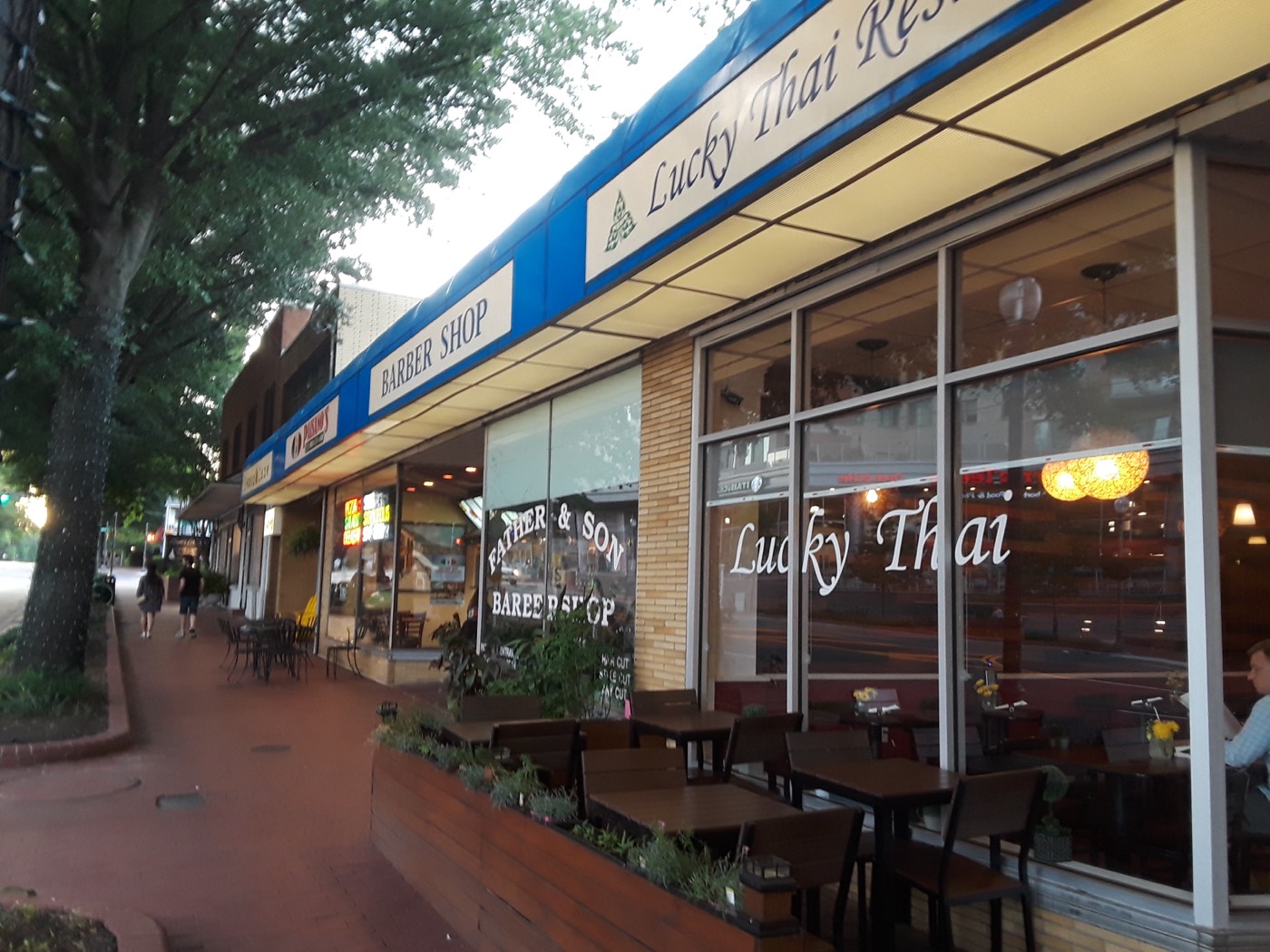
Drive west along Broad Street through downtown Falls Church and the shopfronts read like any prosperous Washington suburb: a 1936 movie house, glass offices, a bike trail threading toward the capital. Then a window stacked with golden saltenas gives the game away. The Bolivians in Falls Church have folded the flavours of a high Andean valley into one of the wealthiest small cities in America, and they have done it so quietly that most of their neighbours have never noticed.
The Place
Falls Church is barely a city at all, at least by size. It covers just over two square miles and holds fewer than fifteen thousand people, an independent municipality wedged between Arlington and Fairfax counties, about six miles from the White House.
It is also one of the richest places in the United States. As of the 2020 census the city’s median household income was roughly $146,922, the second highest of any county or county equivalent in the nation, behind only Loudoun County, Virginia. Its poverty rate sits near two per cent.
That affluence grew from geography. Falls Church incorporated as an independent city in 1948, a railroad and streetcar suburb that became a magnet for federal workers, contractors and professionals who wanted leafy streets within commuting distance of Washington. The State Theatre on North Washington Street, built as a cinema in 1936 and reputed to be one of the first air-conditioned theatres on the East Coast, still anchors a walkable downtown.
How It Became Bolivian
The Bolivian story in greater Falls Church is really the story of Northern Virginia, which holds the largest concentration of Bolivians anywhere in the United States. Roughly 31,200 Bolivian immigrants live across the Washington and Baltimore metropolitan areas, an estimated 38 per cent of all Bolivians in the country, and the great majority of them are clustered in the Virginia suburbs that ring the District.
Falls Church City itself is tiny, and most Bolivian families live just over its borders in Fairfax and Arlington, where housing is cheaper and apartments more plentiful. But the city and its postal addresses, which stretch well beyond the two square miles of the independent municipality into surrounding Fairfax County, have become a commercial heart for that community. The grocers, bakeries and restaurants carry a Falls Church address even when the customers live a few minutes away.
A valley that has always sent people away
Most of these families trace back to one small corner of Bolivia: the Valle Alto, or High Valley, a cluster of agricultural towns in the Department of Cochabamba. Villages such as Arbieto, Tarata and Santa Rosa appear again and again when Northern Virginia Bolivians describe where their grandparents farmed.
The Valle Alto has been defined by emigration since the nineteenth century. Land was scarce, harvests were uncertain, and for generations young people left in search of work, first to other parts of South America and eventually much farther.
The chain that ran through Argentina
The path to Virginia rarely ran straight. Through the 1970s and 1980s many Valle Alto families moved first to Argentina, drawn by work in its cities, before a second leap brought them north. A notable wave reached Northern Virginia in the late 1980s, around 1987, 1988 and 1989, with families making the long trek from Argentina rather than directly from Bolivia.
Bolivian migration to the United States accelerated sharply in the 1980s. By 2010 Virginia was home to more than 31,000 Bolivian-born residents, the largest such population of any state in the country, and the figure has only grown since.
Chain migration did the rest. One relative who found a foothold sponsored a brother, a cousin, a neighbour from the same village, until whole stretches of the Valle Alto had been transplanted, family by family, into the same few zip codes.
Building two worlds at once
What makes the community distinctive is how tightly it stays bound to home. Bolivians in Northern Virginia raise money through soccer leagues and fundraisers, then send it back to the Valle Alto to pave a plaza, repair a church or stage a village festival.
The result is a genuinely transnational life. As one chronicler of the community put it, Bolivians in Virginia describe two spaces at once: Bolivia, the territory of the heart, and the United States, the land of work. The two are held together by constant traffic of money, news, music and people.
From newcomers to homeowners
That work has paid off in concrete ways. Across the DC metro Bolivian community, nearly half of immigrant households own their homes, and rates of self-employment run higher than for other immigrant groups, visible in the family-run restaurants and markets that line the commercial strips around Falls Church.
Many work in construction, building maintenance and the food trade, the industries that built and now sustain the booming suburbs around them. The children of those first arrivals are increasingly American-born professionals, some of them growing up in or commuting through the very Falls Church streets their parents once knew only as a place to shop and gather.
The Landmarks
Luzmila’s Bolivian Restaurant, 809 West Broad Street. Set right on the city’s main commercial spine, Luzmila’s has become a default introduction to Bolivian food for Falls Church locals. The menu runs through saltenas, chicharron, charque, sopa de mani and trancapecho, the dishes of the Cochabamba valley served from morning until night.
Luzmary Bolivian Restaurant, 7151 Lee Highway. Opened in 2015, Luzmary trades on home recipes carried north and cooked the way mothers and grandmothers cooked them. It is the kind of place where the Valle Alto’s village kitchens reappear, intact, in a Virginia strip of shopfronts.
Bolivian Market Inc, 6526 Arlington Boulevard. A neighbourhood grocer rather than a supermarket, the Bolivian Market stocks the pantry of the High Valley: the chillies, grains, cheeses and tinned goods that turn an ordinary American kitchen into a Cochabamba one. For many families it is the weekly anchor of a Falls Church errand.
Cinthia’s Bakery and Cafe, 5860 Columbia Pike. Just southwest of Bailey’s Crossroads, Cinthia’s is one of the bakeries that keep the salteña, that juicy baked empanada, within easy reach. Columbia Pike has long been one of the corridors where Bolivian commerce is thickest.
Pan American Bakery, Columbia Pike, Arlington. A short drive east, this Bolivian bakery is locally famous for its saltenas, the beef and chicken pastries that mark a Sunday morning. Its reputation draws customers well beyond the immediate neighbourhood.
The State Theatre, 220 North Washington Street. Not a Bolivian institution, but the civic heart of Falls Church and a reminder of the city the community shares. The 1936 cinema turned music hall is the kind of downtown landmark that anchors a small city whose Latino residents now make up better than one in ten of its population.
The W&OD Trail. The Washington and Old Dominion rail trail cuts straight through Falls Church on its way to the capital, a forty-five mile ribbon of asphalt that doubles as a bicycle commuting route. It is the kind of shared, ordinary infrastructure where the city’s many communities, Bolivian among them, simply overlap.
Where They Came From
Almost all roads lead back to the Valle Alto of Cochabamba, the temperate farming valley whose towns, Arbieto, Tarata, Santa Rosa and their neighbours, have exported people for well over a century. It is a region whose identity is built as much on those who left as on those who stayed.
Cochabamba’s culture travelled with them. The dishes on Falls Church menus, the saltenas in the bakeries, the dance fraternities that perform Caporales and Tinkus at summer festivals, all of it is recognisably valluno, the culture of that specific high valley rather than Bolivia in the abstract.
Because the migration ran through Argentina for so many, the community also carries traces of that detour, in accents, in family histories, in the timing of arrivals clustered around the late 1980s. The Valle Alto is the root, but the journey was rarely a single step.
Falls Church Today
Falls Church remains, on paper, one of the most affluent and least diverse-looking small cities in America: expensive houses, top-rated schools, a poverty rate near two per cent. Its Hispanic and Latino residents, about a tenth of the population, are a part of that story that the income statistics tend to hide.
That mix of quiet wealth and immigrant enterprise is the Northern Virginia pattern, the same one that produced the Lebanese community in nearby Vienna and the South Asian families who settled in McLean and the planned communities of Stone Ridge. Each found its own foothold in the suburbs around the capital.
The deeper Bolivian presence lives in the ring of Fairfax and Arlington neighbourhoods that share the Falls Church name and postal code. There the community is unmistakable, in the markets and bakeries, in the soccer leagues, and in the great summer gathering of the Festival Boliviano, organised for decades by the Comité ProBolivia, which fills a Northern Virginia fairground with caporales dancers and the music of the Andes.
What endures is the doubleness. Three decades on, families that crossed two continents to reach this corner of Virginia still send money home to pave a plaza in the Valle Alto, still cook the soups of a valley most of their American neighbours could not find on a map. In the wealthiest streets near the capital, a small Andean homeland keeps quietly remaking itself. To trace how a single Cochabamba valley reassembled itself around Falls Church is also to glimpse the wider pattern of Bolivians in nearby Arlington and the other immigrant communities that have reshaped Northern Virginia.
Frequently Asked Questions
Where do the Bolivians in Falls Church mostly come from?
The overwhelming majority trace their roots to the Valle Alto, or High Valley, in the Department of Cochabamba, Bolivia. Towns such as Arbieto, Tarata and Santa Rosa recur in family histories. The Bolivians in Falls Church are part of a chain migration from that one farming region that has been sending people abroad since the nineteenth century.
How large is the Bolivian community around Falls Church and Northern Virginia?
Roughly 31,200 Bolivian immigrants live across the Washington and Baltimore metro areas, about 38 per cent of all Bolivians in the United States, making Northern Virginia the largest Bolivian centre in the country. Fairfax County alone counts around 15,000 and Arlington County about 4,000, many of them in neighbourhoods that share a Falls Church address.
Why did so many Bolivians settle in the Falls Church area?
Chain migration is the main reason. From the 1980s, families from the Valle Alto, often arriving by way of Argentina, followed relatives and former neighbours into the same Northern Virginia suburbs, where construction and service jobs were plentiful. The Bolivians in Falls Church built on that early foothold, sponsoring kin until whole villages were transplanted into a few zip codes.
Where can I try Bolivian food in Falls Church?
Luzmila’s Bolivian Restaurant at 809 West Broad Street and Luzmary at 7151 Lee Highway both serve classic Cochabamba dishes such as saltenas, chicharron and sopa de mani. For groceries and baked goods, the Bolivian Market on Arlington Boulevard and Cinthia’s Bakery on Columbia Pike are longstanding community fixtures.
Is Falls Church really that wealthy?
Yes. As of the 2020 census, Falls Church City had a median household income of about $146,922, the second highest of any county equivalent in the United States, behind only Loudoun County, Virginia. Its poverty rate sits near two per cent, which makes the city’s working immigrant communities easy to overlook in the headline statistics.
How do Bolivians in Northern Virginia stay connected to Bolivia?
The community is intensely transnational. Through soccer leagues, fundraisers and hometown associations, families raise money to improve plazas, churches and festivals back in the Valle Alto. Cultural fraternities perform Caporales and Tinkus dances at events such as the annual Festival Boliviano, keeping the traditions of Cochabamba alive in Virginia.
If your family’s story passed through Falls Church, or any of the places Bolivians have made home in America, Atlas of Home can trace that journey. From a farming village in the Valle Alto of Cochabamba to a salteña counter on Broad Street, to wherever you are now.