
They called it the Belgian Belt. Not officially. You will not find that on any road sign as you drop south out of Sturgeon Bay along Highway 57, past the silos and the dairy barns and the long flat fields that lean toward Green Bay.
But from the 1850s through to the middle of the last century, if you turned off the highway into the village of Brussels, you were in Wallonia. You would hear French-tinged voices in the church porch on Sunday, smell chicken booyah simmering for a parish picnic, and pass small whitewashed chapels at the edges of farm lanes, lit from inside by a single candle.
Brussels, Wisconsin sits about a hundred and seventy miles north of Milwaukee and roughly twenty miles north-east of Green Bay, in the southern half of Door County. The village itself is small, around eleven hundred people, but the cultural footprint of the Belgians in Brussels, Wisconsin stretches far beyond it. Together with neighbouring Namur, Rosiere, Champion, Walhain, Tonet, and Forestville, it forms the largest rural Belgian-American community anywhere in the United States.
Almost everyone here who can trace their family back more than three generations is descended from Walloons. Not Flemish Belgians from the Dutch-speaking north, but French-speaking, Catholic farmers from the rolling country south of Brussels itself. They came in one extraordinary wave starting in 1853, and they never quite left.
Brussels and the Belgian Belt, The Place
Brussels is an unincorporated village in the Town of Brussels, southern Door County. Highway 57 runs straight through it on its way up the peninsula toward Sturgeon Bay and Egg Harbor. Drive five minutes in any direction and you are in open farmland: red brick farmhouses, hay barns, the occasional Lutheran cemetery, and a string of tidy Catholic parishes named for saints unfamiliar to most Americans.
The wider Belgian Belt runs in a triangle across three counties. The Door Peninsula tip in the north, the city of Green Bay in the south-west, and the Lake Michigan shore at Algoma in the east. Within that triangle, the villages bear names that the settlers carried in their pockets from home: Brussels for the capital, Namur for the Walloon provincial capital, Rosiere for Rosières in Walloon Brabant, Champion for a hamlet near Namur, Walhain for another village in Brabant, and Luxemburg for the Belgian province on the German border.
The land here is gently rolling, glacial till over limestone bedrock, with thin topsoil that the first arrivals had to clear of dense hardwood forest before they could plough a furrow. It looks, locals will tell you, a little like home.
How Door County Became Belgian
Before the Belgians
The Door Peninsula was Menominee and Potawatomi country for centuries before the surveyors arrived. By the early 1850s, the southern peninsula was officially open to settlement, but it was still wilderness: hardwood forest, swampy lowlands, and a handful of Yankee logging camps along the bay.
White settlement north of Green Bay was thin. Land was cheap, the rail had not arrived, and the lake winters were brutal. To a hungry farmer in central Belgium, cheap meant possible.
The Belgians Arrive (1853)
The catalyst was a letter. In 1853, ten families from the commune of Grez-Doiceau in Walloon Brabant, smallholders unable to feed their children on their fractured plots, met in each other’s kitchens to discuss emigration. They had read newspaper accounts of cheap government land in Wisconsin, and someone had heard of a ship, the Quinnebaug, sailing from Antwerp in May for thirty-five dollars a passage.
Eighty-one people boarded that ship on 18 May 1853. By autumn most of them had walked north from the docks at Green Bay into the unbroken forest of southern Door County, where they paid the federal government a dollar twenty-five an acre and began felling trees.
What followed was one of the more remarkable bursts of chain migration in nineteenth-century America. Word travelled back to the villages of Brabant, Namur, and Hainaut almost immediately. By 1857, roughly fifteen thousand more Walloons had followed.
They sailed via Antwerp to New York, took trains and lake steamers up to Green Bay, and then walked or rode oxcarts into the woods. Joseph Moreau, Pierre Massart, the Dandois and Delveaux and Patris families, and dozens of others laid the foundations of the villages we still see today. By the end of the decade, roughly three thousand Belgians were farming a twenty-by-fifty mile rectangle of north-eastern Wisconsin.
The early years were brutal. A cholera-like epidemic swept the settlement in 1855. Many families went weeks at a time on fish, wild onions, and roots. But the Walloons stayed. They had nowhere to go back to.
The Belt at Its Peak, and the Fire
By the 1860s the Belgian Belt had real shape. Log churches gave way to frame chapels, then to brick. Catholic parishes were carved out across the three counties. Cheese factories opened. Small brickworks fired the clay that would later, by accident, save many of the homes.
Then came October 1871. On the night of the 8th, a firestorm whipped up by drought and high winds tore across north-eastern Wisconsin. The same dry conditions burned Chicago that night, but the Peshtigo Fire, on the opposite shore of Green Bay, was vastly deadlier and almost completely forgotten by the wider American memory.
The fire jumped Green Bay and tore through the Belgian Belt. The hamlet of Williamsonville, just north-east of Brussels, was annihilated. Of seventy-six residents, only nineteen survived; five men huddled in a well and lived to tell about it. Across Door, Kewaunee, and Brown counties, the death toll among the Belgian settlers ran into the hundreds, and many estimates of the wider region’s loss range between fifteen hundred and two and a half thousand.
What happened next is the part that matters. The Belgians did not leave. They rebuilt, this time in brick. Today, if you drive the back roads of southern Door, the distinctive cream and red brick farmhouses you see are almost all post-1871 reconstructions, raised by farmers who had decided that the next inferno would not take them so easily.
The Change
The twentieth century thinned the community, slowly and without drama. Sons left for jobs in Green Bay and Sturgeon Bay. The Second World War accelerated everything: Walloon-speaking boys went to Europe, came back to a different country, and married outside the tribe.
By the 1970s the Walloon language, once the daily tongue of the Belgian Belt, had narrowed to the elderly. Cheese factories consolidated. Catholic parishes began to share priests, then to merge. Yet the cultural infrastructure built between 1853 and 1900 proved durable. The churches stayed open. The kermisses kept being held. The booyah pots came out every summer for the church picnic.
The Belt did not disappear. It got quieter.
The Landmarks of Belgian Wisconsin
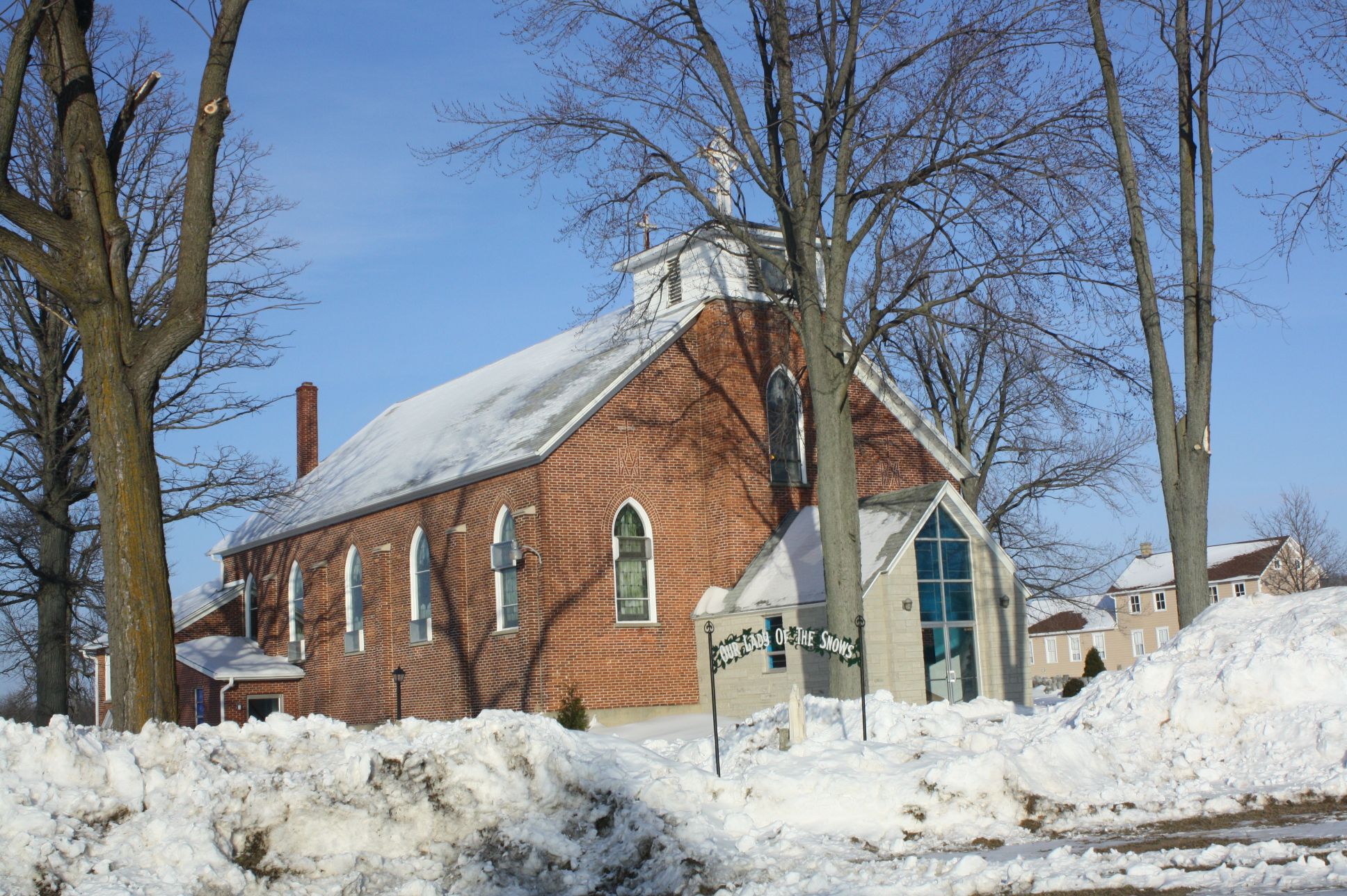
Belgian Heritage Center, 1255 County Road DK, Brussels. Sitting in the Namur National Landmark Historic District, the Heritage Center is the closest thing the community has to a national museum. Its campus is the old St Mary of the Snows complex: an 1893 church now full of exhibits and Walloon-language oral histories, and an 1894 school-and-convent next door. Open weekends from late May through October, and the only museum in the United States dedicated solely to the Walloon-American story.
Our Lady of the Snows Catholic Church, Namur. The handsome brick church at the centre of the Heritage Center campus dates to 1893, replacing an earlier wooden parish lost to wear and fire. It anchored Namur for more than a century and now anchors the museum, hosting the annual Bread & Booyah lunch and the late-summer Kermiss.
Tornado Memorial County Park, Brussels. Five minutes north of the village, on the old site of Williamsonville, the park preserves the well where five men survived the Peshtigo firestorm of October 1871. Founded in 1927, it is the closest thing the Belgian Belt has to a national memorial, and the only place in Wisconsin where you can stand on the ground that the fire whirl actually swept.
The Belgian Roadside Chapels. Scattered along the back roads of Door, Kewaunee, and Brown counties are some twenty-six small votive chapels, most of them built by individual families in the second half of the nineteenth century as thanksgiving for prayers answered. They were modelled on the wayside shrines of the Ardennes. The St Hubert chapel at the St Francis de Paul cemetery north of Duvall is one of the easier ones to find. Each is open to anyone who wants to stop, light a candle, and sit for a minute.
St Peter and St Hubert Parish, Rosiere and Lincoln. Twin Catholic parishes in the heart of the Belt, with Saturday vigil mass at St Hubert in Rosiere and Sunday morning at St Peter in Lincoln. Still active, still serving the descendants of the families who founded them.
Belgian Days, Brussels Town Park. Chartered by the Brussels Lions Club in 1960 and first run in 1961, Belgian Days is the community’s big summer festival. Held the second weekend of July, it features a parade, a youth baseball tournament, three nights of bands in the park, and proper Belgian Belt food: trippe, booyah, and Belgian pie. In its first sixty-odd years it has raised close to a million dollars for local causes.
Brussels Countryside Diner, Highway 57. A working roadside diner that has done as much as anything else to keep trippe on the local menu. Their Belgian trippe, a pork and cabbage sausage served like a hot dog, has been featured on the Travel Channel and remains the easiest way for a visitor to taste the cuisine without waiting for a parish picnic.
Where the Belgian Belt Belgians Came From
Almost every founding family in the Belgian Belt came from Wallonia, the French-speaking southern half of Belgium, and most from a tight cluster of villages in three provinces: Walloon Brabant, Namur, and Hainaut.
The first ten families, the Quinnebaug families of 1853, were from Grez-Doiceau in the commune of Wavre, Walloon Brabant. The next decade’s arrivals fanned out across the same general area: Rosières, Walhain, Bossières, the countryside around the city of Namur, and a scatter of farming hamlets in Hainaut and Liège.
What pushed them out was a familiar set of nineteenth-century pressures. Land fragmentation across too many heirs, repeated potato blights through the 1840s and early 1850s, cholera outbreaks in the lowland towns, and a Belgian state that had little to offer rural Catholics. What pulled them was the same combination that drew so many others: cheap federal land, kin already there, and the slowly building reputation of the Wisconsin Belt as a place where a Walloon farmer could be a Walloon farmer again.
Brussels Today
The Belgian Belt today is rural farming country, with the easy quiet of any northern Wisconsin agricultural community in the early twenty-first century. Dairy and grain still dominate. Newer families have moved in. The Walloon language is, in plain terms, dying. UNESCO classifies Wisconsin Walloon as definitely endangered; fewer than eighty people in the Door County area still speak it, almost all of them in their seventies, eighties, and nineties.
And yet, the cultural infrastructure has not collapsed. The Belgian Heritage Center is in better shape than it was twenty years ago. The Wisconsin Walloon Preservation Project, launched in 2014 by linguist Kelly Biers and now run through the University of Wisconsin–Green Bay’s Belgian American Research Collection, is racing the clock to record and write down what is left of the language. The Kermiss still happens every September, the booyah pots still come out, Belgian Days still fills Brussels Town Park every July.
The Belt does not pretend to be what it was. It is something else now, layered, slower, but conscious. Every brick farmhouse along Highway 57 is a quiet reminder that these families chose to stay after the fire, and after every other thing that came afterwards, and that the choice has not yet been undone.
Frequently Asked Questions
Why did Belgians settle in Door County?
The first Belgian families arrived in 1853 from Grez-Doiceau in Walloon Brabant, drawn by cheap federal land at a dollar twenty-five an acre and newspaper reports of farmable wilderness in north-eastern Wisconsin. Word of mouth and chain migration brought roughly fifteen thousand more Walloons in the following decade. The Belgians in Brussels, Wisconsin and the surrounding Belgian Belt became the largest rural Belgian-American community in the United States.
Is Brussels still Belgian today?
Brussels and the wider Belgian Belt remain culturally Belgian in food, religion, surnames, and architecture, though daily Walloon speech has nearly disappeared. The Belgian Heritage Center in Namur, the annual Kermiss harvest festival, Belgian Days in Brussels Town Park each July, and the Catholic parishes founded by the original settlers all keep the heritage in active use, even as the founding generation passes.
What are the most famous Belgian landmarks in Brussels, Wisconsin?
The Belgian Heritage Center on County Road DK, Our Lady of the Snows Catholic Church in the Namur Historic District, Tornado Memorial County Park on the site of the 1871 firestorm at Williamsonville, the network of twenty-six Belgian roadside chapels across Door, Kewaunee, and Brown counties, and the Brussels Town Park where Belgian Days has been held every July since 1961. The Brussels Countryside Diner on Highway 57 is the easiest place to taste trippe and other Belgian Belt food year-round.
Where in Belgium did the Brussels Wisconsin Belgians come from?
The Brussels Wisconsin Belgians came almost entirely from Wallonia, the French-speaking southern half of Belgium, with the founding 1853 families from the commune of Grez-Doiceau in Walloon Brabant. Subsequent arrivals through the 1850s came from a tight cluster of villages in Walloon Brabant, Namur, and Hainaut, including Rosières, Walhain, Bossières, and the countryside around the city of Namur. They were Walloon-speaking Catholic farmers, not Flemish Belgians.
When did Belgians first arrive in Brussels, Wisconsin?
The first Belgian families arrived in the autumn of 1853, after sailing from Antwerp aboard the Quinnebaug on 18 May 1853 with eighty-one people aboard. They walked north from Green Bay into the unbroken forest of southern Door County, founded the settlements that would become Brussels and Namur, and were followed by roughly fifteen thousand more Walloons over the next ten years.
If your family’s story passed through the Belgian Belt, or any of the Walloon villages south of Brussels that emptied across the Atlantic in the 1850s, Atlas of Home can trace that journey. From the Brabant countryside to a brick farmhouse on Highway 57, to wherever you are reading this now.