
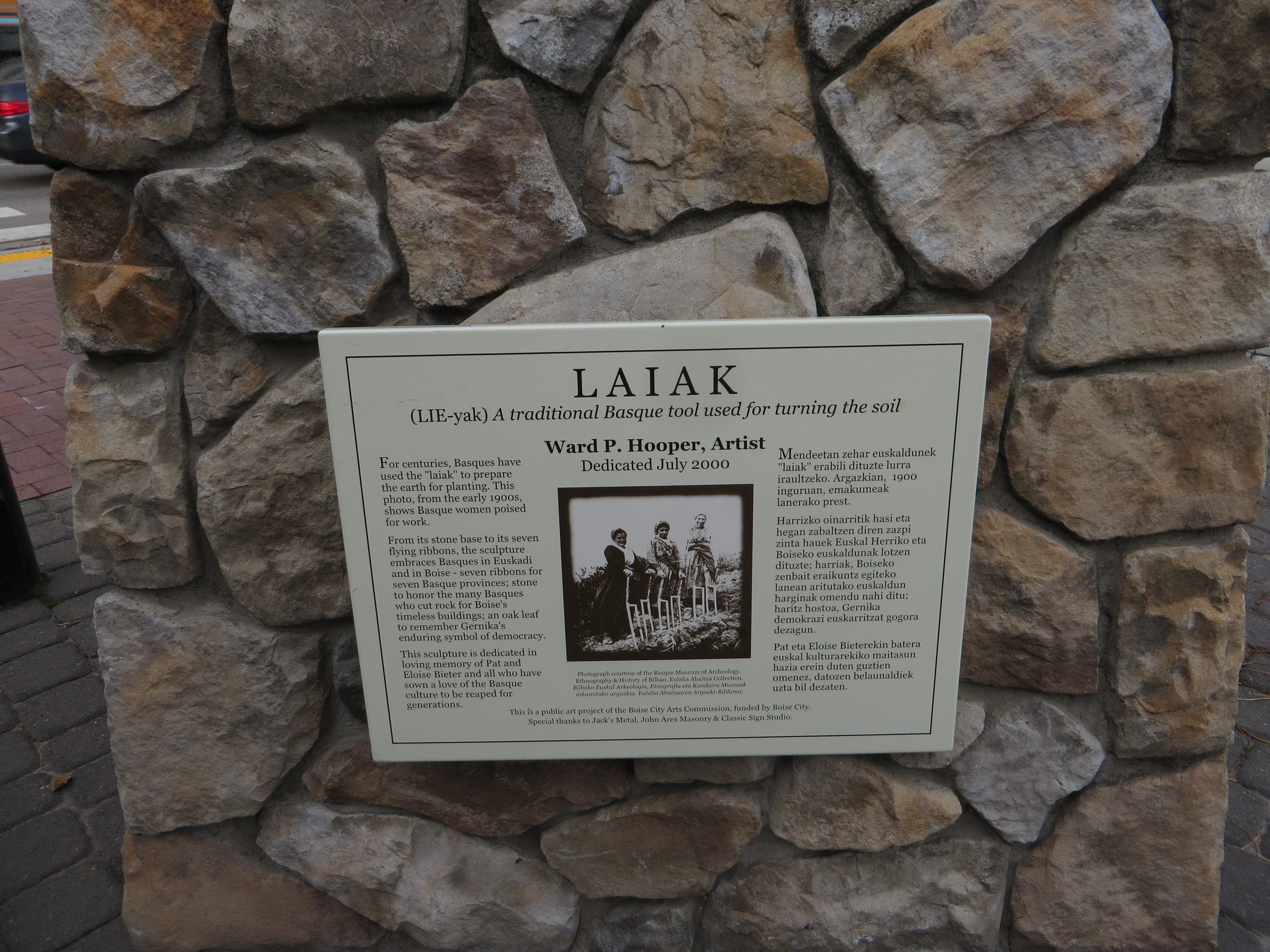
On a July evening on Grove Street, the ikurriña hangs against a desert sky and you can hear the sharp, splintering clack of a pelota off a hundred-foot wall. The sound comes from inside the Anduiza Fronton, built in 1914, where Basque sheepherders once played between months alone in the high desert. One block of downtown Boise carries the third-largest Basque community in the world, after Buenos Aires and Mexico City. They came from two small provinces on the Bay of Biscay, and they made a piece of the Basque Country in Idaho.
The Basque Block
The Basque Block sits on Grove Street in downtown Boise, between Capitol Boulevard and 6th Street, a few minutes’ walk from the Idaho State Capitol. It is a single short block of low brick buildings, a museum, a social hall, a fronton, a market, a restaurant and a bar.
Beyond the block is the Treasure Valley, the wide bench of the Boise River that runs west toward the Snake. South and west of that is the Owyhee high desert, the sagebrush country where Basque herders ran sheep across millions of acres of public land from the 1890s onward. The block is the centre. The country around it is where the work was done.
How Boise Became Basque
Before the Block
Grove Street was platted in the 1860s, one of the first streets of the original Boise townsite. The early residents were Anglo settlers with names like Jacobs, Cartier, Moore and Redway. Cyrus Y. Jacobs, born in 1831, helped plat the town in 1863 and a year later built a brick house at 607 Grove Street. It still stands. It is the oldest brick building in Boise.
The Sheepherding Wave, 1880s to 1920s
The first Basques in the American West came up from California after the Gold Rush, drifting inland into Nevada and southern Oregon as herders. By the 1880s a small trickle had reached Idaho. By the early 1900s it was a wave.
Almost all of them came from two provinces on the Spanish side of the Basque Country: Bizkaia (Vizcaya) and, in smaller numbers, Gipuzkoa (Guipúzcoa). Many sailed from Bilbao. The pattern was chain migration. One man wrote home, another followed, and a village in the Pyrenean foothills would suddenly have a son, a brother and a cousin out on the same Idaho range.
Idaho’s sheep industry was booming. At its peak the state had more than 2.6 million sheep, more sheep than people. Most Americans did not want the work. It meant months alone with a flock, a dog and a wagon, no English required, no neighbours for fifty miles.
The Boarding Houses
A herder’s year ran on a strange clock. Most of it was spent alone with the flock. A few weeks a year, usually in winter and around the lambing in spring, he came back to town. He needed a bed, a hot meal, a letter from home, somebody who spoke Euskara.
In 1910, the old Jacobs house at 607 Grove Street was rented by the Galdos, Bicandi and Uberuaga families and turned into a Basque boarding house. The Uberuagas bought it outright in 1928 for two thousand dollars. It ran as a boarding house until 1969. At its busiest, dozens of men passed through every season.
The boarding houses, called ostatuak, did more than feed and bed people. They were the bank, the post office, the marriage bureau and the dance hall. John and Mark Bieter, in their history An Enduring Legacy, called them “the village church, the town tavern, the bank and the health dispensary.” For a herder coming in off four months of solitude, they were the village itself.
The Anduiza Fronton, 1914
In 1914, Juan and Juana Anduiza built something more ambitious one door down. Architects Nisbet and Paradice, who had just finished the Empire Building nearby, drew them a four-story hotel for herders. Inside, they put a fronton. A real one. A hundred feet long, fifty feet high, walled in brick.
It is still there. It is, by most accounts, the oldest indoor pelota court still in active use in the United States. The first recorded match was in 1915. Pala games run there every weekend during the San Inazio festival.
The Change
The sheep economy peaked in the 1920s. After that it shrank, slowly at first, then faster as wool prices fell, public-land grazing was regulated, and synthetic fabrics took the market. By the 1960s the boarding houses were closing. The Uberuaga house shut in 1969.
But the community had already moved off the range and into town. The herders’ sons and daughters were now schoolteachers, lawyers, restaurant owners, ranchers in their own right. The block stayed. The reason for the block changed.
The Landmarks
Basque Museum and Cultural Center, 611 Grove Street. Founded in 1985, the only museum of its kind in the United States. Its archive holds oral histories, family papers, herder photographs, the Euskara-language materials that almost did not survive the journey. It also owns and runs the Cyrus Jacobs-Uberuaga House next door as its primary exhibit.
Cyrus Jacobs-Uberuaga House, 607 Grove Street. Built 1864, the oldest brick house in Boise. Rented from 1910 and bought in 1928 by the Uberuaga family. A working Basque boarding house until 1969. Restored in the early 2000s. Walk through and you can still see the long communal dining table, the herders’ bunks upstairs, the cast-iron stove in the kitchen.
Anduiza Fronton Building, 619 Grove Street. Built 1914 by Juan and Juana Anduiza. The fronton inside is the oldest active indoor pelota court in the country. The Idaho Basque Studies Program restored it in 1972 with the building’s then-owners. It hosts pala and handball games year-round.
Basque Center, 601 Grove Street. The social club. Members only for some events, open to all for others. It hosts the Oinkari Basque Dancers, the chorus, the mus card tournaments, and the annual San Inazio festival each July, named for Saint Ignatius of Loyola, the Basque patron saint.
Bar Gernika, 202 South Capitol Boulevard. On the corner of the block since 1991. Adelia Simplot, the daughter of a Basque immigrant, bought the old Cub Tavern in 1990 to save it from demolition and reopened it the next year as a Basque pub. Croquetas, chorizo sandwiches, the famous Saturday lamb grinder. Named for Gernika, the Bizkaian town the Luftwaffe bombed in 1937.
Leku Ona, 117 South 6th Street. The block’s full-service restaurant, opened on the corner of Grove and 6th. Family-style Basque cooking. Picon punch at the bar, the bitter aperitif that almost every Basque-American family in Idaho still pours at Christmas.
The Jaialdi grounds, Western Idaho Fairgrounds, Garden City. Once every five years, the Basque community in Boise hosts Jaialdi, the largest Basque festival in the United States. The first was in 1987. The most recent, in July and August 2025, drew tens of thousands of attendees from across the Basque diaspora. The next is in 2030.
Where They Came From
The Basque Country sits across the western Pyrenees, split between Spain and France. Four provinces are on the Spanish side: Bizkaia, Gipuzkoa, Araba (Álava) and Nafarroa (Navarre). Three are on the French side, collectively called Iparralde: Lapurdi, Lower Navarre and Zuberoa.
Almost everyone who came to Boise came from the south. Specifically from Bizkaia, the province around Bilbao, and from Gipuzkoa, the province around San Sebastián. A smaller current came from Nafarroa, with the Pyrenean valleys around Pamplona feeding herders into the Owyhee. Iparralde sent fewer people to Idaho than it did to California and Nevada.
They came carrying Euskara, the Basque language. Euskara is a linguistic isolate, unrelated to any other living language. Spanish and French surround it, but it predates both by thousands of years. In the boarding houses on Grove Street, Euskara was the working language well into the 1950s.
Boise Today
Greater Boise is now home to around fifteen thousand people of Basque descent, the highest concentration outside the Basque Country itself. After Buenos Aires and Mexico City, it is the third-largest Basque community in the world. That ranking would surprise most Americans. It would not surprise anyone in Bilbao.
The block is busy. Bar Gernika fills for lunch. The museum runs school tours and Euskara classes for kids. Boise State University has the only Basque Studies program at a US public university, established in 2005 and now in its third decade. Many of its students are great-grandchildren of herders, learning the language their parents never spoke.
Out in the Owyhee and across the Treasure Valley, Basque-American families still hold sheep ground and ranch land their grandparents bought with herding wages. The flocks are smaller. The names on the deeds are not.
Boise itself is changing fast. The city has been one of the fastest-growing in the West for a decade, with tech workers and remote employees arriving from California and Seattle. The Basque Block has held its ground inside that growth. If anything, the new attention has helped. The 2025 Jaialdi was the biggest in the festival’s history.
On a Saturday in late July, the block closes to traffic. The Oinkari Dancers come out in red and white. The fronton fills with a hundred-year-old echo. Somewhere a grandfather pours a picon punch and a grandchild asks him to say her name in Euskara, the way his mother used to.
Frequently Asked Questions
Why did Basques settle in Boise, Idaho?
Basques first came to Idaho in the 1880s to work as sheepherders. The Owyhee and Treasure Valley high desert resembled the Pyrenean uplands they had left, the sheep industry was booming, and most American workers did not want the months-long solitary work. Chain migration from the Bizkaia and Gipuzkoa provinces pulled successive generations of brothers, cousins and neighbours to Idaho through the 1920s.
Is Boise still Basque today?
Yes. Greater Boise has around fifteen thousand people of Basque descent, the third-largest Basque community in the world after Buenos Aires and Mexico City. The Basque Block in downtown Boise remains the cultural centre, with an active museum, social club, restaurants, an indoor pelota court, an annual festival, and a Basque Studies program at Boise State University.
What are the most famous Basque landmarks in Boise?
The Basque Museum and Cultural Center at 611 Grove Street, the Cyrus Jacobs-Uberuaga House at 607 Grove (Boise’s oldest brick building and a former Basque boarding house from 1910 to 1969), the Anduiza Fronton at 619 Grove (built 1914, the oldest active indoor pelota court in the United States), the Basque Center at 601 Grove, and Bar Gernika at 202 South Capitol Boulevard. Together they form the Basque Block, one short street of buildings between 6th and Capitol.
Where in the Basque Country did the Boise Basques come from?
Almost all came from the southern, Spanish side of the Basque Country. The largest source was the province of Bizkaia (Vizcaya), around Bilbao. The second was Gipuzkoa (Guipúzcoa), around San Sebastián. Smaller numbers came from Nafarroa (Navarre) and from Iparralde, the French Basque Country.
When did Basques first arrive in Boise?
Basques began arriving in Idaho in significant numbers in the 1880s, recruited or word-of-mouth-pulled into the sheepherding industry. The migration peaked between roughly 1900 and the early 1920s. The Cyrus Jacobs house on Grove Street was converted into a Basque boarding house in 1910, and the Anduiza Fronton was built in 1914 to serve the herders wintering in town.
What is Jaialdi?
Jaialdi is an international Basque festival held in Boise every five years. The first Jaialdi was in 1987. It is now the largest Basque festival in the United States and one of the largest in the world. The 2025 edition ran from July 29 to August 3 and drew tens of thousands of attendees. The next Jaialdi will be in 2030.
If your family’s story passed through Boise, or any of the places the Basque diaspora made home, Atlas of Home can trace that journey. From a farmhouse in Bizkaia, to a boarding house on Grove Street, to wherever you are now.