
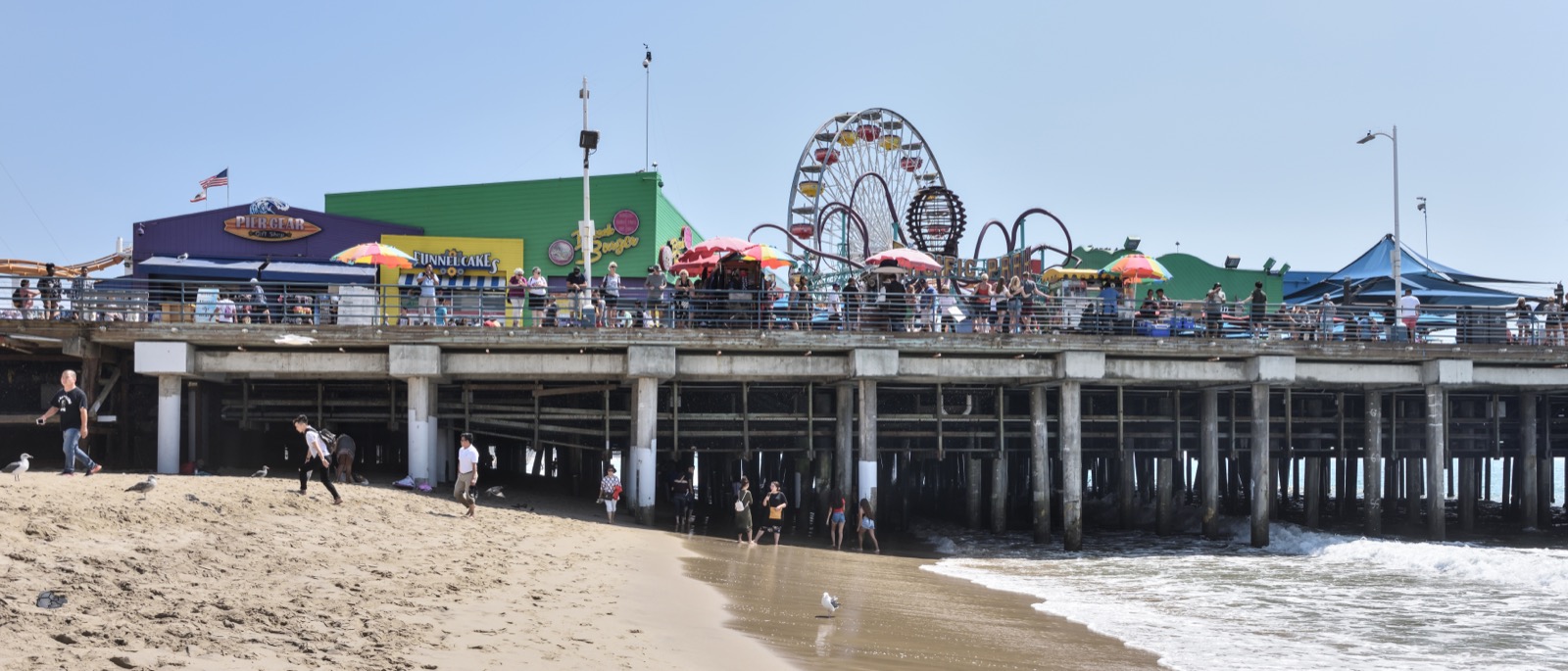
The first sound is the boardwalk. Skateboard wheels on the concrete just before sunrise, a flat white pulled at a Berkeley Street café, an Aussie accent ordering “the usual” without looking up from her phone. Down on the sand at Venice, a longboarder paddles out wearing Bondi Sands on her face and a Tigerlily one-piece.
From the 1980s onward, this stretch of Los Angeles coast became the closest thing the United States has to an Australian neighbourhood. Not a Chinatown, not a Little Italy, but a community of around 44,000 people who picked the Pacific coast that looked most like home.
This is the story of how Venice and Santa Monica became Australian Los Angeles.
Venice and Santa Monica, The Place
Venice and Santa Monica sit side by side on LA’s west side, ten miles from downtown and a world away from it. The Pacific is on one side, the 405 on the other, and in between sits the boardwalk, the Santa Monica Pier, Abbot Kinney Boulevard with its bungalows and boutiques, and the long flat run of Main Street that ties the two cities together.
Venice was conceived as Venice of America in 1905 by the tobacco millionaire Abbot Kinney, who dug canals and shipped in gondolas. Santa Monica, older and steadier, grew up around the pier and the rail line that once ran to downtown LA. Today both are dense, expensive, and dominated by low-slung Spanish bungalows, post-war stucco apartments, and a layer of glass-fronted new builds on top.
The bus from LAX climbs onto Lincoln Boulevard and lands you here in forty minutes. If you have ever stood on Bondi Beach at dawn, the Venice boardwalk at dawn will feel uncannily familiar.
How LA Became Australian
Before the Australians
For most of the twentieth century, Venice was a place Angelenos went to in the summer and tried not to live in the rest of the year. The canals silted up, the amusement piers burned down, and by the 1950s the neighbourhood was cheap, run down, and full of artists and beatniks.
In the 1960s and 70s, Venice and the adjacent strip of Santa Monica became the birthplace of two cultures that would later draw Australians like a magnet. The first was modern surf culture, which moved south down the coast from Malibu and made the breaks off the Venice Pier and the Santa Monica jetty into a daily congregation. The second was modern skateboarding, born of empty 1970s swimming pools and the Z-Boys crew working out of Jeff Ho’s surf shop on Main Street.
The Doors formed in Venice in 1965. The Zephyr team showed up a few years later. By the time Australians began arriving in numbers, the cultural DNA of the place was already set: beach, board, counterculture, sun.
The Australians Arrive
Australians had trickled into Los Angeles since the silent film era, but the wave that built modern Australian LA started in the 1980s and accelerated through the 1990s. Two engines drove it.
The first was the Hollywood pipeline. Australia’s small but disciplined drama-school system, anchored by the National Institute of Dramatic Art in Sydney, the Western Australian Academy of Performing Arts in Perth, and the Victorian College of the Arts in Melbourne, had been producing classically trained actors for decades. Australian soap operas like Neighbours and Home and Away functioned as a parallel academy.
By the late 1980s, the trickle of Australian actors heading to LA had become a procession. Mel Gibson, Nicole Kidman, Russell Crowe, Cate Blanchett, Naomi Watts, Hugh Jackman, Geoffrey Rush, Toni Collette, Heath Ledger, Eric Bana, Margot Robbie and the Hemsworth brothers all came through versions of the same route.
The second engine was surfing. Bondi, Manly and Bronte produced a generation of competitive surfers in the 1970s and 80s who looked at Venice, Malibu and Santa Monica and saw their own coast. Surf shops on Main Street started carrying Australian brands. Australian shapers set up benches in industrial Venice. Aussies took jobs as lifeguards, surf instructors and bartenders along the boardwalk.
Once a couple of thousand Australians were in place, chain migration did the rest. A cousin who was doing well in Santa Monica sponsored a younger brother. The brother brought a girlfriend. The girlfriend’s flatmate from Brisbane flew over for a fortnight and stayed three years.
Venice at Its Peak
By the early 2010s, the Australian fingerprint on Venice and Santa Monica was unmistakable. The decade arrived with a single, near-comic export: the flat white.
Coffee in Los Angeles before 2010 was Starbucks, Coffee Bean, and a small archipelago of third-wave roasters. Australians, raised on espresso culture imported from postwar Italian and Greek migration to Sydney and Melbourne, looked at the LA cup and saw a problem. They opened cafés to fix it. Bluestone Lane, an Australian-owned chain founded by ex-AFL footballer Nick Stone, landed on Rose Avenue in Venice. Great White, founded by a pair of Australian friends in 2017, opened on Speedway and became the cafe Venice now defines itself by.
Bondi Harvest, the Santa Monica café opened in 2017 by Bondi chef Guy Turland at 1814 Berkeley Street, served the food Turland had grown up eating: smashed avocado, açai bowls, sourdough toast under poached eggs and dukkah. Little Lunch Coffee opened in Venice with a menu of Tim Tams and Anzac biscuits next to the espresso machine. Eveleigh, named after the Sydney inner-city suburb, ran on the Sunset Strip from 2009 until December 2024 under Australian chef Jordan Toft and became the unofficial dining room of Aussie Hollywood for fifteen years.
This was also the period in which the entertainment-industry wing of the community was at full strength. Australia House on Century Park East ran G’Day USA, the annual cultural and trade festival launched by Consul-General John Olsen in 2004 as G’Day LA. The G’Day USA Arts Gala became a fixture of the LA awards-season calendar, with Hugh Jackman, Nicole Kidman, Cate Blanchett and Russell Crowe rotating through as hosts and honorees. The American Australian Association, founded in 1948 by Sir Keith Murdoch, ran scholarships, networking and a year-round programme of events.
You could spend a full Australian day in the neighbourhood without speaking to an American. Breakfast at Bondi Harvest. Surf at the pier. Coffee at Great White. Lunch at Hu Kitchen. Afternoon meeting at Australia House. Beach cricket at Venice on Australia Day weekend, drinks at the Venice Whaler with a Triple J countdown on the speakers, dinner at Eveleigh.
The Change
The first jolt was COVID. Australia closed its borders in March 2020 and kept them effectively shut for almost two years. The expat community went into a strange suspension. Some Australians flew home and stayed home. Others were locked out and could not return to family for the better part of a decade. Eveleigh, the spiritual dining room of Aussie LA, held on through the pandemic but closed in December 2024 after fifteen years.
The second pressure has been Venice itself. Rents on Abbot Kinney Boulevard climbed to among the highest commercial rents in the country during the late 2010s. The Snap headquarters move into Venice in 2014 brought tech money into a neighbourhood that was already running out of room. Several Australians who had built lives in Venice moved north to Topanga, east to Silver Lake or, like Chris Hemsworth in 2015, back to Byron Bay.
The community did not collapse. It dispersed. The 44,000 Australians the consulate counts in Metro LA are still mostly here, just spread across more zip codes than they were a decade ago.
The Landmarks of Australian LA
Bondi Harvest, 1814 Berkeley Street, Santa Monica. Guy Turland’s transplanted Bondi café, opened 2017, served as the daytime headquarters of Aussie Santa Monica through the late 2010s. Smashed avo, açai, flat whites pulled the way they are at home. A second branch opened at Platform in Culver City.
Great White, 1604 Pacific Avenue, Venice. Founded in 2017 by two Australian friends, expanded to West Hollywood and Larchmont. Now the café Venice’s Australians take visiting Australians to, the closest thing Los Angeles has to a Bondi Icebergs.
Bluestone Lane, 1100 Abbot Kinney Boulevard, Venice. Australian-owned chain founded in New York in 2013 by ex-AFL footballer Nick Stone, on Abbot Kinney since the mid-2010s. The Aussie coffee bridge between Manhattan and Venice.
Little Lunch Coffee, Lincoln Boulevard, Venice. A multi-roaster bar named for the Australian schoolyard word for recess, stocked with Tim Tams, Vegemite and Anzac biscuits.
The Australian Consulate-General and Australia House, Century Plaza Towers, 2029 Century Park East, Century City. The 31st-floor consulate is the formal heart of Australian LA. Austrade and the G’Day USA team work out of the same building. Australia Day receptions, ANZAC Day commemorations and the federal election polling station all happen here.
The Venice Whaler, 10 Washington Boulevard, Venice. Not Australian-owned but adopted. Australia Day drinks, Melbourne Cup viewing parties, AFL grand-final breakfasts and a generation of Aussie expats meeting their first Californian flatmate have all passed through this beachfront bar.
Eveleigh, 8752 West Sunset Boulevard, West Hollywood. A ghost landmark. Named for the Sydney suburb, run by chef Jordan Toft from 2009 to December 2024, it functioned for fifteen years as the dining room of Aussie Hollywood. The garden patio under the lemon trees is gone.
Where the LA Australians Came From
The Australians who built Venice and Santa Monica came overwhelmingly from the eastern coastal cities, which is to say from places that already looked a lot like where they were going.
Sydney sent the largest single contingent, and within Sydney the eastern beaches did most of the work. Bondi, Bronte, Tamarama, Coogee, Manly across the harbour, and the inner-east neighbourhoods of Paddington, Surry Hills and Darlinghurst fed surfers, chefs, actors and producers into the LA pipeline in proportions far larger than their share of the Australian population.
Melbourne supplied the second wave: actors trained at the Victorian College of the Arts, designers, ad-agency creatives, hospitality operators from St Kilda and Fitzroy. Brisbane and the Gold Coast sent surfers and television-industry workers. Perth contributed the WAAPA graduates: Hugh Jackman, Frances O’Connor, Tim Minchin and a long list of others trained at the Western Australian Academy of Performing Arts before flying east, then further east. Adelaide and Tasmania sent smaller cohorts, with Hobart and Launceston quietly over-represented in the production-crew ranks.
Almost all came from coastal Australia. Almost none came from the inland.
Venice Today
Walk Abbot Kinney Boulevard on a Tuesday morning in 2026 and the Australian accent is still everywhere. It is at the till at Great White, on the yoga mat at Modo, behind the counter at the Erewhon café on Rose Avenue, on the phone outside the Snap building. It is in the booking system at the Pendry West Hollywood, where Aussie hospitality staff have been quietly running rooms since it opened.
But it is a quieter presence than it was. Some of the loudest Australians of the 2010s have gone home. Others have moved out to Topanga, the Palisades, Malibu, or up the coast to Ojai. The Australians who remain in Venice and Santa Monica tend to be the ones who have made the call: this is the life. The beach is round the corner, the work is here, the kids are at Westside or Crossroads, and the trip back to Sydney happens once a year over Christmas.
The community has rebuilt since the border closures. New arrivals have come through the E-3 visa, the special category open only to Australians under the 2005 free-trade agreement, which lets up to 10,500 Australian professionals a year work in the United States. The Hollywood pipeline still runs. The flat white is now so naturalised in Los Angeles that the people who installed it have, in a sense, won.
If your family’s journey ran through Bondi or Bronte, through Melbourne or Manly, and ended up on Abbot Kinney or the Santa Monica boardwalk, the trail is fresh and the people who walked it are mostly still here. The story is still being written.
Frequently Asked Questions
Why did Australians settle in Venice and Santa Monica?
Australians settled in Venice and Santa Monica because LA’s west-side beach communities offered the closest thing to the eastern Australian coast: warm ocean, reliable surf, a beach-cafe culture and an open, outdoor lifestyle. The Hollywood entertainment industry pulled actors, directors, crew and writers from the 1980s onward, and a parallel wave of surfers, chefs and hospitality workers followed, building an informal but durable community of around 44,000 Australians across Metro Los Angeles.
Is Venice still an Australian expat hub?
Yes, Venice and Santa Monica remain the heart of Australian Los Angeles, though the community has dispersed since the COVID border closures and the rise in west-side rents. Australian-owned cafés like Great White, Bluestone Lane and Bondi Harvest still anchor the neighbourhood, and the Hollywood pipeline that brings new Australian actors and crew to LA each year is still running through the E-3 visa scheme.
What are the most famous Australian landmarks in LA?
The most recognisable Australian landmarks are Bondi Harvest on Berkeley Street in Santa Monica, Great White on Pacific Avenue in Venice, Bluestone Lane on Abbot Kinney Boulevard, and the Australian Consulate-General and Australia House on Century Park East in Century City. Eveleigh on the Sunset Strip ran from 2009 to December 2024 and was for fifteen years the unofficial dining room of Aussie Hollywood.
Where in Australia did the LA Australians come from?
Most of the LA Australians came from coastal eastern Australia, with the largest contingent from Sydney’s eastern beaches: Bondi, Bronte, Coogee, Manly and the inner-east suburbs of Paddington, Surry Hills and Darlinghurst. Melbourne, Brisbane and the Gold Coast, and Perth, supplied the next-largest waves, with Adelaide and Tasmania contributing smaller cohorts.
When did Australians first arrive in LA?
Australians had trickled into Los Angeles since the silent film era of the 1920s, but the modern Australian community in Venice and Santa Monica formed in the 1980s and accelerated through the 1990s, driven by the Hollywood pipeline and a generation of Australian surfers and hospitality workers who saw the LA coast and recognised home. The community reached its peak in the 2010s with the spread of Australian café culture across the west side.
If your family’s story passed through Venice or Santa Monica, or through Bondi, Bronte, Manly, Melbourne or Perth before that, Atlas of Home can trace that journey. From the eastern Australian coast to the Pacific shore of California, to wherever you are now.