
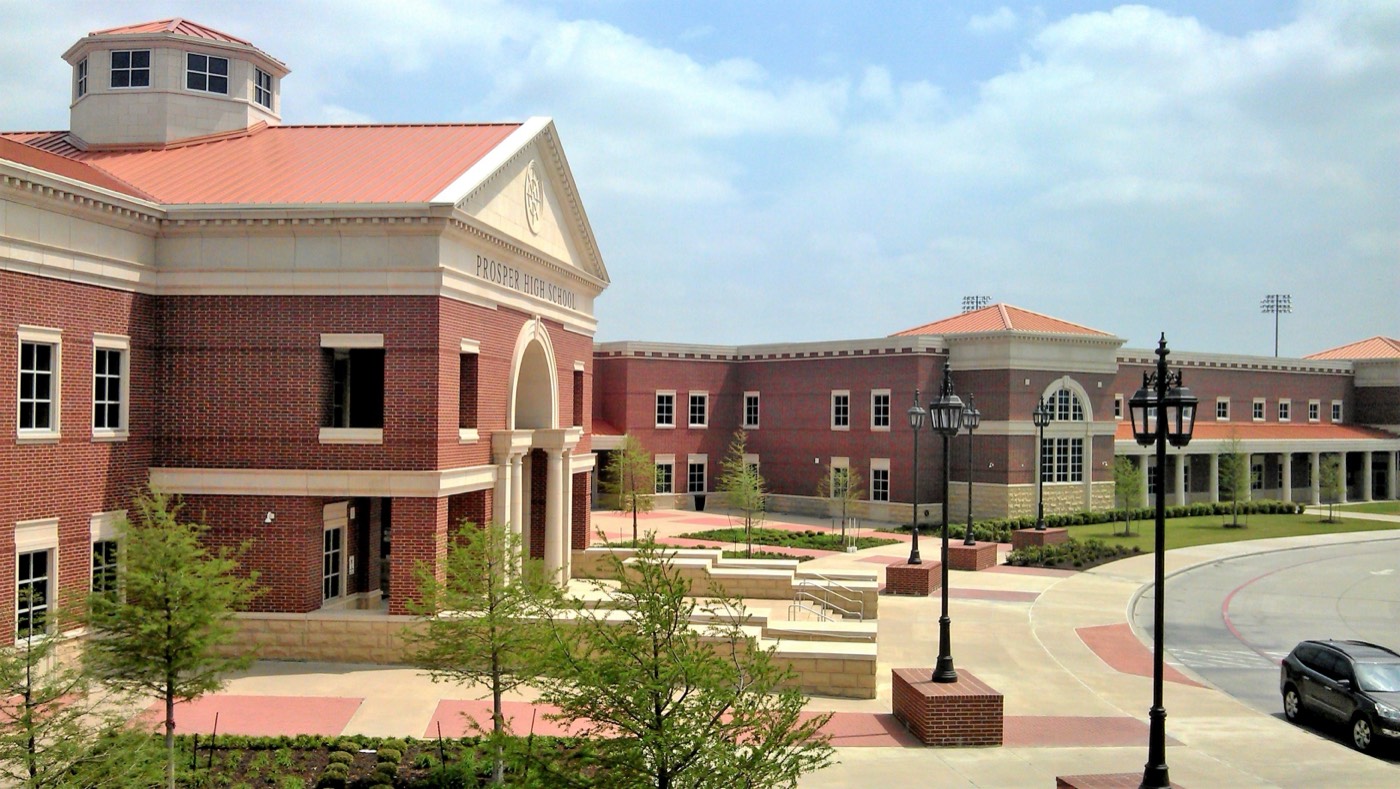
Drive north from Frisco on the Dallas North Tollway and the city thins out into something newer. The billboards advertise master-planned communities with names like Windsong Ranch and Star Trail, and behind them rise the rooftops of a town that barely existed two decades ago. This is Prosper, and the Indians in Prosper, Texas have become one of the clearest signs of how fast it has changed. In a place that counted fewer than 10,000 residents in 2010, families with roots in Hyderabad, Chennai and Pune now fill the new cul-de-sacs, drawn by some of the best public schools in the state.
The Place
Prosper sits at the northern edge of Collin County, about seven miles past Frisco and a dozen from McKinney, straddling the line into Denton County. It was farmland until very recently: cotton and corn on the Blackland Prairie, a railway stop named in 1902 for the prosperous crops of that year.
For most of the twentieth century it was tiny. The population sat around 270 in the 1940s and had not cracked a few thousand by 2000. Then the Dallas North Tollway pushed north, the corporate campuses of Frisco and Plano filled with engineers, and Prosper became the next frontier of growth. By 2026 it had passed 50,000 residents, with the town projecting roughly 72,000 at buildout.
It is also wealthy. The median household income runs well north of $175,000, average home values clear $800,000, and homeownership sits around 90 percent. Prosper is, by most measures, one of the most affluent fast-growing suburbs in the country.
How It Became Indian
Prosper did not have an Indian community to speak of in 2010. The 2010 census put the Asian share of the town at under two percent. The story of how that changed is really the story of the corridor below it, and of one good school district.
The Frisco effect spills north
By the 2010s, the stretch of suburbs along the Dallas North Tollway and US-75, from Plano up through Frisco, had become one of the largest concentrations of Indian professionals in the American South. Toyota moved its North American headquarters to Plano. JPMorgan Chase, Capital One and Liberty Mutual built campuses nearby. The major Indian IT services firms, Infosys, TCS, Wipro and Cognizant, staffed those projects and rotated thousands of engineers through the region on H-1B and L-1 visas.
Frisco filled first. Its Indian population grew so quickly that grocers, temples and restaurants followed, and home prices and school crowding rose with them. For families arriving a few years later, or trading up from a first house in Frisco or Plano, the next open land lay just north. That land was Prosper.
The school district as the magnet
If one institution explains the Indian arrival in Prosper, it is Prosper Independent School District. The district carries an A rating, ranks in the top tier of Texas school systems, and has built out new campuses at a furious pace to keep up with enrolment. Prosper High School, opened in 2009, was for a time the most expensive high school building ever constructed in Texas.
That reputation travelled fast through Indian family networks, where school quality is often the single largest factor in choosing a home. By the mid-2020s the district had become strikingly diverse: Asian students made up close to 30 percent of enrolment, and minority students together formed a majority of the student body. In the elementary and middle schools of newer Prosper, the share is higher still.
Families described the trade-off plainly. They wanted Frisco-quality schools in a quieter, newer setting, and they were willing to drive ten or fifteen minutes south for groceries and temples to get it.
The master-planned wave
The arrivals clustered in Prosper’s big master-planned communities. Windsong Ranch, with its much-publicised crystal-clear lagoon, drew young families. So did Star Trail, Gentle Creek, Light Farms and the Lakes of Prosper. These developments offered exactly what many relocating Indian professionals were looking for: new construction, generous square footage, community pools and trails, and assignment to Prosper ISD schools.
The pattern repeated thousands of times over a short span. An engineer takes a job along the tollway, rents in Frisco or Plano for a year or two, then buys new in Prosper when the second child reaches school age. The town’s explosive growth, often 9 to 13 percent a year, was built substantially on that decision, made over and over by families from across India. Collin County as a whole now counts more than 100,000 Indian residents, roughly nine percent of its population, and Prosper sits at the leading edge of where that number is still rising fastest.
The Landmarks
Because Prosper’s Indian community is so new, much of its cultural infrastructure still sits just over the line in Frisco. These are the places Prosper families live around.
Karya Siddhi Hanuman Temple, 18011 Coit Road, Frisco. Inaugurated in 2015 on a ten-acre site, this is one of the largest Hindu temples in the Western Hemisphere, crowned by a 72-foot South Indian gopuram. For Prosper families it is the spiritual anchor of the region, hosting bhajan, Carnatic music and Kuchipudi dance classes, and serving vegetarian meals in its cafeteria.
Prosper High School, 301 Eagle Drive, Prosper. The flagship of the district that drew so many families north. Its hallways and parking lots now reflect the town’s shift, and its science and competition teams have filled with the children of the new arrivals.
Patel Brothers, Frisco. The national Indian grocery chain’s Frisco store is the default weekend stop for Prosper households, stocking spices, fresh produce, in-house samosas and rotis, and stacking the aisles with sweets and gulab jamun each Diwali season.
India Bazaar, Frisco. A smaller, busier neighbourhood grocer that competes with Patel Brothers for the area’s Indian shoppers, valued for its produce and quick essentials despite the crowds.
The Dallas North Tollway corridor. Not a single address but the spine of the whole story: the road that carries Prosper’s engineers south to the corporate campuses of Frisco and Plano each morning, and the reason the town’s growth pointed north in the first place.
Windsong Ranch, Prosper. The master-planned community best known for its multi-acre crystalline lagoon. Its rapid early build-out and family amenities made it one of the first Prosper developments where Indian households arrived in real numbers.
Firefly Park, PGA Parkway and the Dallas North Tollway, Frisco. The multibillion-dollar mixed-use district rising on Prosper’s southern doorstep, near the PGA of America headquarters that opened in 2022, a sign of how thoroughly the corridor has commercialised around these new suburbs.
Where They Came From
The Indians in Prosper come overwhelmingly from urban, educated India, and disproportionately from the south. Hyderabad and the wider Telugu-speaking belt are heavily represented, alongside Chennai and Tamil Nadu, Bengaluru, and the cities of Maharashtra such as Pune and Mumbai.
That tilt follows the industries that brought them. The IT services firms staffing the Dallas corridor recruit heavily from southern technology hubs, and the H-1B pipeline draws from the same engineering colleges. North Indian and Gujarati families are present too, but the South Indian presence is strong enough to shape which temples, restaurants and grocers thrive nearby. It is why a South Indian temple anchors the region, and why Telugu and Tamil are as likely as Hindi to drift across a Prosper backyard on a weekend afternoon.
Most arrived not directly from India but from a first American landing somewhere else: a few years in Frisco or Plano, or a stint in another tech metro before a transfer to Texas. Prosper is, for many, the second or third move, the one made once careers and green-card timelines felt settled enough to buy. Others arrive from older Texas Indian enclaves such as the Indian community in Coppell, trading a settled suburb for newer construction and a younger school district.
Prosper Today
Prosper today is a town still under construction, and its Indian community is being built at the same pace. Drive through Windsong Ranch or Star Trail on a weekend and the new diversity is plain, in the children at the pools, the cricket games on open ground, the cars heading south toward the Frisco temple on a festival morning.
The honest limitation is that Prosper itself still has little Indian commercial life of its own. There is no Indian grocery row inside the town, no cluster of restaurants. Families drive to Frisco for that, and accept it as the cost of the schools and the newer homes. As the population approaches buildout, that may change; retail tends to follow rooftops, and Prosper now has the rooftops.
What is already clear is that the town’s growth and its Indian growth are the same story. A farm stop named for prosperous crops has become a destination chosen, again and again, by families who measured it first by its schools. The community here is younger and less settled than in the Indian neighbourhoods of Frisco or the older Indian community in Plano, but it is growing faster than almost anywhere, and it knows exactly why it came.
Frequently Asked Questions
How large is the Indian community in Prosper, Texas?
Prosper does not publish a precise Indian headcount, but the Asian share of the town rose from under two percent in 2010 to around seven percent in the 2020 census, and has kept climbing since. Indians make up the large majority of that Asian population, and the share is higher among school-age children, with Asian students near 30 percent of Prosper ISD enrolment.
Why did so many Indian families move to Prosper?
The main draw is Prosper Independent School District, an A-rated system with new campuses that ranks among the best in Texas. Combined with new, larger homes and proximity to the tech and corporate jobs along the Dallas North Tollway, this made the Indians in Prosper, Texas one of the fastest-growing parts of the town.
Where do Prosper’s Indian families shop for groceries and worship?
Most drive ten to fifteen minutes south into Frisco. Indian grocers such as Patel Brothers and India Bazaar are in Frisco, as is the Karya Siddhi Hanuman Temple, one of the largest Hindu temples in the Western Hemisphere. Prosper itself has little Indian retail of its own so far.
Which neighbourhoods in Prosper are popular with Indian families?
The master-planned communities draw the most arrivals: Windsong Ranch, Star Trail, Gentle Creek, Light Farms and the Lakes of Prosper. These offer new construction, community amenities and assignment to top Prosper ISD schools.
How is Prosper related to Frisco, McKinney and Plano?
Prosper sits just north of Frisco, about a dozen miles from McKinney, and a short drive up the tollway from Plano. The Indian community grew as families spread north from the established Indian communities of McKinney and Frisco in search of newer homes and open school capacity.
Where in India do most Prosper Indian families come from?
They come largely from urban, educated India, with a strong southern tilt: Hyderabad and the Telugu belt, Chennai, Bengaluru, and cities of Maharashtra such as Pune. The pattern follows the IT services firms and engineering pipelines that recruit for the Dallas tech corridor.
If your family’s story passed through Prosper, or any of the places Indians have made home in America, Atlas of Home can trace that journey. From a college in Hyderabad or Chennai to a new house in Windsong Ranch, to wherever you are now.