
They call it HiFi. Not on the freeway signs, not on the city maps your phone shows you, but on the white steel arch that floats over Beverly Boulevard at Belmont Avenue, and on the painted tiles set into the crosswalks at Temple and Union.
From the 1940s through the 1970s, if you got off the bus at Temple Street and walked east, you walked into the Philippines. The smell of garlic and vinegar from somebody’s back kitchen. A jeepney sticker on a parking meter. And at the end of the block, the Filipino Christian Church, where most of LA’s earliest Filipino arrivals were baptised, married, and buried.
Historic Filipinotown, The Place
Historic Filipinotown sits in central Los Angeles, tucked between Echo Park to the north and Westlake to the south, a hilly half-square-mile pinned in by the 101 Freeway and the long ridge of Silver Lake. The neighbourhood is bounded by Hoover Street to the east, Glendale Boulevard to the west, Beverly Boulevard to the south, and the freeway to the north. Temple Street is the commercial spine. Beverly Boulevard is the southern wall.
The housing is a tight mix of mid-century apartments, prewar bungalows, and steep little side streets that climb toward the Echo Park reservoir. There is no subway stop. You arrive by Metro bus, by the 101, or by walking up Alvarado from the lake.
How LA Became Filipino
Before the Filipinos
Before it was HiFi, this stretch of central LA belonged to a different city. In the 1880s and 1890s, the bluffs above the LA River and the flats around what is now Westlake were home to Anglo professionals, then to a growing Mexican working-class community pushed west out of the original pueblo. Bunker Hill, Temple-Beaudry, and the Crown Hill ridge held boarding houses, small markets, and the bustle of a city still figuring out where its centre would land.
The first Filipinos in Los Angeles did not yet live here. They lived in “Little Manila,” a few blocks of cheap hotels and pool halls around Bunker Hill and First Street, downtown. That earlier core would later be erased by mid-century redevelopment. The community that survived and grew up around it eventually moved west, into the Temple and Beverly corridor, and made this neighbourhood its own.
The Filipinos Arrive
Filipinos began arriving in California in 1903, the year the United States Congress passed the Pensionado Act. The Philippines had been a U.S. colony for five years. The Act paid for selected Filipino students to study at American universities, and the first hundred sailed for California that year. They were the first wave. Small, formal, often returning home.
The second wave came louder. Between 1906 and 1934, the Philippines was a U.S. territory and Filipinos travelled as U.S. nationals, exempt from the Asian exclusion laws that locked out Chinese and Japanese workers. Tens of thousands of young men, almost all single, came to work the fields of Hawaii and California. They cut asparagus in the Sacramento Delta. They picked grapes around Stockton. They followed the lettuce harvest down to Salinas and Watsonville.
They were called the Manong generation, from the Ilocano word for “older brother.” By the 1930s, the dominant image of the Filipino in California was the manong: the field worker, the bachelor, the union organiser. When the season ended, many of them wintered in Los Angeles. They rented rooms in Little Manila downtown, played pool, sent money home, and waited for the next harvest.
A third wave followed the Second World War. Filipino soldiers who had fought alongside Americans against the Japanese became eligible for U.S. citizenship. Filipino war brides came with returning GIs. The community downtown grew, aged, and quietly looked for a place to settle.
HiFi at Its Peak
In 1950, the Filipino Christian Church bought the old Union Avenue Methodist building on the corner of Union and Court. It was the first major Filipino institution to plant itself permanently in the Temple-Beverly corridor, and it pulled the rest of the community with it. Other churches followed. Filipino social clubs, lodges, and barbershops opened on Temple. Families bought small bungalows up the hill toward Silver Lake.
The biggest surge came after 1965. The Hart-Celler Immigration Act abolished the old national-origin quotas and prioritised skilled professionals and family reunification. The Philippines, an English-speaking former colony with an American-style medical education system, was perfectly positioned to send nurses, doctors, technicians, and accountants. Within a decade, more than seventy thousand Asian doctors had arrived in the United States, with Filipinos forming the largest single share.
Many of them landed first in LA Filipinotown. They rented rooms above Temple Street businesses, attended Mass at the Filipino Christian Church or at the Iglesia ni Cristo congregations forming nearby, and then, as their salaries grew, looked for a house with a driveway. The neighbourhood swelled in the late 1960s and 1970s. Filipino restaurants, bakeries, and groceries opened along Temple. Sunday after Mass, the corner of Temple and Belmont was as Filipino as a corner in Manila.
The Change
The change started, as it usually does, with success. By the 1980s, the doctors and nurses who had arrived in the late 1960s had paid off their first mortgages and were looking for bigger houses with better schools. They moved south to Carson, east to West Covina and Cerritos, north to Eagle Rock and the San Fernando Valley. The single-occupancy hotels closed. The bungalows passed to younger families, often Central American, who were arriving in their own large wave during the Salvadoran and Guatemalan civil wars.
By the late 1990s, the Filipino population of the old neighbourhood had shrunk significantly. But the community did not leave the area emotionally. Filipino churches, service organisations, and social clubs stayed put, and the neighbourhood remained the symbolic anchor of Filipino Los Angeles.
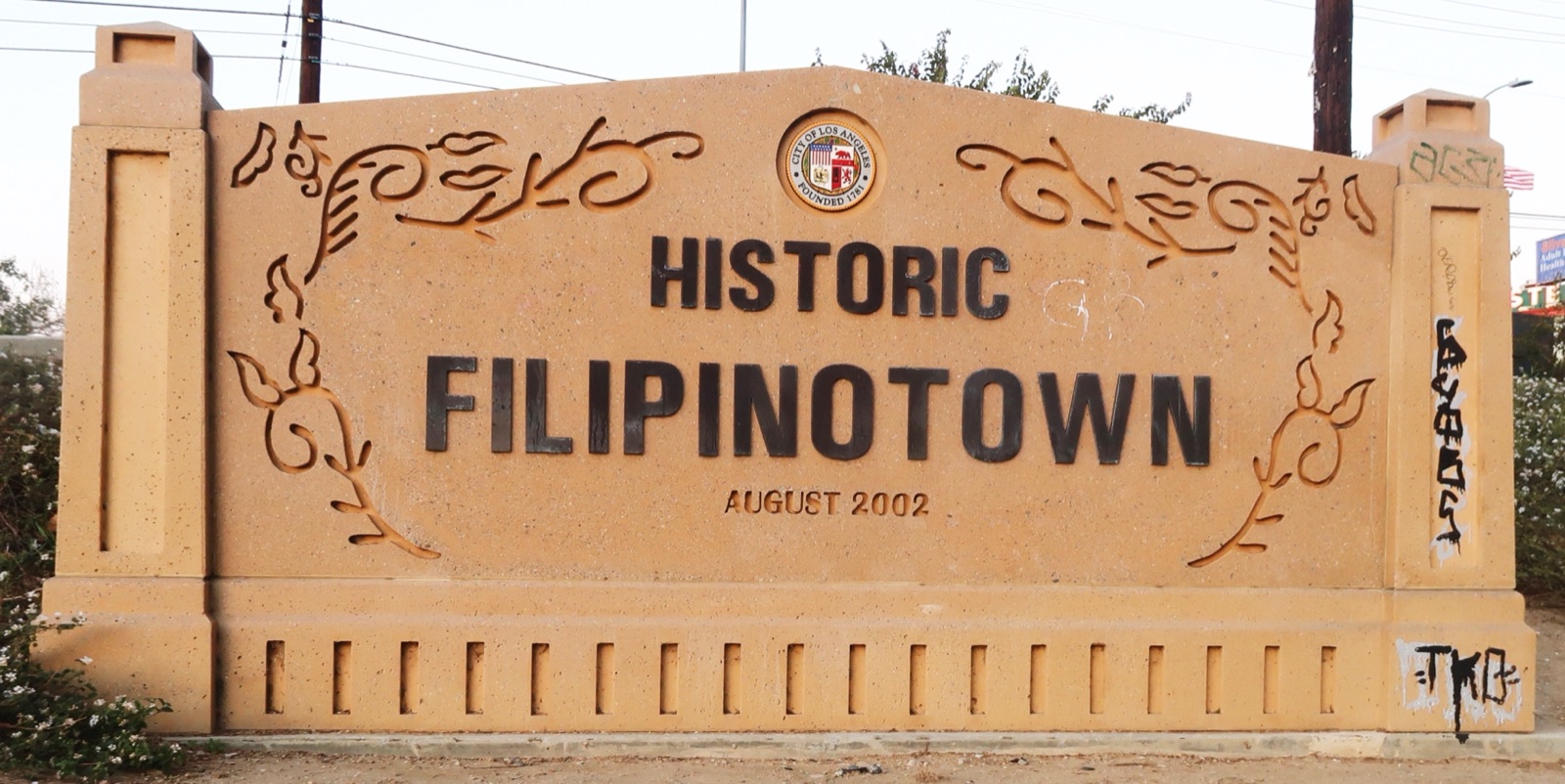
In 2002, after a thirty-year campaign by community leaders, the LA City Council officially designated Historic Filipinotown. The bill was championed by then-councilmember Eric Garcetti, who later became mayor of Los Angeles. It was the first official geographical designation honouring Filipinos anywhere outside the Philippines.
The Landmarks of Filipino LA
Filipino Christian Church (301 N Union Avenue). The mother church of Filipino LA. Founded in 1928 as a fellowship for the city’s earliest Filipino arrivals, reorganised as a formal church in 1933, and moved to its current Union Avenue building in 1950. Its arrival on the corner is the single event that pulled the Filipino community into this neighbourhood. The building, a modest 1920s Methodist chapel, was added to the U.S. National Register of Historic Places in 2024.
Gintong Kasaysayan, Gintong Pamana, Unidad Park (Beverly Boulevard at Belmont Avenue). The largest Filipino-American mural in the country, 150 feet wide and 30 feet high, painted by artist Eliseo Art Silva in 1995. The title translates as “A Glorious History, A Golden Legacy.” A giant bird spans the wall, its wings carrying figures from five centuries of Filipino history: pre-colonial chieftains, Andres Bonifacio, Carlos Bulosan, Filipino farmworkers from the Delano grape strike, nurses in white. It is the neighbourhood’s emotional centre of gravity.
Filipino American World War II Veterans Memorial, Lake Street Park (227 N Lake Street). Unveiled in November 2006 by then-Council president Eric Garcetti. It honours the 250,000 Filipino soldiers and 7,000 Filipino American soldiers who fought for the United States in the Second World War, many of them denied their promised veterans’ benefits for decades after. Designed by Cheri Gaulke, it is still the only Filipino American Second World War memorial in the country.
Talang Gabay Eastern Gateway (Beverly Boulevard at Belmont Avenue). An 82-foot-wide, 30-foot-high white steel arch unveiled in May 2022 after twenty years of community fundraising and design work. Designed by Eliseo Art Silva (the muralist) and Celestino Geronimo Jr., it incorporates the parol lantern of Filipino Christmas, the gumamela flower for frontline workers, and the Sarimanok bird of Mindanao. It is the largest gateway of its kind to any Filipino community in the world.
Bahay Kubo Restaurant (2330 W Temple Street). A turo-turo, or point-point, cafeteria-style Filipino place opened by Garland Gozon in 1988 and moved to Temple in 1992. Heaping pans of pancit, lechon kawali, kare-kare, and crispy pata. Generations of Filipino grandmothers have walked their grandchildren through the steam table here, naming each dish in Tagalog and explaining what their own mother used to put in it.
Tribal Cafe (1651 W Temple Street). Opened in 1995 on the eastern edge of HiFi, a Filipino-owned vegan and vegetarian cafe that has become a community living room. Smoothies and turon and rice plates served to nurses heading home, kids doing homework, and the occasional film crew. Still here, still busy, on a stretch of Temple Street that has otherwise changed beyond recognition.
SIPA, Search to Involve Pilipino Americans (3200 W Temple Street). Founded in 1972 by a group of young Filipino American activists influenced by the civil rights and antiwar movements. SIPA is the oldest Filipino American social-service nonprofit in LA, running youth programs, small-business support, and the festivals that keep the neighbourhood Filipino on paper and in spirit.
Filipino American Service Group Inc., FASGI (135 N Park View Street). Incorporated in 1981, FASGI runs transitional housing and senior services for the older generation, the manongs and lolas who came in the 1960s and 1970s and never moved out to Carson with their children.
Where the LA Filipinos Came From
Filipino LA is not from any single Philippine province. It is the most plural Filipino diaspora anywhere outside Manila itself. But the patterns are real, and they show up in the food, the dialects spoken in the church halls, and the surnames on the gravestones.
The Manong generation, the farmworkers of the 1920s and 1930s, came overwhelmingly from the Ilocos region in the dry northwest of Luzon. Ilocos Norte, Ilocos Sur, La Union, Pangasinan. Ilocano was for decades the language you would hear in the pool halls of old Little Manila, and it remained the language of the eldest residents of HiFi well into the 2000s.
The Visayas sent the second great stream, especially Cebu, Bohol, and the sugar-cane provinces of Negros and Iloilo. The post-1965 nurses and doctors came from across the country: Manila and the Tagalog provinces of Cavite, Batangas, and Bulacan, the Pampangan towns north of the capital, the central plain of Nueva Ecija, and the southern Visayas. Apl.de.Ap of the Black Eyed Peas, who later filmed the “Bebot” video in HiFi, was born in Sapang Bato in Pampanga.
HiFi Today
The honest answer is that Historic Filipinotown is no longer where most of LA’s Filipinos live. The city with the largest Filipino population in California, and in many years the highest Filipino share of any U.S. city, is Carson, twenty miles south of HiFi on the 110 freeway. After Carson come Eagle Rock, West Covina, Cerritos, Walnut, and Panorama City in the Valley. Greater LA holds more than half a million Filipinos, the largest Filipino population centre outside the Philippines, and only a fraction of them live in HiFi anymore.
The neighbourhood itself has gentrified hard. Median rent has risen from roughly $912 a month in 2012 to around $2,700 in 2025. The Filipino share of the population has dropped by about a quarter in that same period. Many of the bungalows that were Filipino family homes in the 1970s now sell for well over a million dollars. The remaining Filipino businesses, churches, and service organisations operate alongside coffee bars, design studios, and apartment buildings with rooftop pools.
And yet, on a Sunday morning, you can still stand on the corner of Temple and Union and see what this place was. The mural is still there. The arch is up. The Filipino Christian Church bells still ring. The lolas still queue at the steam table at Bahay Kubo.
The Festival of Philippine Arts and Culture, born in HiFi in 1992, runs every September. The Filipinos of LA moved on. The neighbourhood stayed, holding the memory for the half a million scattered children who can point at a corner of central LA and say: that is where my family first lived in America.
Frequently Asked Questions
Why did Filipinos settle in Historic Filipinotown?
Filipinos settled in the Temple-Beverly corridor in the 1940s and 1950s after their earlier downtown community, Little Manila on Bunker Hill, was cleared for redevelopment. The arrival of the Filipino Christian Church on Union Avenue in 1950 anchored the community in the area, and the post-1965 wave of Filipino nurses and doctors made it the residential heart of Filipino Los Angeles through the 1970s.
Is HiFi still Filipino today?
Historic Filipinotown is the official cultural and symbolic home of Filipino LA, but most Filipinos no longer live there. The largest Filipino population centres in Los Angeles County are now Carson, Eagle Rock, West Covina, Cerritos, and Panorama City. HiFi has gentrified, the Filipino share of its population has dropped significantly, and rents have roughly tripled since 2012, though Filipino churches, restaurants, and service organisations remain.
What are the most famous Filipino landmarks in HiFi?
The most important landmarks in Historic Filipinotown are the Talang Gabay Eastern Gateway arch at Beverly and Belmont, the Gintong Kasaysayan mural in Unidad Park, the Filipino American World War II Veterans Memorial in Lake Street Park, and the Filipino Christian Church on Union Avenue. Bahay Kubo restaurant on Temple Street and the SIPA community centre are still the social anchors.
Where in the Philippines did the LA Filipinos come from?
The earliest Filipino farmworkers in California, the Manong generation, came largely from the Ilocos region in northwest Luzon. Later waves came from the Visayas, especially Cebu, Bohol, and Iloilo, and from Pampanga and the Tagalog provinces around Manila. The post-1965 medical-professional wave drew from across the country, making LA Filipinotown one of the most plural Filipino communities outside Manila.
When did Filipinos first arrive in LA?
The first Filipinos arrived in Los Angeles after the 1903 Pensionado Act, which sponsored Filipino students to study at American universities. The first large wave came between 1906 and 1934 as agricultural workers, the Manong generation, who wintered in downtown LA between harvests. The community settled into what is now Historic Filipinotown in the 1940s and 1950s.
If your family’s story passed through Historic Filipinotown, or through any of the cities where Filipino LA scattered next, Atlas of Home can help you trace that journey. From a province in the Ilocos or a barrio in Cebu, to a bungalow on Temple Street, to wherever you are now.
Featured image: Historic Filipinotown Western Gateway sign on Temple Street. (image: Wikimedia Commons)