
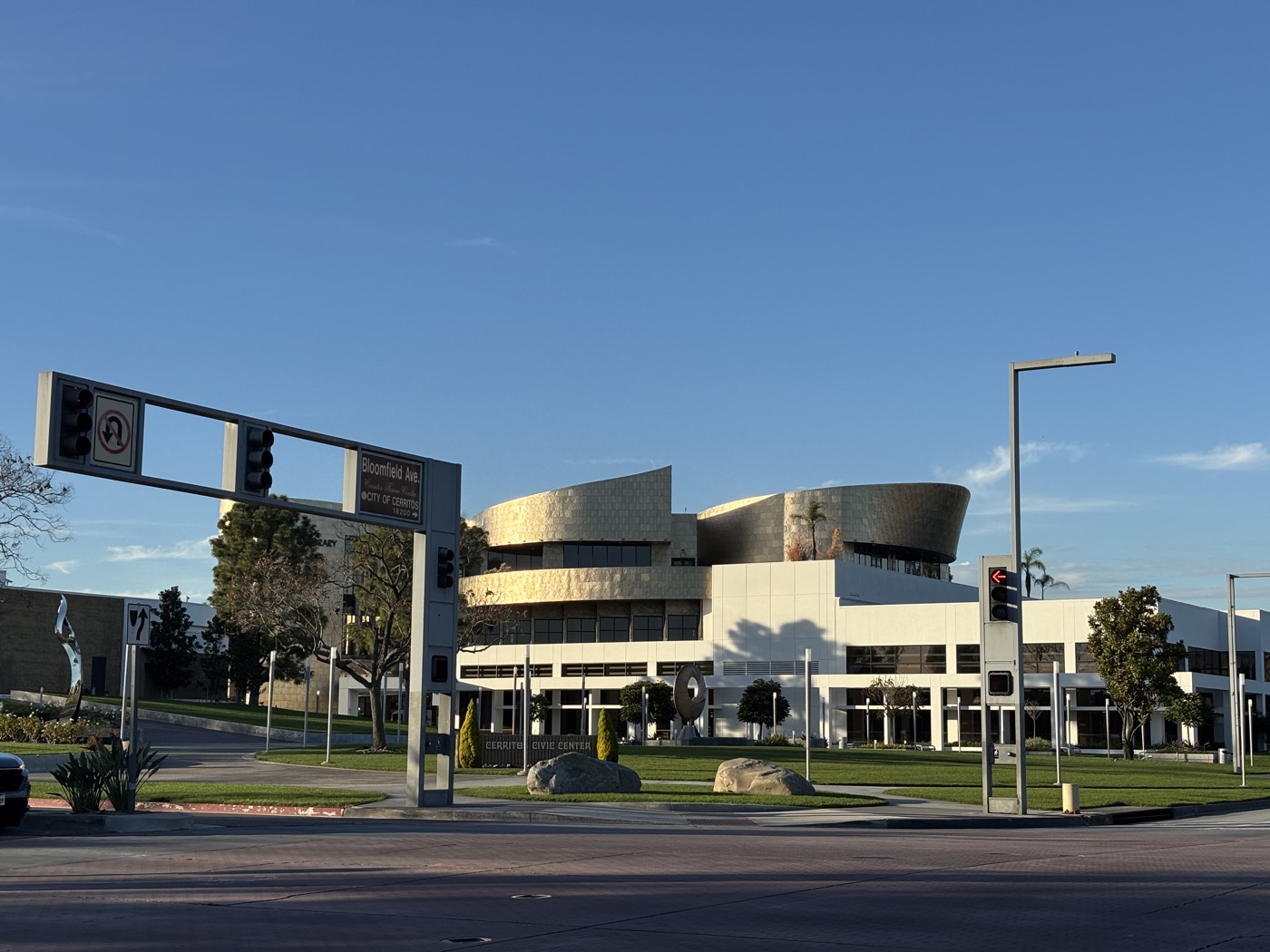
On a Sunday morning in Cerritos, the parking lots of the Korean churches fill before nine, the Korean bakeries along Artesia Boulevard sell out of soft milk bread by noon, and the grandparents walking the loop at Cerritos Regional Park greet one another in Korean. The Koreans in Cerritos did not arrive in a single wave or settle a single street. They folded themselves into one of Southern California’s most quietly prosperous suburbs, a former dairy town turned model of Asian American middle-class arrival, and made it as much theirs as anyone’s.
The Place
Cerritos sits in the southeast corner of Los Angeles County, hard against the Orange County line, roughly twenty miles from downtown Los Angeles. It was incorporated in 1956 as Dairy Valley, a town with more than four hundred dairies and cows outnumbering people, then renamed Cerritos in 1967 as the herds gave way to tract homes and shopping centres.
What followed was an experiment in planned affluence. The city built its tax base on retail, and today its residents are the second-highest retail spenders in California after Beverly Hills. The 2023 median household income was a striking 133,953 dollars, the schools rank among the best in the state, and the population of roughly 48,000 is more than sixty percent Asian.
How It Became Korean
Cerritos was built to be sold. When the dairies closed in the 1960s, developers laid out wide streets and uniform lots, and the city marketed itself relentlessly to the rising middle class. It had no old ethnic core, no immigrant tenement past. That blank, orderly newness turned out to be exactly what a certain kind of immigrant family was looking for.
The 1980s: arrival of the professionals
Since the 1980s, Cerritos has attracted large numbers of Filipino, Korean, Taiwanese, Indian and Chinese immigrant families. The Korean newcomers were rarely the first generation off the plane. Many had already spent years in Los Angeles, often in or around the Korean enclave of Koreatown in central Los Angeles, building businesses and saving toward a house in a town with good schools.
Cerritos offered what Koreatown could not: quiet streets, large new homes, and the ABC Unified School District, whose reputation had already begun to travel through Korean church networks and family conversations. A dentist in Koreatown, a dry-cleaner, a small wholesaler, would buy in Cerritos and commute back into the city to work.
After 1992: the great suburban shift
The 1992 Los Angeles riots fell hardest on Korean American shopkeepers in and around South Los Angeles and Koreatown, who watched a generation of work burn while help did not arrive. The aftermath accelerated a migration that was already underway. Thousands of Korean families moved out of the urban core toward southeast Los Angeles County and northern Orange County, seeking a more peaceful environment and good schools while keeping their businesses in the city.
Cerritos, perched on the county line, became one of the natural destinations. From here a family could still drive into Koreatown for work in half an hour, yet send their children to Whitney High and walk to a clean park at night. The same logic pulled Koreans into the neighbouring cities of La Palma, Buena Park, Fullerton and Irvine, building a loose Korean belt across the county line.
Building a community in place
By 2000, Korean was the single most common ancestry reported in Cerritos, at just over seventeen percent of residents, ahead of every other group in a famously diverse city. That figure mattered less as a statistic than as a threshold. Once enough Korean families lived in a place, the institutions came: churches first, then markets, bakeries, hagwon tutoring centres, and the Korean-language signage that quietly tells newcomers they have arrived somewhere that will hold them.
Cerritos never became a Koreatown in the way central Los Angeles did. Its Korean life is distributed rather than concentrated, woven into shopping plazas it shares with the city’s large Chinese, Taiwanese and Indian populations. This is the same multiethnic Cerritos that produced the parallel stories of the Chinese in Cerritos and the Taiwanese in Cerritos. The Korean community grew alongside them, in the same plazas, the same schools, the same lined-up Sunday lots.
The Landmarks
Korean Hope Presbyterian Church, 19319 Carmenita Road. One of the anchor Korean congregations of the city, set on Cerritos’s eastern edge where the streets run toward the Orange County line. For Korean Cerritos, the Presbyterian church is not only a place of worship but a clearing house for jobs, childcare, college advice and the slow business of keeping a language alive in children born in America.
Cerritos Korean Church, 12229 Del Amo Boulevard. A long-standing Christian congregation serving Korean families on the city’s western side. The geography of Korean worship in Cerritos, churches spread across the city rather than clustered downtown, mirrors the way the community itself settled: everywhere and nowhere in particular, throughout the grid.
Hanmi Market, 13321 Artesia Boulevard. A Korean grocery on the Artesia corridor, the long commercial spine that carries much of Cerritos’s Asian retail. The aisles of marinated bulgogi, house-made banchan and walls of ramen are where the everyday Korean kitchen in Cerritos is restocked, a short drive from home.
Somunnan Korean Restaurant, 13303 Artesia Boulevard. A neighbourhood Korean restaurant beside the market, the kind of place that serves budae jjigae, naengmyeon and gamjatang to families after church and to teenagers after exams. It is unpretentious and busy, the social grammar of a community that eats together more than it performs.
Whitney High School, 16800 Shoemaker Avenue. Repeatedly ranked the top public high school in California and among the best in the nation, this selective ABC Unified school is, for many Korean families, the reason Cerritos exists on the map at all. Its student body is overwhelmingly Asian, and it runs a Korean Parents’ Association, a small institution that says a great deal about who is in the room.
Cerritos Library, 18025 Bloomfield Avenue. The titanium-clad municipal library, opened in 2002, is the city’s civic showpiece and a daily destination for Korean families, with children doing homework and grandparents reading the Korean-language press. Its mere existence, lavish and free, embodies the bargain Cerritos struck: high taxes on retail spent visibly on its residents.
Los Cerritos Center, 239 Los Cerritos Center. The regional mall, open since 1971, predates the Korean community and outgrew its origins along with the city. On weekends it functions as a shared living room for Cerritos’s Asian middle class, Korean teenagers and Chinese teenagers and Indian teenagers moving through the same food court their parents shopped before them.
Where They Came From
The Koreans of Cerritos came, overwhelmingly, from South Korea, and most of them came twice: once across the Pacific, and again across Los Angeles. The first crossing followed the loosening of American immigration law in 1965, which opened the door to skilled and professional Koreans during the decades of South Korea’s hard industrial rise.
Many landed first in Los Angeles, where Koreatown gave new arrivals a footing in business and worship before the wealth and the worry both pointed them outward to the suburbs. Cerritos drew the families who had already made it partway: the small-business owners, the professionals, the parents whose entire calculus had narrowed to a single question about which district their children would attend.
The pull was reinforced by the larger Korean gravity of northern Orange County just across the line, home to the second-largest Korean population in the United States, anchored by Garden Grove’s officially recognised Koreatown and the sprawling churches of the region. Cerritos sat at the hinge of that world and the Los Angeles one, claimed fully by neither and shaped by both.
Cerritos Today
Cerritos today is comfortable, orderly and, by the measures it cares about, successful. The Korean families who arrived in the 1980s and 1990s have raised children who went to Whitney and Cerritos High and then to the University of California campuses, and some of those children have come back to raise their own families in the same quiet streets.
The community is also ageing and shifting. Younger Korean Americans, more assimilated and more mobile, increasingly look to Irvine and the newer developments of Orange County, while some of the Korean commercial energy has migrated to the glossier Korean malls across the county line in Buena Park. Cerritos remains a Korean home, but a settled one rather than a frontier.
What it retains is the texture of a community that built itself without fanfare. The churches still fill on Sundays, the markets still stock the week’s banchan, and the parents still trade notes on tutoring and test dates. The Koreans in Cerritos never needed a banner street or a gate. They had the schools, the church, the market and one another, distributed across a town that was, conveniently, built to be filled.
Frequently Asked Questions
How large is the Korean community in Cerritos, California?
Korean was the single most commonly reported ancestry in Cerritos as of the 2000 census, at just over seventeen percent of residents, ahead of every other group. The Koreans in Cerritos form one of the largest groups within a city that is more than sixty percent Asian overall.
Why did so many Koreans move to Cerritos?
Korean families were drawn to Cerritos by its top-ranked ABC Unified schools, its safety and its large new homes, while remaining close enough to drive into Los Angeles for work. Migration accelerated after the 1992 Los Angeles riots, when thousands of Korean families left the urban core for the suburbs.
What is the relationship between Cerritos and Koreatown in Los Angeles?
Many Koreans in Cerritos first lived or worked in Koreatown before buying homes in the suburbs roughly twenty miles away. A common pattern was to keep a business in Koreatown while raising children under the Cerritos schools, treating the two places as parts of one Korean life.
Where do Koreans in Cerritos worship and shop?
Korean churches such as Korean Hope Presbyterian Church on Carmenita Road and Cerritos Korean Church on Del Amo Boulevard anchor community life, while Korean markets and restaurants line the Artesia Boulevard corridor. Hanmi Market and neighbouring Korean restaurants serve as everyday gathering points.
How is the Korean community in Cerritos different from the Chinese and Taiwanese ones?
Cerritos is genuinely multiethnic, with large Chinese, Taiwanese, Indian and Korean populations sharing the same plazas and schools. The Korean community grew in parallel with the others, distributed across the city rather than concentrated, alongside the city’s Chinese and Taiwanese communities.
Is Cerritos still a centre for Korean Americans today?
Yes, though it is now a settled community rather than a growing frontier. Younger Korean Americans increasingly move toward Irvine and Buena Park, but Cerritos retains its Korean churches, markets and long-established families across the city’s quiet residential grid.
If your family’s story passed through Cerritos, or any of the places Koreans have made home in America, Atlas of Home can trace that journey. From the streets of Koreatown to a house under the best schools in California, to wherever you are now.