
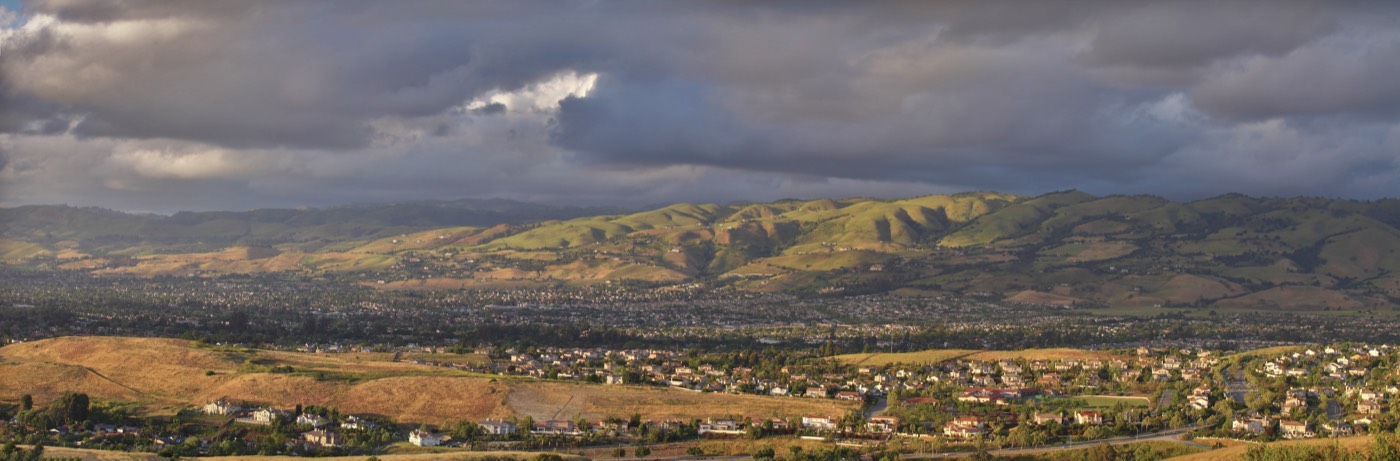
Drive east from downtown San Jose, past the old orchards that gave Story Road its long Vietnamese second life, and the land begins to climb. The flatland storefronts give way to cul-de-sacs and ridgeline homes, and somewhere along Aborn Road you have crossed into Evergreen. The Vietnamese in Evergreen are not the refugees of the noodle shops and jewellery stalls below. They are, very often, their children: the engineers, the physicians, the small-business owners who turned a foothold in the valley into a house in the hills.
The Place
Evergreen sits in the southeast corner of San Jose, tucked against the foothills of the Diablo Range. The land was once Rancho Yerba Buena, a Mexican-era grant given to Antonio Chaboya, whose name still marks a middle school, a road, and a park. For most of the twentieth century it was orchard and vineyard country, the green that gave the district its name.
Today it is one of San Jose’s most desirable neighbourhoods, defined by rolling hills, large lots, and the gated enclave of Silver Creek Valley Country Club on the southern ridge. More than two-thirds of working residents hold executive, management, or professional jobs. The schools are among the best in the city, and the houses cost accordingly.
Two high schools anchor the district: Evergreen Valley High and Silver Creek High, both highly rated and both, year after year, full of Vietnamese surnames on the honour rolls. Evergreen Valley College sits at the foot of the range, and the wider Evergreen Elementary School District serves thousands of children across more than a dozen campuses. For families weighing where to settle in the valley, those catchments are often the deciding factor.
How It Became Vietnamese
The story of the Vietnamese in Evergreen begins below the hills, on the flatlands of East San Jose, and it begins with the Fall of Saigon in April 1975.
The first wave settles on the flats
When the war ended, the United States resettled the first cohort of Vietnamese refugees through camps including Camp Pendleton in Southern California. Many drifted north to Santa Clara County, drawn by a warm climate that recalled home and by an electronics industry hungry for assembly-line labour. They landed not in the hills but on the affordable east side, along Senter Road, King Road, and Tully Road, a resettlement the San José Public Library has documented in detail.
The boat people of the late 1970s and 1980s followed, and the numbers grew quickly. By 2010 San Jose counted more than 180,000 Vietnamese residents, roughly a tenth of the city. It remains the largest Vietnamese population of any single city outside Vietnam, a story told in full in our piece on the Vietnamese in Little Saigon, San Jose.
Lion Plaza and the first storefronts
The commercial heart came first. In 1982 developer Jerry Chen converted a former Safeway at the corner of King and Tully roads into Lion Market, then the largest Asian supermarket in Northern California. The surrounding Lion Plaza had its grand opening in April 1988, one of the first centres to serve the city’s Vietnamese and Chinese communities. Phở Hòa, later an international chain, opened one of its earliest locations there.
A few years on the east side, the Le family turned a single catering truck into Lee Bros. Foodservice, supplying more than 500 trucks by 1985, many of them Vietnamese-owned. In 1983 the family opened a permanent banh mi shop on Santa Clara Street and called it Lee’s Sandwiches. The east side was building an economy of its own.
The move to the hills
As the first refugees’ children came of age in the 1990s and 2000s, the trajectory bent upward. Engineers at the valley’s chip and software firms, doctors, and shop owners who had done well began buying into Evergreen, where the schools were strong and the lots were generous. The district’s hillside subdivisions filled with Vietnamese families who had arrived with nothing two decades earlier.
The shift showed up in the census numbers. Asian Americans now make up around 60 per cent of Evergreen’s residents, and roughly 18.5 per cent of the population over the age of five speaks Vietnamese at home, a share higher than nearly any neighbourhood in the country. Evergreen became, in effect, the prosperous upstairs to Little Saigon’s bustling ground floor.
The move was rarely a clean break. Families who bought in the hills kept their dentists, their herbalists, and their Sunday habits downhill, driving back to Story Road for groceries and to Tully Road for a haircut. The hill house was the reward; the flatland remained the homeland in miniature. That double geography, residence up high and ritual down low, still defines how the community lives.
The fight over a name
The community’s growing weight became unmistakable in the 2007 to 2008 dispute over what to call the Story Road business district. The City Council first voted to name it the Saigon Business District, a compromise that enraged residents who wanted Little Saigon. After a public meeting drew more than a thousand people, the council reversed course in March 2008. The episode put a recall effort against councilmember Madison Nguyen in motion and announced that San Jose’s Vietnamese had become a political force, not just an economic one. Many of the voters and donors in that fight lived up in Evergreen.
The Landmarks
Grand Century Mall, 1111 Story Road. Opened in 2000 at the centre of the officially designated Little Saigon, the indoor mall fills with jewellery counters, music shops, and herbal-remedy stalls. For Evergreen families it is the place you drive down the hill to for Tet shopping and a haircut, the cultural anchor of the wider community.
Vietnam Town, Story Road. Built in the 2000s as a condominium-style commercial development, Vietnam Town gave Vietnamese business owners something the refugee generation rarely had: a deeded piece of the American commercial pie, restaurants and offices they owned outright rather than rented.
Lion Plaza, 1710 to 1834 Tully Road. The plaza that started it all, anchored by Lion Market. Its early Chinese-American shops passed over the years to Vietnamese proprietors as the surrounding neighbourhood changed, a small living record of the east side’s demographic turn.
Duc Vien Buddhist Community Pagoda, 2440 McLaughlin Avenue. Founded by the nun Thich Dam Luu, who fled Vietnam by boat and started a temple in a rented house in the early 1980s. She saved for a decade to raise the down payment, and by the end of 1993 the nuns presided over a 9,000-square-foot temple with stone pillars and iron gates. It remains one of the few US Buddhist centres run by women.
Most Holy Trinity Catholic Church, 2040 Nassau Drive. Founded in 1961 in the orchards off Senter Road, the parish today serves Vietnamese, Hispanic, Filipino, and Samoan worshippers, with Vietnamese-language Masses on Saturday evening and Sunday. For Evergreen’s Catholic Vietnamese families it is a Sunday institution.
Vietnamese American Cultural Center, 2072 Lucretia Avenue. Housed within the Shirakawa Community Center, the VACC runs ESL and computer classes for elders, martial arts and homework hours for children, and the big seasonal gatherings: Lunar New Year, the Hung Kings commemoration, and the Mid-Autumn Moon Festival.
Evergreen Village Square. The district’s own civic centre, a plaza with a branch of the San José Public Library, a farmers market, and dining, where the Vietnamese families of the hills meet their neighbours of every background.
Where They Came From
The Vietnamese of Evergreen trace back, overwhelmingly, to South Vietnam: to Saigon and the Mekong Delta, the regions most exposed when the South fell in 1975. The earliest arrivals were often the educated and the affiliated, military officers, civil servants, professionals, people with the most to lose under the new government and the means to leave first. It is the same southern diaspora that built Southern California’s enclaves, the Vietnamese in Little Saigon, Westminster and the Vietnamese in Fountain Valley.
The boat people who came next were a broader cross-section, fishermen and farmers and shopkeepers who risked the South China Sea. Chain migration did the rest. One sibling sponsored another; a household in a King Road apartment became the landing pad for cousins, and the cousins eventually bought their own homes uphill.
Evergreen Today
Evergreen today is a quiet kind of arrival story. The drama of the east side, the contested signs and the council votes, played out down the hill; up here the evidence is in the everyday. It is in the Vietnamese spoken at the Evergreen Village Square farmers market, in the pho shops along Aborn and Quimby roads, in the high schoolers from Evergreen Valley and Silver Creek whose parents grew up in refugee apartments.
The district is genuinely mixed. Indian, Filipino, Mexican, and Chinese families share the same cul-de-sacs and the same coveted school catchments, much as the Indians in Santa Clara have made their own corner of the valley, and the dining strip reflects it. But Vietnamese remains the language you are most likely to overhear that is not English, and the rhythms of the Vietnamese calendar, Tet above all, set the tone for much of the neighbourhood.
What Evergreen represents is the second act that Little Saigon’s first generation worked toward. The noodle shops and jewellery stalls of Story Road were never the destination. The destination was the house in the hills, the good school, the children who became engineers and doctors. In Evergreen, that act is being lived out, unhurried and largely undramatic, on streets that were orchards within living memory.
Frequently Asked Questions
Where is the Vietnamese community in Evergreen, San Jose?
The Vietnamese in Evergreen are spread across the district’s hillside subdivisions in southeast San Jose, including the area around Aborn, Quimby, and White roads. The community’s commercial and religious heart lies just downhill in the flatlands of East San Jose, along Story Road and Tully Road.
How many Vietnamese people live in Evergreen?
Evergreen does not publish a standalone Vietnamese count, but roughly 18.5 per cent of residents over the age of five speak Vietnamese at home, one of the highest shares of any neighbourhood in the United States. Asian Americans make up around 60 per cent of the district.
How is Evergreen different from San Jose’s Little Saigon?
Little Saigon, centred on Story Road in the East San Jose flatlands, is the commercial and cultural core where Vietnamese businesses cluster. Evergreen is the more affluent residential district in the foothills above it, home to many of the professionals and second-generation families whose roots run through Little Saigon.
Why did Vietnamese families move to Evergreen?
As the children of refugees prospered in Silicon Valley’s tech and medical economy in the 1990s and 2000s, many moved uphill to Evergreen for its highly rated schools, larger homes, and quieter streets, while keeping close ties to the businesses and temples below.
Does San Jose have the largest Vietnamese population in the world outside Vietnam?
Yes. San Jose is home to roughly 145,000 to 180,000 Vietnamese residents depending on the count, the largest Vietnamese population of any single city outside Vietnam. The Vietnamese in Evergreen are a prosperous part of that wider community.
What are the main Vietnamese landmarks near Evergreen?
Key sites include Grand Century Mall and Vietnam Town on Story Road, Lion Plaza on Tully Road, the Duc Vien Buddhist Community Pagoda on McLaughlin Avenue, Most Holy Trinity Catholic Church on Nassau Drive, and the Vietnamese American Cultural Center on Lucretia Avenue.
If your family’s story passed through Evergreen, or any of the places Vietnamese have made home in America, Atlas of Home can trace that journey. From a fishing village on the Mekong Delta to a catering truck on King Road, to a house in the Evergreen hills, to wherever you are now.