
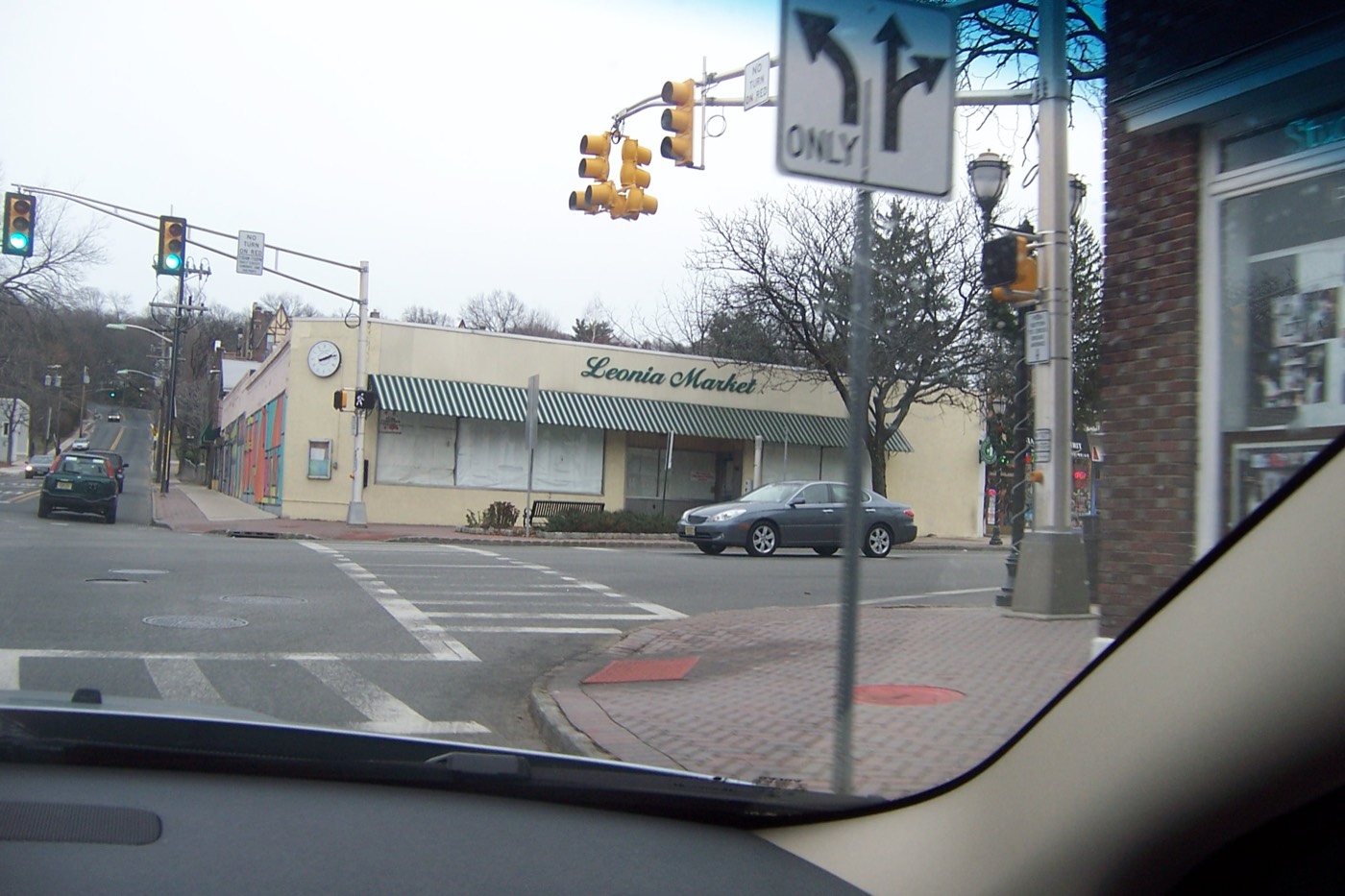
Drive west off the George Washington Bridge, past the towers of Fort Lee, and within a mile the streets quieten into a grid of clapboard houses, old maples, and a small downtown where the deli sign sits beside Korean lettering. This is Leonia, a 1.6-square-mile borough in Bergen County where Koreans have built one of the most concentrated communities of their kind in America, hidden inside a town that once called itself the Athens of New Jersey.
The Place
Leonia sits at the New Jersey end of the George Washington Bridge approach, tucked between Fort Lee to the south, Palisades Park to the west, and Englewood to the north. It was incorporated as a borough on 5 December 1894, carved out of Ridgefield Township during the wave of small-town secessions that Bergen County still calls boroughitis.
For its first century Leonia was known for something other than demographics. In 1899 the advertising man Artemus Ward founded the Leonia Heights Land Company and drew academics, illustrators, and writers up the hill, and by the 1930s the borough claimed one of the highest per-capita counts of entries in Who’s Who in America anywhere in the country.
It remains a town of about 9,300 people, leafy and walkable, with a single high school and a downtown a few blocks long. What has changed is who walks those blocks.
How It Became Korean
Korea came to Leonia by way of the bridge. The story begins not in the borough itself but in the wider arc of Korean settlement across the Hudson, and it follows the same logic that built every Korean enclave in Bergen County: proximity, schools, and the slow gravity of one family pulling the next.
The first crossing
Koreans first settled the New York metropolitan area intending to stay in the city, running greengrocers, dry cleaners, and wholesale businesses in Manhattan and Queens. Beginning in the 1980s, the more established among them began crossing the George Washington Bridge into Bergen County, drawn by the same things that drew everyone else to the suburbs: space, safety, and schools.
The numbers tell the speed of it. In 1990 roughly 16,000 Koreans lived in Bergen County. By 2000 that figure had climbed to about 37,000, a jump of more than 130 percent in a single decade. By the 2010s, more than 60 percent of New Jersey’s entire Korean population would be concentrated in this one county at the foot of the bridge.
The pull was practical as much as cultural. A Korean family in Queens could keep its city job, its city church, and its city suppliers while gaining a driveway and a school district, all within a twenty-minute drive of where they had started. The bridge made Bergen County feel less like leaving the city than extending it.
Why these towns
Through the 1990s, Manhattan branches of Korean firms and wholesale houses relocated to Bergen County to escape rising city rents, and the employees and owners who worked there chose to live nearby. The first dense settlement formed in Palisades Park, where by the 2000 Census more than a third of residents claimed Korean ancestry, the highest share of any town in the country.
From that core the community spread outward into the adjoining boroughs along Broad Avenue and the bridge approach. Leonia, Ridgefield, Fort Lee, and Englewood Cliffs all filled with Korean families in turn, each town a short drive from the last, linked by the same commercial spine and the same churches.
The Leonia turn
Leonia drew a particular slice of that migration. Where Palisades Park became the dense commercial heart, the borough up the hill attracted the professional and business families who wanted a quieter street, a yard, and above all the schools. By the 2000 Census, 17.24 percent of Leonia residents identified as being of Korean ancestry, the fourth-highest share in the United States and the second-highest of any New Jersey municipality, behind only Palisades Park.
That share kept climbing. Asian residents made up about 26 percent of Leonia in 2000 and roughly 42 percent by 2020, with Koreans the largest group among them. The borough that had once filled with illustrators and Nobel laureates was now filling with Korean physicians, accountants, restaurateurs, and the children they sent to Leonia High School.
The corridor takes shape
The commerce followed the families. Broad Avenue, Leonia’s downtown spine, runs straight into the far larger Korean strip in Palisades Park, and over two decades the stretch through Leonia filled in with Korean restaurants, bakeries, and a grocer. The result is less a self-contained Koreatown than a northern extension of the corridor that runs from Fort Lee through Palisades Park and up into Leonia, a single Korean commercial world spread across borough lines that mean nothing to a hungry family on a Saturday night.
By the 2010s the local Korean press, restaurant guides, and church bulletins all treated the cluster of towns as one place. A reader in Seoul looking at a map would see four municipalities. A Korean grandmother shopping for banchan sees one neighbourhood that happens to have several mayors.
The Landmarks
Kaya Garden, 450 Broad Avenue. A Korean kitchen on Leonia’s main commercial street, known for grilled meats and the traditional dishes that anchor a Korean menu. It sits at the northern end of the Broad Avenue corridor, where the strip thins out from the density of Palisades Park into the quieter blocks of Leonia.
Honey Pig, 344 Broad Avenue. A Korean barbecue house on the same stretch, part of a small chain known across the metropolitan Korean community for its tabletop grills and late hours. It has occupied the building at 344 Broad through several turnovers of the address, a reminder of how quickly Korean restaurants cycle through these storefronts.
The Broad Avenue corridor. Not a single address but the through-line of the whole community. Broad Avenue runs south from Leonia straight into Palisades Park’s dense Korean commercial strip of supermarkets, bakeries, and karaoke rooms, so the Leonia blocks function as the calmer, residential-facing top of that corridor.
Leonia High School, 100 Christie Heights Street. The single public high school for the borough, serving grades nine through twelve. It is the institution that drew many Korean families to Leonia in the first place, and its student body reflects the town’s transformation, a real-world measure of why parents chose this hill over the city across the river.
Congregation Adas Emuno, 254 Broad Avenue. The borough’s historic synagogue, founded in the nineteenth century and a marker of the older Leonia. Its presence on Broad Avenue, a few doors from the Korean restaurants, is a small lesson in how immigrant towns layer rather than replace one another.
Wood Park and Sylvan Park. The borough’s green spaces, where the everyday life of a Korean suburban family plays out the way it does in any American town: after-school pickups, weekend games, parents on the sidelines. They are landmarks precisely because they are ordinary, the proof that this is a place to live and not just to eat.
Where They Came From
The Koreans who settled Leonia came overwhelmingly from South Korea, and within the United States most arrived not directly from abroad but from across the Hudson. The pattern was a two-step migration: first from Korea to New York City, often to Queens or Manhattan, and then, once established, from the city out to Bergen County.
The families who reached Leonia tended to be the ones who had already done well. They were the business owners, professionals, and managers who could afford a single-family house and who prized the borough’s schools above the convenience of the city. They were following not a homeland region so much as a class trajectory, the suburban move that Korean New Yorkers made once their footing was secure.
That is why Leonia reads differently from the denser enclaves below it. The community here is the residential, white-collar end of the same migration that filled Palisades Park, a difference of degree rather than origin.
You can read the class story in the housing. Palisades Park ran to apartments and two-family homes built close to the commercial strip, while Leonia kept its detached houses on tree-lined streets up the hill. The Koreans who chose Leonia were buying that distinction deliberately, the same way earlier generations of New Yorkers had bought their way out of the tenements and into the boroughs of Bergen County.
Leonia Today
Today Leonia is a town where roughly two in five residents are Asian, the largest group Korean, and where that fact is woven so quietly into daily life that visitors often miss it. The houses are the same century-old clapboard and brick they always were. The names on the school rosters and the storefronts have changed.
The borough functions as the quiet top floor of a much larger Korean world that runs down Broad Avenue through Palisades Park and over to Fort Lee, and connects north to the wealthier Korean towns of the Northern Valley like Closter. Families live in Leonia and shop, worship, and eat across the line in any of the neighbouring towns, treating the borough boundaries as the bureaucratic fictions they are.
It is not a perfect story. Korean restaurants open and close on Broad Avenue with bruising speed, and the dense commercial energy still belongs to Palisades Park rather than to Leonia itself. But for the families who crossed the bridge looking for a yard and a good school, the borough has delivered exactly what they came for, which is the most ordinary and the most ambitious thing an immigrant town can offer.
Frequently Asked Questions
How many Koreans live in Leonia, New Jersey?
At the 2000 Census, 17.24 percent of Leonia residents identified as being of Korean ancestry, the fourth-highest share of any place in the United States. Asian residents overall rose to roughly 42 percent of the borough by 2020, with Koreans the largest single group.
Why did so many Koreans settle in Leonia and the surrounding towns?
Koreans in Leonia largely followed a move out of New York City beginning in the 1980s and 1990s, crossing the George Washington Bridge into Bergen County for better schools, more space, and a safer suburban setting while staying within commuting reach of Manhattan.
Where is the Korean community in Leonia centred?
Broad Avenue is the spine. It runs from Leonia straight down into the dense Korean commercial strip of neighbouring Palisades Park, so Leonia’s Korean restaurants and grocer sit at the quieter, residential top of a single corridor that crosses several borough lines.
How does Leonia compare to Fort Lee and Palisades Park?
The three towns form one Korean corridor at the New Jersey end of the bridge. Palisades Park is the dense commercial heart with the highest Korean share, Fort Lee the largest in raw numbers, and Leonia the quieter, more residential and professional end of the same community.
What schools serve Korean families in Leonia?
Leonia Public Schools runs the borough’s pre-K through grade twelve system, with Leonia High School on Christie Heights Street as the single secondary school. The strength of these schools was a leading reason Korean families chose Leonia over the city across the river.
Is there a Koreatown in Leonia?
Not on its own. The recognised Koreatown is in adjoining Palisades Park, and Leonia functions as a northern extension of that commercial corridor rather than a separate enclave, with Korean businesses concentrated along its share of Broad Avenue.
If your family’s story passed through Leonia, or any of the places Koreans have made home in America, Atlas of Home can trace that journey. From a first apartment in Queens to a clapboard house on a Leonia side street, to wherever you are now.