
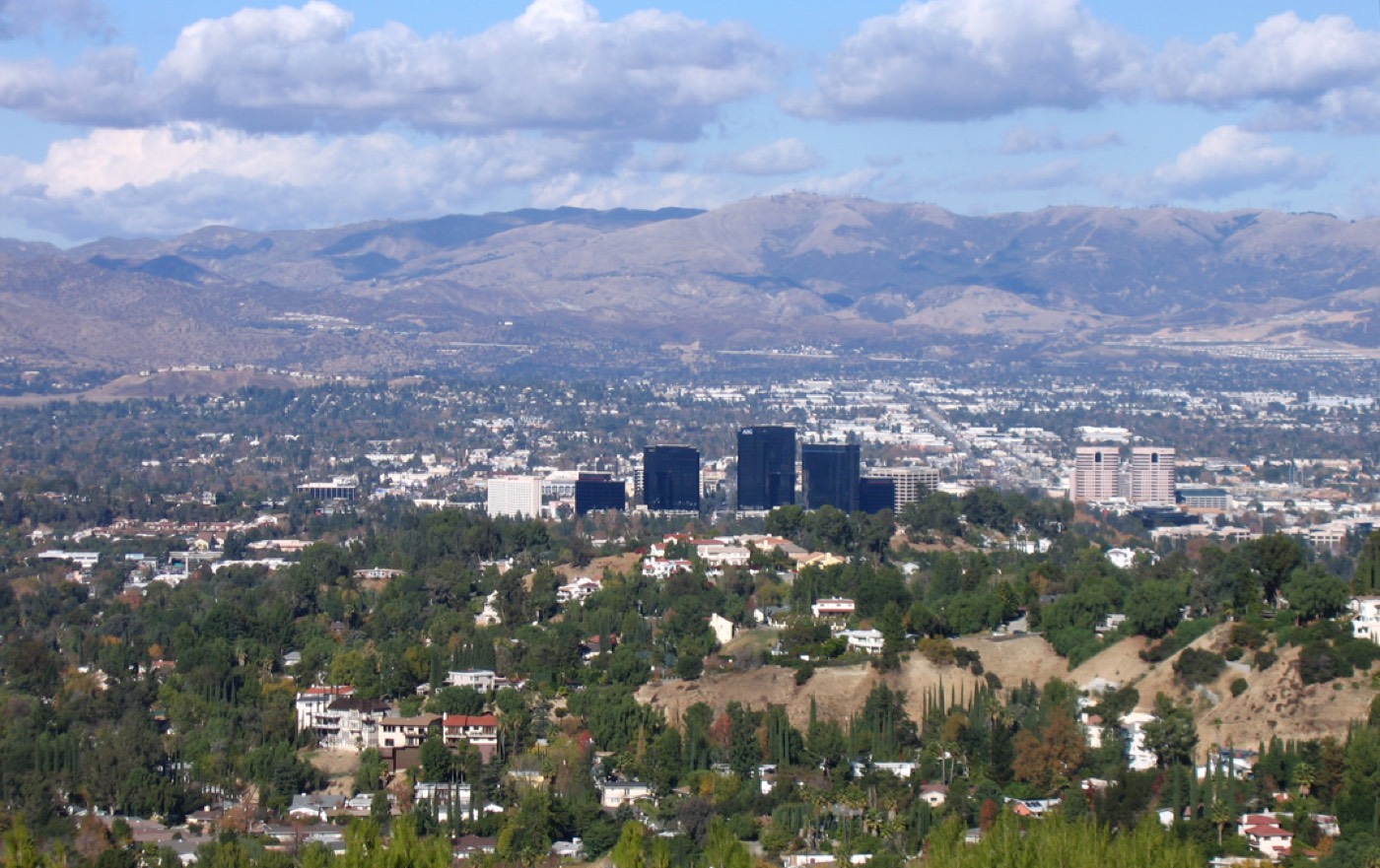
On a Friday afternoon along Ventura Boulevard, the air near the western end of the San Fernando Valley smells of saffron, grilled kabob and fresh sangak bread. The Persians in Woodland Hills have made this affluent stretch of west Los Angeles their own, quietly, over four decades. They came after a revolution, settled among the oak-shaded hills, and built a life of synagogues, markets, professional offices and Nowruz tables that now feels as native to the neighbourhood as the towers of Warner Center.
The Place
Woodland Hills sits at the south-western edge of the San Fernando Valley, pressed up against the Santa Monica Mountains. It was once part of the Rancho El Escorpion land grant, ranch and orchard country, before the post-war boom turned it into one of the Valley’s most prosperous residential districts.
Today it is among the higher-income neighbourhoods in Los Angeles, with a median household income above $90,000 and roughly 70,000 residents. Warner Center, the cluster of high-rise offices built up through the 1980s on land once owned by Harry Warner of Warner Bros., anchors the local economy.
The streets climb into canyons of ranch houses and gated estates, while Ventura Boulevard runs the commercial spine. It is a neighbourhood of professionals, executives and families, the kind of place Iranian arrivals were looking for when they fanned out from the Westside.
How It Became Persian
There were Iranians in Los Angeles before 1979, students and professionals scattered across the city. But the community that defines Woodland Hills today was born of exile.
The Revolution and the First Wave
The 1979 Islamic Revolution and the fall of the Shah sent hundreds of thousands of Iranians abroad. Los Angeles received the largest share, the biggest Iranian population anywhere outside Iran, and by most estimates the Greater Los Angeles region is now home to roughly half a million Iranian Americans.
The first arrivals clustered on the Westside, in Westwood and Beverly Hills, where the dense corridor of Persian businesses earned the nickname Tehrangeles. Many came with capital, education and professional credentials. They were doctors, engineers, jewellers and merchants who had lost a country but not their skills.
This was not a migration of the desperate. The Iranians who reached Los Angeles tended to be the urban, professional and entrepreneurial classes who had the means to leave and the qualifications to rebuild. That head start shaped where they settled, and why so many gravitated toward neighbourhoods with strong schools and large homes rather than to the city’s poorer districts.
Crossing the Hill into the Valley
As families grew and the Westside grew expensive, Iranians began crossing the Santa Monica Mountains into the San Fernando Valley. Encino and Tarzana filled first, then Woodland Hills further west, drawing those who wanted larger homes, good schools and a quieter pace without leaving the orbit of Persian life.
The move mirrored a pattern across Iranian Los Angeles. The Persians of Encino and their Tarzana neighbours formed a continuous Valley corridor extending from the original Tehrangeles district, and Woodland Hills became its western frontier. The community here is notably mixed: Iranian Muslims, Jews, Christians, Zoroastrians and Bahais who have lived as neighbours for decades.
The Persian Jewish Community
A large share of Woodland Hills Iranians are Jewish. Los Angeles holds the largest Persian Jewish population in the United States, estimated at around 50,000, and a substantial part of it settled across the west Valley.
Iranian Jews had lived in Iran for some 2,700 years, one of the oldest Jewish communities on earth. When that life ended after 1979, congregations reconstituted themselves in California. Eretz Cultural Center, founded in 1979 and now at 6170 Wilbur Avenue in adjacent Tarzana, grew into one of the largest Persian Jewish cultural centres in the state, serving families across Woodland Hills and the wider Valley.
For these families, the Valley offered something the older parts of Jewish Los Angeles could not: room to grow. Persian Jewish households tend to be close-knit and multigenerational, with grandparents, parents and children living near one another, and the larger houses of Woodland Hills, Tarzana and Encino suited that way of life. The result was a steady westward drift of Persian Jewish families along the Valley floor through the 1980s and 1990s.
Putting Down Roots
By the 1990s and 2000s the community had moved from refuge to permanence. Persian-owned medical and dental practices, law firms, real-estate offices and construction companies spread through Warner Center and along Ventura Boulevard.
Markets and bakeries opened to feed the growing population, and the children of the first wave passed through the local public schools and on to university. Woodland Hills stopped being a place Iranians had fled to and became simply where they were from.
The Landmarks
Woodland Hills Market, 19964 Ventura Boulevard. The neighbourhood’s anchor Persian grocer, with shelves of dried limes, barberries, basmati rice and pickled vegetables, a halal meat counter and an in-store bakery turning out fresh flatbread. For many Valley families it is the weekly stop that keeps a Persian kitchen running.
Shirin Restaurant, 21826 Ventura Boulevard. A long-running Persian dining room that draws families from across the west Valley for koobideh, joojeh and stews ladled over saffron rice. On weekend nights its tables fill with multigenerational gatherings, grandparents to grandchildren, conducted in a mix of Farsi and English.
Asal Bakery and Kabob, 20008 Ventura Boulevard. Part bakery, part grill, it pulls Persian families from all over the San Fernando Valley for fresh bread, sweets and skewered kabob. The display cases of Persian pastries are a fixture before holidays and family celebrations.
Eretz Cultural Center, 6170 Wilbur Avenue, Tarzana. Founded in 1979 as Iranian Jews were arriving, it became one of the largest Persian Jewish cultural and religious centres in California. Just east of Woodland Hills, it serves as a hub for worship, weddings, classes and community gatherings for west Valley Persian families.
Temple Aliyah, 6025 Valley Circle Boulevard. A long-established Conservative congregation in the heart of the west Valley, founded in 1962, that has welcomed many Persian Jewish families among its members. In recent years it merged with Shomrei Torah to form a new congregation, Hamakom.
El Camino Real Charter High School, 5440 Valley Circle Boulevard. One of the top public high schools in the area, with a strong academic record, it has educated generations of Woodland Hills children, many of them the sons and daughters of Iranian families who chose the neighbourhood partly for its schools.
Westfield Topanga and the Warner Center district. The vast shopping centre and the surrounding cluster of office towers form the commercial heart of Woodland Hills, where Persian professionals work, dine and gather, and where the community’s everyday economic life plays out.
Where They Came From
The Persians of Woodland Hills trace back overwhelmingly to Iran’s cities, above all Tehran, along with Shiraz, Isfahan and Hamadan. They are not a peasant migration but an urban, educated diaspora: families that ran businesses, practised medicine and law, or worked in trade before the revolution.
For Iranian Jews in particular, the roots run deep into ancient communities in Tehran, Shiraz, Isfahan and Hamadan, cities with synagogues centuries old. The departure after 1979 was, for many, the end of a presence measured in millennia.
What united them on arrival was a shared language, cuisine and calendar rather than a single hometown. That common Persian culture, more than any one village, is what they rebuilt along Ventura Boulevard.
Woodland Hills Today
The Persian presence in Woodland Hills is now woven into ordinary life rather than concentrated in a single visible district. There is no neon Tehrangeles strip here. Instead there are Persian doctors’ offices in Warner Center, kosher and halal sections in the local markets, and Farsi spoken in the school pickup line.
Nowruz, the Persian New Year at the spring equinox, is the moment the community is most visible. Haft-sin tables appear in homes across the neighbourhood, families gather for the thirteen days of celebration, and the markets and bakeries do their busiest trade of the year. It is a holiday observed by Iranians of every faith, a thread that ties Muslim, Jewish and secular families together.
Persian businesses thread quietly through the neighbourhood’s commercial life. Real-estate brokers, mortgage offices, jewellers, rug dealers and cosmetic and dental practices carry Iranian names, and the community’s professionals are heavily represented in the offices of Warner Center. The visibility is in the surnames on the doors rather than in any single signposted strip.
The second and third generations are now thoroughly American, raised between the Valley and the Westside, fluent in both worlds. Some have moved further out to the Persian community in Irvine or kept ties to Beverly Hills, but Woodland Hills remains a settled, prosperous heart of Iranian Valley life. For a community that began in exile, that quiet permanence is its own kind of achievement.
Frequently Asked Questions
How large is the Persian community in Woodland Hills?
There is no exact count for the neighbourhood alone, but Woodland Hills is part of a Greater Los Angeles region home to roughly half a million Iranian Americans, the largest Iranian population outside Iran. The Persians in Woodland Hills form a significant part of the wider west San Fernando Valley Iranian community.
Why did Iranians settle in Woodland Hills?
Most arrived after the 1979 Islamic Revolution, first settling on the Westside and then crossing into the San Fernando Valley as families sought larger homes, good schools and a quieter setting. Woodland Hills offered all three while keeping the community within reach of Persian life in Encino, Tarzana and Westwood.
Is the Woodland Hills Persian community mostly Jewish?
A large share is Jewish, reflecting the fact that Los Angeles holds the largest Persian Jewish population in the United States, around 50,000 people. But the Persians in Woodland Hills also include Muslims, Christians, Zoroastrians and Bahais who have lived as neighbours for decades.
Where can you find Persian food in Woodland Hills?
Ventura Boulevard is the main corridor. Woodland Hills Market at 19964 Ventura Boulevard supplies Persian groceries and fresh bread, while restaurants such as Shirin at 21826 Ventura Boulevard and Asal Bakery and Kabob at 20008 Ventura Boulevard serve traditional dishes to families from across the Valley.
How is Nowruz celebrated in Woodland Hills?
Nowruz, the Persian New Year at the spring equinox, is the community’s most visible holiday. Families set haft-sin tables at home, gather over thirteen days of celebration, and the local Persian markets and bakeries see their busiest trade of the year, observed across Muslim, Jewish and secular households alike.
How does Woodland Hills relate to Tehrangeles?
Tehrangeles, the dense Persian business corridor in Westwood, is the symbolic centre of Iranian Los Angeles. Woodland Hills is part of the residential Valley extension of that world, connected to it by family, faith and commerce but quieter and more suburban in character.
If your family’s story passed through Woodland Hills, or any of the places Persians have made home in America, Atlas of Home can trace that journey. From the synagogues and bazaars of Tehran and Shiraz, to a saffron-scented boulevard at the edge of the San Fernando Valley, to wherever you are now.