
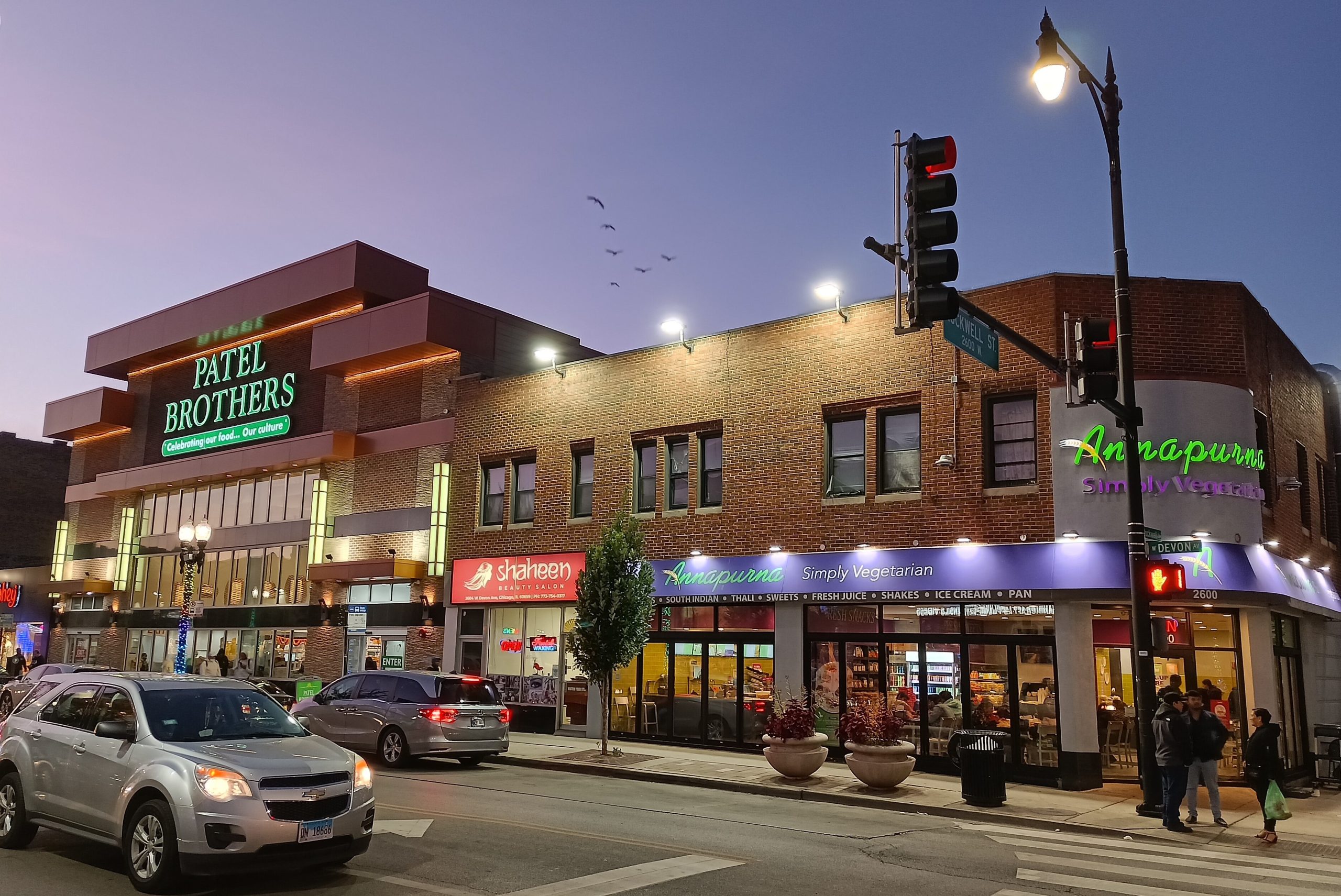
The sari shop window glows at dusk on the Indian end of Devon Avenue, gold thread catching the streetlight as a Gujarati grandmother folds silk for tomorrow’s wedding. A delivery dolly rumbles out of the Patel Brothers loading dock a few blocks east, stacked with twenty-pound sacks of basmati and bitter melon flown in that morning.
Bolted above the intersection at Western, the green honorary plaque reads Mahatma Gandhi Marg, hung there in 1991 when the city of Chicago made it official. From Western Avenue to California, this one-mile stretch is the oldest Indian commercial corridor in the American Midwest. On a Saturday in October the sidewalk smells like cardamom, frying onion, and the smoke of a hundred diyas being lit for Diwali.
Devon Avenue, The Place
Devon Avenue runs east to west along the far north edge of Chicago, through the neighbourhoods of West Ridge and West Rogers Park, six and a half miles north of the Loop. The Indian commercial spine is the mile between Western Avenue and California Avenue, with the heaviest density of saree houses, sweet shops, and groceries clustered between Maplewood and Rockwell.
North of Devon, the streets are lined with red-brick Chicago bungalows and three-flat apartment buildings put up in the 1920s for a different wave of immigrants entirely. The CTA’s 155 Devon bus runs the length of it. The Western Brown Line stop drops you two miles south, which is why most of the regulars drive.
How Devon Avenue Became Indian
Before the Indians
For most of the twentieth century, Devon was a Jewish street. By the early 1960s, three quarters of West Rogers Park’s residents were Jewish, roughly 47,000 people, mostly Eastern European families who had moved north from Lawndale and Albany Park, joined after the war by Holocaust survivors and, later, by Soviet Jews from Moscow, Kyiv, and Odesa.
The signage was Yiddish and Hebrew. The bakeries were Rosenblum’s and Levinson’s. The stretch from California to Kedzie still carries the honorary name Golda Meir Boulevard, a remnant of the era when Devon was the spine of Ashkenazi Chicago.
That world began to thin in the late 1960s as Jewish families moved north into Skokie and west into Lincolnwood. Storefronts emptied. Rents fell. The street was waiting for whoever came next.
The Indians Arrive
What came next was the Immigration and Nationality Act of 1965, signed by Lyndon Johnson and known forever after as Hart-Celler. The law tore up a forty-year quota system built around national origin and replaced it with one that prioritised skilled professionals and family reunification. In 1965, 582 Indians were admitted to the United States. By 1971, more than nine in ten Indian admissions were classed as professional or technical workers.
Chicago, with its teaching hospitals, engineering firms, and big public university system, absorbed an outsized share. Indian physicians took residencies at Cook County, Rush, and the VA. Engineers found work at Motorola and the South Side steel mills. Computer scientists turned up at Bell Labs in Naperville. The first wave was not poor and it was not rural. It was overwhelmingly professional, almost entirely English-speaking, and looking for a place to buy a sari, a packet of toor dal, and a bag of fennel seed without driving to a port city on either coast.
That place turned out to be Devon Avenue. In 1973, a man named Ratan Sharma opened a small storefront at 2534 West Devon and called it India Sari Palace. He had been managing a Hong Kong-based sari company that ran a mail-order catalogue. Of its five thousand American customers, a striking number lived within a few train stops of Devon, so Devon is where he put the store. It was the first South Asian retail business on the street.
A year later, in September 1974, two brothers from the village of Bhandu in Mehsana district, Gujarat, signed the lease on a 900-square-foot space at 2610 West Devon. Mafat Patel had arrived in 1968 to study engineering at Youngstown State; his younger brother Tulsi and Tulsi’s wife Aruna joined him in 1971. They named the shop Patel Brothers and stocked it with the things they themselves missed: turmeric, hing, atta, the right kind of green chilli. The store paid for itself in the first month.
Devon at Its Peak
Through the 1980s and into the 2000s, Indian Devon thickened from a handful of pioneer storefronts into a fully formed neighbourhood economy. Where Patel Brothers led, others followed. Sweet shops opened, then jewellers, then tailors, then video stores renting bootleg VHS copies of Amitabh Bachchan films, then travel agents selling Air India tickets at a discount, then accountants who could file an H-1B and a green-card petition between cups of chai.
The clientele was no longer just the Devon professionals. Indian families now drove in from Naperville, Aurora, and Schaumburg for the weekly Saturday shop. Patel Brothers in particular became a pilgrimage. Cars pulled up with Wisconsin plates, Indiana plates, Michigan plates. The brothers added a second store, then a third, then began franchising. By the late 1990s the chain was opening in New Jersey, Houston, Atlanta, the Bay Area.
The street took on a rhythm. Weekdays were quiet. Saturdays and Sundays were a slow, dense crawl, parents pushing strollers between Tahoora and Sukhadia’s, teenagers ducking into the music shop, uncles arguing politics outside the chai stall. In August, the India Independence Day Parade rolled west from Western Avenue, floats draped in saffron and green, the tricolour everywhere. In October, the buildings lit up for Diwali and the sidewalks filled with people buying new clothes, gold bangles, and pyramids of mithai for the festival of lights.
In 1991, the city made the obvious official. The blocks between Western and California, the densest stretch of Indian-owned business in the Midwest, were honorarily co-named Mahatma Gandhi Marg. The sign still hangs above the intersection.
The Change
The same upward mobility that built Indian Devon eventually pulled people away from it. Second-generation Indian Americans, raised in the West Ridge bungalows, did not stay. They went to Northwestern, Illinois, Notre Dame. They became radiologists, software architects, hedge-fund analysts. By 2000, roughly 80 percent of Indian Chicagoans lived in the suburbs.
The pull was specific. Naperville had the school district and the I-88 tech corridor jobs. Schaumburg had Motorola and the cul-de-sac houses. Bartlett got the BAPS Swaminarayan Mandir in 2004, a hand-carved Italian marble temple shipped in forty thousand pieces from India and reassembled on twenty-seven acres of prairie. The centre of Indian gravity in Chicago slid west and south, away from Devon.
Devon kept its commercial pulse, but the residential character of the surrounding blocks shifted. Bangladeshi families arrived in the 1990s and 2000s and opened businesses east of the Indian core. Afghan refugees came after 2001 and again after 2021. The street layered, the way Devon has always layered. The Jewish bakeries became sari shops; the sari shops now share the block with Bangladeshi groceries and Afghan kebab houses.
The Landmarks of Indian Devon Avenue
Patel Brothers, 2610 W Devon Ave. The founding business of Indian Devon. Mafat and Tulsi Patel opened the first store in September 1974 in a 900-square-foot space and never moved. In 2021 they opened a flagship a few doors down, and in 2024 the family celebrated fifty years on the block. Every Indian American grocery chain in the country traces a line back to this storefront.
India Sari Palace, 2534 W Devon Ave. Opened in 1973 by Ratan Sharma, the first South Asian retail business on Devon. For three decades it dressed the Midwest’s Indian brides, mothers, and bharatanatyam dancers, holding around three thousand steady customers even after a dozen rivals opened on the same street. The shopfront closed in recent years, but its place in the story is fixed.
Sukhadia’s Sweets and Snacks, 2559 W Devon Ave. The Gujarati sweet shop that taught the rest of Chicago what kaju katli, mohanthal, and ghari taste like at room temperature. The trays of mithai in the glass case are the closest thing Devon has to a community altar, restocked every morning, sold out by every festival.
Mysore Woodlands, 2548 W Devon Ave. South Indian vegetarian, family-run, the masala dosa as long as your forearm. For decades the default Sunday-lunch destination for Tamil, Telugu, and Malayali families across the metro area, and the only Devon restaurant to hold a kosher certification, an artefact of the street’s layered past.
Annapurna Simply Vegetarian, 2600 W Devon Ave. The oldest vegetarian Indian restaurant in Chicago, opened in 1982 when Devon was still finding its Indian feet. A Gujarati thali kitchen that has fed three generations of West Ridge families and the suburban diaspora that comes back to visit.
Hyderabad House, 2225 W Devon Ave. The Hyderabadi biryani anchor of the street, with the dum-cooked rice, the salaan, the bone marrow, the mirchi ka salan. A reminder that Indian Devon is not only Gujarati but also Telugu, Andhra, and Deccan in its appetites.
The Mahatma Gandhi Marg Sign, Devon and Western. Approved by the city council in 1991, the honorary co-naming hangs in green and white at the eastern gateway to the Indian strip. It is the only thing in Chicago named for the man who walked out of South Africa and into world history, and on August evenings around the Independence Day parade, people stop to photograph it.
Where the Devon Avenue Indians Came From
The first and largest stream was Gujarati. The Patel community in particular, with deep roots in the Charotar belt around Anand, Kheda, and Vadodara districts, dominated the commercial life of the street. Mafat and Tulsi Patel came from Mehsana, a few hours north of that belt; thousands of their countrymen followed the same chain through the 1970s and 1980s, sponsoring cousins, brothers, brothers-in-law, the slow accumulation of an entire jati transplanted to a Chicago avenue.
Punjab sent the second great stream, sometimes Hindu but more often Sikh, settling north of Devon and pulling toward the gurdwaras in Palatine and Glen Ellyn. Mumbai and Maharashtra sent middle-class professionals, the doctors and engineers who arrived first and seeded the neighbourhood.
South India sent Tamil, Telugu, Malayali, and Kannadiga families, many of them software engineers, many of them clustered around the Lemont Hindu Temple of Greater Chicago, which opened in 1986 on bluff land southwest of the city. Bengal sent a smaller but distinct community, academics and physicians mostly, with the photographer Mukul Roy chronicling Devon in its early years.
What unified them on Devon was not region or language but the absence of a closer option. For thirty years, if you lived in the upper Midwest and wanted a length of Banarasi silk, a copy of The Hindu, or a tin of pure ghee, Devon was where you went.
Devon Avenue Today
The Indian commercial corridor on the east side of Western Avenue is still intact in 2026, but it does not look quite the way it did in 1995. The residential base has thinned; most second- and third-generation Indian Americans live in Naperville, Schaumburg, Aurora, or Bartlett, and they come to Devon as visitors rather than neighbours.
The street has layered again. West of Western Avenue, the Pakistani commercial strip is its own world, with its own story that deserves its own telling. East of Western, Bangladeshi and Afghan businesses have moved into spaces a Jewish bakery once occupied and an Indian sari shop occupied after. The newer Patel Brothers flagship, opened in 2021, is bigger and slicker than anything on the block in the 1980s, and on weekends the parking lot is still full.
The India Independence Day parade still rolls every August. The buildings still light up for Diwali every October. The Mahatma Gandhi Marg sign is still bolted in place above the intersection. The shop windows still glow at dusk with gold thread and silk, and someone, somewhere on the block, is still folding a sari for tomorrow’s wedding.
Frequently Asked Questions
Why did Indians settle on Devon Avenue?
The 1965 Hart-Celler Act opened the door to skilled Indian professionals, and Chicago’s hospitals, engineering firms, and universities pulled in doctors, engineers, and academics through the late 1960s and 1970s. As Jewish families moved north into Skokie and Lincolnwood, Devon Avenue’s storefronts emptied and rents fell, creating space for India Sari Palace in 1973 and Patel Brothers in 1974 to anchor what became the largest Indian commercial corridor in the American Midwest.
Is Devon Avenue still Indian today?
Devon Avenue remains a working Indian commercial corridor in 2026, especially the mile between Western and California co-named Mahatma Gandhi Marg, but most Indian Americans now live in suburbs like Naperville, Schaumburg, Bartlett, and Aurora. The shops, restaurants, and annual festivals are still here, but the residential heart has shifted west and south.
What are the most famous Indian landmarks on Devon Avenue?
Patel Brothers at 2610 W Devon, founded in 1974 by Mafat and Tulsi Patel, is the most recognisable, alongside India Sari Palace at 2534 W Devon, the first South Asian retail business on the street. Sukhadia’s Sweets, Mysore Woodlands, Annapurna, and Hyderabad House have each anchored the food side of Indian Devon for decades, and the honorary Mahatma Gandhi Marg sign at Devon and Western marks the gateway.
Where in India did the Devon Avenue Indians come from?
The dominant origin is Gujarat, especially the Charotar belt around Anand, Kheda, and Vadodara, and Mehsana district to the north, home of the founding Patel family. Substantial communities also came from Punjab, Mumbai and Maharashtra, the four states of South India (Tamil Nadu, Andhra Pradesh, Karnataka, Kerala), and Bengal.
When did Indians first arrive on Devon Avenue?
The first significant arrivals followed the 1965 Hart-Celler Act, professionals settling in West Ridge through the late 1960s. The commercial corridor began with India Sari Palace in 1973 and Patel Brothers in September 1974, with the street fully formed as Indian Devon by the mid-1980s.
If your family’s story passed through Devon Avenue, or any of the Gujarati villages, Punjabi towns, and South Indian cities that sent people to Chicago, Atlas of Home can trace that journey. From the Charotar belt to West Ridge, from Mehsana to Mahatma Gandhi Marg, to wherever you live now.