
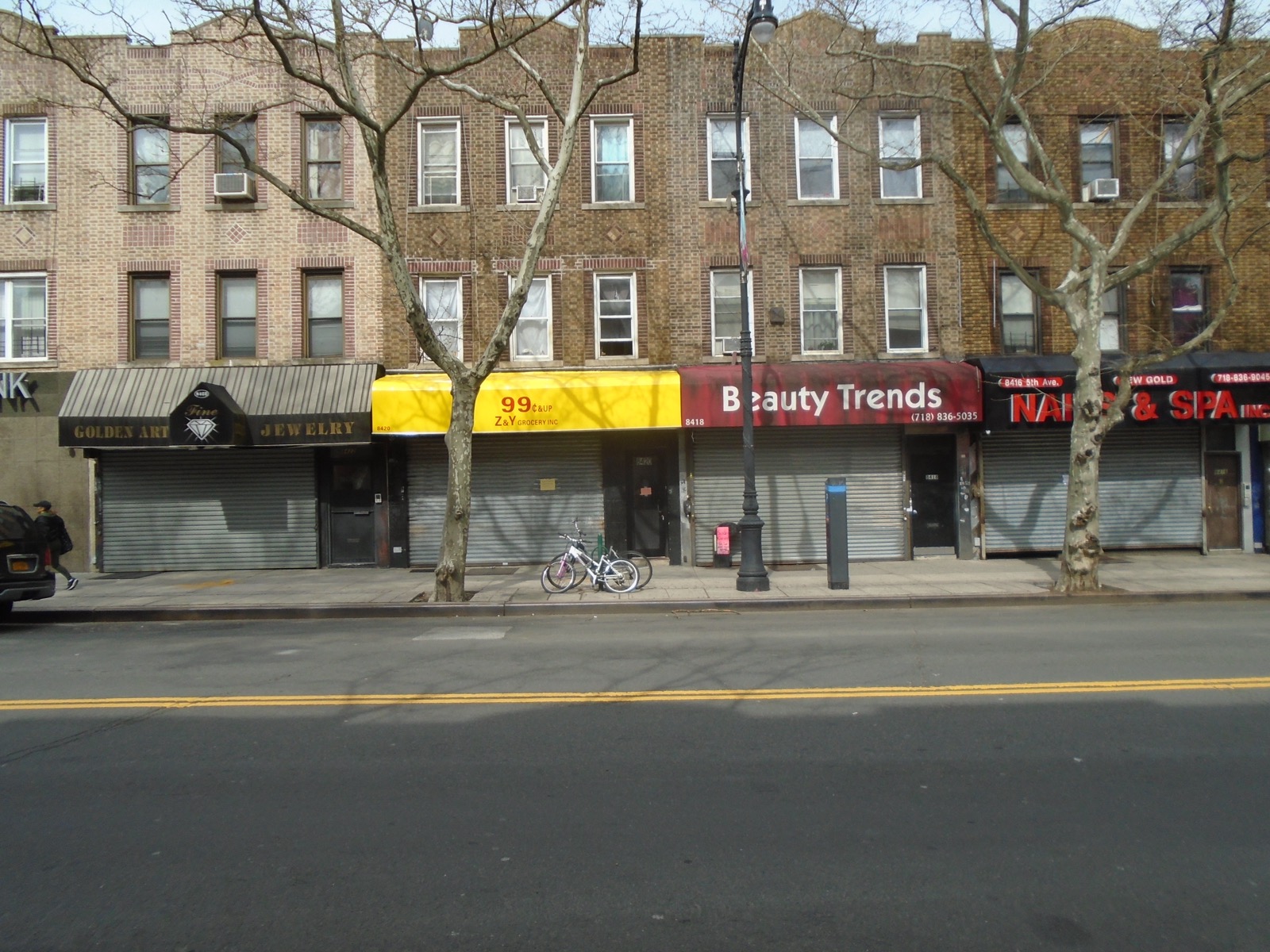
On a Friday night in Bay Ridge, the smoke off the shawarma spit at the corner of 73rd and 5th rolls past a storefront window painted with Arabic script. Three Palestinian flags hang from a second-floor balcony down the block. From a bakery, the sound of someone arguing in Levantine Arabic over the price of knafeh. This is the Arab spine of Brooklyn, a fifteen-block stretch of Fifth Avenue where roughly eight thousand Arab New Yorkers have built one of the largest Arab-American neighbourhoods on the East Coast.
Bay Ridge, The Place
Bay Ridge sits in the southwestern corner of Brooklyn, hard against the water of the Narrows and the steel arc of the Verrazzano-Narrows Bridge. The R train is the neighbourhood’s only subway, threading up Fourth Avenue from the 95th Street terminus and taking the better part of an hour to reach midtown Manhattan.
The housing is a brick-and-limestone mix of row houses, walk-up tenements, and pre-war apartment buildings, set on long avenues that drop steadily toward the harbour. Fifth Avenue is the commercial spine. Third Avenue is the bar-and-restaurant strip. Eighth Avenue, further inland, is now largely Chinese.
How Bay Ridge Became Arab
Before the Arabs
For most of the twentieth century, Bay Ridge was a Northern European neighbourhood. Norwegian sailors and shipyard workers settled in such numbers that Eighth Avenue picked up the nickname Lapskaus Boulevard, after the salted Norwegian beef stew. By 1971 the local Norwegian community was 55,000 strong and called itself the fourth-largest Norwegian city in the world.
Irish, Italian, and Greek families layered in beside them. The R-train line, finished in 1916, turned Bay Ridge from a coastal village into a commuter neighbourhood for the working classes of Brooklyn.
The Arab presence here is older than people remember. Some Bay Ridge families trace their lines to Christian Syrian and Lebanese arrivals who left the Ottoman Empire in the late 1800s and settled in Little Syria, the Arabic-speaking quarter that ran along Washington Street in Lower Manhattan.
When the city demolished Little Syria in the 1940s to make ramps for the Brooklyn-Battery Tunnel, many of those families crossed the water into Brooklyn. A direct subway connected the two places, and that is part of why so many of them landed in Bay Ridge.
The Arabs Arrive
The real transformation came in the 1970s. The 1965 Hart-Celler Immigration Act had finally lifted the national-origin quotas that had kept the door narrowed for decades. Palestinians, Egyptians, and Yemenis began arriving in numbers.
The Palestinians came mostly from the West Bank, from villages outside Jerusalem, Ramallah, and Bethlehem. The Egyptians were a mix of Coptic Christian and Muslim, often arriving on family-reunification visas through relatives who had come earlier. The Yemenis came from the Hadhramaut and the south, frequently passing first through other American cities before settling into Bay Ridge’s small-business economy.
The Lebanese civil war that began in 1975 sent another large cohort across the Atlantic. They were Maronite Christians from the mountain villages above Beirut and Shia Muslims from the southern towns near Tyre and Sidon. Many of them chose Bay Ridge because relatives already lived there and rents on Fifth Avenue were still cheap enough that a recent arrival could open a small restaurant or a phone-card shop.
Bay Ridge at Its Peak
By the 1990s, Fifth Avenue from about 65th Street down to 86th had reorganised itself around the Arab community. Halal butchers, hookah cafés, Lebanese bakeries, Yemeni qat-free coffee houses, Egyptian groceries selling fava beans and dried molokhia. Mosques opened in former retail spaces. Travel agencies advertised cheap flights to Amman and Cairo.
The Arab American Association of New York opened its first doors on Fifth Avenue in December 2001, three months after 9/11. The community had stepped into a hostile decade, with FBI surveillance, hate crimes, and what neighbours have since called a wall of suspicion. AAANY became the place where new arrivals went for help with English classes, immigration paperwork, and legal aid.
Linda Sarsour, born in Brooklyn to Palestinian parents from Beit Hanina and El-Bireh, became AAANY’s executive director in 2005 at the age of twenty-five. She ran it for the next twelve years, turning it into one of the most visible Arab-American advocacy organisations in the country before leaving in 2017 for national work.
The Change
The 2010s brought a Syrian wave. The civil war that started in 2011 drove tens of thousands of Syrians toward the United States, and many of those who reached New York found their way to Bay Ridge through the existing Levantine networks.
They came from Damascus, Aleppo, Homs. Some had been doctors and engineers at home. Many started over behind shop counters.
The Yemeni community kept growing too. Bay Ridge already had the largest cluster of Yemeni-owned bodegas and small retail operations in the city, and after the Yemeni civil war intensified in 2015 the family chains tightened further.
Then came October 2023 and the Gaza war. Bay Ridge became one of the most politically engaged Arab neighbourhoods in the country. Thousands of people marched up Fifth Avenue with Palestinian flags that month, shutting the avenue down.
In May 2024 a Nakba commemoration ended in police arrests and a sharp confrontation. The community has since held iftars on Fifth Avenue during Ramadan, organised mutual-aid drives for Gaza families, and worked through City Council politics with Justin Brannan and others.
The Landmarks of Arab Bay Ridge
Arab American Association of New York sits at 7111 Fifth Avenue. Founded in December 2001 by a small group of Arab civic leaders working out of one room, it now runs English classes, after-school programs, legal services, and youth organising. It is, more than any single mosque or restaurant, the institutional heart of Arab Bay Ridge.
Tanoreen Restaurant at 7523 Third Avenue is the neighbourhood’s most decorated kitchen. Rawia Bishara, born in Nazareth and arrived in New York in 1974, opened it in 1998 to cook the Palestinian food she made at home. Her daughter Jumana joined her in 2006. Tanoreen now carries a Michelin Bib Gourmand and Rawia has been nominated three times for the James Beard Award for Best Chef NYC.
Yemen Café and Restaurant at 7317 Fifth Avenue opened in 1986 as one of the first Yemeni restaurants in the United States. The chicken mandi, lamb haneeth, and salta on the menu have travelled with Yemeni families since the 1960s. It is halal and sells no alcohol, which is part of what made it a community space rather than just a restaurant.
Karam Restaurant at 8519 Fourth Avenue is the Lebanese kitchen the neighbourhood relies on for shawarma, lahmajeen, and za’atar pies. Family owned, recipes carried over generations. The dining room is small and busy.
Salam Arabic Lutheran Church at 414 80th Street is one of the more unusual landmarks of Arab Bay Ridge. The building was originally Salem Danish Evangelical Lutheran Church, designed by the Danish architect Carl Jensen for the neighbourhood’s Scandinavian community. In 1995 an Arabic-speaking congregation took it over. Renamed Salam, it became the first Arabic Lutheran church in North America and now holds bilingual services in English and Arabic every Sunday at 11.
Islamic Society of Bay Ridge, also known as Masjid Musab, sits at 6807 Fifth Avenue. Established in 1980, it is one of the older Sunni mosques in the borough and a hub for the predominantly Palestinian and Egyptian Muslim population on the avenue.
The Fifth Avenue corridor itself, roughly 65th to 86th Street, is the landmark that matters most. The block-by-block density of Arab storefronts, the trilingual signage in Arabic, English, and sometimes Urdu, the smell of kebab smoke and cardamom coffee. The avenue is the neighbourhood’s stage, and on the right Friday evening it is unmistakable.
Where the Bay Ridge Arabs Came From
The Palestinians came overwhelmingly from the West Bank. Beit Hanina, on the northern edge of Jerusalem. Beit Jala and Beit Sahour, the Christian towns next to Bethlehem. Ramallah, Hebron, and a scatter of villages outside each. A handful of Bay Ridge families also trace to 1948 displacement from coastal cities like Jaffa and Haifa.
The Lebanese came in two distinct streams. The Christians, mostly Maronite, came from the mountain villages of Mount Lebanon, including the Bsharri-Becharre area and the Bekaa Valley. The Muslims, mostly Shia, came from the south, from Tibnin, Tyre, and the villages around Sidon. Both streams accelerated through the 1975 to 1990 civil war.
The Syrians, in the older wave, came from what is now Lebanon as well as from Damascus and Aleppo when those were still Ottoman cities. The newer wave, from 2011 onward, came from Damascus, Aleppo, and Homs as the country tore itself apart.
The Egyptians came largely from Cairo and the Nile Delta. The Coptic Christian families often went on to Jersey City, but a smaller Coptic and a larger Muslim Egyptian population stayed in Bay Ridge, anchored around grocery shops and family-run businesses.
The Yemenis came from Aden, from the Hadhramaut, and from villages outside Sana’a. They moved through the American bodega economy, often spending years in upstate New York or Michigan before settling family in Bay Ridge.
Bay Ridge Today
The neighbourhood today is more layered than it has ever been. The Norwegians are mostly gone, though a handful of bakeries and the May 17th parade still mark the connection.
The Italians remain at around twenty percent of the population. The Chinese community along Eighth Avenue has grown steadily. Younger professionals priced out of Park Slope and Brooklyn Heights have started arriving in numbers.
The Arab community is not fading. If anything it has deepened, with Fifth Avenue now holding more Arab businesses than it did a decade ago.
The political consciousness sharpened through the Gaza war. AAANY is bigger than it was under Sarsour. New restaurants, like Tanoreen’s recent Dumbo expansion, are carrying Bay Ridge cooking out into the wider city.
What you hear on Fifth Avenue on a weekend afternoon is the same mix you would have heard twenty years ago, only louder and more confident. Arabic in three or four dialects. English with the cadence of second-generation Brooklyn.
The clatter of a knafeh tray being slid out of an oven. A neighbourhood that has been rebuilt from somewhere else and is still rebuilding.
Frequently Asked Questions
Why did Arabs settle in Bay Ridge?
Arabs settled in Bay Ridge primarily because earlier Arab arrivals had already established a foothold there. Christian Syrian and Lebanese families displaced from Manhattan’s Little Syria moved into Bay Ridge in the 1940s, and the post-1965 Palestinian, Egyptian, and Yemeni waves followed the same chain. Cheap rents along Fifth Avenue, a direct R-train ride to Manhattan, and an existing Arab social and commercial infrastructure made the neighbourhood the natural landing place.
Is Bay Ridge still Arab today?
Yes, very much so. Bay Ridge is home to roughly 8,000 Arab residents and is the largest Arab-American neighbourhood in New York City. The Fifth Avenue commercial corridor from around 65th Street to 86th Street is dense with Palestinian, Yemeni, Lebanese, Syrian, and Egyptian businesses, and the community has grown rather than shrunk over the last decade.
What are the most famous Arab landmarks in Bay Ridge?
The most prominent landmarks include the Arab American Association of New York at 7111 Fifth Avenue, Tanoreen Restaurant at 7523 Third Avenue, Yemen Café at 7317 Fifth Avenue, the Islamic Society of Bay Ridge at 6807 Fifth Avenue, Salam Arabic Lutheran Church at 414 80th Street, and Karam Lebanese Restaurant at 8519 Fourth Avenue. The Fifth Avenue commercial spine itself is the neighbourhood’s defining landmark.
Where did the Bay Ridge Arabs come from?
The Palestinians came from West Bank villages around Jerusalem, Bethlehem, Ramallah, and Hebron, including Beit Hanina, Beit Jala, and Beit Sahour. The Lebanese came from Mount Lebanon’s Maronite Christian villages and from Shia Muslim towns in the south near Tyre and Sidon. Syrians came from Damascus and Aleppo, Egyptians from Cairo and the Nile Delta, and Yemenis from Aden and the Hadhramaut region.
When did Arabs first arrive in Bay Ridge?
The first Arab residents arrived in Bay Ridge in the 1940s, when Christian Syrian and Lebanese families displaced from Manhattan’s Little Syria moved across the harbour. The transformation into a primarily Arab commercial district began after the 1965 Hart-Celler Immigration Act, with large waves of Palestinians, Egyptians, and Yemenis arriving through the 1970s and continuing every decade since.
If your family’s story passed through Bay Ridge, or through any of the West Bank villages, Lebanese mountains, or Egyptian Delta towns that fed it, Atlas of Home can trace that journey. From Beit Hanina or Bsharri or Sana’a to Fifth Avenue, to wherever you are now.