
Where the National City Filipinos Came From
The earliest waves came largely from the Ilocos region of northern Luzon and from the Visayan islands of Cebu and Panay, the same provinces that sent labourers up and down the West Coast. The Navy then drew heavily from the towns ringing the bases, above all Olongapo and the wider Zambales coast around Subic Bay, and Cavite near old Sangley Point.
The post-1965 professionals, the nurses and doctors and teachers, came from across the archipelago, with a strong Tagalog-speaking presence from Manila and central Luzon. National City’s sister-city bond with Olongapo is the clearest map of all: it marks the single town from which more of these families came than any other.
The pull of the homeland never loosened. Remittance counters and balikbayan-box shippers still line Plaza Boulevard, sending dollars and goods back to the towns that the sailors left.
National City Today
National City remains profoundly Filipino. The 2020 census counted Filipinos as roughly 19 percent of the population, close to 11,000 people, a share that has held steady for two decades even as families fanned out across the South Bay.
The community has also found its political voice. After residents argued that an at-large system diluted the Filipino vote, National City moved to district elections beginning in 2022. The grandchildren of stewards now sit at the table their grandfathers once served.
Walk Plaza Boulevard on a Saturday and the present is loud and unmistakable. Teenagers carry boba past the doors of Seafood City, a fiesta tent goes up in a church lot, and the smell of garlic rice drifts from a corner turo-turo. The harbor that brought the first sailors is still there. The story it started is still being written, the same way it is in the other great Navy-town Filipino community in Virginia Beach, and the same way newer arrivals reshape places like the Chaldean enclave of El Cajon elsewhere in the county.
Frequently Asked Questions
Why did Filipinos settle in National City, California?
The U.S. Navy was the engine. Filipino men enlisted as Navy stewards from the colonial era after 1898, and after their tours many settled near Naval Base San Diego and the 32nd Street station, which border National City. Chain migration then pulled relatives across the Pacific, making National City one of the most Filipino communities in the continental United States.
Is National City still Filipino today?
Yes. The 2020 census counted Filipinos as roughly 19 percent of National City’s population, close to 11,000 people, a share that has stayed steady for two decades. Many established families moved to nearby Chula Vista and Bonita, but National City remains the commercial and spiritual heart of Filipino San Diego.
What are the most famous Filipino landmarks in National City?
Seafood City Supermarket on East Plaza Boulevard, which opened its first-ever store here in 1989, is the best known. Other anchors include Island Pacific Supermarket, St. Anthony of Padua Church on West 18th Street, and the historic naval waterfront along San Diego Bay.
Where in the Philippines did the National City Filipinos come from?
Early arrivals came mainly from the Ilocos region of northern Luzon and from Cebu and Panay in the Visayas. The Navy drew heavily from towns near the bases, especially Olongapo by Subic Bay, now National City’s sister city, and Cavite near Sangley Point. Post-1965 professionals came from across the islands, including Manila and central Luzon.
When did Filipinos first arrive in National City?
Filipinos appeared in the wider San Diego area in the early 1900s, with students at the State Normal School in 1903 and Navy enlistees soon after. National City itself became strongly Filipino from the 1950s onward, as steward-generation sailors settled near Naval Base San Diego after World War II.
If your family’s story passed through National City, or any of the Navy towns and provinces the Filipino community made home, Atlas of Home can trace that journey. From the streets of Olongapo and the rice country of Ilocos to a bungalow near the bay, to wherever you are now. Explore your story →
Sources and further reading: National City, California (Wikipedia) and the San Diego History Center on Filipino migrants in San Diego.
National City at Its Peak
By the 1960s and 1970s the steward mold finally broke. Around 1969 and 1970, Filipino sailors were at last allowed to train in ratings of their own choosing, and a generation moved into engineering, medicine, and the technical trades. Careers deepened, pensions accrued, and families that had once rented now owned.
Layered on top of the Navy families came a second, very different wave. The Immigration and Nationality Act of 1965 opened the door to professionals, and the Philippines became the largest single supplier of nurses to the United States. Between 1966 and 1991 at least 35,000 Filipino nurses immigrated, and a great many staffed the hospitals of San Diego County.
Nurses married sailors. Sailors’ daughters became nurses. The two streams braided into one community that was both blue-collar and professional, devout and ambitious.
By the 2000 census Filipinos made up just over 18 percent of National City. The neighbouring Paradise Hills district of San Diego filled with the same families, until the South Bay as a whole became the recognised heart of Filipino San Diego. Daily life ran on Sunday Mass, weekend lechon, and the long-distance pull of relatives still back home.
The Change
Two things reshaped the community in the late twentieth century. In 1992 the United States closed Subic Bay, and with it ended the enlistment pipeline that had fed National City for nearly a century. The eruption of Mount Pinatubo the year before had already pushed a final wave of families across the Pacific.
At the same time the established families did what successful immigrant families do. They moved up and out, many to the larger lots of Chula Vista and Bonita, while keeping National City as the place they came back to for groceries, church, and funerals.
The community did not fade. It spread. National City stayed the commercial and spiritual centre even as the bedrooms migrated south.
The Landmarks of Filipino National City
Seafood City Supermarket, 1420 East Plaza Boulevard. This is holy ground for the chain. Seafood City, now the largest Filipino supermarket chain in North America, opened its very first store here in National City in 1989, originally under the name Manila Seafood. Inside, Grill City turns out sisig, kare-kare, and lumpia, and Bakers Avenue fills the air with fresh pandesal and ube.
Island Pacific Supermarket, 2720 East Plaza Boulevard. The rival Filipino grocer anchors the other end of the strip, with the restaurant Philhouse attached. Between the two markets, Plaza Boulevard reads like a high street transplanted from Metro Manila.
St. Anthony of Padua Church, 410 West 18th Street. The parish was established in 1910, long before the Filipino wave, but it became a spiritual home for Navy families and their children. The current Mission-style church was consecrated in December 1998, and its calendar of fiestas and Filipino devotions reflects the congregation that fills its pews.
FAVA Hall, 2962 Market Street, San Diego. Just over the line in San Diego, the Filipino American Veterans Association built its hall after the group formed in 1946. It stands as a monument to the steward generation, the men who served before the country fully recognised them.
The Mile of Cars, National Avenue. Not a Filipino landmark in itself, but the dealership strip where countless Navy families bought their first American car on a steward’s or a nurse’s wages. It is woven into the family lore of the place.
Westfield Plaza Bonita, on the eastern edge. The regional mall straddling National City and the Bonita line became a de facto Filipino gathering place, its food court and shops reflecting the community that surrounds it.
Where the National City Filipinos Came From
The earliest waves came largely from the Ilocos region of northern Luzon and from the Visayan islands of Cebu and Panay, the same provinces that sent labourers up and down the West Coast. The Navy then drew heavily from the towns ringing the bases, above all Olongapo and the wider Zambales coast around Subic Bay, and Cavite near old Sangley Point.
The post-1965 professionals, the nurses and doctors and teachers, came from across the archipelago, with a strong Tagalog-speaking presence from Manila and central Luzon. National City’s sister-city bond with Olongapo is the clearest map of all: it marks the single town from which more of these families came than any other.
The pull of the homeland never loosened. Remittance counters and balikbayan-box shippers still line Plaza Boulevard, sending dollars and goods back to the towns that the sailors left.
National City Today
National City remains profoundly Filipino. The 2020 census counted Filipinos as roughly 19 percent of the population, close to 11,000 people, a share that has held steady for two decades even as families fanned out across the South Bay.
The community has also found its political voice. After residents argued that an at-large system diluted the Filipino vote, National City moved to district elections beginning in 2022. The grandchildren of stewards now sit at the table their grandfathers once served.
Walk Plaza Boulevard on a Saturday and the present is loud and unmistakable. Teenagers carry boba past the doors of Seafood City, a fiesta tent goes up in a church lot, and the smell of garlic rice drifts from a corner turo-turo. The harbor that brought the first sailors is still there. The story it started is still being written, the same way it is in the other great Navy-town Filipino community in Virginia Beach, and the same way newer arrivals reshape places like the Chaldean enclave of El Cajon elsewhere in the county.
Frequently Asked Questions
Why did Filipinos settle in National City, California?
The U.S. Navy was the engine. Filipino men enlisted as Navy stewards from the colonial era after 1898, and after their tours many settled near Naval Base San Diego and the 32nd Street station, which border National City. Chain migration then pulled relatives across the Pacific, making National City one of the most Filipino communities in the continental United States.
Is National City still Filipino today?
Yes. The 2020 census counted Filipinos as roughly 19 percent of National City’s population, close to 11,000 people, a share that has stayed steady for two decades. Many established families moved to nearby Chula Vista and Bonita, but National City remains the commercial and spiritual heart of Filipino San Diego.
What are the most famous Filipino landmarks in National City?
Seafood City Supermarket on East Plaza Boulevard, which opened its first-ever store here in 1989, is the best known. Other anchors include Island Pacific Supermarket, St. Anthony of Padua Church on West 18th Street, and the historic naval waterfront along San Diego Bay.
Where in the Philippines did the National City Filipinos come from?
Early arrivals came mainly from the Ilocos region of northern Luzon and from Cebu and Panay in the Visayas. The Navy drew heavily from towns near the bases, especially Olongapo by Subic Bay, now National City’s sister city, and Cavite near Sangley Point. Post-1965 professionals came from across the islands, including Manila and central Luzon.
When did Filipinos first arrive in National City?
Filipinos appeared in the wider San Diego area in the early 1900s, with students at the State Normal School in 1903 and Navy enlistees soon after. National City itself became strongly Filipino from the 1950s onward, as steward-generation sailors settled near Naval Base San Diego after World War II.
If your family’s story passed through National City, or any of the Navy towns and provinces the Filipino community made home, Atlas of Home can trace that journey. From the streets of Olongapo and the rice country of Ilocos to a bungalow near the bay, to wherever you are now. Explore your story →
Sources and further reading: National City, California (Wikipedia) and the San Diego History Center on Filipino migrants in San Diego.
You could hear it before you saw it: the slap of slippers on a porch, a lola calling the kids in for merienda, the radio carrying a Tagalog ballad over the hum of a returning destroyer. From the 1950s onward, if you turned off Interstate 5 into National City, you stepped into the most Filipino corner of the continental United States. Nearly one in five residents traces a line back to the islands. And almost every one of those lines runs through the U.S. Navy.
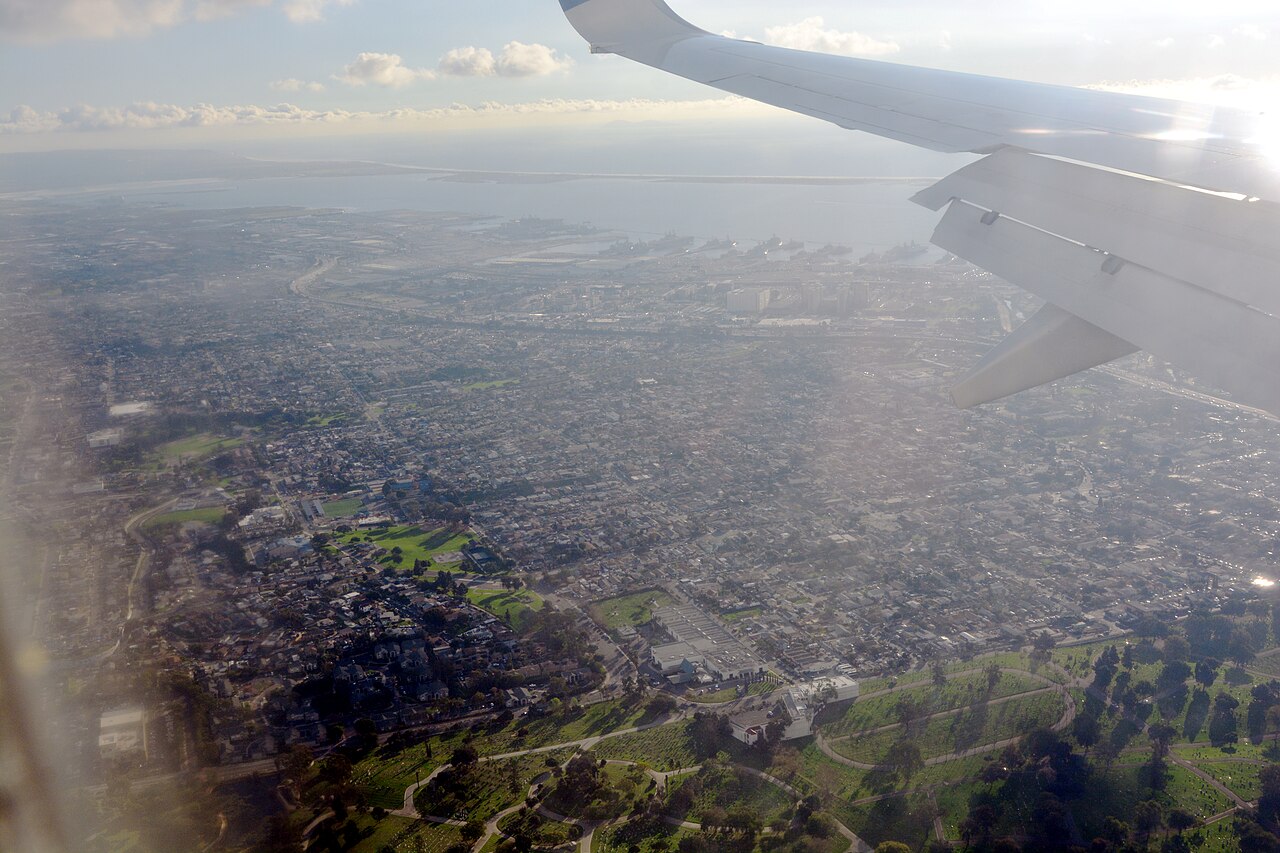
National City sits at the top of the South Bay, wedged between San Diego to the north and Chula Vista to the south, with Bonita and Paradise Hills curling along its eastern edge. Its three-mile waterfront along San Diego Bay is part of Naval Base San Diego, the largest naval base on the West Coast. Incorporated in 1887, it is the second-oldest city in San Diego County, a grid of modest stucco bungalows, a famous Mile of Cars on National Avenue, and commercial strips that turned Filipino sometime in the last fifty years.
This is the story of how the Filipinos in National City, California built a home around a harbor, and what holds the place together today.
National City and the Place
The city is small and dense, just over nine square miles holding more than 56,000 people. The street grid runs flat from the bay up toward the hills, with Plaza Boulevard and East 8th Street as the main commercial arteries.
The housing is working-class and unfussy: single-storey bungalows, postwar tract homes, low apartment blocks. What gives the place its character is the proximity to the water and the gates of the naval base, which for generations set the rhythm of family life here.
How National City Became Filipino
Before the Filipinos
National City began as ranch land carved from Rancho de la Nacion, developed by the Kimball brothers in the 1860s and 1870s as a railroad and port town. For its first half-century it was a mixed working town of railway men, ranchers, and the families who served the growing port.
San Diego itself already had a small Filipino presence by the early 1900s. The first recorded Filipino migrants in the region were students enrolled at the State Normal School, now San Diego State University, in 1903, brought over under the Pensionado Act. A small downtown community of restaurants and pool halls gathered around Market Street between 15th and 16th in the years that followed.
But National City itself did not become Filipino until the Navy made it so.
The Filipinos Arrive
The engine was the U.S. Navy. After the United States took the Philippines as a colony in 1898, Filipino men were allowed to enlist, and for decades they were recruited for one role only: steward. They cooked, cleaned, and served officers, often for an entire career, while the ships they crewed carried them to San Diego and Norfolk, the two great naval hubs of the country.
Enlistment ran through the bases in the Philippines. Men signed up at Sangley Point in Cavite and, after 1947, through the Philippine Enlistment Program at Subic Bay. National City became sister city to Olongapo, the town that grew up around Subic, a bond that says everything about where these families came from.
A sailor would finish a tour, marry, and look for a house near the base. The 32nd Street station and the bay frontage were minutes away. So a chief petty officer would buy a bungalow in National City, then sponsor a cousin, who sponsored a brother, who married and bought two doors down.
This is the same chain migration that built Filipino enclaves up the coast, from the Filipino heart of Daly City south of San Francisco to the older Manilatown of Historic Filipinotown in Los Angeles. In National City the anchor was not a cannery or a farm. It was a flag and a paycheck.
National City at Its Peak
By the 1960s and 1970s the steward mold finally broke. Around 1969 and 1970, Filipino sailors were at last allowed to train in ratings of their own choosing, and a generation moved into engineering, medicine, and the technical trades. Careers deepened, pensions accrued, and families that had once rented now owned.
Layered on top of the Navy families came a second, very different wave. The Immigration and Nationality Act of 1965 opened the door to professionals, and the Philippines became the largest single supplier of nurses to the United States. Between 1966 and 1991 at least 35,000 Filipino nurses immigrated, and a great many staffed the hospitals of San Diego County.
Nurses married sailors. Sailors’ daughters became nurses. The two streams braided into one community that was both blue-collar and professional, devout and ambitious.
By the 2000 census Filipinos made up just over 18 percent of National City. The neighbouring Paradise Hills district of San Diego filled with the same families, until the South Bay as a whole became the recognised heart of Filipino San Diego. Daily life ran on Sunday Mass, weekend lechon, and the long-distance pull of relatives still back home.
The Change
Two things reshaped the community in the late twentieth century. In 1992 the United States closed Subic Bay, and with it ended the enlistment pipeline that had fed National City for nearly a century. The eruption of Mount Pinatubo the year before had already pushed a final wave of families across the Pacific.
At the same time the established families did what successful immigrant families do. They moved up and out, many to the larger lots of Chula Vista and Bonita, while keeping National City as the place they came back to for groceries, church, and funerals.
The community did not fade. It spread. National City stayed the commercial and spiritual centre even as the bedrooms migrated south.
The Landmarks of Filipino National City
Seafood City Supermarket, 1420 East Plaza Boulevard. This is holy ground for the chain. Seafood City, now the largest Filipino supermarket chain in North America, opened its very first store here in National City in 1989, originally under the name Manila Seafood. Inside, Grill City turns out sisig, kare-kare, and lumpia, and Bakers Avenue fills the air with fresh pandesal and ube.
Island Pacific Supermarket, 2720 East Plaza Boulevard. The rival Filipino grocer anchors the other end of the strip, with the restaurant Philhouse attached. Between the two markets, Plaza Boulevard reads like a high street transplanted from Metro Manila.
St. Anthony of Padua Church, 410 West 18th Street. The parish was established in 1910, long before the Filipino wave, but it became a spiritual home for Navy families and their children. The current Mission-style church was consecrated in December 1998, and its calendar of fiestas and Filipino devotions reflects the congregation that fills its pews.
FAVA Hall, 2962 Market Street, San Diego. Just over the line in San Diego, the Filipino American Veterans Association built its hall after the group formed in 1946. It stands as a monument to the steward generation, the men who served before the country fully recognised them.
The Mile of Cars, National Avenue. Not a Filipino landmark in itself, but the dealership strip where countless Navy families bought their first American car on a steward’s or a nurse’s wages. It is woven into the family lore of the place.
Westfield Plaza Bonita, on the eastern edge. The regional mall straddling National City and the Bonita line became a de facto Filipino gathering place, its food court and shops reflecting the community that surrounds it.
Where the National City Filipinos Came From
The earliest waves came largely from the Ilocos region of northern Luzon and from the Visayan islands of Cebu and Panay, the same provinces that sent labourers up and down the West Coast. The Navy then drew heavily from the towns ringing the bases, above all Olongapo and the wider Zambales coast around Subic Bay, and Cavite near old Sangley Point.
The post-1965 professionals, the nurses and doctors and teachers, came from across the archipelago, with a strong Tagalog-speaking presence from Manila and central Luzon. National City’s sister-city bond with Olongapo is the clearest map of all: it marks the single town from which more of these families came than any other.
The pull of the homeland never loosened. Remittance counters and balikbayan-box shippers still line Plaza Boulevard, sending dollars and goods back to the towns that the sailors left.
National City Today
National City remains profoundly Filipino. The 2020 census counted Filipinos as roughly 19 percent of the population, close to 11,000 people, a share that has held steady for two decades even as families fanned out across the South Bay.
The community has also found its political voice. After residents argued that an at-large system diluted the Filipino vote, National City moved to district elections beginning in 2022. The grandchildren of stewards now sit at the table their grandfathers once served.
Walk Plaza Boulevard on a Saturday and the present is loud and unmistakable. Teenagers carry boba past the doors of Seafood City, a fiesta tent goes up in a church lot, and the smell of garlic rice drifts from a corner turo-turo. The harbor that brought the first sailors is still there. The story it started is still being written, the same way it is in the other great Navy-town Filipino community in Virginia Beach, and the same way newer arrivals reshape places like the Chaldean enclave of El Cajon elsewhere in the county.
Frequently Asked Questions
Why did Filipinos settle in National City, California?
The U.S. Navy was the engine. Filipino men enlisted as Navy stewards from the colonial era after 1898, and after their tours many settled near Naval Base San Diego and the 32nd Street station, which border National City. Chain migration then pulled relatives across the Pacific, making National City one of the most Filipino communities in the continental United States.
Is National City still Filipino today?
Yes. The 2020 census counted Filipinos as roughly 19 percent of National City’s population, close to 11,000 people, a share that has stayed steady for two decades. Many established families moved to nearby Chula Vista and Bonita, but National City remains the commercial and spiritual heart of Filipino San Diego.
What are the most famous Filipino landmarks in National City?
Seafood City Supermarket on East Plaza Boulevard, which opened its first-ever store here in 1989, is the best known. Other anchors include Island Pacific Supermarket, St. Anthony of Padua Church on West 18th Street, and the historic naval waterfront along San Diego Bay.
Where in the Philippines did the National City Filipinos come from?
Early arrivals came mainly from the Ilocos region of northern Luzon and from Cebu and Panay in the Visayas. The Navy drew heavily from towns near the bases, especially Olongapo by Subic Bay, now National City’s sister city, and Cavite near Sangley Point. Post-1965 professionals came from across the islands, including Manila and central Luzon.
When did Filipinos first arrive in National City?
Filipinos appeared in the wider San Diego area in the early 1900s, with students at the State Normal School in 1903 and Navy enlistees soon after. National City itself became strongly Filipino from the 1950s onward, as steward-generation sailors settled near Naval Base San Diego after World War II.
If your family’s story passed through National City, or any of the Navy towns and provinces the Filipino community made home, Atlas of Home can trace that journey. From the streets of Olongapo and the rice country of Ilocos to a bungalow near the bay, to wherever you are now. Explore your story →
Sources and further reading: National City, California (Wikipedia) and the San Diego History Center on Filipino migrants in San Diego.
You could hear it before you saw it: the slap of slippers on a porch, a lola calling the kids in for merienda, the radio carrying a Tagalog ballad over the hum of a returning destroyer. From the 1950s onward, if you turned off Interstate 5 into National City, you stepped into the most Filipino corner of the continental United States. Nearly one in five residents traces a line back to the islands. And almost every one of those lines runs through the U.S. Navy.
National City sits at the top of the South Bay, wedged between San Diego to the north and Chula Vista to the south, with Bonita and Paradise Hills curling along its eastern edge. Its three-mile waterfront along San Diego Bay is part of Naval Base San Diego, the largest naval base on the West Coast. Incorporated in 1887, it is the second-oldest city in San Diego County, a grid of modest stucco bungalows, a famous Mile of Cars on National Avenue, and commercial strips that turned Filipino sometime in the last fifty years.
This is the story of how the Filipinos in National City, California built a home around a harbor, and what holds the place together today.
National City and the Place
The city is small and dense, just over nine square miles holding more than 56,000 people. The street grid runs flat from the bay up toward the hills, with Plaza Boulevard and East 8th Street as the main commercial arteries.
The housing is working-class and unfussy: single-storey bungalows, postwar tract homes, low apartment blocks. What gives the place its character is the proximity to the water and the gates of the naval base, which for generations set the rhythm of family life here.
How National City Became Filipino
Before the Filipinos
National City began as ranch land carved from Rancho de la Nacion, developed by the Kimball brothers in the 1860s and 1870s as a railroad and port town. For its first half-century it was a mixed working town of railway men, ranchers, and the families who served the growing port.
San Diego itself already had a small Filipino presence by the early 1900s. The first recorded Filipino migrants in the region were students enrolled at the State Normal School, now San Diego State University, in 1903, brought over under the Pensionado Act. A small downtown community of restaurants and pool halls gathered around Market Street between 15th and 16th in the years that followed.
But National City itself did not become Filipino until the Navy made it so.
The Filipinos Arrive
The engine was the U.S. Navy. After the United States took the Philippines as a colony in 1898, Filipino men were allowed to enlist, and for decades they were recruited for one role only: steward. They cooked, cleaned, and served officers, often for an entire career, while the ships they crewed carried them to San Diego and Norfolk, the two great naval hubs of the country.
Enlistment ran through the bases in the Philippines. Men signed up at Sangley Point in Cavite and, after 1947, through the Philippine Enlistment Program at Subic Bay. National City became sister city to Olongapo, the town that grew up around Subic, a bond that says everything about where these families came from.
A sailor would finish a tour, marry, and look for a house near the base. The 32nd Street station and the bay frontage were minutes away. So a chief petty officer would buy a bungalow in National City, then sponsor a cousin, who sponsored a brother, who married and bought two doors down.
This is the same chain migration that built Filipino enclaves up the coast, from the Filipino heart of Daly City south of San Francisco to the older Manilatown of Historic Filipinotown in Los Angeles. In National City the anchor was not a cannery or a farm. It was a flag and a paycheck.
National City at Its Peak
By the 1960s and 1970s the steward mold finally broke. Around 1969 and 1970, Filipino sailors were at last allowed to train in ratings of their own choosing, and a generation moved into engineering, medicine, and the technical trades. Careers deepened, pensions accrued, and families that had once rented now owned.
Layered on top of the Navy families came a second, very different wave. The Immigration and Nationality Act of 1965 opened the door to professionals, and the Philippines became the largest single supplier of nurses to the United States. Between 1966 and 1991 at least 35,000 Filipino nurses immigrated, and a great many staffed the hospitals of San Diego County.
Nurses married sailors. Sailors’ daughters became nurses. The two streams braided into one community that was both blue-collar and professional, devout and ambitious.
By the 2000 census Filipinos made up just over 18 percent of National City. The neighbouring Paradise Hills district of San Diego filled with the same families, until the South Bay as a whole became the recognised heart of Filipino San Diego. Daily life ran on Sunday Mass, weekend lechon, and the long-distance pull of relatives still back home.
The Change
Two things reshaped the community in the late twentieth century. In 1992 the United States closed Subic Bay, and with it ended the enlistment pipeline that had fed National City for nearly a century. The eruption of Mount Pinatubo the year before had already pushed a final wave of families across the Pacific.
At the same time the established families did what successful immigrant families do. They moved up and out, many to the larger lots of Chula Vista and Bonita, while keeping National City as the place they came back to for groceries, church, and funerals.
The community did not fade. It spread. National City stayed the commercial and spiritual centre even as the bedrooms migrated south.
The Landmarks of Filipino National City
Seafood City Supermarket, 1420 East Plaza Boulevard. This is holy ground for the chain. Seafood City, now the largest Filipino supermarket chain in North America, opened its very first store here in National City in 1989, originally under the name Manila Seafood. Inside, Grill City turns out sisig, kare-kare, and lumpia, and Bakers Avenue fills the air with fresh pandesal and ube.
Island Pacific Supermarket, 2720 East Plaza Boulevard. The rival Filipino grocer anchors the other end of the strip, with the restaurant Philhouse attached. Between the two markets, Plaza Boulevard reads like a high street transplanted from Metro Manila.
St. Anthony of Padua Church, 410 West 18th Street. The parish was established in 1910, long before the Filipino wave, but it became a spiritual home for Navy families and their children. The current Mission-style church was consecrated in December 1998, and its calendar of fiestas and Filipino devotions reflects the congregation that fills its pews.
FAVA Hall, 2962 Market Street, San Diego. Just over the line in San Diego, the Filipino American Veterans Association built its hall after the group formed in 1946. It stands as a monument to the steward generation, the men who served before the country fully recognised them.
The Mile of Cars, National Avenue. Not a Filipino landmark in itself, but the dealership strip where countless Navy families bought their first American car on a steward’s or a nurse’s wages. It is woven into the family lore of the place.
Westfield Plaza Bonita, on the eastern edge. The regional mall straddling National City and the Bonita line became a de facto Filipino gathering place, its food court and shops reflecting the community that surrounds it.
Where the National City Filipinos Came From
The earliest waves came largely from the Ilocos region of northern Luzon and from the Visayan islands of Cebu and Panay, the same provinces that sent labourers up and down the West Coast. The Navy then drew heavily from the towns ringing the bases, above all Olongapo and the wider Zambales coast around Subic Bay, and Cavite near old Sangley Point.
The post-1965 professionals, the nurses and doctors and teachers, came from across the archipelago, with a strong Tagalog-speaking presence from Manila and central Luzon. National City’s sister-city bond with Olongapo is the clearest map of all: it marks the single town from which more of these families came than any other.
The pull of the homeland never loosened. Remittance counters and balikbayan-box shippers still line Plaza Boulevard, sending dollars and goods back to the towns that the sailors left.
National City Today
National City remains profoundly Filipino. The 2020 census counted Filipinos as roughly 19 percent of the population, close to 11,000 people, a share that has held steady for two decades even as families fanned out across the South Bay.
The community has also found its political voice. After residents argued that an at-large system diluted the Filipino vote, National City moved to district elections beginning in 2022. The grandchildren of stewards now sit at the table their grandfathers once served.
Walk Plaza Boulevard on a Saturday and the present is loud and unmistakable. Teenagers carry boba past the doors of Seafood City, a fiesta tent goes up in a church lot, and the smell of garlic rice drifts from a corner turo-turo. The harbor that brought the first sailors is still there. The story it started is still being written, the same way it is in the other great Navy-town Filipino community in Virginia Beach, and the same way newer arrivals reshape places like the Chaldean enclave of El Cajon elsewhere in the county.
Frequently Asked Questions
Why did Filipinos settle in National City, California?
The U.S. Navy was the engine. Filipino men enlisted as Navy stewards from the colonial era after 1898, and after their tours many settled near Naval Base San Diego and the 32nd Street station, which border National City. Chain migration then pulled relatives across the Pacific, making National City one of the most Filipino communities in the continental United States.
Is National City still Filipino today?
Yes. The 2020 census counted Filipinos as roughly 19 percent of National City’s population, close to 11,000 people, a share that has stayed steady for two decades. Many established families moved to nearby Chula Vista and Bonita, but National City remains the commercial and spiritual heart of Filipino San Diego.
What are the most famous Filipino landmarks in National City?
Seafood City Supermarket on East Plaza Boulevard, which opened its first-ever store here in 1989, is the best known. Other anchors include Island Pacific Supermarket, St. Anthony of Padua Church on West 18th Street, and the historic naval waterfront along San Diego Bay.
Where in the Philippines did the National City Filipinos come from?
Early arrivals came mainly from the Ilocos region of northern Luzon and from Cebu and Panay in the Visayas. The Navy drew heavily from towns near the bases, especially Olongapo by Subic Bay, now National City’s sister city, and Cavite near Sangley Point. Post-1965 professionals came from across the islands, including Manila and central Luzon.
When did Filipinos first arrive in National City?
Filipinos appeared in the wider San Diego area in the early 1900s, with students at the State Normal School in 1903 and Navy enlistees soon after. National City itself became strongly Filipino from the 1950s onward, as steward-generation sailors settled near Naval Base San Diego after World War II.
If your family’s story passed through National City, or any of the Navy towns and provinces the Filipino community made home, Atlas of Home can trace that journey. From the streets of Olongapo and the rice country of Ilocos to a bungalow near the bay, to wherever you are now. Explore your story →
Sources and further reading: National City, California (Wikipedia) and the San Diego History Center on Filipino migrants in San Diego.