
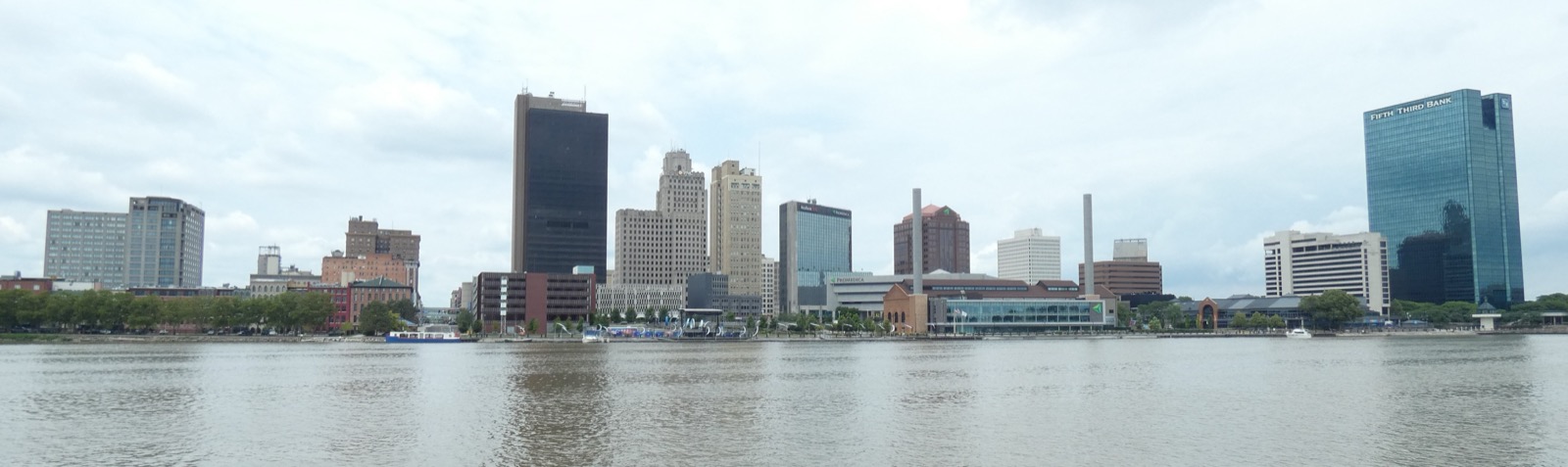
They came up the rivers and the rail lines with packs on their backs. From the 1880s through the 1920s, if you turned off Cherry Street into Toledo’s Old North End, you walked into a corner of Mount Lebanon. Coffee scented with cardamom on the stove, Arabic traded across shop counters, and the smell of kibbeh from a kitchen window. Locals had a name for it. They called it Little Syria, and for the better part of a century it was the heart of Lebanese Toledo.
Little Syria: The Place
The neighbourhood sat in Toledo’s Old North End, a dense grid of frame houses and brick storefronts north of downtown, near where the Maumee River bends toward Lake Erie. It ran through streets like Cherry, Lagrange, Bush, Champlain, Magnolia and Walnut, with the largest cluster of families along Summit Street.
By 1910, roughly three quarters of the city’s Syrian and Lebanese residents lived here. It was a working neighbourhood of peddlers, grocers and tradespeople, the kind of place where the church, the corner store and the kitchen table did the work of holding a community together.
How Little Syria Became Lebanese
Before the Lebanese
Toledo in the late nineteenth century was a fast-growing Great Lakes port and rail hub, a city of German, Irish, Polish and Hungarian newcomers drawn to its factories, glassworks and grain trade. The Old North End was a mixed immigrant quarter, modest and affordable, exactly the sort of foothold a new arrival could afford.
Into that mix came the first families from the eastern Mediterranean. They were catalogued in the records of the day as Syrians, since their homeland was then part of Ottoman Syria. Most, in fact, came from the villages of Mount Lebanon, and they would carry the name Lebanese once their country drew its own borders.
The Lebanese Arrive
The founding figure of the Lebanese in Toledo, Ohio was Michael H. Nassr, remembered as the dean of the city’s Syrian-Lebanese community. He reached the United States through New Orleans in the late 1870s with his wife Dabla, and by 1881 he had settled in Toledo.
Nassr opened a dry goods store and produce stand on Cherry Street. It became more than a shop. He stocked the packs of Syrian peddlers passing through Toledo on their routes between Cleveland and Fort Wayne, and that supply line turned the city into a natural way station, then a destination.
Word travelled back to the mountain villages. One family wrote home, sent passage money, and pulled the next across. This was chain migration in its purest form, village by village, surname by surname, until whole pockets of Mount Lebanon had quietly relocated to a few blocks of northern Ohio.
The peddling life suited the moment. A peddler could earn close to a thousand dollars a year at a time when a factory hand made under four hundred, and the work demanded only a pack, a route and nerve. The same pattern built Arab enclaves across the Midwest, from the Lebanese community in Dearborn, Michigan to the original tenements of Little Syria in Lower Manhattan, where many of these families first landed before heading inland.
Little Syria at Its Peak
By the 1910s and 1920s the community had put down deep roots. Peddling gave way to storefronts. Former peddlers reinvested their savings into confectioneries, tailor shops, barber shops, dry goods stores and fruit stands, and many never went back to Lebanon at all.
Faith anchored daily life. Before the First World War the community was almost entirely Christian, split between the Maronite and Melkite branches of the Eastern Rite Catholic Church and the Antiochian Orthodox. In 1913 a small group of Syrian and Lebanese families founded what became St. George Orthodox Cathedral, holding their first services in their own tongue rather than borrowing Protestant halls.
Father Samuel David served St. George in these years and was later raised to Bishop of Toledo in 1936. The parish opened a Syrian School in 1924 to teach Arabic to the children, and organised a girls’ choir in 1927 to chant the Good Friday lamentations, small institutions that did the quiet work of passing on a language and a liturgy.
This was the Toledo that shaped Amos Jacobs, the son of Maronite immigrants from the village of Bsharri in Mount Lebanon. The world would come to know him as Danny Thomas. He grew up in Toledo, attended St. Francis de Sales Church and Woodward High School, and absorbed his father’s Lebanese songs and mountain stories before leaving to chase a career in entertainment.
The Change
Success did to Little Syria what it has done to immigrant quarters everywhere. As families prospered, they moved out. The pull toward the suburbs gathered force after the Second World War, and one by one the old institutions followed their congregations west.
St. George Orthodox left the Old North End in 1974 and consecrated a new cathedral on Woodley Road in west Toledo. St. Elias Antiochian Orthodox, founded downtown in 1937, relocated to Sylvania around 1979 and 1980. By the early 1960s the neighbourhood once called Little Syria had largely emptied of the people who gave it the name.
This was not collapse so much as graduation. The corner store had paid for the suburban house, and the children of peddlers were now doctors, lawyers and teachers. The neighbourhood faded, but the community did not.
The Landmarks of Lebanese Toledo
Michael Nassr’s store, Cherry Street. The first anchor of the community, opened by Michael H. Nassr after he settled in Toledo in 1881. His dry goods and produce business supplied the peddlers who fanned out across the Midwest, and it drew the next wave of families to the Old North End. The shop is long gone, but it is where the story starts.
St. George Orthodox Cathedral, 3754 Woodley Road. Founded in 1913 by Syrian and Lebanese families in the North End and now seated in west Toledo, St. George is the oldest continuous institution of the community. Its annual Summer Festival is billed as the only Middle Eastern church festival in Toledo, with baked kibbe, sfeeha meat pies, stuffed grape leaves and trays of pastry drawing crowds from across northwest Ohio.
St. Elias Antiochian Orthodox Church, 4940 Harroun Road, Sylvania. Chartered in 1937 by nineteen men in a downtown mansion at Mulberry and Huron, with George K. Darah as first president, St. Elias grew out of the same Syro-Lebanese migration. For years its three-day summer festival was a fixture for families across northwest Ohio and southeast Michigan.
St. Francis de Sales Church. The parish where a young Amos Jacobs, the future Danny Thomas, worshipped while growing up in Toledo. It is a thread between the everyday Catholic life of the Lebanese community and the most famous son it ever produced.
Jamie Farr Park, Manhattan Boulevard. A riverside park renamed in 1998 for Jameel Joseph Farah, born in Toledo in 1934 to a Lebanese grocer father from the Bekaa Valley. As Jamie Farr he played Corporal Klinger on M*A*S*H, written as a Lebanese-American Toledoan so that Farr could lace the dialogue with Toledo Mud Hens games and Tony Packo’s hot dogs.
The Old North End streets. Cherry, Lagrange, Summit and the blocks around them were the living core of Little Syria. Walk them today and the storefronts have other names, but the bones of the neighbourhood that received Mount Lebanon are still there.
Where the Toledo Lebanese Came From
The great majority traced back to Mount Lebanon, the chain of villages in the country’s interior highlands. Bsharri, the cedar-country home of Danny Thomas’s parents, sent many. So did the coastal towns and the Bekaa Valley, the wide farming plain that produced Jamie Farr’s father, along with families from Tripoli, Zahle and Beirut.
What drove them out was a familiar mix: crowded land, thin harvests, Ottoman taxation and conscription, and the simple gravity of relatives already abroad. They were overwhelmingly Christian in these decades, and they carried their Maronite, Melkite and Orthodox faith with them. The same homeland fed Lebanese enclaves across America, and you can trace the wider Arab-American map from these mountain villages outward to communities like the Chaldeans of metropolitan Detroit.
Little Syria Today
The Old North End is no longer Little Syria. The Arab families that built it scattered to Toledo’s western suburbs and to Sylvania and Perrysburg decades ago, and the neighbourhood is now a more diverse, lower-income quarter. A handful of older Lebanese shopkeepers held on into recent years, but the dense enclave is gone.
The community itself, though, is anything but gone. It simply moved. St. George Cathedral on Woodley Road and St. Elias in Sylvania still anchor Lebanese and Antiochian families, and the St. George Summer Festival each August still fills tables with kibbe and fatayer for thousands of Toledoans who would not call themselves Lebanese at all.
The enduring legacy is bigger than any neighbourhood. Danny Thomas channelled a Toledo Lebanese boy’s vow into St. Jude Children’s Research Hospital, funded through ALSAC, the charity Arab-American families founded in 1957. The peddler’s pack on Cherry Street and a children’s hospital in Memphis turn out to be the same story, told one generation apart. This pattern of an immigrant neighbourhood that disperses yet keeps its faith and its food echoes the arc of older Toledo communities, including the Hungarians of Birmingham in east Toledo.
Frequently Asked Questions
Why did Lebanese immigrants settle in Toledo, Ohio?
The Lebanese in Toledo, Ohio first arrived as peddlers in the 1880s, drawn by the city’s position on the rail and river routes between Cleveland and Fort Wayne. Michael Nassr’s store on Cherry Street supplied travelling peddlers and turned Toledo from a way station into a destination. As families prospered, chain migration from Mount Lebanon brought relatives across to join them.
Is Toledo’s Little Syria neighbourhood still Lebanese today?
No. The Old North End that was once called Little Syria emptied of its Arab families by the early 1960s as they moved to Toledo’s suburbs. The Lebanese community is still active, but it is now centred on suburban churches like St. George Cathedral and St. Elias in Sylvania rather than the old neighbourhood.
Who are the most famous Lebanese people from Toledo?
The two best known are Danny Thomas, the entertainer who grew up in Toledo and founded St. Jude Children’s Research Hospital, and Jamie Farr, who played Corporal Klinger on M*A*S*H. Both were children of Lebanese immigrants, and Farr’s character was written as a fellow Lebanese-American Toledoan.
Where in Lebanon did the Toledo Lebanese come from?
Most came from the villages of Mount Lebanon, including Bsharri in the cedar country, along with the Bekaa Valley and coastal towns near Tripoli and Beirut. They were largely Christian Maronites, Melkites and Antiochian Orthodox who left because of crowded land, Ottoman taxation and the pull of relatives already in America.
When did Lebanese immigrants first arrive in Toledo?
The first Lebanese in Toledo, Ohio arrived in the 1880s, with Michael H. Nassr settling in the city by 1881 as the founding figure of the community. The main wave of family migration ran from then through the 1920s, building the Old North End enclave known as Little Syria.
If your family’s story passed through Little Syria, or any of the places the Lebanese made home, Atlas of Home can help you trace that journey. From a village in Mount Lebanon to a corner store on Cherry Street, to wherever you are now. Explore your story →
Further reading: Danny Thomas on Wikipedia and Jamie Farr on Wikipedia.