
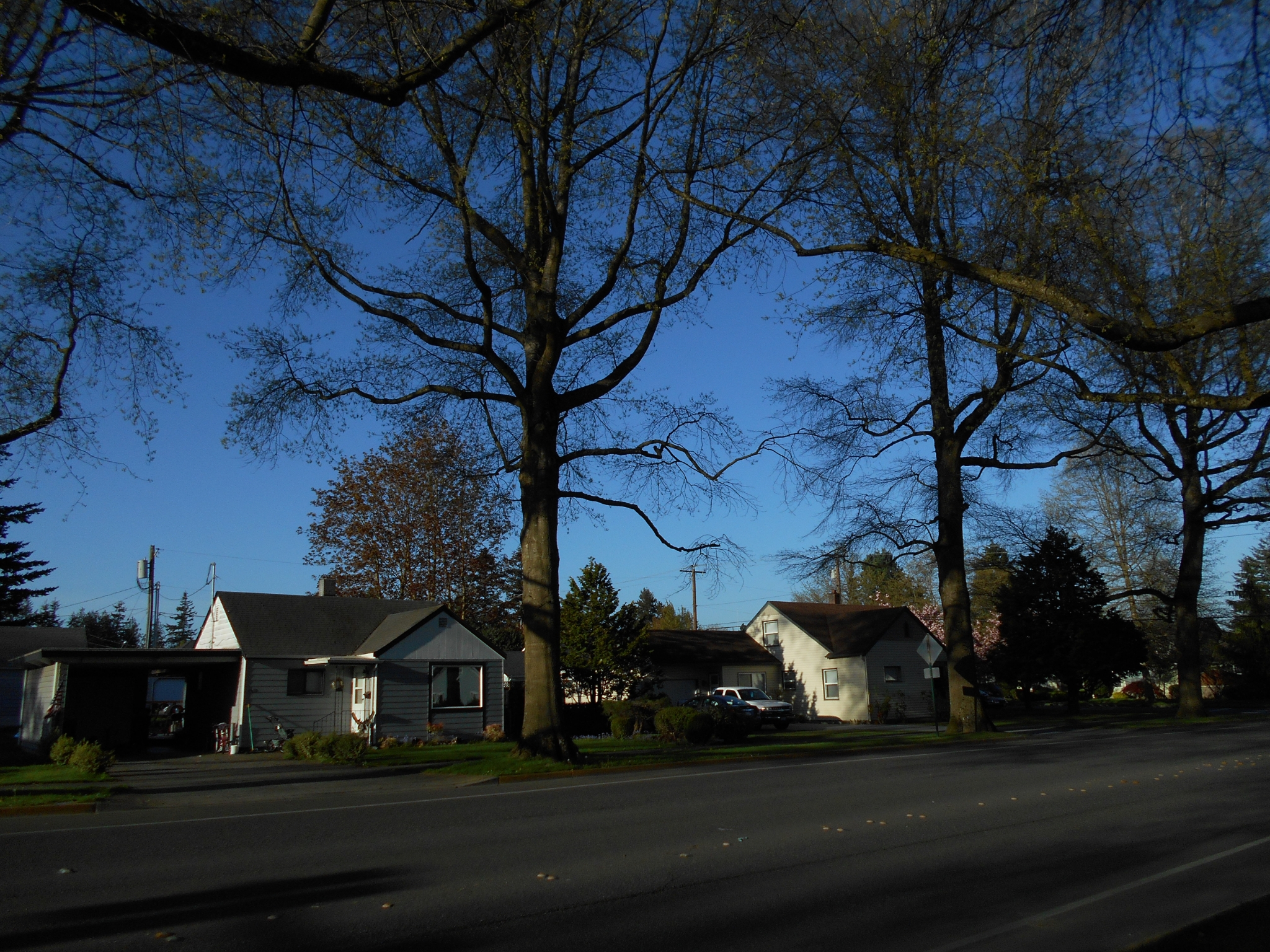
They came by canoe. In 1896, three Dutch farmers from Oak Harbor paddled up the Nooksack River to a logging town in the far northwest corner of Washington, looking at stump-cleared land and seeing pasture. Within a generation the Dutch in Lynden, Washington had turned that flat green valley into one of the most concentrated outposts of Dutch Calvinist America, a town that would later claim more churches per capita than almost anywhere in the country. Today you can stand on Front Street under a 72-foot working windmill and hear it told as both family history and Main Street brand.
Lynden, Washington: The Place
Lynden sits in the Nooksack Valley of Whatcom County, about five miles south of the Canadian border and fifteen miles north of Bellingham. The land is flat, wet, and rich, river-bottom soil drained for dairy pasture and berry rows that run to the horizon.
The town grew around Front Street, its commercial spine, while frame farmhouses and red barns spread out across the section grid beyond. It is a prosperous, tidy, deeply churched farm town, and that character is no accident of weather. It was built, parcel by parcel, by people from one small country across the Atlantic.
How Lynden Became Dutch
Before the Dutch
The Nooksack Valley was home to the Nooksack people long before any farmhouse stood on it. The town itself was founded by Phoebe Goodell Judson, an Ohio-born pioneer who settled on the river in 1871 and named the place Lynden after a line of verse, changing the spelling of “Linden” because she thought it looked better.
Judson is remembered as the “Mother of Lynden.” In the 1870s she raised funds to clear the log jams choking the Nooksack so steamers could reach the town. Through the 1880s and early 1890s Lynden was a logging settlement, sawmills working through the fir, the future farmland still standing in stumps.
The Dutch Arrive
The catalyst was a broke promoter named Reinder E. Werkman. Arriving in Seattle in 1894 jobless, Werkman saw opportunity in the cheap cutover land and went to work selling it to the one audience he knew would listen: the struggling Dutch farm colonies of the American Midwest.
He shipped a section of giant fir back east as proof of the soil’s fertility and mounted exhibits of Northwest produce in Holland and Grand Rapids, Michigan. As a land agent for the Great Northern Railroad, he had every reason to fill the valley.
The pitch landed. Midwest Dutch farmers were facing failing farms, and Lynden offered good soil, a mild climate, no crop failures, and no brutal sub-zero winters. The first families reached nearby Oak Harbor on March 11, 1895, with a second group following that November.
In 1896 three scouts, Douwe J. Zylstra, Herman Oordt, and Aart Veleke, made the canoe trip from Oak Harbor up to Lynden. The first Dutch settlers arrived in 1897, and D. J. Zylstra, born in Drachten in the Frisian Netherlands, brought his family to Lynden on June 17, 1898.
Lynden at Its Peak
What happened next was chain migration in its purest form. Each family that prospered wrote home, and home now meant both the Netherlands and the older Dutch colonies of the Midwest: Pella, Iowa, Holland, Michigan, and the daughter settlements scattered across the Dakotas.
The anchor was the church. The First Christian Reformed Church of Lynden was organized in 1900 with fifteen charter families bearing names still all over the valley: Block, Bierlink, VanderGriend, Stremler, Veleke, Oordt, Zylstra, Faber, and Troost among them. Rev. Abel J. Brink arrived as the first pastor in September 1900, reportedly dropped off at the general store with no one expecting him.
Schools followed the steeples. Lynden Christian School and Ebenezer Christian School both opened around 1910, ensuring that faith and Dutch identity passed intact to the second generation. The pattern of devout, land-owning, hard-working farm families anchored to a Reformed congregation gave Lynden its enduring shape.
This is the same Calvinist settlement logic that built older Dutch enclaves, and readers tracing those roots will recognise it in the story of the Dutch in Holland, Michigan and the Dutch in Pella, Iowa, the very colonies that seeded Lynden in the first place.
The Change
Lynden did not decline the way many ethnic enclaves did. Logging gave way fully to agriculture by the early 1900s, a local dairy processing plant opened in 1902, and the valley settled into a long, stable prosperity built on milk and berries.
By the mid-1950s there were four Christian Reformed churches in town. By 1990 there were nine congregations across the Reformed spectrum, and by 1995 the town counted some 28 Dutch-tradition churches, with many businesses still voluntarily closed on Sundays.
The shift, when it came, was less about people leaving and more about the heritage becoming self-conscious. In the 1980s Lynden leaned into its Dutch identity as civic brand, and the farm town quietly became a destination too.
The Landmarks of Dutch Lynden
Dutch Village Inn and the Front Street Windmill, corner of 7th and Front Street. Opened July 1, 1987 on the site of a former car dealership, the 72-foot working windmill became the signature image of Lynden. Beneath it ran a 150-foot canal stocked with fish through a small Dutch-themed village of shops and a cafe. The rooms inside the mill have changed hands over the years, but the windmill still turns over downtown.
First Christian Reformed Church, Lynden. Organized in 1900 with fifteen families, this was the institution that made Lynden Dutch. Every later congregation in town traces its lineage, directly or by reaction, back to that founding.
Lynden Heritage Museum, 217 Front Street. Founded in 1976 by George Young as the Lynden Pioneer Museum and renamed in 2023, it holds more than 37,000 historical objects. Its collection of horse-drawn farm equipment and pioneer life is among the largest in the Pacific Northwest, and it tells the Dutch settlement story in detail.
Holland Days, downtown Front Street, first weekend of May. Started in 1985, this two-day spring festival fills the street with klompen dancers in wooden shoes, Dutch costume, and traditional food. It is the most visible expression of the town’s heritage and draws visitors from across the region.
The Northwest Washington Fair, Northwest Washington Fairgrounds, Lynden. Held in Lynden since 1909, the ten-day August fair draws roughly 200,000 visitors with livestock, agricultural exhibits, a rodeo, and a demolition derby. It is the secular heartbeat of the farm community the Dutch built.
Lynden Christian School. Opened around 1910, it remains a cornerstone of the community and a reason families with Dutch Reformed roots have stayed put for four and five generations.
Where the Lynden Dutch Came From
The Dutch who built Lynden came in two streams. Some arrived directly from the Netherlands, from northern farming provinces like Friesland, the home of early settler D. J. Zylstra of Drachten. Many more came as second-stage migrants, families who had already tried the American Midwest and were moving on in search of better, cheaper land.
Those Midwest colonies were the Dutch Calvinist heartland: Pella in Iowa, Holland in Michigan, and the spreading daughter settlements in northwest Iowa, southwest Minnesota, and the Dakotas. Failing farms and crowded land pushed them west, and Werkman’s promotion pulled them to the Nooksack.
The result is a community whose roots run through three places at once: a province in the Netherlands, a colony on the prairie, and a green valley below the Canadian line. It is a long thread, and it is exactly the kind of multi-stage journey that connects Lynden to the wider Dutch and broader Northern European settlement of the American West, from the Norwegians in Ballard, Seattle to other immigrant communities who reshaped the Pacific Northwest.
Lynden Today
Lynden in 2026 is a town of roughly 17,000, growing fast, and still unmistakably Dutch in flavour. Recent census figures put Dutch ancestry around 21 percent, down from the 30 percent reported in 2010 but still extraordinary for an American town this size.
The farms remain the real story. Whatcom County produced over 58 million pounds of red raspberries in 2023, around 99 percent of the state’s crop, and farms around Lynden grow about 90 percent of the frozen red raspberries in the entire United States. The dairy herds and berry rows the Dutch planted still run the local economy.
The heritage is now layered, part genuine inheritance and part Front Street identity, with the windmill, the Dutch storefronts, Holland Days, and a December Sinterklaas celebration. New arrivals from across the Pacific Rim and Latin America increasingly share the valley, much as the broader region has long absorbed waves of newcomers from the Japanese in Nihonmachi, Seattle to today. The Dutch farm town the canoe scouts found is still here, still milking and picking, and still keeping its own particular faith.
Frequently Asked Questions
Why did the Dutch settle in Lynden, Washington?
The Dutch settled in Lynden because a Holland, Michigan promoter named Reinder E. Werkman marketed the cheap, stump-cleared Nooksack Valley land to struggling Dutch farm colonies in the Midwest. Lynden offered rich soil, a mild climate, and no brutal winters or crop failures, which drew families seeking better farmland. The first Dutch settlers arrived in 1897 and built a farming and church community that endures.
Is Lynden, Washington still Dutch today?
Yes, Lynden remains strongly Dutch in 2026, though the share has eased over time. Around 21 percent of residents claim Dutch ancestry, down from 30 percent in 2010, and the town still celebrates its roots with the windmill on Front Street, Holland Days, Sinterklaas, and a dense network of Reformed churches.
What are the most famous Dutch landmarks in Lynden, Washington?
The best-known landmarks are the 72-foot working windmill at the Dutch Village Inn on Front Street, the Lynden Heritage Museum, and the First Christian Reformed Church organized in 1900. The annual Holland Days festival each May and the historic Front Street storefronts are the most visible expressions of the town’s Dutch identity.
Where in the Netherlands did the Lynden Dutch come from?
Many Lynden families came from the northern farming provinces of the Netherlands, including Friesland, the birthplace of early settler D. J. Zylstra of Drachten. A large share, however, arrived as second-stage migrants from older Dutch Calvinist colonies in the American Midwest such as Pella, Iowa, and Holland, Michigan.
When did the Dutch first arrive in Lynden, Washington?
The first Dutch settlers reached Lynden in 1897, after scouts Douwe J. Zylstra, Herman Oordt, and Aart Veleke canoed up the Nooksack River from Oak Harbor in 1896. The settler D. J. Zylstra brought his family to Lynden on June 17, 1898, and the First Christian Reformed Church was organized in 1900.
If your family’s story passed through Lynden, or any of the places the Dutch made home, Atlas of Home can trace that journey. From a farmhouse in Friesland to a colony on the Iowa prairie to a green valley below the Canadian border, the thread is yours to follow. Explore your story →
Sources: Lynden, Washington on Wikipedia and the HistoryLink thumbnail history of Lynden.