
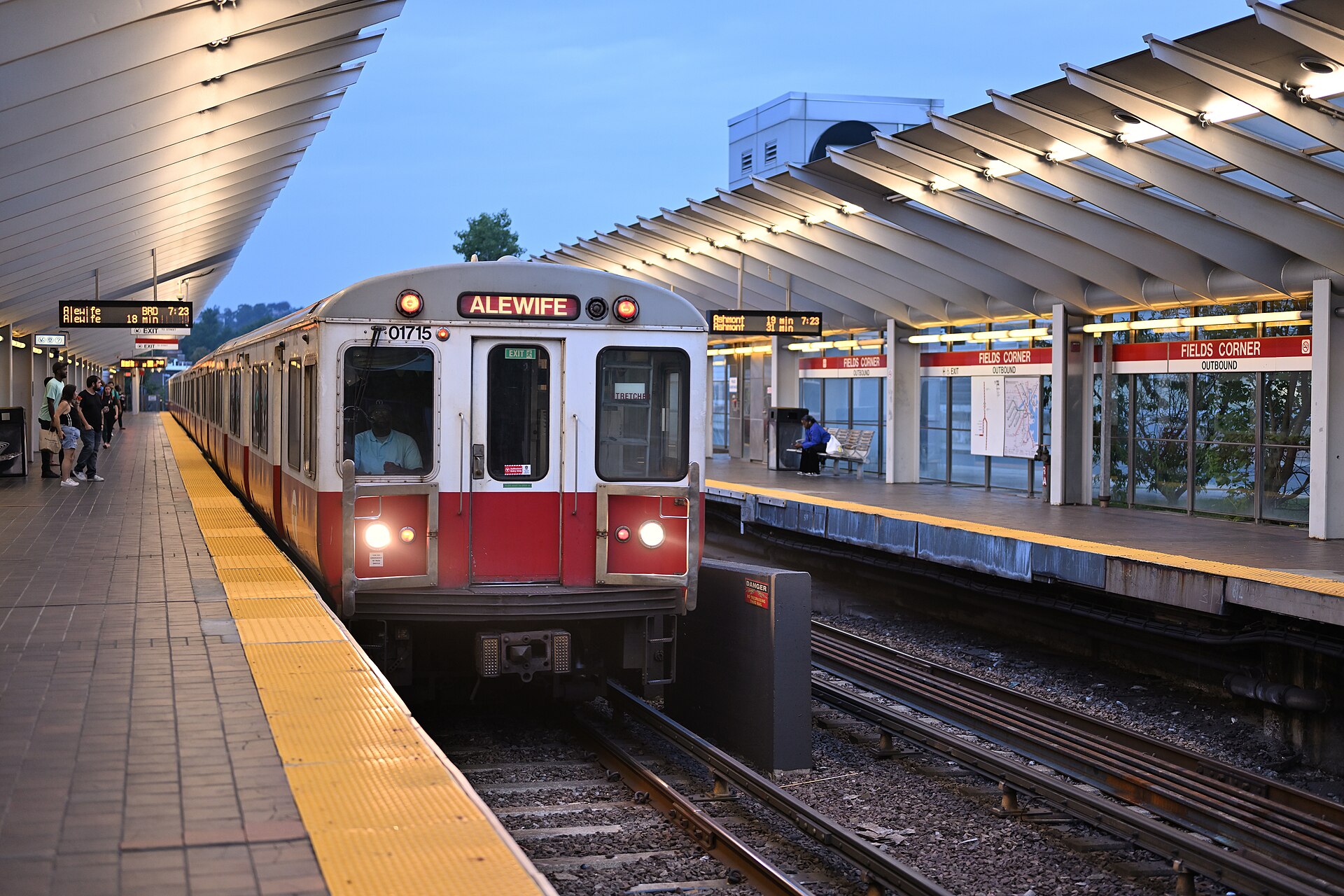
They never put it on the Red Line map. But step off the train at Fields Corner, turn onto Dorchester Avenue, and the air changes. Star anise and charred lemongrass drift out of open doorways, lottery radios crackle in Vietnamese, and the signs above the shops read Phở, Bánh Mì, and Tiệm Vàng. For half a century, this half-mile of Dot Ave has been the beating heart of the Vietnamese in Fields Corner, Boston, the densest Vietnamese commercial strip in all of New England.
Fields Corner: The Place
Fields Corner sits in the middle of Dorchester, the largest and most populous neighbourhood in Boston. It takes its name from a general store the Field brothers, Enos and Isaac, ran at the meeting of Adams Street and Dorchester Avenue in the nineteenth century.
The Fields Corner stop on the MBTA Red Line opened on November 5, 1927, and the trains still rattle through every few minutes. The streets around it are lined with wood-frame triple-deckers, the three-storey timber houses that have sheltered wave after wave of working families.
It is a working-class, commercial, immigrant neighbourhood, and its main artery, Dorchester Avenue, locals simply call Dot Ave.
How Fields Corner Became Vietnamese
Before the Vietnamese
Long before the pho shops, Dorchester was Irish. Catholic immigrants arrived in large numbers through the middle of the nineteenth century, settling thickly across the neighbourhood and meeting open hostility from older Protestant residents.
In 1854 a Catholic church building in the area was destroyed by fire, widely believed to have been set by the nativist Know-Nothing movement. Eighteen years later, in 1872, Father Peter Rowan led the construction of St. Peter Church to serve the swelling Irish parish.
For a century afterwards, Dorchester was one of the great Irish strongholds of Boston. You can read that earlier chapter in our piece on the Irish in Dorchester, Boston, the community whose triple-deckers the Vietnamese would later make their own.
The Vietnamese Arrive
The story begins, as so many Vietnamese stories do, with April 30, 1975, the day Saigon fell and South Vietnam ceased to exist. In the years that followed, hundreds of thousands fled by sea, the boat people who risked pirates and open water rather than live under the new Communist government.
The United States resettled roughly a million Southeast Asian refugees, and greater Boston became one of the top ten resettlement sites in the country. Most came from the south of Vietnam, from Saigon and the Mekong Delta provinces, carrying almost nothing.
The first arrivals did not land in Fields Corner. They were scattered by resettlement agencies into Chinatown, Allston-Brighton, and East Boston. But as rents in those areas climbed through the 1980s, families began moving south to Dorchester, where the old Irish triple-deckers were cheap and the apartments were big enough for three generations.
Chain migration did the rest. One family wrote to a cousin still in a Thai refugee camp, that cousin sponsored a sister, the sister opened a noodle shop, and the shop hired the next arrivals off the boat.
In 1980 fewer than 500 Asian Americans lived in Fields Corner. By 2000 the number had passed 10,000. Bryant Tran, who escaped Vietnam with his mother and two sisters in the late 1980s and spent his teenage years in a Thai camp before a Catholic parish sponsored the family to Boston, is one face of that surge.
Fields Corner at Its Peak
By the 1990s and 2000s, Fields Corner had become the largest and most important Vietnamese community in New England. Dot Ave filled with pho houses, bakeries, jewellery shops, herbalists, hair salons, and travel agents booking flights back to a homeland many had never expected to see again.
The turning point came in 1994, when community leaders founded the Vietnamese American Initiative for Development, known to everyone as VietAID. It remains the first and only grassroots community development corporation founded and run by Vietnamese refugees and immigrants in the United States.
VietAID’s crowning achievement opened in 2002: the Vietnamese American Community Center at 42 Charles Street, an 18,000 square foot building raised from the ground up at a cost of 5.1 million dollars. A 28 member steering committee and more than a thousand small donors helped fund it. It was the first purpose-built Vietnamese community centre in America.
Daily life revolved around the calendar of home. Tet, the Lunar New Year, brought lion dancers down Dot Ave in red and gold. The Mid-Autumn Festival, Tet Trung Thu, filled Town Field park with lanterns and a night market each September.
The Change
The same cheap rents that built the enclave are now its biggest threat. As Dorchester gentrifies and housing costs climb, younger Vietnamese families have begun moving out toward Quincy, Malden, and the suburbs.
The shift has been gradual rather than sudden. Vietnamese Americans still make up around three quarters of the Asian American population of Dorchester, and Fields Corner is still home to more than 13,000 Asian American residents. But the community that re-rooted here in the 1980s is ageing, and the second generation faces a familiar choice between the old block and a bigger house elsewhere.
The Landmarks of Vietnamese Fields Corner
Vietnamese American Community Center, 42 Charles Street. The symbolic anchor of the neighbourhood and the first of its kind in the country. Built by VietAID in 2002, it hosts a preschool, after-school programmes, ESOL classes, and the cultural celebrations that knit the community together.
Phở 2000, 198 Adams Street. A plain, cafeteria-style room serving pho light enough to be called refreshing, plus banh xeo, the sizzling crepe stuffed with shrimp and pork. The kind of unpretentious counter that defines eating in Fields Corner.
Bánh Mì Ba Le, 1052 Dorchester Avenue. Part bakery, part grocery, part takeout window, turning out some of the best banh mi in the city alongside Vietnamese beef wrapped in betel leaf. Proof that a single storefront can hold an entire food culture.
Chau’s Bakery, 1456 Dorchester Avenue. A neighbourhood institution for crusty banh mi packed with cold cuts and beef, the sort of place where the morning regulars order without looking at a menu.
Phở Hòa, Dorchester Avenue. A longtime gathering point on Dot Ave, its wall now carries the “Community in Action: A Mural for Vietnamese People,” which has become a backdrop for community walking tours and a touchstone for local pride.
Town Field, off Dorchester Avenue. The neighbourhood’s green heart, where the Tet Trung Thu night market unfolds every autumn and where the community now hopes to plant a permanent memorial to the journey that brought them here.
Fields Corner station, Dorchester Avenue at Charles Street. The Red Line stop that gave the neighbourhood its name and its rhythm. Rebuilt between 2004 and 2008, it remains the gateway through which generations of refugees first walked into their new American street.
Where the Fields Corner Vietnamese Came From
The overwhelming majority of Fields Corner’s Vietnamese trace their roots to southern Vietnam: to Saigon, now Ho Chi Minh City, and to the rice-growing provinces of the Mekong Delta. They were the people most exposed when the South collapsed in 1975, the soldiers, officials, merchants, and their families who had the most to fear and the most reason to flee.
They left in distinct waves: the first airlift evacuees of 1975, the boat people of the late 1970s and 1980s, and later relatives reunited through sponsorship and orderly departure programmes. That layered migration mirrors other Vietnamese strongholds across America, from Little Saigon in Westminster, California, the largest enclave of all, to the fishing community of Versailles in New Orleans. Fields Corner is New England’s chapter of that same scattered story.
Fields Corner Today
In 2026 Fields Corner is layered rather than fading. The pho counters and gold shops still line Dot Ave, but Latino, Cape Verdean, and Black families share the triple-deckers now, much as their Vietnamese and Irish neighbours did before them. A few blocks south, you can trace another of these layers in the story of the Haitians in Mattapan, Boston.
The community’s status is now official as well as felt. After the Boston City Council endorsed the idea in December 2019, the Massachusetts Cultural Council formally designated the Boston Little Saigon Cultural District on May 18, 2021, covering a half-mile stretch of Dorchester Avenue and the adjoining Charles, Park, and Adams streets.
And the neighbourhood is busy turning memory into permanence. The 1975 Vietnamese Diaspora Commemoration Initiative, led by local artist Ngọc-Trân Vũ, is raising money for a memorial at Town Field: a bronze banyan tree some fifteen to twenty feet tall, crowned with conical hats, its four pillars marking the successive waves that carried people from the fall of Saigon to this corner of Boston. Fifty years after the boats, the children of the refugees are not closing the story. They are casting it in bronze.
Frequently Asked Questions
Why did Vietnamese refugees settle in Fields Corner?
Vietnamese refugees first resettled in Boston’s Chinatown, Allston-Brighton, and East Boston after the fall of Saigon, but moved to Fields Corner in the 1980s as rents elsewhere rose. The neighbourhood’s affordable Irish-era triple-deckers and good Red Line access made it ideal, and chain migration soon concentrated the community there. Today the Vietnamese in Fields Corner, Boston form the largest such enclave in New England.
Is Fields Corner still Vietnamese today?
Yes, though it is increasingly mixed. Vietnamese Americans still make up roughly three quarters of Dorchester’s Asian American population, and Dorchester Avenue remains lined with Vietnamese restaurants, bakeries, and shops. Rising housing costs have pushed some younger families to Quincy and the suburbs, but the cultural core endures.
What are the most famous Vietnamese landmarks in Fields Corner?
The most significant is the Vietnamese American Community Center at 42 Charles Street, the first purpose-built Vietnamese community centre in America, opened by VietAID in 2002. Other anchors include the pho houses and bakeries of Dorchester Avenue, the Phở Hòa community mural, and Town Field park, which hosts the annual Mid-Autumn night market.
Where in Vietnam did the Fields Corner Vietnamese come from?
Most came from southern Vietnam, especially Saigon, now Ho Chi Minh City, and the provinces of the Mekong Delta. They were the families most endangered when South Vietnam fell in 1975, and they left in successive waves as airlift evacuees, boat people, and sponsored relatives.
When did Vietnamese people first arrive in Fields Corner?
Vietnamese refugees began arriving in greater Boston after the fall of Saigon in 1975, but the move into Fields Corner gathered pace in the 1980s. Fewer than 500 Asian Americans lived in the neighbourhood in 1980, a figure that passed 10,000 by 2000 as the Vietnamese in Fields Corner, Boston became the region’s largest community.
If your family’s story passed through Fields Corner, or any of the places the Vietnamese made home after 1975, Atlas of Home can help you trace that journey. From a village in the Mekong Delta to a refugee camp in Thailand, to a triple-decker on Dot Ave, to wherever you are now. Explore your story →
Sources include Vietnamese Americans in Boston (Wikipedia) and Global Boston, Boston College.