
On the first Sunday of June, the parking lot off Fairview Avenue fills with men in lederhosen and women carrying foil-wrapped strudel, and somewhere inside a brick hall a chorus sings in a language almost no one else on Earth still speaks. The Gottscheers in Ridgewood are throwing a party for a country that no longer exists. Their villages were emptied in the 1940s and the homeland was dissolved, so the festival, the dialect, the recipes, and the crowning of a young woman as Miss Gottschee all happen here, in a corner of Queens, because here is the last place they can.
It is one of the strangest and most moving facts in the borough’s immigrant history. A 600-year-old culture from a forested pocket of what is now Slovenia did not survive in Europe. It survived in Ridgewood.
Ridgewood: The Place
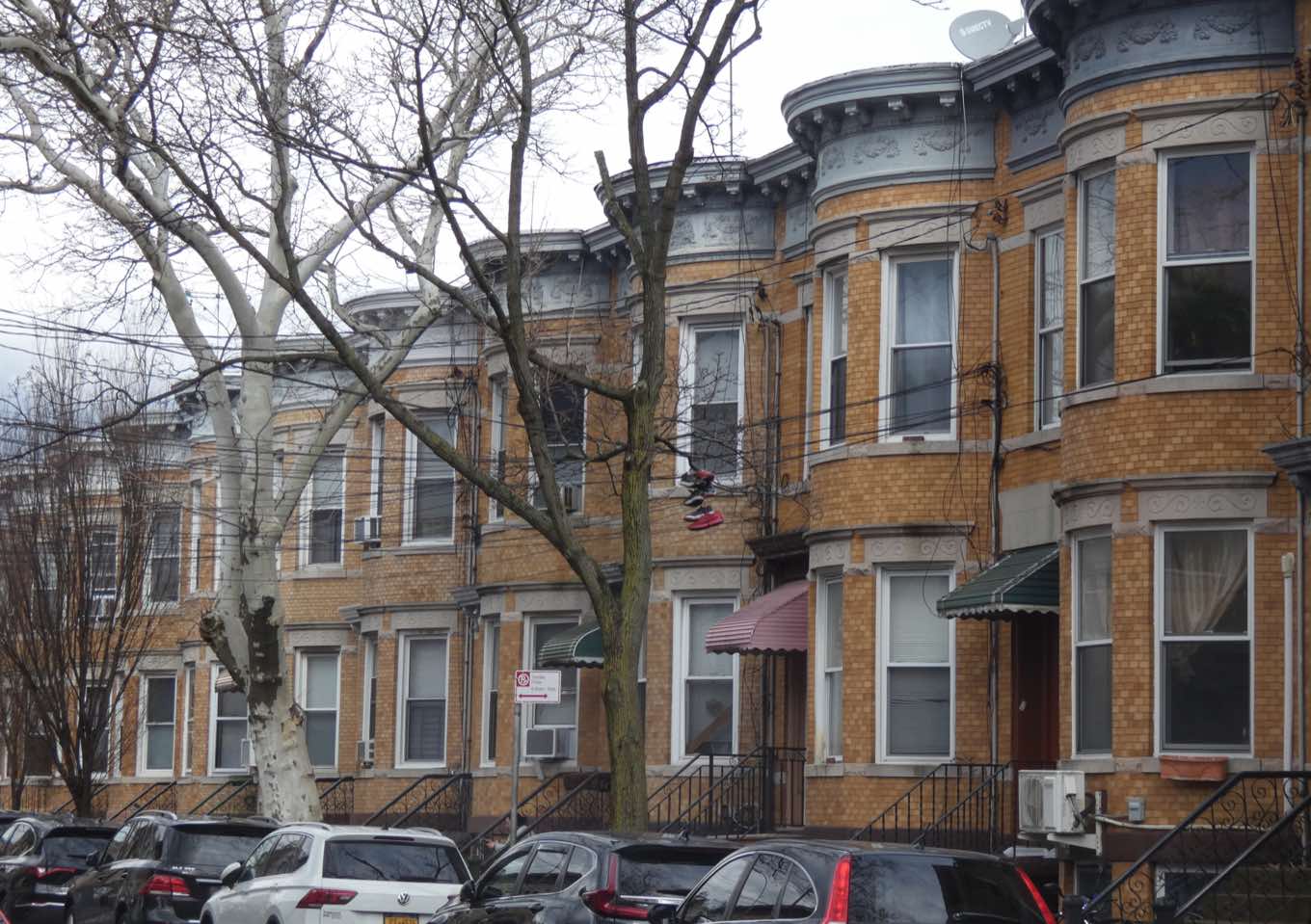
Ridgewood sits on the Queens side of the Brooklyn border, hard against Bushwick and East Williamsburg to the west and wrapping toward Glendale and Middle Village to the east. The M train runs through its center along Myrtle Avenue, with a transfer to the L at Myrtle-Wyckoff. The neighborhood is famous for its housing: block after block of three-story brick rowhouses, many of them the spacious, affordable “Mathews Model Flats” built between roughly 1908 and 1914 for working families. Several stretches are now protected as national and city historic districts.
How Ridgewood Became the Last Gottschee
Before the Gottscheers
Ridgewood grew up as a German neighborhood before the Gottscheers ever arrived in numbers. Much of it was built between 1905 and 1915 to house the workers in the breweries and knitting mills clustered along the Brooklyn-Queens line. By 1880, Brooklyn counted around 35 breweries, including a famous “brewer’s row” in neighboring Bushwick, and the families who pulled the lagers and ran the looms wanted homes nearby.
Developer Gustav X. Mathews supplied them. His company put up hundreds of identical brick flats, airy and cheap enough for a mill hand to afford, and they drew German families out of crowded Bushwick, Williamsburg, and the Lower East Side. The local paper, the Ridgewood Times, printed its first 1908 issue in both English and German. Into this already-German world the Gottscheers would slip almost unnoticed at first, just another set of German speakers among many.
The Gottscheers Arrive
The Gottscheers were not quite like the other Germans, though. They came from Gottschee, a 331-square-mile upland of forest and small villages in the Kočevje region of present-day Slovenia, where German-speaking farmers had been settled by the counts of Ortenburg beginning around 1330. For six centuries they lived as a linguistic island in Slovene-speaking territory, speaking an archaic dialect called Gottscheerish and famous across the old Austrian empire as itinerant peddlers.
Emigration to America began in the 1880s, as the homeland’s roughly 26,000 people started leaving for work abroad. Many crossed to New York and Cleveland, and in New York the largest number gravitated to the German world straddling Brooklyn and Queens. They took jobs in the same breweries and knitting mills that built Ridgewood, and chain migration did the rest: one family wrote home, a cousin followed, then a whole village’s worth of relatives clustered onto the same few streets.
By 1924 there were enough of them, scattered across small social clubs in Ridgewood and Williamsburg, to want a building of their own. They pooled their money, formed a holding corporation, and bought a hall on Fairview Avenue. It opened that December.
Ridgewood at Its Peak
What turned a comfortable immigrant community into the last refuge of an entire people was catastrophe at home. In October 1941, after Nazi Germany and Fascist Italy carved up Yugoslavia, the two powers agreed to “resettle” the Gottscheers out of their ancient homeland and into German-occupied territory to the north. Roughly 12,000 people were moved from their villages in the winter of 1941 and 1942, allowed to take only some belongings and a fraction of their livestock. When the war ended, they could not go back. Yugoslavia now held the land, the dialect was banned, and most of the old villages were abandoned or destroyed.
The people scattered. Some settled in Austria and Germany, but thousands of displaced Gottscheers came to New York, and most of them came to Ridgewood and neighboring Glendale, where relatives and a familiar hall were already waiting. The flow grew after a 1950 U.S. law eased entry for displaced persons. By the 1930s the Gottscheer population in Queens had already matched or passed the number still living in the homeland, and after the war the balance tipped for good. Greater Ridgewood became the largest Gottscheer community anywhere in the world.
Their old Manhattan cousins in the original Little Germany on the Lower East Side had already dispersed uptown and across the river by then, and the broader German Yorkville scene was its own world. The Gottscheers in Ridgewood were something rarer: not just a neighborhood of immigrants, but a homeland in exile.
The Change
The clubhouse on Fairview almost did not survive its first five years. A fire gutted the building around 1929, and the community rebuilt it. Demand kept growing with the postwar refugees, and in December 1962 a larger Gottscheer Hall opened, with a banquet room, a modern kitchen, and smaller meeting halls upstairs. At least a dozen Gottscheer clubs ran nearly all their affairs there.
Then time did what the war could not. The generation born in the old country grew old. Their American-born children and grandchildren learned English first, married outside the community, and moved to the suburbs. The Gottscheerish dialect, never a written language for most families, began slipping away. The neighborhood itself changed too, with younger newcomers from Brooklyn discovering Ridgewood’s cheap rents and old beer hall in the 2010s.
The Landmarks of Gottschee in Queens
Gottscheer Hall, 657 Fairview Avenue. This is the heart of it. Bought in 1924 by Gottscheers who had no clubhouse of their own, rebuilt after the 1929 fire, and enlarged in 1962, the hall has hosted weddings, communions, choir nights, and the community’s annual dances for a century. Its centennial in November 2024 drew a sold-out gala, where Joseph Morscher, president of the Gottscheer Central Holding corporation, told the room it was still a place where Gottscheers gather to sing, dance, and enjoy each other’s company.
The Gottscheer Relief Association. Incorporated in New York on April 15, 1946, the Relief Association was founded to send aid to Gottscheers stranded in postwar Europe. It never stopped working. Today it is the umbrella body for all the Gottscheer clubs, and its mission long ago expanded from relief to preservation: keeping the customs, the recipes, and above all the language alive in memory of the homeland.
The choirs. Two singing societies carry the old songs. The Gottscheer Männerchor, a men’s chorus, traces its roots to 1900, and the women’s Deutsch Gottscheer Gesangverein to 1937. They still perform in Gottscheerish, German, and English, and a chorus sang at the hall’s hundredth-anniversary night.
Die Erste Gottscheer Tanzgruppe. Founded in 1981, the folk-dance group keeps the steps and the costumes of the homeland in motion, performing at festivals and cultural events. It is one of the younger institutions in a community where most of the clubs were born before World War II.
Blau-Weiss Gottschee. In 1951, immigrants who had settled in Ridgewood and Glendale founded a soccer club to recreate a piece of home on the pitch. It became one of the most successful youth soccer programs in the country: its under-16 side won a U.S. national title in 1985, and its academy later helped develop U.S. men’s national team players including Timothy Weah. The club still trains young players out of Middle Village.
St. Matthias Roman Catholic Church. Built by the Mathews company in 1911 and 1912 as Ridgewood filled with German Catholic families, St. Matthias became a spiritual anchor for the Gottscheers who arrived later. Its pastor took part in the Gottscheer Hall centennial, a reminder of how tightly parish and clubhouse were woven together in immigrant Ridgewood.
Where the Ridgewood Gottscheers Came From
They came from one small, specific place: the Gottschee enclave around the town of Kočevje, in the wooded highlands south of Ljubljana in what is now Slovenia. Within that 331-square-mile pocket there were once around 176 villages, and families in Ridgewood can still name the particular hamlet a grandmother left, even though most of those villages no longer stand.
The settlers who founded those villages had themselves come from somewhere specific centuries earlier: East Tyrol and Carinthia, the alpine valleys of the old Austrian lands, brought south by the counts of Ortenburg around 1330. That double displacement, alpine peasants resettled in Slovenia in the 1330s, then their descendants scattered to Queens in the 1940s, is the long arc that ends on Fairview Avenue.
Ridgewood Today
The Gottscheers in Ridgewood are an aging community, and they know it. The fluent speakers of Gottscheerish are mostly elderly now, the people who were children in the old country before the resettlement. UNESCO lists the dialect as critically endangered, with perhaps fewer than a hundred fluent speakers left in the world, the largest cluster of them in Queens. There are essentially no children learning it as a first language anymore, in Slovenia or here.
So the work has turned to preservation. Cultural activists like Alfred Belay, long the head of the Relief Association’s cultural committee, have compiled the homeland’s recipes into a Gottscheer cookbook and recorded narrated audio journeys through the lost villages. The choirs keep singing, the dance group keeps dancing, and every first Sunday in June the Gottscheer Volksfest, held since 1947 at Plattduetsche Park out on Long Island, still draws over a thousand people and still crowns a Miss Gottschee, a tradition since 1964. The clubs themselves still meet at the hall on Fairview, where the foyer is lined with portraits of past pageant queens. You can read the same impulse to hold on in the Slovenian immigrant story in the Slovenian neighborhoods of Cleveland, the other American city where Gottscheers and their Slovene neighbors put down roots, and in the German-Austrian world of Yorkville in Manhattan.
Gottscheer Hall itself has found a second life. It rents out for weddings and parties, and on many nights the century-old room with its wood paneling and raised stage fills with a younger crowd for indie rock bills, comedy showcases, and album-release parties. Some evenings it is a polka night for the old families; other evenings it is a guitar band for newcomers who may not know what Gottschee was. Both are keeping the lights on at 657 Fairview, and for a homeland that exists now only in memory and in Queens, the lights staying on is the whole point.
Frequently Asked Questions
Why did the Gottscheers settle in Ridgewood, Queens?
Ridgewood was already a German immigrant neighborhood, built between 1905 and 1915 to house brewery and knitting-mill workers, so early Gottscheer arrivals from the 1880s onward found familiar language, work, and affordable brick flats there. Chain migration concentrated them on a few streets, and after World War II thousands of displaced Gottscheers joined relatives already in the area. That is how the Gottscheers in Ridgewood grew into the largest community of their kind anywhere.
Is Ridgewood still a Gottscheer neighborhood today?
Only faintly, and the change has been generational. The fluent speakers of the Gottscheerish dialect are now mostly elderly, and many descendants have moved to the suburbs or married outside the community. The clubs, choirs, and Gottscheer Hall continue, but the neighborhood today is broadly mixed, with many younger residents drawn from nearby Brooklyn.
What are the most famous Gottscheer landmarks in Ridgewood?
Gottscheer Hall at 657 Fairview Avenue, opened in 1924, is the central landmark and marked its centennial in 2024. Others include the Gottscheer Relief Association founded in 1946, the men’s and women’s choirs, and the Blau-Weiss Gottschee soccer club founded in 1951. St. Matthias Roman Catholic Church served as the community’s parish.
Where did the Ridgewood Gottscheers come from?
They came from the Gottschee enclave around the town of Kočevje in present-day Slovenia, a German-speaking island of about 176 villages settled by alpine colonists from Tyrol and Carinthia beginning around 1330. The Gottscheers in Ridgewood are the descendants of that 600-year-old community, which was emptied by Nazi-era resettlement in 1941 and 1942 and never reconstituted in Europe.
When did the Gottscheers first arrive in New York?
Gottscheer emigration to the United States began in the 1880s, with many settling in the German districts straddling Brooklyn and Queens. By the 1930s the Gottscheer population in Queens already matched or exceeded the number remaining in the homeland, and a much larger wave of war refugees arrived during and after World War II.
If your family’s story passed through the forests of Gottschee, the streets of Ridgewood, or any of the places where a vanished homeland was carried across an ocean and kept alive, it deserves to be told before the last fluent voices fall silent.