
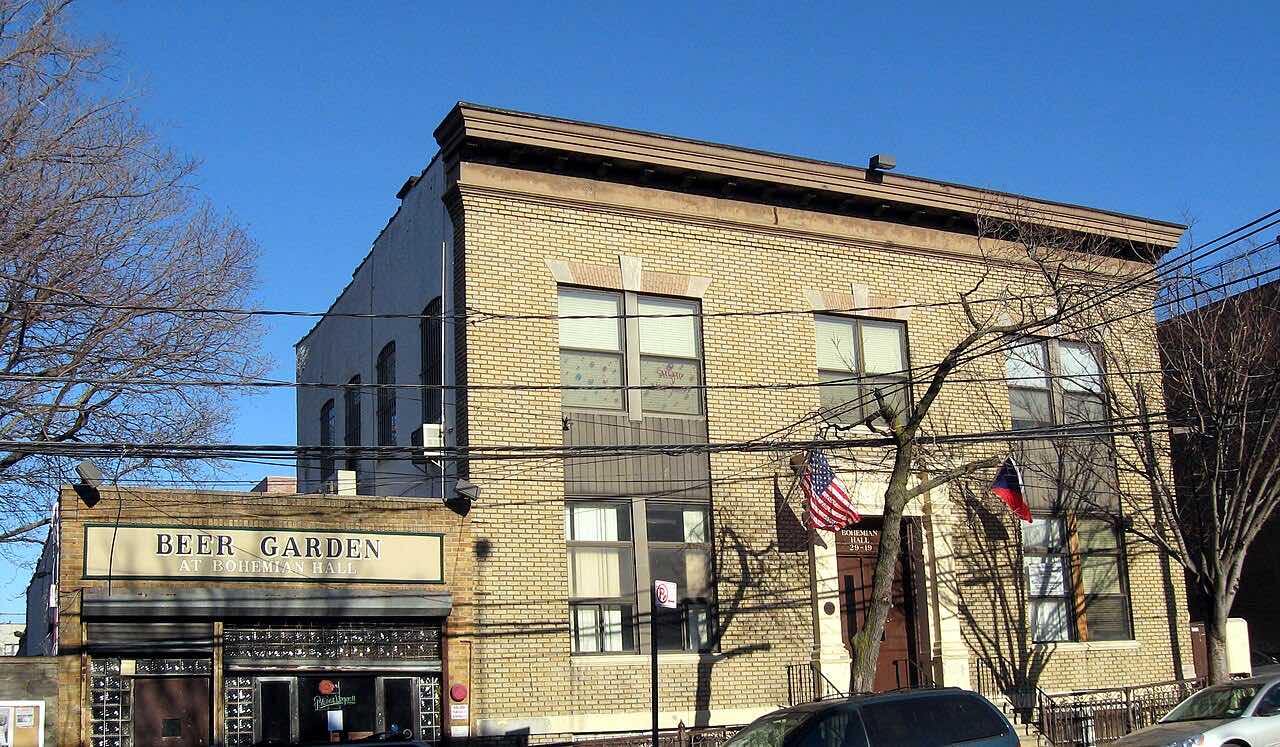
On a Saturday in July, the line snakes down 24th Avenue before the gate even opens. Inside, under linden trees that throw real shade across a courtyard the size of a city block, a thousand people are drinking Pilsner Urquell from plastic cups and waiting on plates of pork and dumplings. An accordion competes with a soccer match somewhere. This is Bohemian Hall, built by the Czechs in Astoria more than a century ago, and it is the last beer garden of its kind in New York City, the survivor of a breed that once numbered in the hundreds.
They built it brick by volunteer-laid brick, and they still own it. On the same lot, on most Saturday mornings, their great-grandchildren are learning to conjugate Czech verbs.
Astoria: The Place
Astoria sits at the northwest corner of Queens, across the East River from Manhattan’s Upper East Side, bounded roughly by the river, Astoria Boulevard, and Steinway Street. The N and W trains run elevated along 31st Street, dropping riders a few blocks from the beer garden. The housing is a dense weave of low brick row houses, prewar apartment blocks, and the occasional surviving frame house, the bones of a neighborhood that was still farmland and meadow when the Czechs arrived.
How Astoria Became a Czech Stronghold
Before the Czechs
Before the Czechs settled here, the story of their community in New York unfolded entirely in Manhattan. The first wave came out of Austria-Hungary in the 1870s and 1880s, peasants and craftsmen from Bohemia and Moravia, and they crowded onto the Lower East Side around Tompkins Square. They packed the blocks between East Houston and East 8th Streets, and Avenue B filled with so many Czech shops and saloons that locals called it Czech Boulevard.
Almost all of them worked cigars. Whole families rolled tobacco in tenement rooms, paid by the piece, and the trade defined them. In February 1874 some 800 cigar workers walked off the job in one of the era’s bitter strikes. Jacob Riis later photographed these airless rooms for How the Other Half Lives, and the Cigarmakers’ Union pushed Albany for a law to ban the work in tenements altogether.
By the late 1880s, after the Third Avenue Elevated opened the way uptown, the community pulled itself out of the Lower East Side and resettled in Yorkville. This was the original Little Bohemia, clustered between Second Avenue and the river from roughly East 65th to East 73rd Streets. Cigar factories near 70th Street ran on the labor of Czech women and girls, and in 1897 the community opened a grand new gathering place, the Bohemian National Hall at 321 East 72nd Street, which still stands.
The Czechs Arrive
From Yorkville, families began crossing into Queens. Astoria offered what the crowded Upper East Side could not: light, air, and the chance of a yard. The move was the familiar second-generation step up, out of the tenement and toward a house, and chain migration did the rest. One family followed another from the same Manhattan blocks, often from the same villages back in Bohemia, until a recognizable Czech district had formed in northwest Queens.
They organized early. In 1892, immigrants from Austria-Hungary founded the Bohemian Citizens’ Benevolent Society, naming it for the medieval Kingdom of Bohemia. A benevolent society in that era was insurance, social club, and cultural lifeline in one: it buried members, schooled their children, and kept the language alive. By the turn of the century the Society needed a building of its own.
The Czechs settling here were part of a flood. By 1910 roughly 200,000 first-generation Czechs lived in the United States, drawn out of central Europe by poor land, overpopulated villages, and the dream of escaping conscription into the Imperial army. The same chain migration carried Czechs to the farm towns of the Midwest, from the meat-packing wards of the Czech community in Cedar Rapids, Iowa to the prairie settlement of Wilber, Nebraska, the self-declared Czech capital. Astoria was their great urban counterpart on the East Coast.
Astoria at Its Peak
In 1910 the Society bought two lots of an old farm on 24th Avenue and got to work. The architect Frank Chmelik drew up a modest Classical Revival hall, and on October 1, 1910, the cornerstone went down. Volunteers from the neighborhood put the building up themselves, in sections. The first piece became the entrance. The Main Hall came next and doubled as a gymnasium for the Sokol, the Czech physical-culture movement founded in Prague in 1862 on the creed of a sound mind in a sound body. In 1919 the outdoor bar and the garden were finished.
The timing was almost cruel. The beer garden opened just as national Prohibition arrived to outlaw the sale of beer, the very thing a beer garden exists to do. Across the city, the German and Czech beer gardens died one after another. There had been more than 800 of them in New York, three in Astoria alone. Bohemian Hall survived because it was never only a bar. It was a chartered cultural center and gathering place, and that status carried it through the dry years.
This was also the moment the community’s politics turned homeward. American Czechs and Slovaks had pressed hard for an independent homeland, and on May 31, 1918, in Pittsburgh, Tomas Masaryk signed the agreement binding the two peoples into one future state. He declared Czechoslovak independence that October and became the new country’s first president. In Astoria, that distant triumph was celebrated under the same roof where the language was being taught to the children.
The Change
Two later waves refreshed the community when it might otherwise have faded. After the Communist coup of February 1948, some 12,000 Czechoslovaks fled their country within six months, many of them professionals who refused to live under the new regime. Twenty years later, when Warsaw Pact tanks crushed the Prague Spring on August 21, 1968, another exodus followed. Doctors, professors, and engineers landed in New York, and Astoria’s Czech institutions gave them a foothold.
Still, assimilation worked its slow erosion. The children of the postwar arrivals moved out to the suburbs, the cigar trade was long gone, and by the early 1990s the Hall itself was nearly broke. Revenue had fallen so far that the building, the National Register landmark and beer garden both, was threatened with closing. What saved it was not the old guard alone. A coalition of neighbors, many of them not Czech at all, organized a Save the Hall campaign and refused to let the last beer garden die.
The Landmarks of Czech Astoria
Bohemian Hall and Beer Garden, 29-19 24th Avenue. This is the heart of everything. The brick hall holds a restaurant, a Sokol gym, and a language school, and behind it spreads the beer garden, a walled yard of roughly 200 by 125 feet that can pack in 800 people at long picnic tables. In 2001 the federal government added the whole complex to the National Register of Historic Places, citing its place in Czech and Slovak immigration history.
The Linden Trees, in the garden courtyard. The linden is the national tree of the Czechs, and several shade the beer garden. One of them was planted in 2000 by Vaclav Havel, the dissident playwright who led the Velvet Revolution and became the first president of a free Czech Republic. He came to Astoria, was moved by the fight to keep the Hall alive, stayed for hours, held a press conference, and put a young lime tree in the ground. It still grows there.
The Czech and Slovak Language School, inside Bohemian Hall. Founded in 1910 alongside the building, the school exists for one stubborn reason: to teach the language to the children of immigrants and their descendants. Saturday-morning classes still run from 9:30 to noon, and a steady stream of Queens kids spends its weekends learning the grammar their great-grandparents brought from Bohemia.
The Sokol Gymnasium, in the Main Hall. The Sokol movement made physical training a form of national pride, and when the Main Hall went up it was built to double as a gym. The American branches trace back to the first United States Sokol, founded in St. Louis in 1865, with Sokol New York following in 1867. In Astoria the apparatus shared a roof with the dance floor and the bar, the body and the beer treated as one civic project.
The Bohemian National Hall, 321 East 72nd Street, Manhattan. The grand predecessor across the river is worth naming because it is the building Astoria’s families left behind. Opened in 1897 in old Little Bohemia, it served the community before the move to Queens and survives today, restored, housing the Czech consulate and a theater. It is the before to Astoria’s after.
The Beer Garden Bar, the 1919 structure. The outdoor bar finished in 1919 is the literal last man standing of New York’s beer-garden age. Where 800 once poured, this one alone kept pouring, and on a summer Saturday the line for a pitcher can run out the gate and down the block.
Where the Astoria Czechs Came From
They came from the Czech lands of the old Austrian empire, chiefly Bohemia and Moravia, with Silesia mixed in. Many traced to southern and western Bohemia, where the soil was thin and the work scarce, or to the overcrowded farm districts of central Bohemia where there were simply too many sons for too little land. An 1867 Austrian law finally made legal emigration possible, and the trickle became a wave.
What pushed them out was rarely religion or politics in this period. It was economics and the Imperial draft. America offered land in the West and, for young men, an escape from years of conscription. Those who landed in New York went into the cigar shops first, then, a generation later, carried their savings across the river to Astoria.
Astoria Today
Astoria is no longer a Czech neighborhood, and it would be dishonest to pretend otherwise. It is one of the most diverse districts in the city, layered with Greek, Egyptian, Bangladeshi, and Latin American life. The same blocks that drew the Czechs later drew the Greek community that made Astoria a second Athens, and a few streets over you find the Egyptian shops and cafes of Little Egypt on Steinway Street. The Czechs are now one thread in a much wider weave.
But the institution they built has not just survived, it has thrived. The beer garden is mobbed all summer, 100-odd picnic tables filled with a crowd that arrives for the linden shade and the cold Pilsner Urquell, the Staropramen and Krusovice and Czechvar. Every Memorial Day weekend the Society throws the Czech and Slovak Festival, two days of folk dancing, accordion, and svickova and kolache, and an Oktoberfest follows in late September. Behind the noise, the Society still counts a few hundred member families and still pours its bar profits back into the building and the school.
That is the quiet genius of it. The cigar trade is gone and Little Bohemia is a memory, but on a Saturday a Queens child learns Czech in a hall her ancestors raised, then steps out into a garden where the whole city has come to drink under a tree a president planted. The community did not preserve itself in amber. It kept the doors open and let everyone in.
Frequently Asked Questions
Why did Czechs settle in Astoria?
The Czechs in Astoria mostly arrived by way of Manhattan, moving out of the crowded Little Bohemia in Yorkville in search of light, air, and room for a house. Astoria was still part farmland in the late 1800s and early 1900s, and chain migration drew family after family from the same Manhattan blocks and the same villages in Bohemia.
Is Astoria still a Czech neighborhood today?
Not in the way it once was. Astoria is now one of New York’s most diverse neighborhoods, with large Greek, Egyptian, and Latin American populations. The Czech presence endures mainly through Bohemian Hall, where the Bohemian Citizens’ Benevolent Society still runs a beer garden, a Czech and Slovak language school, and an annual festival.
What are the most famous Czech landmarks in Astoria?
Bohemian Hall and Beer Garden at 29-19 24th Avenue is by far the best known, recognized as the last surviving beer garden in New York City and listed on the National Register of Historic Places. Its courtyard holds linden trees, including one planted by former Czech president Vaclav Havel in 2000.
Where did the Astoria Czechs come from?
They came from the Czech lands of Austria-Hungary, mainly Bohemia and Moravia, leaving villages with poor soil, overpopulation, and the burden of Imperial military service. Most landed first on Manhattan’s Lower East Side and worked in the cigar trade before moving up to Yorkville and then across to Astoria.
When did Czechs first arrive in Astoria?
The Czechs in Astoria began crossing from Manhattan in the late 1800s, and they organized the Bohemian Citizens’ Benevolent Society in 1892. They laid the cornerstone of Bohemian Hall on October 1, 1910, and finished its beer garden in 1919.
If your family’s story passed through the cigar shops of old Little Bohemia or a beer garden in Queens, that history is worth holding onto.