
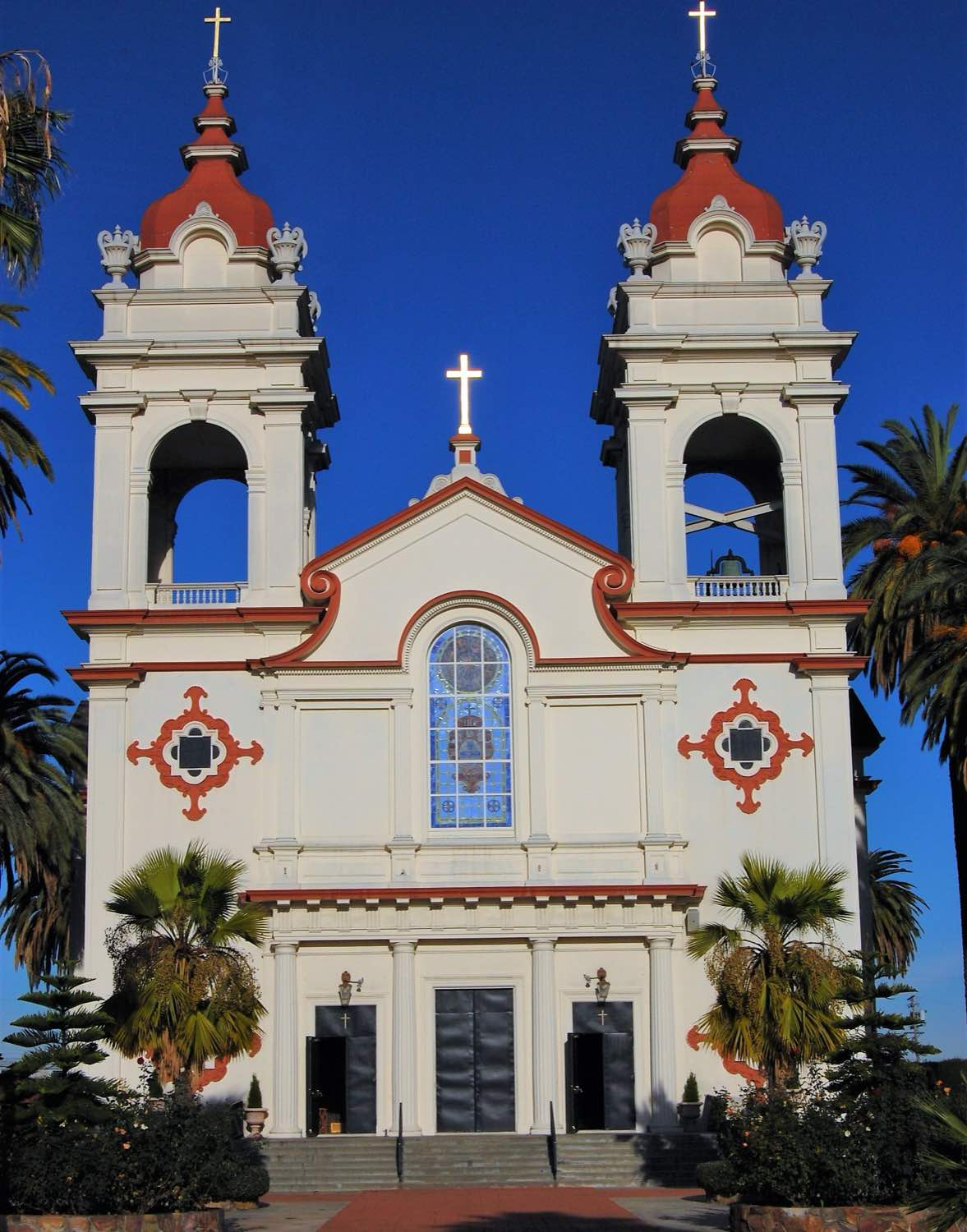
On the right Sunday in early summer, a brass band climbs the steps of a white twin-towered church on East Santa Clara Street, and a girl in a velvet cape carries a silver crown the length of the nave. Outside, volunteers ladle sopas from steaming pots: bread, beef, and broth scented with mint, handed free to anyone who shows up hungry. The smell of it drifts down toward the freeway. This is how the Portuguese in San Jose have kept faith with a fourteenth-century queen and with the islands their grandparents left, year after year, on the same blocks of the city’s east side.
Little Portugal sits where Santa Clara Street bends and becomes Alum Rock Avenue, a low-slung corridor of bakeries, social halls, and a church that towers over everything around it. The story of how it got there starts not in Lisbon but 800 miles out in the Atlantic, on a scatter of volcanic islands called the Azores.
Little Portugal: The Place
Little Portugal runs along the seam where East Santa Clara Street turns into Alum Rock Avenue, roughly from 23rd Street to 34th Street on the northeast side of San Jose. It is hemmed by US 101 to the west and bleeds into the Anne Darling neighborhood to the north. The housing is modest: single-story bungalows, stucco cottages, and the occasional grander home, much of it built when this was still farm country. A future BART station sits directly behind the parish church, between the freeway and 28th Street.
How Little Portugal Became Portuguese
Before the Portuguese
Before the orchards, the Santa Clara Valley belonged to the Tamien Ohlone, and then to Spanish and Mexican ranchos. By the second half of the nineteenth century, American settlers had turned the valley floor into a sea of fruit trees, apricots, prunes, cherries, and pears, and called it the Valley of Heart’s Delight. Harvest was seasonal and labor-hungry, and the canneries that processed the crop needed hands every summer.
Those hands came from everywhere. Surviving worker cabins preserved at History Park, built around 1905 to 1920, document the Chinese, Filipino, Italian, Japanese, Mexican, and Portuguese crews who followed the ripening fruit across the valley. Into that economy the Azoreans arrived, already farmers, already used to coaxing crops from hard volcanic ground.
The Portuguese Arrive
The first thread was the whale. From the 1840s, Yankee whaling ships had recruited crew in the Azores, and Azorean men jumped ship in San Francisco and Monterey, sending word home that California had land and work. Portuguese settlers began reaching the Santa Clara Valley in the 1850s, and over the following decades the trickle became a chain: a brother sent for a brother, a village in the Azores slowly reassembling itself around the canneries and dairies of a valley it had never seen.
The numbers tell how complete the transformation was. By the First World War, Portuguese residents made up roughly 70 percent of the population of nearby Santa Clara, and by the 1940s Santa Clara County held close to a third of all the Portuguese people in California. The men worked orchards, dairies, and the Mission Trail garbage routes; the women and children worked the cannery lines through the long hot summers. They were paid by the season and they saved by the decade.
The faith came with them, and so did the festa. In 1914, Monsignor Henrique Augusto Ribeiro and a founding group of 318 Portuguese families established the Five Wounds Portuguese National Parish to serve the growing community of East San Jose. It would become the anchor that everything else in Little Portugal organized itself around.
Little Portugal at Its Peak
By mid-century the neighborhood along Alum Rock Avenue had everything a Portuguese family needed within a few blocks. There were bakeries selling massa sovada and custard tarts, fish markets stacking dried bacalhau, a sausage maker, a jeweler, social clubs, and athletic clubs, all clustered under the bell towers of Five Wounds. The império of the Holy Spirit, the small chapel that hosted the crowning of the festa queen, stood near East Santa Clara Street and the highway, the ceremonial heart of the year.
Then came a second wave from a single catastrophe. On September 27, 1957, the Capelinhos volcano began erupting off the island of Faial, burning for thirteen months, swallowing 300 houses and forcing 2,000 people from their homes. In 1958 Congress passed the Azorean Refugee Act, co-sponsored by Senator John F. Kennedy, opening non-quota visas to the displaced. Most Faialenses landed in the Portuguese mill cities of the northeast, joining the older communities of the Portuguese in New Bedford and the mills of Fall River, but a steady share came west to the valley where cousins were already waiting.
The new arrivals deepened Little Portugal rather than founding it. They filled the cannery shifts, bought the bungalows, and packed the festa until, by some years, fifteen thousand people crowded the church grounds for the Festa do Divino Espírito Santo.
The Change
The orchards that built the community were the first thing to vanish. Through the 1950s and 1960s the Valley of Heart’s Delight became Silicon Valley, the prune trees bulldozed for subdivisions and chip fabs, and the canneries that had paid for so many first homes closed one by one. The freeways arrived too: US 101 and later Interstate 280 carved through the east side, hardening Little Portugal’s edges.
The families did what immigrant families do when they prosper. The second and third generations went to San Jose State, took office jobs, and moved out to the suburbs of Evergreen and beyond, leaving the old neighborhood older and quieter on ordinary weekdays. The shops thinned. But the parish held, and the festa never missed a year, and the halls kept their lights on.
The Landmarks of Little Portugal
Five Wounds Portuguese National Church, 1375 East Santa Clara Street. Founded in 1914, the twin-towered church is the most recognizable building on the east side and the spiritual capital of Portuguese San Jose. Monsignor Ribeiro bought the Pavilion of Portugal from San Francisco’s 1915 Panama-Pacific International Exposition for the sum of $200, and volunteers dismantled it in two weeks; while most of the timber proved unusable, the pavilion’s stained glass and decorative pieces were carried south and worked into the new church. The first Mass was said on June 29, 1918, during that year’s festa, and the finished building was dedicated on July 13, 1919, before a crowd of thousands.
The Império and I.E.S. Hall, near East Santa Clara Street and US 101. The Irmandade do Espírito Santo built the first permanent império in San Jose around 1915 to house the Holy Spirit crown between festas. A faithful replica of that little chapel, its plaza centered on a granite compass rose copied from Lisbon, was dedicated at History Park in 1997 and now holds the Portuguese Historical Museum.
Popular Bakery, Alum Rock Avenue. Portuguese-owned and run for over three decades, Popular has supplied the neighborhood with breads and tarts from the islands: queijadas, sweet egg breads, and the orange, coconut, and bean tarts that turn up on every festa table. On feast weekends the line runs out the door and the cases empty by noon.
The Portuguese Athletic Club, 1401 East Santa Clara Street. Founded on February 22, 1962 by Portuguese immigrants who wanted a place to play soccer and gather, the club fielded its first side in the Peninsula Soccer League that same season. More than sixty years on, it still hosts matches, dances, and banquets a block from the church.
The Portuguese Band of San José, 100 North 27th Street. Known as the Banda Velha, the Old Band, it was founded in 1971 and inaugurated in February 1972 after its founder Eleutério Borba watched an accordion player carry a Holy Spirit hymn through a procession at Five Wounds. It is the oldest Portuguese marching band still playing in California, and it still leads the festa up the church steps every June.
Adega, 1614 Alum Rock Avenue. A reminder that the corridor is not only a museum, Adega opened in 2015 and in 2017 became the first restaurant in San Jose to win a Michelin star, cooking the food of the Azores and the mainland for a city that had mostly forgotten the neighborhood was there. Its success put Little Portugal back on the map for a new generation of diners.
Where the San Jose Portuguese Came From
Almost everyone here traces back to the Azores, the nine Portuguese islands strung across the mid-Atlantic, and rarely to the mainland. The earliest families came largely from São Jorge, Faial, Pico, and Terceira, islands of small farms and hard volcanic soil where land was scarce and inheritance left younger sons with nothing. Whaling first opened the route, and chain migration did the rest, pulling whole parishes toward the same San Jose blocks.
The Capelinhos eruption added a sharp Faial accent to that mix in the late 1950s and 1960s. Families who lost their houses to ash on Faial rebuilt them in stucco on the east side of San Jose, and the festas they brought, the crownings, the free sopas, the devotion to Our Lady of Fátima, were the festas of the islands transplanted whole.
Little Portugal Today
On a regular Tuesday, Little Portugal can look like any older San Jose neighborhood: quieter than it was, its storefronts a mix of Portuguese names and newer arrivals, many of the founding families long since moved to the suburbs. The displacement is real, and the city has flagged these blocks as among its most vulnerable to gentrification as Silicon Valley money pushes east. The corridor that once had a bakery, a fish market, and a sausage shop on every block now has fewer of each.
But the institutions endure with surprising stubbornness. POSSO, the Portuguese Organization for Social Services and Opportunities, founded by San Jose State students in 1974 and incorporated in 1976, still cooks and delivers hundreds of meals a day to immigrant elders, its name a deliberate answer to the old fatalism of não posso, I cannot. The festa still draws thousands, and second and third generation grandchildren drive back across the valley each June for the crowning and the sopas they grew up with. Their story rhymes with the Portuguese of the Ironbound in Newark, another island community that turned an industrial neighborhood into a homeland.
The biggest test is coming. A BART extension is planned to open in the 2030s, with a station named for the neighborhood, 28th Street/Little Portugal, rising directly behind Five Wounds with a red-and-white facade meant to echo the church. It will bring development and pressure in equal measure. Whether the trains carry the next generation away or bring new neighbors to the festa, the crown will come out in June, the band will play, and the sopas will be free.
Frequently Asked Questions
Why did the Portuguese settle in San Jose?
Azorean immigrants were experienced farmers, and the Santa Clara Valley’s orchards, dairies, and canneries offered exactly the seasonal agricultural work they knew. Word first spread through whalers who jumped ship in California in the mid-1800s, and chain migration did the rest. By the First World War the Portuguese in San Jose and neighboring Santa Clara made up a large share of the population.
Is Little Portugal still Portuguese today?
Partly. Many founding families have moved to San Jose’s suburbs, and the corridor is more mixed than it once was, with real displacement pressure as Silicon Valley expands east. Yet the Portuguese in San Jose still anchor the neighborhood through Five Wounds church, POSSO, the social clubs, and a Holy Spirit festa that draws thousands every June.
What are the most famous Portuguese landmarks in San Jose?
The Five Wounds Portuguese National Church on East Santa Clara Street is the best known, founded in 1914 and dedicated in 1919. Other landmarks include the Portuguese Athletic Club, the Banda Velha or Portuguese Band of San José, Popular Bakery on Alum Rock Avenue, and the Portuguese Historical Museum’s replica império at History Park.
Where did the Portuguese of San Jose come from?
Almost all came from the Azores, the nine Portuguese islands in the mid-Atlantic, rather than mainland Portugal. The earliest families came mainly from São Jorge, Faial, Pico, and Terceira. A later wave arrived from Faial after the Capelinhos volcano erupted in 1957 and the Azorean Refugee Act of 1958 opened the door.
When did the Portuguese first arrive in San Jose?
Portuguese settlers began reaching the Santa Clara Valley in the 1850s, drawn by whaling-era stories of California land and work. The community grew steadily through the late 1800s and early 1900s around orchard and cannery labor. The founding of Five Wounds parish in 1914 marked the point at which the Portuguese in San Jose had become a settled, organized community.
If your family’s story passed through the Azores and the orchards of the Santa Clara Valley, the festa on Alum Rock Avenue is still keeping it. Every crown and every pot of sopas is a thread back to a small island and a long crossing.