
At dawn the corner of Southard and Olivia smells of scorched sugar and dark roast, and a small window opens onto the sidewalk. A hand passes out a paper thimble of cafe con leche, thick and sweet, and a pressed sandwich wrapped in wax paper. Ninety miles of water away, the same coffee is poured the same way. For more than 150 years that stretch of sea has carried Cubans north to this two-by-four-mile island, and the island has carried their language, their cigars, and their politics back the other way. To understand Cubans in Key West is to understand that the nearest piece of America to Havana once spoke more Spanish than English.
Key West: The Place
Key West is the last inhabited island in the Florida Keys, a coral outcrop closer to Cuba than to Miami. The Overseas Highway, built on the bones of Henry Flagler’s 1912 railroad, is the only road in. The old town is a dense grid of wood-frame “conch” houses with porches, shutters, and tin roofs, packed tight against hurricanes and the heat.
How Key West Became Cuba’s First American Home
Before the Cubans
The Spanish called the island Cayo Hueso, bone cay, for the human remains found there. In 1822 a businessman named John Simonton bought it from a Spanish officer for about two thousand pesos, and the United States planted its flag the same year. The first settlers were Bahamian immigrants known as Conchs, who made their living wrecking ships on the reef, fishing, turtling, and harvesting sea salt. By the 1830s, on the strength of salvage and salt, Key West was reportedly the richest city per capita in the country, a frontier seaport long before the cigar makers arrived.
The Cubans Arrive
The change began in 1868. That October a planter named Carlos Manuel de Cespedes freed his slaves at his home in Bayamo and called for “Cuba Libre,” igniting the Ten Years’ War against Spanish rule. The fighting and the reprisals that followed sent thousands of Cubans fleeing across the Straits of Florida, and the closest safe ground flew the American flag.
They did not arrive empty-handed. Cigar manufacturers brought their trade with them, and one of the largest was Vicente Martinez Ybor, a Spaniard who had built a fortune in Havana and reopened his factory in Key West around 1869. Rolling Cuban tobacco on American soil let him sidestep the import duty on finished cigars and sell into the United States more cheaply. Other manufacturers followed the same logic, and the island filled with tabaqueros, the skilled rollers who worked the benches.
Key West at Its Peak
By the 1870s and 1880s Key West was the cigar capital of the world. At the height of the boom the island held more than 100 factories turning out cigars by the tens of millions a year, and by 1876 over two thousand cigar makers were producing some 62 million cigars annually. In 1890 the census counted 18,786 residents, making Key West the largest and richest city in Florida, ahead of Jacksonville, Tampa, and the small village that would become Miami. Roughly half of those residents were Cuban.
The cigar factory floor had its own institution: the lector, the reader. Perched on a raised platform, the lector read aloud all day to the rollers below, newspapers in the morning, novels and poetry in the afternoon. The workers, not the owners, paid him, each chipping in around 25 cents a week, and they voted on what he read. A popular lector could out-earn everyone on the floor. The custom turned crowded workrooms into schools, and it carried news of the independence struggle straight to the benches.
Cubans did not stay confined to the factory. The community elected Carlos Manuel de Cespedes y Cespedes, son of the man who had started the war, as the first Cuban-born mayor of Key West around 1875. Cubans served in the Florida legislature, sat as judges and justices of the peace, ran pharmacies and newspapers, and organized the politics of exile from the island.
The Change
On April 1, 1886, a fire tore through Key West and destroyed 18 cigar factories and more than 600 buildings. The blaze, combined with rising labor militancy among the well-read tabaqueros, convinced Vicente Martinez Ybor that the island’s future was fragile. He had already been scouting the mainland, and in 1885 he had begun moving operations to a patch of scrub near Tampa that would soon bear his name. The handoff was decisive. As Tampa’s railroads and harbor pulled the industry north, the story of the trade continued in the new district of Cuban Ybor City, where many Key West rollers and, later, Spanish immigrants in Ybor City rebuilt the cigar capital on a larger scale. Hurricanes, the rise of the cigarette, and the Depression finished what the fire began.
The Landmarks of Cuban Key West
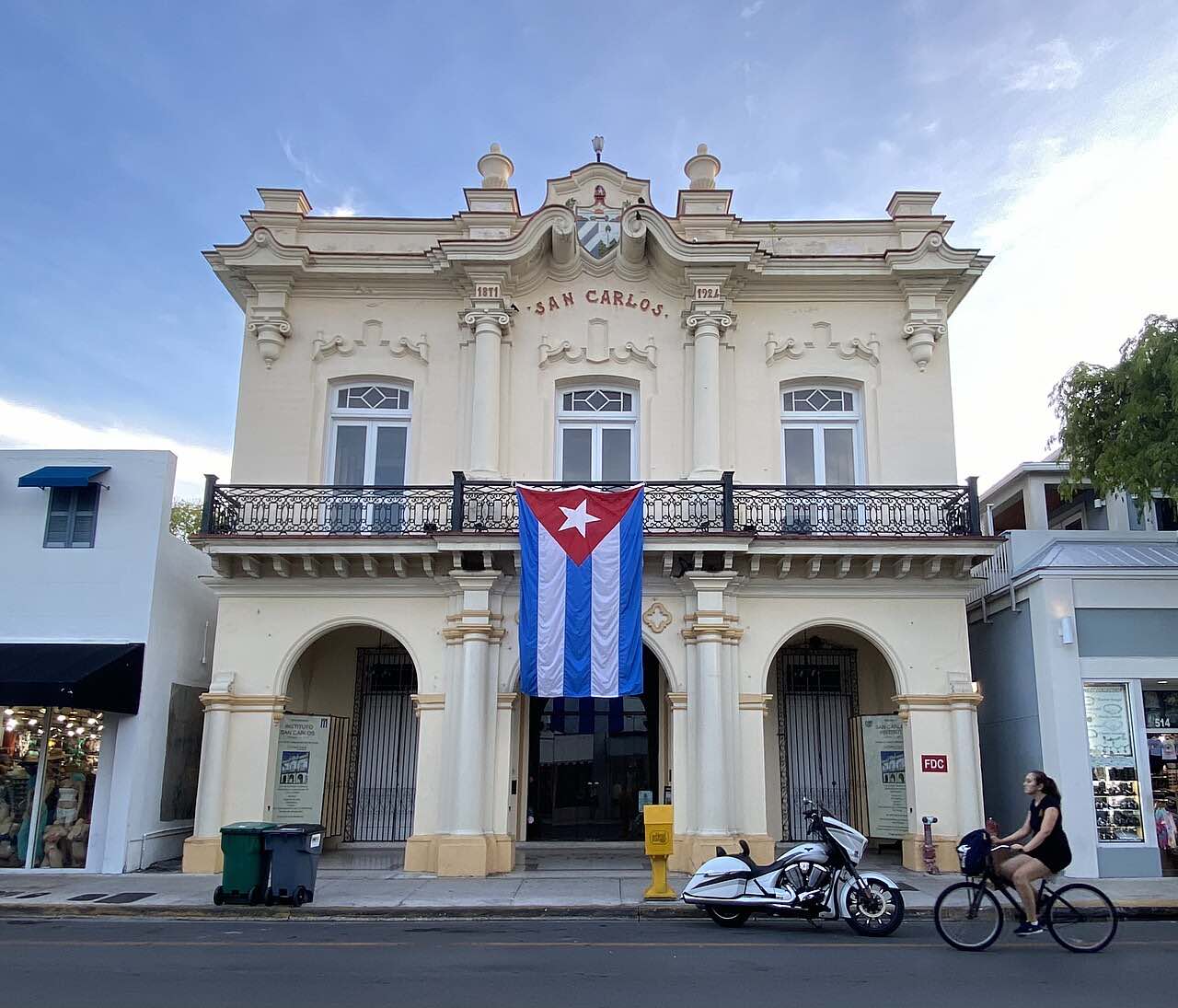
San Carlos Institute, 516 Duval Street. Cuban exiles founded the San Carlos on November 11, 1871, naming it for a seminary in Havana. Juan Maria Reyes and Jose Dolores Poyo led the effort, and the institute became school, theater, library, and headquarters of the independence movement all at once, the place Jose Marti would call “La Casa Cuba.” It moved from Anne Street to Fleming Street and finally to Duval, and its bilingual, racially integrated classrooms were among the first of their kind in the nation.
The Marti assembly at San Carlos. On January 3, 1892, Jose Marti stood before a packed hall at the San Carlos and announced that the fractured exile groups would unite, the founding moment of the Partido Revolucionario Cubano. Crowds of cigar workers had greeted him at the dock and marched him up Duval Street. The party he built in the factory towns of Florida would carry the war for independence back to Cuba three years later.
The rebuilt San Carlos. A hurricane wrecked the building in 1919, and its president Jose Renedo led a delegation to Havana that secured 80,000 dollars from the Cuban government to rebuild it. The architect Francisco Centurion designed the present two-story landmark with marble stairways, Cuban tile floors, and a soil-and-tree memorial gathered from every province of Cuba. It opened on October 10, 1924.
The E. H. Gato Cigar Factory and Gato Village, Simonton Street. Eduardo Hidalgo Gato, who fled Cuba as a young man and later helped finance Marti, built one of the island’s largest factories here. Around it he laid out roughly 40 cigar makers’ cottages, a settlement known as Gatoville, and added a streetcar line, a hospital, and a baseball league. The two-room cottages, porch in front and outhouse behind, housed the families that rolled his cigars.
La Te Da, 1125 Duval Street. The house belonged to cigar manufacturer Teodoro Perez, and Marti spoke from its second-floor veranda to crowds gathered in the street below. They called the spot “La Terraza de Marti,” the terrace of Marti, which the name La Te Da still echoes today.
5 Brothers Grocery, 930 Southard Street. Opened in 1978 by a Cuban family, this corner store kept the old neighborhood rhythm alive long after the factories closed. Locals still line up at the counter for buchi coffee, the Cuban Mix sandwich, and bollos, fried black-eyed-pea fritters the shop claims to be the last in town to make.
Where the Key West Cubans Came From
The first great wave came out of eastern Cuba, the Oriente, where the Ten Years’ War began and the Spanish reprisals fell hardest. Havana sent the manufacturers and many of their skilled rollers, since the cigar trade was concentrated in the capital. As factories multiplied, chain migration did the rest: a roller who found work on the island wrote home, and brothers, cousins, and whole village benches followed across the 90-mile crossing.
The ties never fully broke. Through the 20th century ferries and, by the 1950s, cheap daily flights linked Key West and Havana in under an hour, so families lived in both places at once. When the 1980 Mariel boatlift carried roughly 125,000 Cubans north, many of the boats landed first at the Truman Annex docks in Key West, the same shoreline their great-grandparents had reached a century before. Most of those newcomers pushed on up the highway to join the larger Cuban world of Little Havana in Miami, but the first American ground they touched was the old exile island.
Key West Today
The factories are gone, but the Cuban grain runs through the island. The San Carlos Institute, shuttered and nearly demolished in the 1980s, reopened on January 4, 1992, exactly a hundred years after Marti’s first address, and now operates as a museum and cultural center on Duval Street. The old Gato factory survives as county offices and a small cigar museum, and a heritage trail of markers traces the cigar-era streets.
Day to day, the culture is edible and audible. Cuban Coffee Queen pours con leche from its windows at several spots around town, 5 Brothers still presses sandwiches on Southard Street, and the bolita numbers game that once ran through the workrooms lingers in local memory. The accent here is its own thing, a Cuban-Conch creole stitched from two island cultures that learned to live in one place.
Key West will always be the southernmost city, the end of the road, the bar at the end of the night. But it was a Cuban city first, the place where exile became a homeland and a country’s freedom was organized one factory bench at a time. The coffee window still open at dawn is the proof that the crossing never really ended.
Frequently Asked Questions
Why did Cubans settle in Key West?
Cubans in Key West first arrived after 1868, when the Ten Years’ War against Spanish rule sent thousands of refugees fleeing across the 90-mile strait to the nearest American soil. Cigar manufacturers like Vicente Martinez Ybor relocated their factories there to avoid the U.S. import duty on finished cigars, drawing skilled rollers and their families in growing numbers.
Is Key West still a Cuban city today?
Not in the way it was in 1890, when roughly half the population was Cuban and Key West was the largest city in Florida. The cigar industry moved to Tampa and the population shifted, but Cuban heritage remains woven into daily life through the San Carlos Institute, Cuban coffee windows, and family ties to the island.
What are the most famous Cuban landmarks in Key West?
The San Carlos Institute at 516 Duval Street is the best known, founded by exiles in 1871 and tied to Jose Marti. Others include the E. H. Gato Cigar Factory and its village of cigar makers’ cottages, La Te Da on Duval Street, and 5 Brothers Grocery, which has served Cuban coffee and sandwiches since 1978.
Where did the Key West Cubans come from?
The first wave came largely from eastern Cuba, the Oriente region where the Ten Years’ War erupted, along with Havana, the heart of the cigar trade. Through chain migration, rollers who found work would bring over brothers, cousins, and neighbors from the same towns.
When did Cubans first arrive in Key West?
The first major wave of Cubans in Key West came in 1868 at the start of the Ten Years’ War, and the community grew through the 1870s and 1880s as the island became the cigar capital of the world. Later waves followed, including the Mariel boatlift of 1980, when many refugees landed at the Truman Annex docks.
If your family’s story passed through the coffee windows and rolling benches of Key West, every name and crossing is a thread worth following back across the water.