
On the third weekend of August, Consaul Street closes to traffic and fills with the smell of paprika. Church women ladle chicken paprikás over noodles, men turn coils of kolbász on smoking grills, and somewhere a bacon roast sputters fat onto a fire. This is the Birmingham Ethnic Festival, and it has happened every summer since 1974. The street it runs on was nearly demolished that same year, which is exactly why the party started.
The Hungarians in Birmingham, Toledo built this corner of East Toledo with foundry wages and parish dues, and more than a century later they still come back to it. Some drive in from the suburbs. Some fly home from across the country. The fourth generation now stands at the same grills their great-grandparents did.
Birmingham: The Place
Birmingham sits on the east bank of the Maumee River near its mouth, hemmed in by Front Street’s old industrial waterfront and the Conrail tracks. It is a compact grid of small lots and one-and-a-half-story frame cottages, most of them worker housing put up between the 1890s and the 1920s. Consaul Street is the spine, running through the heart of the neighborhood past the churches and the corner taverns. The Birmingham Historic District, roughly bounded by Genesee, York, Esther, Magyar, Consaul, and the rail line, went onto the National Register of Historic Places in 1996.
How Birmingham Became Hungarian Toledo
Before the Hungarians
The land that became Birmingham was farmed first, by French, German, and Irish settlers drawn to the rich loamy soil along the river. Their names still mark the map in streets and parks like Collins, Valentine, and Paine. By the late nineteenth century, that farmland was giving way to iron. Front Street and the riverfront filled with foundries and furnaces, and the neighborhood took the name Birmingham to echo the great iron city of England, just as the district to the north took the name Ironville.
The early Catholic settlers worshipped at Sacred Heart, the parish that already served East Toledo. That was the world the first Hungarians walked into: a young industrial ward, still half rural, hungry for foundry labor.
The Hungarians Arrive
In 1890 the National Malleable Castings Company opened a foundry on Front Street and brought its workforce with it. The company transferred roughly two hundred Hungarian workers from its existing plant in Cleveland, sponsoring nearly a hundred families to make the move to East Toledo. Those families became the seed of the neighborhood. They were skilled foundry hands, and the company knew exactly what it was getting when it recruited them.
Chain migration did the rest. A man who found steady work at National Malleable or at the Toledo Furnace Company wrote home, and a brother followed, then a cousin, then a whole village’s worth of neighbors. The numbers tell the story plainly. In 1900, East Toledo counted 647 residents of Hungarian birth. By 1920, that figure had climbed to more than 3,000. The newcomers clustered tight around the foundry and the streets just east of it, building a Hungarian colony dense enough to support its own butchers, bakers, and saloons.
They organized fast. The King Matthias Sick and Benevolent Society came first, a mutual-aid lodge that pooled pennies against the day a foundry man was hurt or buried. Its Catholic members soon split off to form the Saint Stephen society, the Greek Catholics formed the Saint Michael society, and the Reformed Protestants founded the John Calvin society. Each of those would build a church.
Birmingham at Its Peak
By the years between the wars, Birmingham was a self-contained Hungarian town inside Toledo. Six blocks of Consaul Street held grocery and confectionery shops, cleaners, bowling alleys, a theater, and a row of taverns where men stopped on the walk home from the swing shift. Takács sold the sausage. National Bakery baked the bread. The funeral home that buried the neighborhood had started life as Kigyóssy’s before the name was softened to Kinsey’s.
Life ran on the parish calendar and the foundry whistle. There was a Corpus Christi procession in summer, a harvest dance in autumn, and at Christmas the Bethlehemes folk play carried over straight from the old country. Easter Monday meant dousing day, when boys sprinkled water or perfume on the girls. On some streets, the houses were arranged the way they had been back home, around shared yards, an echo of the Heves County village of Átány laid down in Ohio lumber.
The neighborhood even printed its own news. Dr. Géza Farkas, born in 1878 in Egerszeg, started a Hungarian-language paper called Toledo in 1929. At St. Stephen’s, Monsignor Elemér Eördögh, who had come to the parish in 1913, presided over the largest Hungarian congregation in the city. Two further waves added to the colony: a steady prewar stream, and then, after the failed 1956 revolution, a small group of refugees, perhaps seventy-five of whom settled in Birmingham among people who already spoke their language.
The Change
The foundries did not last. As heavy industry along the river contracted after World War II, the wages that had built Birmingham thinned out, and the children of the foundry men moved to newer suburbs. The neighborhood, spared the wrecking ball of postwar urban renewal, aged quietly in place.
Then came 1974. City planners, reworking the approaches around the I-280 corridor and the Craig Memorial Bridge, proposed widening Consaul Street and throwing an overpass across the heart of Birmingham. The plan would have flattened the buildings along one side of the street and cut the neighborhood in two. Instead it cut the neighborhood loose. Residents organized as the Birmingham Neighborhood Coalition, led by figures like St. Stephen’s Father Martin Hernady, Nancy Packo, and Oscar Kinsey, and they fought. They packed council chambers, blocked the street, and beat City Hall. Toledo dropped the overpass, and the careers of two future officeholders, councilman Peter Ujvagi and county commissioner Francis Szollosi, were launched in the fight.
The Landmarks of Birmingham
St. Stephen King of Hungary Catholic Church (1880 Genesee Street, at Consaul) is the anchor. The parish was organized in 1898, a year after a Hungarian priest from Cleveland began visiting the foundry families, and its first church went up in 1899 with about a hundred families on the rolls. The grand basilica that stands today, designed by Toledo architect Joseph C. Huber Jr. and completed in 1914, carries an oversized statue of Hungary’s patron saint, murals of Hungarian saints, and stained glass bearing the Hungarian royal coat of arms beside American shields.
Calvin United Church of Christ (corner of Bakewell and Bogar Streets) was the Hungarian Reformed congregation’s answer to the Catholic basilica. The Italian Renaissance building, designed by architect T. W. Matz and finished in the mid-1900s for about $13,000, seated 650 and wore the same pairing of Hungarian and American emblems. Organized as the Magyar Reformed Church, the congregation took the name Calvin United Church of Christ in 1962.
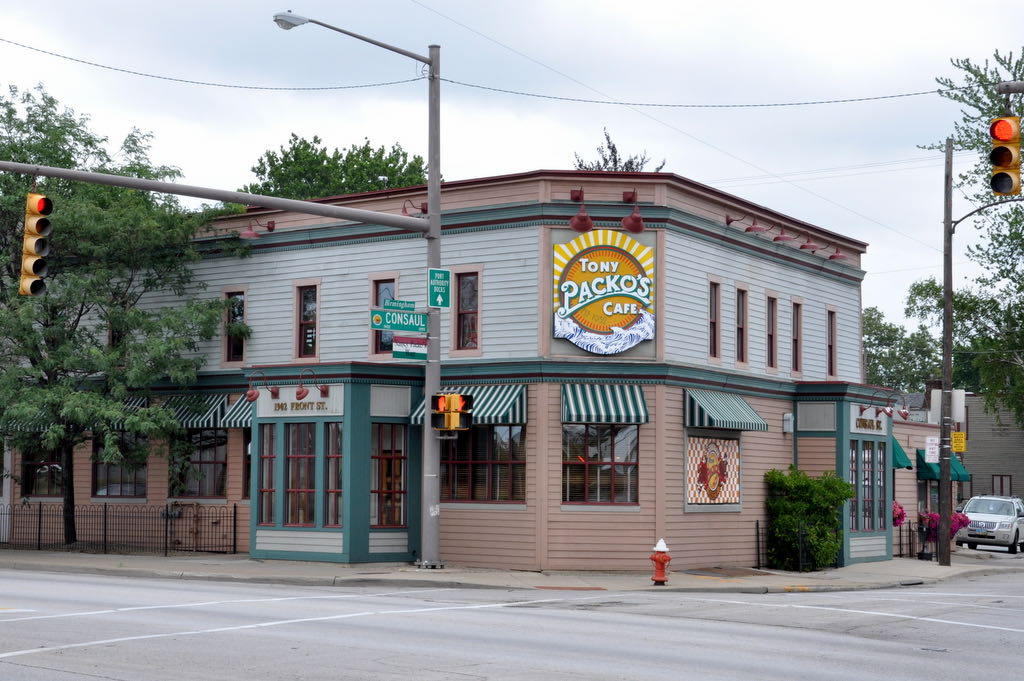
Tony Packo’s Cafe (1902 Front Street, at Consaul) is the landmark the wider world knows. Tony Packo, the Toledo-born son of Hungarian immigrants, opened a sandwich and ice cream shop in 1932 on a hundred-dollar loan from relatives, in the worst of the Depression. He took a kolbász sausage, sliced it lengthwise so it stretched further, laid it on rye with a spicy chili sauce, and called it the Hungarian hot dog. There had never been such a thing in the old country. In 1935 he bought the wedge-shaped building at Front and Consaul, and it has anchored the corner ever since.
Packo’s became famous twice over. In 1972 the actor Burt Reynolds stopped in, and when Tony’s daughter asked for an autograph he grabbed a hot dog bun and signed it, starting a tradition that now lines the walls with celebrity signatures, the fragile originals long since replaced by foam replicas. Then Toledo native Jamie Farr, playing Corporal Klinger on M*A*S*H, name-checked the place on national television starting in 1976, telling the world that the Hungarian side of Toledo had the greatest hot dogs going.
The Hungarian Club of Toledo (224 Paine Avenue) keeps the social life going, a gathering hall in the historic neighborhood that anchors the festival weekend alongside the churches. The Playdium, built in 1902 at 1956 Front Street by Hungarian immigrant John Strick, is a smaller treasure: a pale brick hall whose tin cornice is stamped with the Hungarian coat of arms and the crown of St. Stephen, with a stage upstairs and a bowling alley in the basement. And the modest worker cottages themselves, especially the handful on Whittemore and Bakewell with their distinctive double-arched corner doorways, are landmarks of a kind, the everyday housing stock that the 1996 historic-district listing was written to protect.
Where the Birmingham Hungarians Came From
The Hungarians who built Birmingham were overwhelmingly Palóc, from the hilly counties of north-central Hungary: Heves, Abaúj, and Gömör. These were farming districts where land was tight and industrial wages abroad looked like a way out, and the National Malleable connection to Cleveland gave Toledo’s colony its specific shape, since the first arrivals came by way of that city’s foundries rather than straight off the boat.
Particular villages came over almost intact. The clearest fingerprint is Átány in Heves County, whose communal yard-sharing was reproduced on certain Birmingham streets, a piece of Palóc village life rebuilt within sight of a Toledo foundry. Origin shaped faith as well: most families were Roman Catholic, but enough were Greek Catholic and Reformed that the neighborhood needed three churches rather than one.
Birmingham Today
Birmingham is no longer a place where you can live an entire life in Hungarian, and it does not pretend to be. The foundries are gone, most of the corner stores are closed, and the families that filled the cottages have scattered across greater Toledo. St. Stephen’s is now the St. Stephen Campus of Epiphany of the Lord, a parish that folded together three historic East Toledo churches, and weekend Mass still fills the 1914 basilica.
What survives is durable. Tony Packo’s has grown into a small local chain with several Toledo-area locations, the original still standing at Front and Consaul. The church kitchens still turn out chicken paprikás dinners and cabbage rolls by the tray, rolled by hand for fundraisers that double as reunions. The Birmingham Development Corporation still speaks up for the homes near the river.
And every August, Consaul Street closes again. The Birmingham Ethnic Festival, born as a victory party in 1974, marked its fiftieth year in 2024 and shows no sign of stopping. Grandchildren and great-grandchildren come back for the paprikás and the kolbász and the bacon roasts, for the dancers and the church tours, for one weekend a year when the foundry neighborhood is fully itself again. A community that beat City Hall to keep its street is not about to let go of it now.
Frequently Asked Questions
Why did Hungarians settle in Birmingham, Toledo?
The Hungarians in Birmingham, Toledo came for foundry work. In 1890 the National Malleable Castings Company opened a plant on Front Street and transferred roughly two hundred Hungarian workers from its existing foundry in Cleveland, sponsoring nearly a hundred families. Chain migration from north-central Hungary did the rest, and the colony grew up tight around the foundry.
Is Birmingham still a Hungarian neighborhood today?
It is no longer Hungarian in daily life, but the heritage is very much alive. St. Stephen’s church still holds weekend Mass, Tony Packo’s still anchors Front and Consaul, and the Birmingham Ethnic Festival has drawn crowds back to the neighborhood every August since 1974, marking its fiftieth year in 2024. Many descendants return specifically for that weekend.
What are the most famous landmarks of Birmingham in Toledo?
The best known is Tony Packo’s Cafe at 1902 Front Street, made famous nationally by Jamie Farr’s Corporal Klinger on M*A*S*H and by its walls of celebrity-signed buns. The other anchors are St. Stephen King of Hungary Catholic Church, completed in 1914, and Calvin United Church of Christ, the former Hungarian Reformed congregation.
Where in Hungary did Toledo’s Birmingham Hungarians come from?
Most came from the Palóc counties of north-central Hungary, chiefly Heves, Abaúj, and Gömör. These were tight-landed farming districts, and one village in particular, Átány in Heves County, left such a mark that its communal yard layout was rebuilt on some Birmingham streets. Many arrived by way of Cleveland’s foundries rather than directly from Europe.
When did Hungarians first arrive in Birmingham, Toledo?
The Hungarians in Birmingham, Toledo arrived in 1890, when the National Malleable Castings Company moved its Hungarian foundry workforce from Cleveland to a new plant on Front Street. They organized the parish of St. Stephen King of Hungary by 1898, and the Hungarian-born population of East Toledo climbed from 647 in 1900 to more than 3,000 by 1920.
If your family’s story passed through a foundry colony like Birmingham, through a parish hall kitchen, a Consaul Street tavern, or a village in Heves County, that history is worth tracing while the people who remember it are still here to tell it. The same pattern of work, faith, and chain migration shaped Hungarian enclaves like the Buckeye Road Hungarians of Cleveland and the Hungarians of New Brunswick, New Jersey, just as it drew Central European Catholics to mill towns like Slovak Whiting, Indiana.