
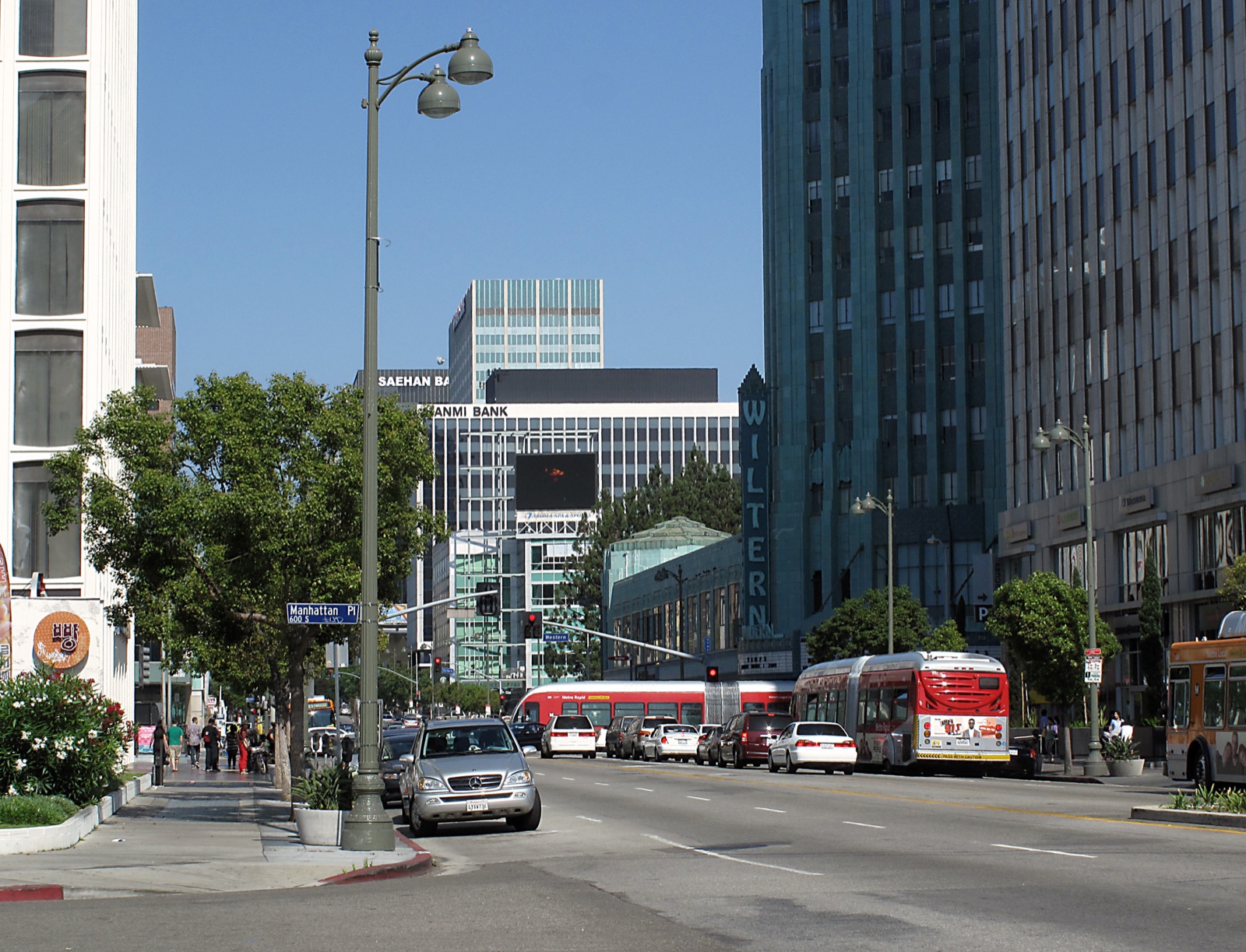
Wilshire Boulevard at midnight, and the signs are not in English. Hangul neon stacks ten storeys up the side of a tower at Western Avenue: spa, plastic surgeon, karaoke, BBQ on the third floor. A line forms outside BCD Tofu House on Vermont, the same line that has formed there most nights since 1996. By the late 1970s most businesses on Olympic Boulevard between Vermont and Western were Korean-owned. Today this rectangle of central Los Angeles is the largest concentration of Korean commerce anywhere outside the Korean peninsula.
Koreatown, The Place
Koreatown sits roughly three miles west of downtown Los Angeles. The city’s official boundaries draw it as Third Street on the north, Olympic Boulevard on the south, Vermont Avenue on the east, and Western Avenue on the west, though the lived neighbourhood spills past those lines toward Beverly Boulevard and Hancock Park.
Wilshire Boulevard is the spine. Two Metro stations, Wilshire/Vermont and Wilshire/Western, anchor the D Line as it runs beneath the boulevard. The housing stock is unusually dense for Los Angeles: prewar courtyard apartments, Art Deco towers, postwar dingbat buildings, and a steady churn of new mid-rises rising next to taquerias and 24-hour soft-tofu houses.
Few neighbourhoods in the city walk this well. Few have as many people doing it.
How Koreatown Became Korean
Before the Koreans
In the 1920s, the stretch of Wilshire between Vermont and Western was the most fashionable address in Los Angeles. The Brown Derby sat at the corner of Wilshire and Alexandria. The Ambassador Hotel ran the Cocoanut Grove. The Pellissier Building and its Wiltern Theatre, an Art Deco landmark cased in blue-green terra-cotta, opened in 1931 to a premiere attended by Clark Gable and Joan Crawford.
The neighbourhood emptied of its wealth after the war. White homeowners moved west toward the beach and north toward the hills, and a Jewish middle class that had built congregations along Wilshire began to disperse. By the 1960s the mid-Wilshire district held vacant office space, ageing apartment blocks, and rents low enough to be interesting.
It was at that moment that the Koreans began to arrive in numbers.
The Koreans Arrive
A small Korean presence had existed in Los Angeles since the early 1900s, clustered first around Bunker Hill and later along Jefferson Boulevard near USC. The first Korean Methodist gathering met on Magnolia Avenue near the university in 1904. A Korean Presbyterian congregation organised in 1906. These were a few hundred people, mostly students and political exiles.
The hinge was the Immigration and Nationality Act of 1965, also called Hart-Celler, which scrapped the national-origin quotas that had effectively blocked Asian immigration for forty years. Between 1968 and 1970 the Korean population of the United States doubled. Tens of thousands of new arrivals chose Los Angeles.
The catalyst within the catalyst was a man named Hi Duk Lee.
In 1971 Lee and his wife Kil Ja put about seven thousand dollars of their savings into a storefront at Olympic and Normandie and opened Olympic Market, the first Korean supermarket in Los Angeles. He went on to open a restaurant and nightclub, Young Bin Kwan, at 3014 West Olympic in May 1975. Lee then began lobbying the city to recognise what he could see forming around him.
The first Koreatown sign was officially installed in 1982.
Koreatown at Its Peak
The 1970s and 1980s were the boom years. South Korea’s economy was accelerating, Seoul was modernising at speed, and a generation of Koreans were taking the new opportunity to study, work, or join family in the United States. Many landed in Los Angeles because someone they knew was already there.
By the late 1970s most of the businesses on Olympic Boulevard and 8th Street had Korean owners. Korean-language newspapers, banks, churches, schools, and television channels followed. Hangul signage spread block by block along Wilshire and Western.
By the 1980s Los Angeles held the largest Korean settlement anywhere outside Korea, around two hundred thousand people in the broader county. The neighbourhood was a small city in itself, capable of housing, feeding, banking, and burying its own without ever needing English.
Then came the spring of 1992.
The Change: Sa-i-gu
On 29 April 1992 a mostly suburban jury in Simi Valley acquitted four Los Angeles police officers of the videotaped beating of Rodney King. Six days of civil unrest followed. South Los Angeles burned. Koreatown burned with it.
The community now calls those days Sa-i-gu, literally “four-two-nine”, the date written as numerals. By the end of the week, more than fifty people were dead across the city. Roughly 2,300 Korean-owned businesses had been damaged, looted, or destroyed. Korean losses alone were estimated at close to four hundred million dollars, more than a third of the total property damage in the riots.
The Korean American community had not built the conditions that produced the King verdict. It absorbed a large share of the cost anyway.
A year on, fewer than one in four destroyed businesses had reopened. A Los Angeles Times survey found that close to forty percent of Korean Americans in the area were thinking about leaving. The defining image of Sa-i-gu, the rooftop shopkeepers defending their stores with rifles because no police came, hardened into a generational memory.
It also produced a political awakening. The 1.5 and second generations, the ones who had grown up speaking English in American schools while their parents worked twelve-hour days, stepped into civic life. Korean American legal aid, voter registration drives, and pan-Asian coalition work expanded sharply in the 1990s. The community that had been largely invisible in city politics became, within a decade, organised and audible.
Koreatown rebuilt. By the early 2000s it was busier than it had been before. K-Pop and the global wave of Korean cinema and television drew a new generation of visitors. Latino immigration from Mexico and Central America reshaped the resident population. Gentrification arrived with the Metro D Line. The neighbourhood became layered: Korean commerce on top of Latino streets on top of an Art Deco bone structure from the 1920s.
The Landmarks of Korean Koreatown
The Wiltern Theatre, 3790 Wilshire Boulevard. The blue-green terra-cotta tower at Wilshire and Western opened in 1931 and was twice nearly demolished in the late 1970s before preservationists saved it. It now functions as Koreatown’s anchor music venue, hosting both K-Pop acts and American touring artists in a 1930s movie palace.
Olympic Market, originally 3122 West Olympic Boulevard. Hi Duk Lee’s 1971 grocery is no longer there in its original form, but it is the address where Koreatown effectively began. Every Korean supermarket in the neighbourhood is a descendant of this storefront.
BCD Tofu House, 869 South Western Avenue. Hee Sook Lee opened her first soondubu jjigae restaurant on Vermont and 7th in April 1996 and grew it into a chain that now operates in cities across the United States and Asia. The Koreatown locations stay open twenty-four hours and serve a queue of Korean grandparents, K-Pop stars, and night-shift workers who all want the same bubbling stone pot.
Park’s BBQ, 955 South Vermont Avenue. Chef Jenee Kim opened Park’s in 2003 and named it after a famous restaurant in Seoul. It carries a Michelin Guide recommendation and is one of the restaurants most often cited as the reason a non-Korean Angeleno first crossed Vermont Avenue.
Aroma Spa & Sports, 3680 Wilshire Boulevard. A 336,000 square-foot complex with a Korean jjimjilbang at its centre: jade saunas, hot and cold pools, a four-storey driving range, a swimming pool, and a karaoke floor. It is also a social institution where Korean families spend whole afternoons.
Koreatown Galleria, 3250 West Olympic Boulevard. A three-storey indoor mall on the southeast corner of Olympic and Western, opened in 2001. Galleria Market on the bottom floor is the largest Korean supermarket in the city. The upper floors carry a food court, K-Pop merchandise, and Korean beauty brands. It is the closest thing the neighbourhood has to a town square.
Korean American National Museum, planned at 3727 West 6th Street. The first national museum of Korean American history. The project was founded by community members in 1991, the year before Sa-i-gu, and after more than three decades of fundraising and redesign, construction in Koreatown is still pending. When the doors open, the building itself will be a landmark.
Where the LA Koreans Came From
The post-1965 wave was overwhelmingly South Korean and overwhelmingly urban. Seoul sent the largest share, with Gyeonggi-do, the province ringing the capital, close behind. Busan, the southern port city, sent a significant cohort. So did Daegu, Incheon, and the smaller cities of Gyeongsangnam-do and Jeollanam-do.
Jeju Island, the volcanic island off the south coast with its own dialect and its own grim 20th-century history, contributed a distinctive immigrant population. Many Jeju arrivals continued to organise as Jeju in Los Angeles, with their own homeland associations separate from the mainland Korean clubs.
A common path ran through American universities. A student would arrive on an F-1 visa to do graduate work at USC or UCLA, stay on through Optional Practical Training, sponsor a sibling, then a parent. Family reunification provisions in the 1965 Act made chain migration not just possible but efficient. One arrival could pull a dozen relatives across the Pacific over a decade.
From the 1990s onward, a smaller stream of North Korean refugees reached Los Angeles via South Korea and third countries. Their numbers are modest, but Koreatown is one of the few American places where a North Korean defector can find work, worship, and food that resemble home.
Koreatown Today
The numbers cut against the name. As of the most recent census-based estimates, Latinos make up roughly 53 percent of Koreatown’s resident population. Asian Americans, the great majority of them Korean, are around 32 percent. White and Black residents together account for about twelve percent. Mexico and Korea are by far the two most common countries of birth.
What persists is the commercial layer. Korean ownership still dominates the storefronts on Wilshire, Olympic, Western, and Vermont. Korean churches, Korean banks, Korean schools, Korean media offices and Korean restaurants form the visible texture of the neighbourhood even as the second and third generations have moved out to Cerritos, Fullerton, Buena Park, and Irvine for better-rated schools, single-family homes, and shorter commutes.
The K-Pop boom of the 2010s reversed some of that drift. Tourism arrived. K-Beauty stores opened next to old soft-tofu houses. The KTOWN Night Market began drawing hundreds of thousands of visitors a year. New mid-rises rose around the Metro stations, and a generation of young Korean Americans, second and third generation, found reasons to come back to the neighbourhood their grandparents built.
Koreatown is not what it was in 1985, and it is not what its name promises. It is something stranger and more durable: a Latino neighbourhood with a Korean main street, a Korean commercial economy carried on a foundation laid by people who arrived two generations ago and never quite left.
Frequently Asked Questions
Why did Koreans settle in LA’s Koreatown?
Koreans settled in Koreatown because the mid-Wilshire district was emptying out in the 1960s, with affordable rents, vacant commercial space, and a small existing Korean presence around Jefferson Boulevard. After the Immigration and Nationality Act of 1965 reopened Asian immigration, tens of thousands of new arrivals chose Los Angeles, and entrepreneurs like Hi Duk Lee anchored the community on Olympic Boulevard from 1971 onward.
Is Koreatown still Korean today?
The resident population is now roughly 53 percent Latino and around 32 percent Asian, with Koreans the largest Asian group. But Korean commercial life still dominates the storefronts, churches, banks, media, and restaurants of Koreatown, and the neighbourhood remains the largest Korean commercial district outside the Korean peninsula.
What are the most famous Korean landmarks in Koreatown?
The Wiltern Theatre at Wilshire and Western, BCD Tofu House on Western Avenue, Park’s BBQ on Vermont, Aroma Spa & Sports on Wilshire, and the Koreatown Galleria at Olympic and Western are among the best-known. The forthcoming Korean American National Museum on West 6th Street will join them when construction is complete.
Where in Korea did the LA Koreans come from?
The post-1965 wave came primarily from Seoul and the surrounding Gyeonggi-do province, along with the southern port city of Busan and other urban centres. Jeju Island contributed a distinct population that continues to maintain its own homeland associations in Los Angeles, and a smaller stream of North Korean refugees has reached Koreatown via third countries since the 1990s.
When did Koreans first arrive in Koreatown?
A small Korean community existed in Los Angeles from the early 1900s, with the first Korean Methodist gathering in 1904 and the first Korean Presbyterian congregation in 1906. The mass arrival began after the Immigration and Nationality Act of 1965, with the first Korean supermarket on Olympic Boulevard opening in 1971 and the first official Koreatown sign installed by the city in 1982.
If your family’s story passed through Koreatown, or any of the places the Korean diaspora made home, Atlas of Home can trace that journey. From a village in Gyeonggi-do to a storefront on Olympic Boulevard, to wherever in the world you are now.