
The smell hits first. Lemon and garlic and charred lamb drifting out of an open door on Eastern Avenue, where a sign in the window reads OPA and the walls inside are painted the exact blue of a Cycladic shutter. On a Sunday in June, the side streets off Ponca fill with folding chairs, a bouzouki wires up under a tent, and trays of loukoumades come out hot and dripping with honey. This is Greektown Baltimore, two miles east of the harbor, where rowhouses fly the white and azure of a country most of the cooks left fifty years ago.
It did not start here. It started downtown, in the alleys behind the public markets, with teenagers selling candy from carts.
Greektown: The Place
Greektown sits in southeast Baltimore, a tight grid of brick and formstone rowhouses bounded roughly by Lombard Street, O’Donnell Street, South Haven Street, and the trench of Interstate 895. Eastern Avenue, the old streetcar spine, runs straight through the middle and carries the restaurants, the bakery, and the church. The neighborhood climbs a low rise that residents called The Hill long before anyone painted GREEKTOWN on a sign. Sparrows Point and the working waterfront are a short drive east, which is no accident.
How Greektown Became Greek Baltimore
Before the Greeks
The Hill was not Greek to begin with. Germans built much of the housing stock in the late nineteenth century, and Polish and Italian families filled the blocks around them, drawn by the canneries, the rail yards, and the steel mills down at Sparrows Point. East Baltimore in those years ran on immigrant muscle. Boats unloaded at Fells Point and Canton, and the new arrivals walked straight into the city’s factories, much as the Genoese and southern Italians who built Little Italy a few miles west by the harbor had done a generation earlier.
When the writer Rafael Alvarez recalled his family moving in around 1935, the neighborhood still went by The Hill. The Greeks were arriving, but they were not yet the name on the door.
The Greeks Arrive
Greeks had been in Baltimore since the 1890s, just not on The Hill. The first wave came overwhelmingly from Laconia, the hard country in the southern Peloponnese around Sparta, and they landed downtown rather than at the port. There was no direct steamship line from the Mediterranean to Baltimore, so most came by train from New York, then clustered around the public markets and went to work.
The work was candy. Greek teenagers pushed confectionery carts and then opened shops, and the names recur in the record. Christos Sempeles and his brothers were running a confectionery by 1891 while still in their teens. The Konstant brothers opened at Lexington Market in 1895. The Prevas family started a confectionery and soda fountain at Broadway Market in 1899, and Anastasios Coroneos, who came from the island of Kythera in 1897, built a chain of candy stores. Sixteen-hour days behind a marble counter were the price of a foothold.
Faith followed money. The city’s first Greek Orthodox worship space opened in 1895 at Bond and Gough streets, backed by the Sempeles brothers. A permanent parish, Evangelismos, formed in 1906, and the Greek Orthodox Cathedral of the Annunciation rose in 1909. In January 1912 the Annunciation set aside a circular plot at Woodlawn Cemetery, the Greek Circle, where families named Prevas, Mavromihalis, Metaxas, and Stavropoulos still lie. The name Mavromihalis is a Maniot name, straight out of the rocky peninsula below Sparta, a quiet confirmation of where these people came from.
Greektown at Its Peak
The move east to The Hill gathered force in the 1930s and exploded after the Second World War. The Greek Civil War and the hunger that followed pushed a fresh wave of villagers toward Baltimore, and they did not stop downtown. They bought rowhouses near the factories, close enough to walk to work and to one another. By the time the Immigration and Nationality Act of 1965 lifted the old quotas, a third surge was on its way, much of it from the Aegean islands rather than the Peloponnese, and it ran into the early 1980s.
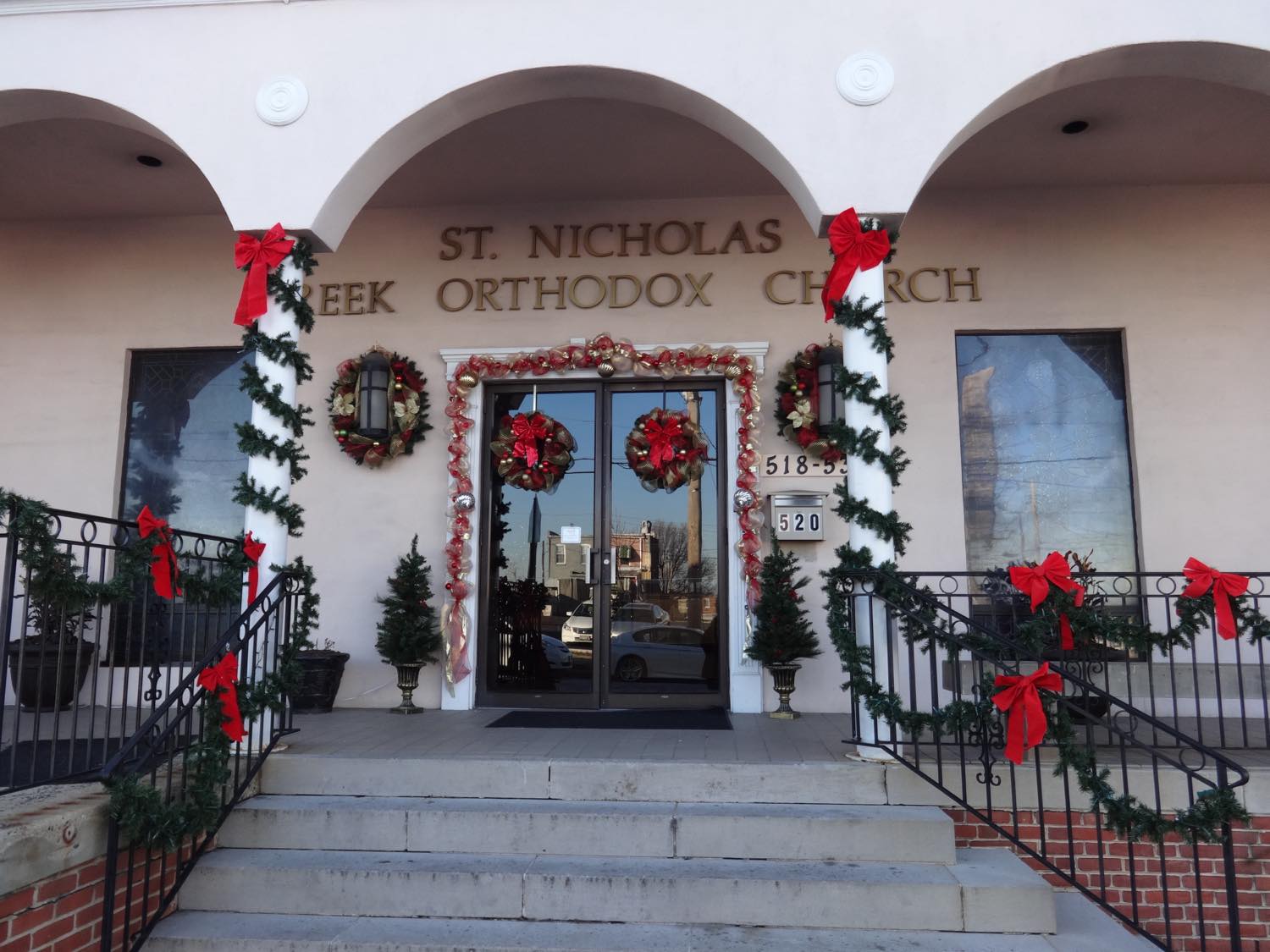
The defining act came in 1952. On September 14 that year, twelve men met in the old Highlandtown Greek School building to found a second Greek Orthodox parish for the growing East Baltimore community. They named it St. Nicholas. The Cathedral of the Annunciation handed over the school building and its land, and the first liturgies were sung there before the congregation built its permanent home at 520 South Ponca Street. St. Nicholas became the gravity well of the neighborhood, the place that turned a cluster of rowhouses into a village.
By the 1980s the metropolitan Greek community numbered in the tens of thousands, and the strip around Eastern Avenue had become unmistakably theirs. In the middle of that decade the residents of The Hill petitioned the Baltimore City Council to make it official. The council agreed, and The Hill became Greektown, a name now stamped on street signs and a brick monument by the highway.
The Change
Success scattered the people who built it, the same story that emptied Chicago’s own Greektown into its suburbs. The second and third generations did well, and doing well in Baltimore meant moving out, to Dundalk, to the eastern suburbs, to Anne Arundel and Baltimore counties. The grandparents who had bought rowhouses to be near the church and the mill watched their grandchildren commute back in for liturgy and leave again by dinner. In the mid-1970s the neighborhood held roughly 500 Greek families. By 2020 that figure was closer to 150.
What stayed was the institutional core: the church, the festival, the restaurants, the bakery. The strip held even as the residential blocks turned over, first to a broad mix of newcomers and increasingly to Latino families, who now run businesses a few doors down from the gyro shops. The blue and white still flies, but you are as likely to hear Spanish on Eastern Avenue as Greek.
The Landmarks of Greektown
St. Nicholas Greek Orthodox Church (520 South Ponca Street) is the anchor. Founded by twelve men in 1952, it grew into the parish whose annual festival draws the scattered families back every June. The grilled lamb, the pastry tables, and the dance troupes in island costume turn the streets around Ponca into a four-day reunion that the church bills as the largest Hellenic event in Maryland.
Ikaros (Eastern Avenue at Ponca Street) was the institution. Theodosios Kohilas, who came from the Aegean island of Ikaria, opened it as a pastry shop in 1969, and his brother Xenos followed from Ikaria in 1975 and eventually took it over. For decades it was the table that out-of-town Greeks asked for by name. Xenos moved it to the Eastern and Ponca corner in 2012 and finally closed it after 2024, citing his health, and Greektown lost the dining room that had defined it.
Samos (600 Oldham Street) carries the torch. Nicholas Georgalas left the island of Samos in 1967 at eighteen, worked, saved, and opened a small carryout here in 1977, serving sandwiches and fries before the menu grew into souvlaki and dolmades. The lines ran out the door and around the block, and the place has collected Best of Baltimore awards for decades. “We don’t use too many elaborate things,” Georgalas has said of Greek cooking. “Lemon, olive oil, garlic, onion.”
Zorba’s (Eastern Avenue) is the octopus house. John Kritikos came from the island of Karpathos in 1982, started working at Zorba’s in 1989, and bought it in 1991. Customers who travel to Greece come back and ask him how he gets the grilled octopus so right, which is exactly the compliment a Karpathian cook wants to hear.
The Acropolis (Eastern Avenue) belonged to Dimitrios “Jimmy” Avgerinos, who arrived in 1970 and opened his own place in 1987. He ran it until his death in 2019 at seventy-three, and his son George kept it going before selling on, a small parable of the generational handoff happening up and down the avenue.
The Greektown murals on South Oldham Street, painted in 2004 and added to since, frame the lot beside St. Nicholas with scenes of the old country, and the brick GREEKTOWN monument out by the interstate greets drivers coming off the highway. Together they do the work that the dwindling Greek population no longer does on the sidewalks: they announce whose neighborhood this was, and in spirit still is.
Where the Greektown Greeks Came From
The first Baltimore Greeks were Laconians, men from the villages around Sparta in the southern Peloponnese who reached the city in the 1890s and built the downtown candy trade. That Spartan thread runs through the oldest names in the community, including the Maniot families resting in the Greek Circle at Woodlawn. Later waves widened the map: immigrants from Kythera, Chios, and Rhodes joined the mix, and by mid-century the flow turned increasingly to the islands.
You can read the geography in the restaurant signs. Ikaros for Ikaria, Samos for Samos, the Karpathian behind the counter at Zorba’s. The Peloponnese built the foundation downtown, and the islands cooked the food that made Greektown famous. Both came for the same reasons their countrymen always did: too little land at home, too many mouths, and a port city across the ocean that needed hands. The same island chains seeded the enormous Greek enclave at Astoria in Queens, the largest in the country.
Greektown Today
Walk Eastern Avenue now and you get a layered street. A Greek bakery and a couple of the old restaurants hold their corners, and the church bells still ring on Ponca, but the storefronts in between increasingly carry Dominican and Mexican names. Greek and Latino families have settled into an easy coexistence built on the same immigrant arithmetic, and former neighborhood leaders describe it as a community that has always made room for the next arrival.
The strip is changing in other ways too. Vacant warehouses near Oldham Street have given way to new apartment developments, and young renters priced out of Canton and Fells Point have started drifting east. The Greektown Community Development Corporation, formed at the turn of the millennium to steady the neighborhood, keeps the murals up and the festival on the calendar.
The Greeks who run Greektown today mostly drive in. They open the restaurants in the morning, light the candles at St. Nicholas on Sunday, and come back in force every June for the festival, the way an island village empties out to the cities and refills for the saint’s day. It is the pattern that keeps a strip alive long after the residents leave, the same one that sustains Detroit’s compact Greektown as a destination rather than a home. The counters their grandfathers built downtown have moved two miles east, but the work is the same, and the door is still open.
Frequently Asked Questions
Why did Greeks settle in Greektown Baltimore?
Greeks first settled downtown in the 1890s, near the public markets where they ran candy shops, then moved east to The Hill, the neighborhood now called Greektown, beginning in the 1930s. The rowhouses there were cheap and close to the canneries and the Sparrows Point steel mills, and a postwar wave of immigrants concentrated around the new St. Nicholas parish.
Is Greektown Baltimore still Greek today?
Partly. The Greek population in the neighborhood has fallen from roughly 500 families in the 1970s to about 150, as later generations moved to the suburbs. The church, the festival, the bakery, and several restaurants still anchor the strip, but many residents are now Latino, and Greektown Baltimore functions today as much through its institutions as its sidewalks.
What are the most famous landmarks in Greektown?
St. Nicholas Greek Orthodox Church at 520 South Ponca Street is the heart of the neighborhood, and its June Greek festival is billed as the largest Hellenic event in Maryland. The classic restaurants, Ikaros, Samos, and Zorba’s, made the area a dining destination, along with the Greektown murals on Oldham Street.
Where did the Greeks of Baltimore come from?
The earliest immigrants came overwhelmingly from Laconia, the region around Sparta in the southern Peloponnese, and built the city’s downtown confectionery trade. Later waves arrived from the Aegean islands, including Ikaria, Samos, Karpathos, Kythera, Chios, and Rhodes, and many of them opened the restaurants that define Greektown.
When did Greeks first arrive in Baltimore?
Greeks began arriving in large numbers in the 1890s, settling downtown near the markets rather than at the port, since there was no direct steamship line from the Mediterranean. The community on The Hill grew from the 1930s onward, and residents successfully petitioned to rename the neighborhood Greektown in the 1980s.
If your family’s story passed through the candy counters of downtown Baltimore or a rowhouse on The Hill, the village around St. Nicholas is still keeping the lights on. Trace the village your people left, and the street where they landed.