
On a Saturday afternoon in Springdale, a low building off Emma Avenue fills with the smell of breadfruit and grilled chicken, and a baby in a flower crown is set on a woven mat while a hundred people sing. This is a kemem, the Marshallese first-birthday feast, and it is happening eight thousand miles from the nearest coral atoll. Outside, the Ozark hills roll green toward the poultry plants. Inside, a Pacific nation is keeping itself alive.
Springdale, a chicken town of about 84,000 in the hills of northwest Arkansas, holds the largest Marshallese community in the continental United States. Roughly 12,000 to 15,000 people from the Republic of the Marshall Islands have made their home here, a population second in the country only to Hawaii. Other Pacific Islanders have built their own American strongholds, from the Tongan community in Salt Lake City to the Samoans of Carson, California, but the Marshallese are, by most accounts, the only Pacific atoll nation to have built a second self in the American interior.
Springdale: The Place
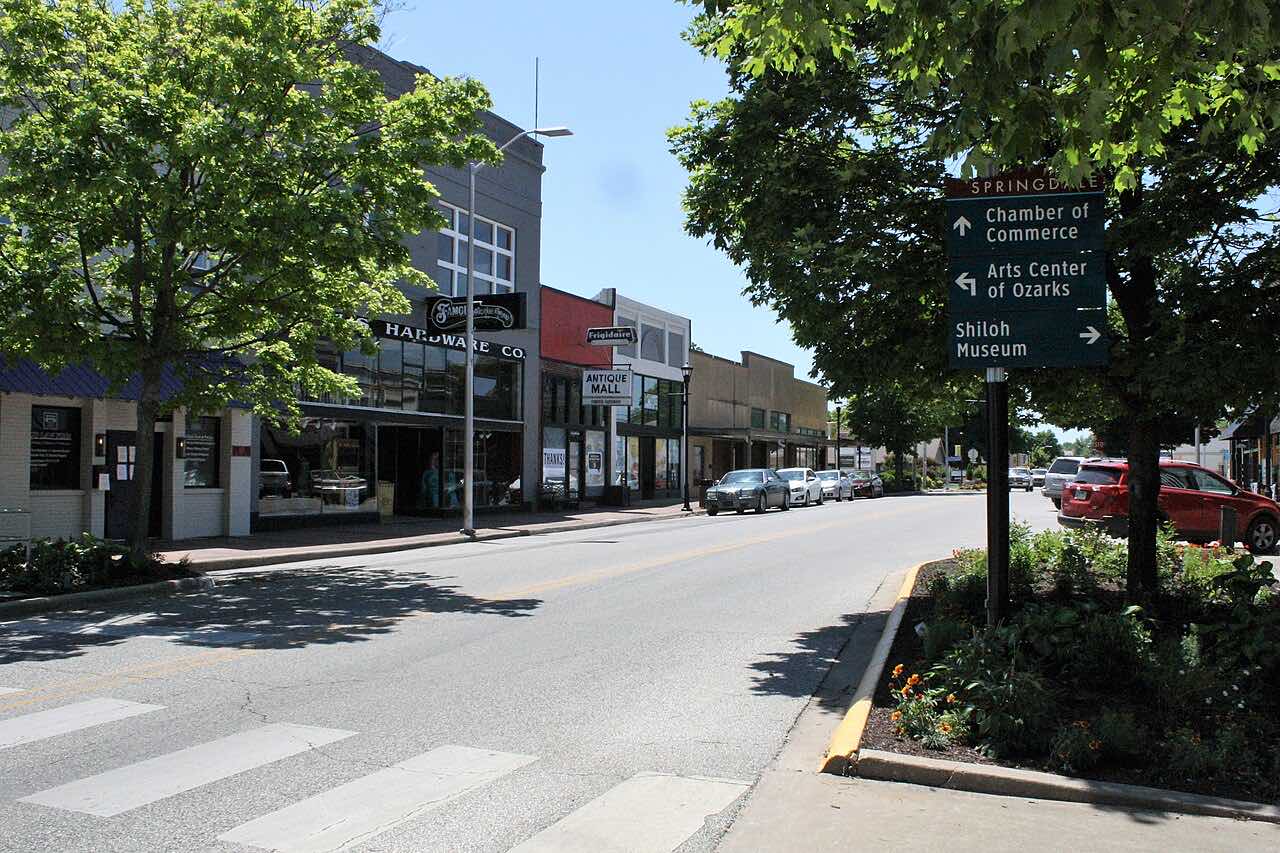
Springdale sits on the Springfield Plateau in the Ozarks, straddling Washington and Benton counties at the center of the booming northwest Arkansas metro that also holds Fayetteville, Rogers, and Bentonville. Interstate 49 and U.S. 71 run past downtown, and the old St. Louis-San Francisco rail line that arrived in 1881 still cuts through. Founded as Shiloh in the 1840s and renamed in 1872 for the “springs in the dale,” it is a city of low brick storefronts on Emma Avenue and sprawling poultry plants on the edges. Affordable apartments and modest ranch houses, more than the coasts could offer, are a large part of why the Marshallese came.
How Springdale Became the Marshallese Capital of America
Before the Marshallese
Springdale was built on chickens. In the early 1930s, a Springdale man named John Tyson started hauling other farmers’ birds to market in his truck, and by 1935 he had founded the company that became Tyson Foods. The state would later name Springdale the poultry capital of the world.
By the late twentieth century, Tyson and the other plants needed more hands than the local labor pool could supply. The work was hard, cold, and physically punishing, the kind of line work that turns over fast. The town was quietly waiting for newcomers willing to do it.
The Marshallese Arrive
The whole story, by community consensus, begins with one man. John Moody, a Marshall Islander, came to Oklahoma on a scholarship in the late 1970s to attend college. The money ran thin and the studying did not stick, and by the early 1980s Moody had drifted into Springdale and taken a job on a Tyson line.
He started at $3.25 an hour. He lost the tip of an index finger to a saw. But the work was steady and full-time, the rent was cheap, and when Moody went back to the islands he carried a simple message: there are jobs in Arkansas, and I will help you get settled. People believed him, and people followed.
What turned a trickle into a migration was a treaty. The Compact of Free Association, signed in 1986, lets citizens of the Marshall Islands live and work in the United States without a visa, for as long as they like. It was the legal door, and Moody’s word of mouth was the map. Relatives sponsored relatives, atoll by atoll, until whole island networks had been transplanted to one Ozark county.
The Compact did not appear out of goodwill. It is bound to one of the darkest chapters in the relationship between the two countries. Between 1946 and 1958 the United States detonated 67 nuclear and thermonuclear weapons over the Marshall Islands, including the 1954 Castle Bravo hydrogen bomb at Bikini Atoll, which proved far larger than its designers predicted and blanketed downwind atolls in radioactive fallout. Bikini and Enewetak were rendered uninhabitable, and their people became permanent exiles in their own country. The Compact’s free migration is, in part, the legacy of that history. Many Marshallese in Springdale carry it in their family stories, and some carry it in their bodies.
Springdale at Its Peak
By the 1990s the migration had a nickname. Locals called the growing community the “Springdale atoll,” and in 1999 a plaque honoring John Moody went up to mark where it had all started. The numbers climbed steadily: a few thousand in the early 2000s, around 6,000 across the region by 2010, and an estimated 12,000 to 15,000 by 2020.
The schools tell the story plainly. Springdale Public Schools, which had a few hundred Marshallese students in 2009, counted more than 3,000 within a decade. The Marshall Islands opened a consulate general on Emma Avenue, one of only three the nation keeps in the United States and the only one in the mainland interior. Carmen Chong Gum served as consul general from 2009, Eldon Alik took the post in 2017, and the office has steadily grown into a full service hub for births, passports, and benefits.
Community institutions rose alongside it. Melisa Laelan, a Majuro native and U.S. Army veteran who in 2013 became the first certified Marshallese court interpreter in the nation, founded the Arkansas Coalition of Marshallese in 2011 to work on health, education, and culture. In July 2013, historian April Brown and ethnomusicologist Jessica Schwartz helped launch the Marshallese Educational Initiative to preserve and teach the community’s history.
The Change
In 2020 the pandemic hit Springdale’s Marshallese with terrible force. The poultry plants kept running as essential work, multigenerational households made distance impossible, and high rates of diabetes and other conditions made the virus deadlier. A CDC analysis of Benton and Washington counties from March to June 2020 found the COVID-19 death rate among Marshallese residents roughly 65 times that of their white neighbors. By that summer, Marshallese people accounted for about half of all COVID-19 deaths in the region while making up a few percent of the population.
The catastrophe exposed an old wound. Since a 1996 welfare law, COFA migrants had been barred from Medicaid even though they paid taxes and could be drafted in their home nation’s defense arrangements. After a fight that community leaders had waged for more than twenty years, Congress permanently restored Medicaid and CHIP eligibility for COFA citizens in the December 2020 relief package. Laelan called it a milestone two decades in the making.
The Landmarks of Marshallese Springdale
The Republic of the Marshall Islands Consulate General, 800 East Emma Avenue. This storefront office is sovereign Marshallese ground in the middle of Arkansas, one of just three RMI posts in the entire country. Families come here for passports and birth registrations, and in recent years its role has expanded to help residents navigate restored federal benefits. It is the diplomatic heart of the only Marshallese capital outside the islands.
The Jones Center, 922 East Emma Avenue. Dedicated in 1995 as a gift to the region from philanthropist Bernice Jones, this sprawling community center has become a gathering place for Marshallese families and the nonprofits that serve them. Its grounds have hosted the Marshallese Farmers’ Market, where island produce and handicrafts change hands. The Marshallese Educational Initiative keeps offices on the campus.
The Marshallese Educational Initiative, 201 West Emma Avenue. Founded in 2013, MEI is the keeper of the community’s memory in Arkansas, running history programs, language work, and exhibits that carry the nuclear and migration story to a wider public. It has helped place Marshallese history in front of audiences at regional museums and in schools.
The “Wind Catcher” mural, on Buck’s Emma Avenue Bar & Tap, across from Shiloh Square. Painted by Marshallese artist Helmar Anitok and unveiled in 2023, this downtown mural draws on island folklore and honors the more than 12,000 Marshallese who resettled in the Ozarks. Commissioned through the University of Arkansas for Medical Sciences, it made the community visible on the city’s main street in a way nothing had before.
The Marshallese churches. Faith is the spine of community life, and the area holds close to a dozen Marshallese congregations, most of them Protestant, with United Church of Christ ministries among the most established. On Sundays they fill with hymns sung in Marshallese, the same songs carried over from the atolls, now echoing in rented halls and storefront sanctuaries across Washington and Benton counties.
The UAMS Northwest community clinic and Dr. Sheldon Riklon. Riklon, one of only a handful of Marshallese physicians in the world, practices in Springdale and works with researcher Dr. Pearl McElfish on the diabetes and health crises that hit the community so hard. The clinic has become a model for culturally grounded care, with Marshallese staff and interpreters at the center of it.
Where the Springdale Marshallese Came From
The community draws from across the Marshall Islands, a scatter of 29 atolls and five islands spread over hundreds of thousands of square miles of the central Pacific. Many trace their roots to the capital, Majuro, and to atolls like Jaluit, Namdrik, Ailinglaplap, and Kwajalein, and the chain migration that Moody began tended to pull families from the same home islands into the same Springdale neighborhoods.
The push factors stacked on top of one another. Unemployment in the islands runs near 40 percent, incomes are low, and healthcare is thin. For the descendants of Bikini, Enewetak, and Rongelap, the nuclear legacy meant homes they could never safely return to. And over it all rises the sea, lapping higher every year against atolls that crest only a few feet above the water. Where some Pacific peoples have moved toward opportunity, like the Hawaiians who built a community in Las Vegas, the Marshallese came partly because the alternative was disappearing.
Marshallese Springdale Today
The community is no longer just line workers. A second generation has grown up in Arkansas classrooms, and Marshallese names now turn up among the city’s teachers, nurses, interpreters, and small business owners. The consulate has expanded, restored Medicaid is reaching families, and the culture is more visible than ever, from the “Wind Catcher” mural downtown to Manit Day each September, when traditional dance, weaving, and storytelling fill local halls and a major Springdale exhibit titled “Navigating Lolelaplap” carried Marshallese voyaging to a regional museum audience.
The challenges have not vanished. Diabetes still cuts deep, with studies finding type 2 diabetes in nearly half of Marshallese adults in Arkansas, and the work in the plants is still hard. Older people miss the reef, and parents watch island words for tides and fishing fade from their American-born children’s speech.
But there is a reason the Marshallese keep building here rather than mourning what they left. For a nation whose ground is slowly going under the Pacific, Springdale is something close to an ark. The atolls may not survive the century. The people, their language, their kemems and their hymns, intend to. In the Ozark hills, eight thousand miles from the lagoon, a Pacific nation is making sure of it.
Frequently Asked Questions
Why did the Marshallese settle in Springdale, Arkansas?
The Marshallese in Springdale arrived chasing steady poultry-plant jobs at Tyson Foods and other companies, drawn by affordable housing and a low cost of living. It began with one man, John Moody, who took a Tyson job in the early 1980s and spread word back to the islands. The 1986 Compact of Free Association then let other Marshallese follow him to the United States without a visa.
Is Springdale still a Marshallese community today?
Yes, very much so. The Marshallese in Springdale number an estimated 12,000 to 15,000, the largest such community in the continental United States and second nationally only to Hawaii. A second generation is growing up local, and the community supports a consulate, churches, nonprofits, and annual cultural events like Manit Day.
What are the most important Marshallese landmarks in Springdale?
The Republic of the Marshall Islands consulate at 800 East Emma Avenue is the diplomatic heart, one of only three RMI posts in the country. The Jones Center on East Emma Avenue and the “Wind Catcher” mural downtown anchor community life, alongside nearly a dozen Marshallese churches and the Marshallese Educational Initiative.
Where did the Springdale Marshallese come from?
They come from across the Marshall Islands, a Pacific nation of 29 atolls, with many tracing roots to Majuro and atolls such as Jaluit, Namdrik, and Kwajalein. They left for jobs, healthcare, and education, and for two existential reasons: the lasting fallout of U.S. nuclear testing on Bikini and Enewetak, and rising seas threatening to drown their homeland.
When did the Marshallese first arrive in Springdale?
The first Marshallese settler, John Moody, came to the area in the early 1980s after a scholarship in Oklahoma led him to a job at Tyson Foods. Migration accelerated through the 1990s, when locals began calling the growing community the “Springdale atoll,” and a plaque honoring Moody was installed in 1999.
If your family’s story passed through Springdale’s Emma Avenue, an island church, or a chicken-plant night shift, it is part of one of the most remarkable migrations in modern America.