
On a Sunday in late August, the smell reaches you before the music does. Sweet bread baking, beef and cabbage simmering into sopas, smoke off a chouriço grill drifting across upper Kennedy Park while a brass band tunes up and a procession in capes and crowns winds toward the bandstand. This is the Great Feast of the Holy Ghost, and it is the loudest, most joyful thing the Portuguese in Fall River do all year. It is also a 14th-century Azorean promise, kept across an ocean, in a city that once spun more cotton thread than almost anywhere on earth.
Fall River has called itself many things. To the men who built it, it was Spindle City. To the families who filled it, it became something closer to a piece of the Azores set down on a Massachusetts hillside. By the count of the U.S. Census, no city in America has a larger share of residents claiming Portuguese ancestry. Walk Columbia Street and the bakery signs, the church bells, and the accents make the statistic feel almost beside the point.
Fall River: The Place
Fall River sits in the far southeastern corner of Massachusetts, on a steep granite slope that drops from a high plateau down to the Taunton River and Mount Hope Bay, with Rhode Island a few minutes to the west. The city climbs the hill in tiers, and the Portuguese heart of it spreads across the lower and eastern wards: the streets below the Hill, the Flint, and the blocks around Columbia Street near the waterfront. Interstate 195 cuts across the old downtown, and the housing is classic mill-city stock, three-decker wooden tenements and tight rows of two-families built for workers who walked to the mills. Those same granite mills, long converted, still line the river and define the skyline.
How Fall River Became the Most Portuguese City in America
Before the Portuguese
Fall River was a Yankee mill town first. Beginning in the 1810s and exploding after the Civil War, local capital dammed the Quequechan River and threw up cotton mills along its falls and the bay. By 1868 the city had passed Lowell to become the leading textile center in America, and by 1875 it was known as Spindle City, second in the world only to Manchester, England.
The first hands in the mills were Yankee, then Irish, who were established in Fall River by the 1830s and built the granite Catholic churches on the Hill. When fifteen new mill corporations were chartered in the boom of 1871 and 1872, recruiters looked north, and French-Canadians poured down from Quebec to tend the looms. The same pull that drew them down from the north would soon reach across the Atlantic. The story of how mill towns absorbed wave after wave of newcomers is one Fall River shares with places like the French-Canadian mill families of Lewiston, Maine.
The Portuguese Arrive
The Portuguese came by sea, and they came first as whalers. From the 1840s, American whaleships had stopped in the Azores to take on water and crew, and young Azorean men signed on to escape conscription and grinding rural poverty. Many ended up in New Bedford, the whaling capital just to the east, and word of southeastern Massachusetts traveled back to the islands. When whaling collapsed around 1870, the cotton mills of Fall River and New Bedford offered the next reason to cross.
They arrived overwhelmingly from the Azores, the chain of volcanic islands eight hundred miles out in the Atlantic, and above all from São Miguel, the largest of them. Chain migration did the rest. A man would come, take a job in a mill or a job nobody else wanted, save, and send for a brother, a wife, a cousin from the same parish back home. Whole villages reassembled street by street in the lower wards. By the 1870s three-quarters of Fall River’s mill population was foreign-born, and the Portuguese, near the bottom of the wage ladder and crowded into the least desirable blocks, became one of its largest groups.
Religion organized the new community. After years of itinerant priests driving over from New Bedford on Saturday nights, the Portuguese Catholics bought a former Baptist chapel at the corner of Columbia and Canal Streets in 1889, and in 1892 it became the parish of Senhor Santo Christo dos Milagres, the Lord Holy Christ of the Miracles. It would be remembered as the mother church of the Portuguese parishes of the diocese. In 1910 the Espirito Santo School opened its doors, the first Portuguese Catholic parochial school in the United States.
Fall River at Its Peak
By 1910 Fall River had reached its zenith, with more than one hundred mills and tens of thousands of workers feeding the looms. The city was the leading cotton-manufacturing center in the country, and the Portuguese were woven through every part of it. Men carded and spun; women, many of them girls of fourteen and fifteen, ran the frames and the weave rooms. Families lived in the company three-deckers, kept hens and grapevines in postage-stamp yards, and made the wages stretch.
Out of the mill grind grew a full Portuguese world. Columbia Street filled with grocers, fish markets, sausage makers, and social clubs where men argued island politics in Micaelense dialect. The Holy Ghost feasts, brought from the islands, took root in the parishes, with their crowned children, their processions, and their free meals of sopas given to all comers. It was the immigrant pattern repeated wherever Portuguese settled in dense numbers, from here to the Portuguese of New Bedford down the road and the tight Lusophone enclaves like the Ironbound of Newark.
The Change
Then the looms went quiet. After World War I, demand for print cloth slumped, and southern mills with cheaper labor and newer machinery undercut New England. The first wave of closures hit in 1923, and over the next several years more than a third of the city’s textile jobs vanished. In 1931 Fall River, its tax base gutted, declared bankruptcy and was placed under state financial control for a decade.
The Depression years were lean, and the immigration quotas of the 1920s had already slowed the flow from the islands to a trickle. But the Portuguese story in Fall River was only half told. On September 27, 1957, the Capelinhos volcano began erupting off the island of Faial, a thirteen-month eruption that buried farmland in ash, leveled homes, and drove thousands of Azoreans from the land. A young senator named John F. Kennedy and Rhode Island’s John Pastore pushed through the Azorean Refugee Act of 1958, opening the door to displaced islanders. Together with the broad immigration reform of 1965, it set off a second great chain migration, more than one hundred thousand Azoreans crossing in the 1960s and 1970s, many of them following relatives straight to Fall River.
The Landmarks of Portuguese Fall River
Santo Christo Church, 240 Columbia Street. The mother church of the city’s Portuguese Catholics began in 1889 in a bought-out Baptist chapel and became a parish in 1892 under Father Cândido d’Ávila Martins. The soaring Gothic Revival building that stands today, designed by Murphy and Hindle, rose between 1924 and 1927 and was finished inside and dedicated in 1948. Its devotion to the Holy Christ of the Miracles came straight from Ponta Delgada in São Miguel.
Espirito Santo Parish, 311 Alden Street. Espirito Santo anchors the Portuguese community on its own hill, and its parish school, opened in 1910, was the first Portuguese Catholic grammar school in the country. Generations of island-born children learned their letters here in two languages, and the parish still holds one of the city’s beloved Holy Ghost feasts each year.
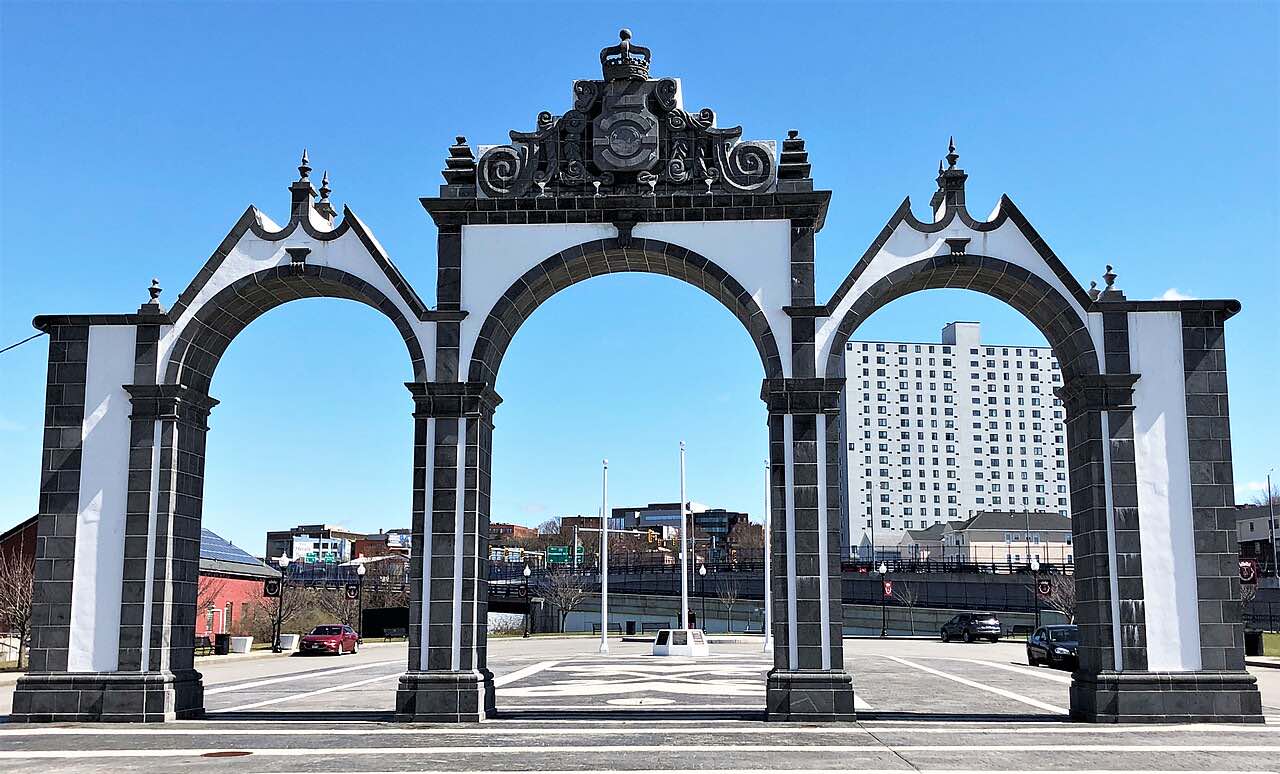
The Gates of the City, Ponta Delgada Boulevard. The triple stone arch by the waterfront is a full-scale echo of the Portas da Cidade in Ponta Delgada, the old gates of the Azorean capital. Dedicated in 2006, it celebrates the sister-city bond between Fall River and Ponta Delgada and has become the unmistakable symbol of Portuguese Fall River, crown and coat of arms facing the harbor.
Kennedy Park, South Main Street. The big park on the south side, formerly South Park and laid out in the 19th century, is where the community gathers in force. Since 1986 its upper green has hosted the Great Feast of the Holy Ghost of New England, billed as one of the largest Azorean celebrations anywhere, five days of food, folklore, and processions every August.
Europa Pastries, 65 Columbia Street. On the corner of Columbia and Ponta Delgada Boulevard, this little cafe has poured coffee and sold sweet bread and custard tarts for more than two decades, the kind of corner counter where the old men still gather in the morning. It is one of a string of bakeries and markets that keep Columbia Street smelling of massa sovada and malasadas.
O Jornal. Founded in 1975 by Azorean community leaders hungry for news of the revolution then convulsing Portugal, the Fall River newspaper grew to serve more than twenty Portuguese-speaking communities across Massachusetts and Rhode Island. It went fully bilingual in 1999 and remains the printed voice of Portuguese southeastern New England.
Where the Fall River Portuguese Came From
The overwhelming majority traced their roots to the Azores, and within the Azores to São Miguel, the populous green island whose dialect you still hear on Columbia Street. The second great wave added a strong contingent from Faial and the central islands, refugees of the Capelinhos eruption who chose Fall River because cousins and former neighbors were already there.
The reasons rarely changed across a century: too little land divided among too many heirs, conscription, isolation, and the example of relatives whose letters and dollars proved that a better life lay across the water. The Azoreans came not as strangers to a random city but as latecomers to a place their own people had already made familiar, which is exactly why so many came.
Fall River Today
Fall River remains, by share of population, the most Portuguese city in the United States, with something near 40 to 50 percent of residents claiming Portuguese ancestry, a distinction it trades back and forth with neighboring New Bedford. The accent persists, the parishes still mark the feast days, and Columbia Street’s bakeries and markets still sell linguiça and sweet bread to people who know exactly what they are buying.
The community has changed shape, as immigrant communities do. The island-born grandparents are fewer now, the second and third generations are scattered through the suburbs and professions, and Portuguese is more often a heritage than a first language. Newer Lusophone arrivals, including a growing Brazilian population, have added their own accents to the mix. The famous chow mein sandwich, that crunchy Fall River oddity born of an earlier immigrant kitchen, now shares menus with caçoila rolls in a city that has always made room for more than one homeland on a plate.
The chef Emeril Lagasse, raised in Fall River by an Azorean mother, Hilda Medeiros, still talks about learning to cook at her stove, and he is only the most famous of the city’s countless Azorean grandchildren. Every August, when the procession sets out for Kennedy Park and the sopas pots go on, you can see the whole arc at once: a 14th-century vow, an ocean crossing, a mill city, and a community that turned all of it into one enormous, generous feast that shows no sign of ending.
Frequently Asked Questions
Why did the Portuguese settle in Fall River?
The Portuguese in Fall River first came as whalers in the mid-1800s, then in large numbers after 1870 to work the booming cotton mills that made the city Spindle City. Chain migration kept the flow going, as each arrival sent home for relatives from the same Azorean parishes, and the mills offered steady, if low-paid, work.
Is Fall River still a Portuguese city today?
Yes. By share of population, Fall River is still the most Portuguese city in America, with roughly 40 to 50 percent of residents claiming Portuguese ancestry, a title it shares with nearby New Bedford. The parishes, the bakeries on Columbia Street, and the annual Holy Ghost feast keep the culture visibly alive.
What are the most famous Portuguese landmarks in Fall River?
For the Portuguese in Fall River, the best known are Santo Christo Church on Columbia Street, the mother parish of the city’s Portuguese Catholics, and the Gates of the City, a stone-arch replica of the gates of Ponta Delgada dedicated in 2006. Kennedy Park, home of the Great Feast of the Holy Ghost, is the third anchor.
Where did the Fall River Portuguese come from?
Almost all came from the Azores, the Portuguese islands far out in the Atlantic, and especially from São Miguel, the largest island. A major second wave arrived from Faial and the central Azores after the 1957 Capelinhos volcanic eruption and the Azorean Refugee Act of 1958.
When did the Portuguese first arrive in Fall River?
Azoreans began reaching the area as whalers in the mid-19th century and arrived in large numbers from about 1870 onward to work in the textile mills. The first Portuguese parish, Santo Christo, was organized in 1889 and formally established in 1892, marking the community’s permanence.
If your family’s story passed through Fall River’s three-deckers, its mills, or a parish on Columbia Street, that story began on a small island in the Atlantic and crossed an ocean to a granite hillside in Massachusetts. It is worth tracing all the way back.