
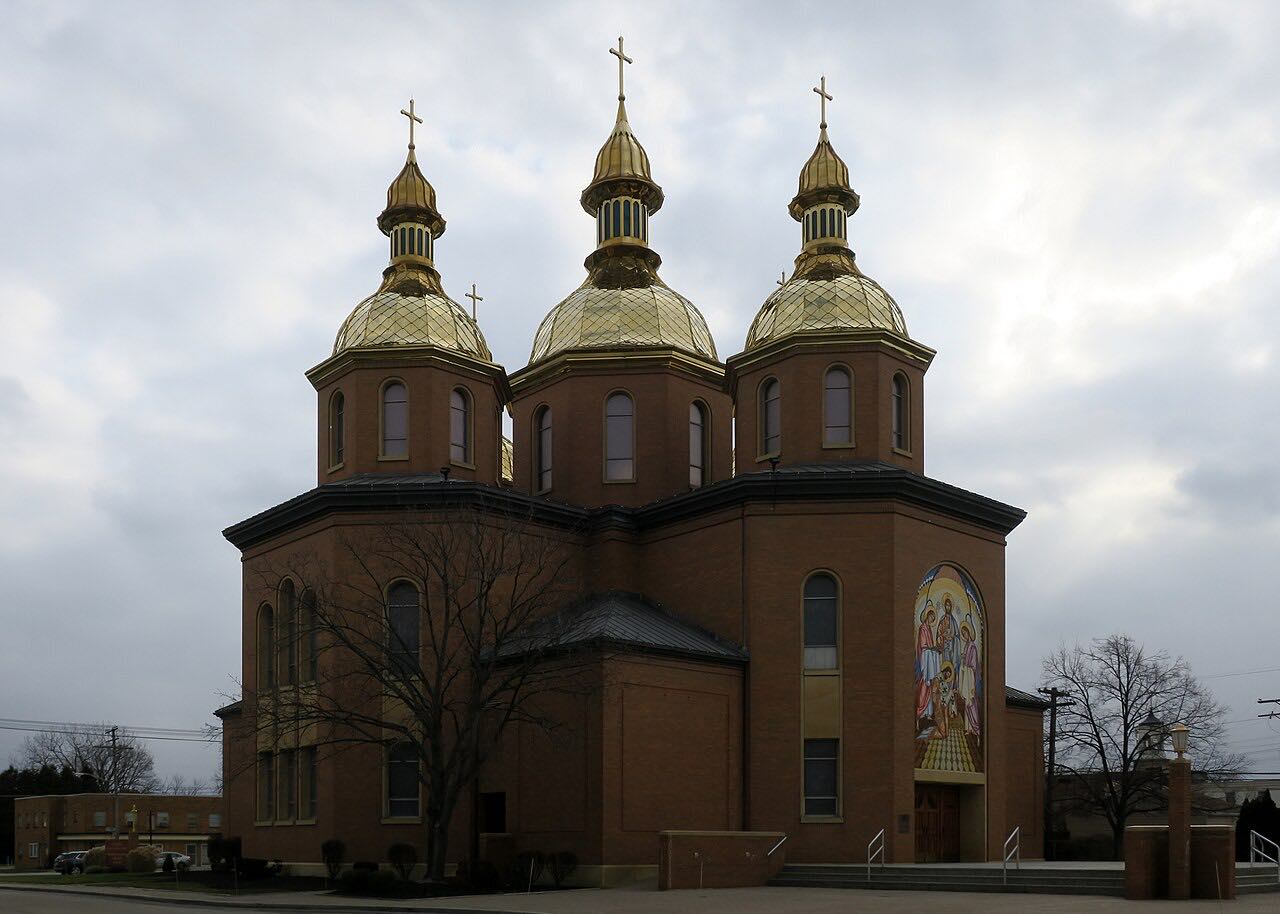
On a clear afternoon, the five gold domes of St. Josaphat catch the sun and throw it back across State Road like a beacon. They are stainless steel wrapped in titanium nitride, raised in 2015 to replace the ones that had weathered, and they are the first thing most people notice driving into Parma. But the domes are the punctuation, not the sentence. The sentence is the smell of fresh kielbasa at State Meats before Easter, the line for pyrohy at a church hall on a Friday in Lent, and the blue-and-yellow flags that have hung from the lampposts since the winter of 2022.
The Ukrainians in Parma did not start here. They started five miles north, on the hills of Tremont, in a Cleveland neighborhood of foundries and onion-domed churches. What happened on State Road is the second act of a story that began in the 1880s, when the first Ukrainian laborers stepped off trains into the smoke of an industrial city and went looking for work.
Parma: The Place
Parma sits on Cleveland’s southern border in Cuyahoga County, the largest suburb in Ohio. Its housing is the postwar story made physical: tidy brick bungalows on grid streets, most under 1,500 square feet, built fast in the boom years. State Road runs north to south as the city’s spine, carrying the two-mile stretch that the city calls Ukrainian Village. The RTA bus lines and Interstate 480 keep it tied to downtown, eight miles up the road.
How Parma Became Ukrainian Village
Before the Ukrainians
Parma was farmland and orchard well into the twentieth century, a quiet township south of a roaring city. The action, for immigrants, was in Cleveland proper. Tremont, perched on the bluffs above the Cuyahoga’s industrial flats, filled in the late 1800s with Poles, Greeks, Slovaks, Carpatho-Rusyns, and Ukrainians who came for the mills and the foundries.
By the early 1930s Cleveland held the largest Lemko population of any American city, and the Lemko Association bought a building on West 11th Street and named it Lemko Hall. Decades later, Hollywood used its ballroom for the long wedding sequence in the 1978 film The Deer Hunter. The Lemkos were a Carpathian people of their own, neighbors and kin to the Ukrainians who were settling the same steep streets.
The Ukrainians Arrive
The first Ukrainians reached Cleveland in the mid-1880s, most of them from Galicia, the Lemko country, and Carpatho-Ruthenia, regions then under Austro-Hungarian rule. They were peasants and laborers escaping crowded land and thin wages, and they took whatever the mills offered. They settled on the west side, in and around Tremont, close enough to walk to work.
The church came next, as it always did. In 1902 Ukrainian Byzantine-rite Catholics from Galicia broke away from a shared parish over questions of nationality and founded their own congregation, holding early services in a Tremont trolley garage. By 1910 they had built Saints Peter and Paul Ukrainian Catholic Church at West 7th Street. The Orthodox followed in 1924, when Father Gregory Chomicky celebrated the first liturgy of St. Vladimir parish in Craftsman Hall on West 14th Street; the congregation built its first church on West 11th Street and dedicated it in 1933.
Then came the war, and a second wave unlike the first. The displaced persons who arrived after 1945 were political refugees: people who had fled the Soviet advance, survivors of the camps, former fighters for an independent Ukraine that no longer existed on any map. They were teachers, engineers, artists, and clergy, and they arrived determined that the language and the faith would not be lost.
It was that generation that built the institutions the community still leans on. In 1950 they organized Ridna Shkola, a Saturday school of Ukrainian studies, first meeting at Saints Peter and Paul on West 7th Street. In 1952 Leonid Bachynsky, a scholar who had left Ukraine for a machinist’s job and a freer country, began gathering the documents and artifacts that became the Ukrainian Museum-Archives, still in Tremont today on Kenilworth Avenue. The scouting groups came too, Plast and the youth of the parishes, drilling children in songs and history their parents had carried out in suitcases.
Parma at Its Peak
In the 1950s Parma was the fastest-growing suburb in America. The mills were still hiring, the GI Bill was paying, and a factory worker could buy a new bungalow on a clean street with a yard. Parma sat right on the city’s southern edge, the first stop out, and the Ukrainians who had spent two generations in Tremont went south by the thousands.
The institutions followed the people. Ridna Shkola moved to Parma in 1959, settling first in Thoreau Park Elementary, then bouncing between Schaaf, Shiloh, and finally Normandy High School as enrollment swelled past 300 students. St. Josaphat parish was established in 1959, and St. Vladimir’s congregation bought land in Parma in the 1950s, hauling the old Parma City Hall two miles down the road in 1957 to sit on its new property at State Road and Marioncliff Drive. The new St. Vladimir cathedral opened in 1966 and was dedicated in 1967.
More parishes came. St. Andrew was founded in Parma in 1972, St. Pokrova in 1973. By 1986 the area’s Ukrainian community numbered more than 35,000, and the center of gravity had moved decisively from Tremont to Parma and its neighbors. State Road filled with butchers, bakeries, and delis run by families who spoke the language at the counter.
The Change
The change here was not collapse but recognition. The Ukrainians had dreamed of a “village” on State Road since the 1940s, and by the 2000s the bones of one were plainly there: the churches, the schools, the shops, the heritage park. In 2007 the trustees of St. Vladimir’s asked the city to hang banners and name the corridor. In October 2008, Parma City Council passed Resolution 290-08, declaring State Road between Tuxedo Avenue and Grantwood Drive to be Ukrainian Village.
The official dedication came on September 19, 2009, with a parade, liturgies, and a festival. A planning committee chaired by Wasyl Liscynesky of the United Ukrainian Organizations of Ohio had pushed it through; the UZO had been representing the community since 1928. What had been a scattering of immigrant parishes was now, formally, a place on the map with its own name.
The Landmarks of Ukrainian Village
St. Josaphat Ukrainian Catholic Cathedral (5720 State Road) grew from a mission school that opened in 1951. Ground was broken on the Byzantine Revival cathedral in 1982, services began in 1985, and it was consecrated on May 1, 1988, timed to the thousandth anniversary of Christianity in Ukraine. Its five gold domes, blessed anew in October 2015 after a $550,000 restoration, are the visual signature of the whole district.
St. Vladimir Ukrainian Orthodox Cathedral (5913 State Road) carries the older lineage, its parish dating to 1924 in Tremont before the move south. An 800-square-foot mosaic was set at its entrance in 1988. Its grand hall has long doubled as a town square: it was here, on February 27, 2022, that Governor Mike DeWine, Mayor Tim DeGeeter, and Senator Rob Portman joined a prayer service and rally days after the invasion began.
The Holodomor Memorial stands on the grounds of St. Vladimir’s, built by John Horan and dedicated in October 1993 on the sixtieth anniversary of the famine. Its inscription is plain about the facts: the famine of 1932 and 1933 was man-made, engineered in Moscow, and it killed millions. A cross tops the monument. For a community largely descended from people who fled Soviet rule, it is not abstract history.
Ukrainian Heritage Park broke ground in 2010, sitting across State Road from St. Josaphat. It is the gathering point for the annual Ukrainian Village Parade and Festival, which runs each August with a beer garden, the Kashtan dancers, the Zorya vocal ensemble, and more pyrohy than anyone can count. The parade steps off on Grantwood Drive and marches north to the park.
State Meats is the everyday landmark, a butcher shop famous for its kielbasa, busiest in the days before Christmas and Easter when the orders stack up. Next door, Mama Maria’s sells the pyrohy and prepared food. Together they are the kind of place where the war relief drives began in 2022, with customers pushing tens and hundreds across the counter and the owners passing it to the churches.
The Ukrainian Museum-Archives remains in Tremont at 1202 Kenilworth Avenue, the one major institution that never moved. It holds the displaced persons’ camp newspapers, the embroidered shirts, the letters and photographs, the physical memory of an exile generation. It is the anchor that keeps Parma’s story tethered to where it began.
Where the Parma Ukrainians Came From
The earliest arrivals came overwhelmingly from western Ukraine, from Galicia and the Carpathian foothills, lands ruled from Vienna before the First World War and from Warsaw between the wars. These were the Greek Catholic strongholds, which is why the first Cleveland parish was Byzantine-rite Catholic and why the Lemko and Rusyn communities settled the same streets. They left because the farms were too small to feed growing families and America was hiring.
The postwar generation came from a wider Ukraine and from the displaced persons camps of Germany and Austria, refugees of war and Soviet occupation rather than economic migrants. Many of the same camps fed the Ukrainian enclave that grew up around the East Village in Manhattan, the other great Ukrainian quarter the postwar exiles built in America. The newest wave is wider still: people from Kyiv, Kharkiv, Lviv, and a dozen other cities, some who came after 1991 and the Soviet collapse, many who arrived after February 2022 with whatever they could carry.
Parma Today
Roughly 4,400 Parma residents claimed Ukrainian ancestry in the 2010 census, about 5.3 percent of the city, one of the densest concentrations in the United States and the largest Ukrainian community in Ohio. The numbers have only grown since 2022. When Russia launched its full-scale invasion, Parma became a natural landing place: in March 2022 the state held a summit on Ukrainian refugees at St. Vladimir’s grand hall, with more than 110 people from some 60 organizations planning the welcome, and resettlement agencies in the area have since assisted thousands of new arrivals.
So State Road carries two communities at once now. There are the grandchildren of the displaced persons, fully American, who come back for the festival and the Christmas kielbasa. And there are the newest Ukrainians, fresh from a war, sitting in English classes and Sunday liturgies inside the same churches the last refugee generation built. The Plast scouts still meet. The pyrohy lines still form on Fridays in Lent.
What began as a few laborers on a Tremont hillside in the 1880s is now a district with its own name, its own domes, and its own job to do all over again. The work of the place has not changed in 140 years: take in the people who arrive with nothing but their language, and make sure they do not lose it.
Frequently Asked Questions
Why did Ukrainians settle in Parma, Ohio?
Ukrainians first settled in Cleveland’s Tremont neighborhood in the 1880s for industrial work. In the 1950s, when Parma was the fastest-growing suburb in America, the community moved south to its affordable new bungalows. Parma sat right on the city’s edge, the first stop out, so the Ukrainians in Parma rebuilt their churches and schools along State Road.
Is Parma still a Ukrainian community today?
Yes. About 5.3 percent of Parma residents claim Ukrainian ancestry, among the densest concentrations in the country and the largest in Ohio. The community grew further after the 2022 invasion, when many refugees resettled there, and State Road’s Ukrainian Village remains an active center of churches, shops, and festivals.
What are the most famous Ukrainian landmarks in Parma?
The best-known is St. Josaphat Ukrainian Catholic Cathedral at 5720 State Road, with its five gold domes restored in 2015. St. Vladimir Ukrainian Orthodox Cathedral and its 1993 Holodomor Memorial sit nearby, along with Ukrainian Heritage Park, the host of the annual August festival and parade.
Where did the Ukrainians in Parma come from?
The earliest immigrants came mostly from western Ukraine, from Galicia and the Carpathian foothills under Austro-Hungarian rule. After 1945 a wave of political refugees arrived from the displaced persons camps of Europe. The newest arrivals come from across Ukraine, including many who fled after the 2022 invasion.
When did Ukrainians first arrive in the Cleveland area?
The first Ukrainians reached Cleveland in the mid-1880s and settled in Tremont. Their first parish, Saints Peter and Paul Ukrainian Catholic Church, was organized in 1902 and built by 1910. The move to suburban Parma came decades later, in the 1950s and 1960s.
If your family’s story passed through the foundries of Tremont or the bungalows of State Road, through a displaced persons camp or a flight from a newer war, that history deserves to be traced and kept. Two of the communities that shaped this corner of Ohio have their own chapters worth reading, from the Slovenians of Cleveland to the Croatians who built their own neighborhoods nearby.